Like an iceberg, 1999, “The avalanche”
I wasn’t there when the wall of snow came tumbling down the slope into Satuumavik school in the Nunavik community of Kangiqsualujjuaq on Jan. 1, 1999. I was fast asleep in my bed in the South, and it wasn’t until early the next morning that I heard about the disaster in a call from a friend in Kuujjuaq.
I later learned that not long after midnight, the cornice of snow that had formed on the slope above the school came rumbling down. And, when it came down, it broke the school’s walls, burying many who were celebrating New Year’s Eve together in the gymnasium, killing nine of them.

Searchers look for survivors after the avalanche, Kangiqsualujjaq, Jan. 1, 1999 in this unattributed photo.
Afterwards, I would learn more than enough about those moments right after the snow crashed into the gym.
But there in the South on that New Year’s day in 1999, 1,500 kilometres from Kangiqsualujjuaq, I was shaken by the avalanche news. I called people I knew in the community. The school principal told me he has just walked into his house after hours spent digging people out inside the gym.
Another man I was able to reach has lost his baby daughter, I learned. I’m devastated that I’ve even called him. What could I say? I felt tears rolling down my cheeks.
This community’s grief became my grief, too. How could I stay here? The weather was terrible where I was, ice pellets were falling, and I couldn’t possibly leave to make the drive to Montreal, although I attempted to drive in anyway. But I couldn’t see anything and turned around.
So I missed that day’s scheduled airline departure to Kuujjuaq.
One of my editors at the Nunatsiaq News, who was also in southern Quebec for the holiday, said we didn’t need to cover this event: “Let the big boys cover it.” CBC had already chartered a plane from Montreal to Kangiqsualujjuaq with some other media, which I missed out on.

In this attributed photo someone takes a photo of a snowmobile caught in Jan. 1, 1999 avalanche in Kangiqsualujjaq
However, I knew I have to go, or it wasn’t not worth working as a journalist in Nunavik. And this was one of the biggest stories in the world as 1999 started. I roused the Nunatsiaq News publisher, Steven Roberts, who said it was okay for me to fly up on First Air — my one-way ticket to Kuujjuaq is a pricey (for then), full-fare ticket of $835.
On Jan. 3 I finally arrived in Kuujjuaq. At the Kuujjuaq Inn I found the entire Quebec government cabinet, including Premier Lucien Bouchard, sitting in the lounge.

Quebec Premier Lucien Bouchard vows to help Kangiqsualujjuaq recover when he visits Kuujjuaq and then Kangiqsualujjuaq in January, 1999. (PHOTO BY JANE GEORGE)
Apart from a reporter from the Globe and Mail, all other journalists have run to Kangiqsualujjuaq to record that community’s trauma. But people in Kangiqsualujjuaq were already overburdened with supplying services to people from Nunavik who were there to help out or to comfort relatives: They didn’t need more mouths to feed.
It occurred to me that I could be a lot more helpful finding out what government plans were in store to help them recover and rebuild after this disaster.
The next day, Prime Minister Jean Chrétien arrived in Kuujjuaq. We were all kept in town by the bad weather, but I knew the situation in Kangiqsualujjuaq was even more bleak: too much pain, too many reporters badgering residents for painful details, not enough trucked water to go around, and it was freezing cold.
Chrétien, Quebec’s Liberal Party leader Jean Charest and the then-deputy premier Bernard Landry all stayed at the Kuujjuaq Inn, where I was also staying, too, and they dined together — a rare common move among politicians who didn’t agree on much in 1999. The politicians also took the time to tour Kuujjuaq, visiting patients at the local hospital and stopping at the Kuujjuaq Forum.

Prime Minister Jean Chrétien and Makivik Corp. President Pita Aatami listen to Kuujjuaq Mayor Michael Gordon talk about what he saw in Kangisualujjuaq after the avalanche. (PHOTO BY JANE GEORGE)
In its gym, Kuujjuaq mayor Michael Gordon, who had gone to Kangiqsualujjuaq, some 30 minutes by air from Kuujjuaq, after the avalanche, told Chrétien what the snow-filled gym in Kangiqsualujjuaq looked like, buried in snow.
Finally, the next day, we flew to Kangiqsualujjuaq, a short plane trip from Kuujjuaq. I stopped off at the wrecked shell of a school that was cordoned off and guarded by Canadian Rangers.
It was numbingly cold that day, despite my heaviest Arctic winter clothing. Tired and traumatized mourners were set to bury the nine victims of the avalanche in the community’s municipal garage, the only safe large space available for such a gathering.
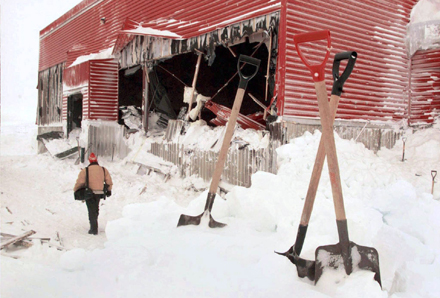
This unattributed photo shows the damage caused by the Jan. 1, 1999 avalanche.
The funeral scene was simple: on the wall a cross fashioned from two metal pipes; handmade crosses and bouquets of flowers placed on each coffin; and a hockey shirt draped on a 34-year-old hockey player’s coffin.
More than 700 people attended the funeral service, conducted by Bishop Joseph Idlout of the Anglican Eastern Arctic Diocese and Kuujjuaq’s Anglican minister, Benjamin Arreak. They read messages of condolences from the religious leaders and an expression of sympathy from Queen Elizabeth.
“I was shocked to hear of the horrific New Year’s tragedy in northern Quebec,” wrote the Queen.
Willie Etok, the father of two avalanche victims, also addressed the funeral, thanking all those who worked during the hours following the avalanche to keep the number of deaths down.
“On behalf of the people of Kangiqsualujjuaq, I would like to pass on thanks for the many people who have come to assist in our grieving, many people from all parts of the country, and the world, who have come to be with us, to help us, in this horrible situation,” said Etok. “To the families who have lost their loved one, we are the same, all in one.”
One young girl’s face was covered in tears. Another held a small white flower and a tissue. A couple who lost their young son struggled to comfort their other children. Many in attendance still showed physical injuries from the avalanche — bandages and slings.
Idlout’s words about love and hope comforted the mourners, although many were unable to sing the chosen hymn, “Nearer my God to thee,” without breaking down. There was a moment of silence for the victims.
After the religious service, coffins were opened for the final farewell to the victims from friends and family. The burial followed in minus 30 C temperatures.
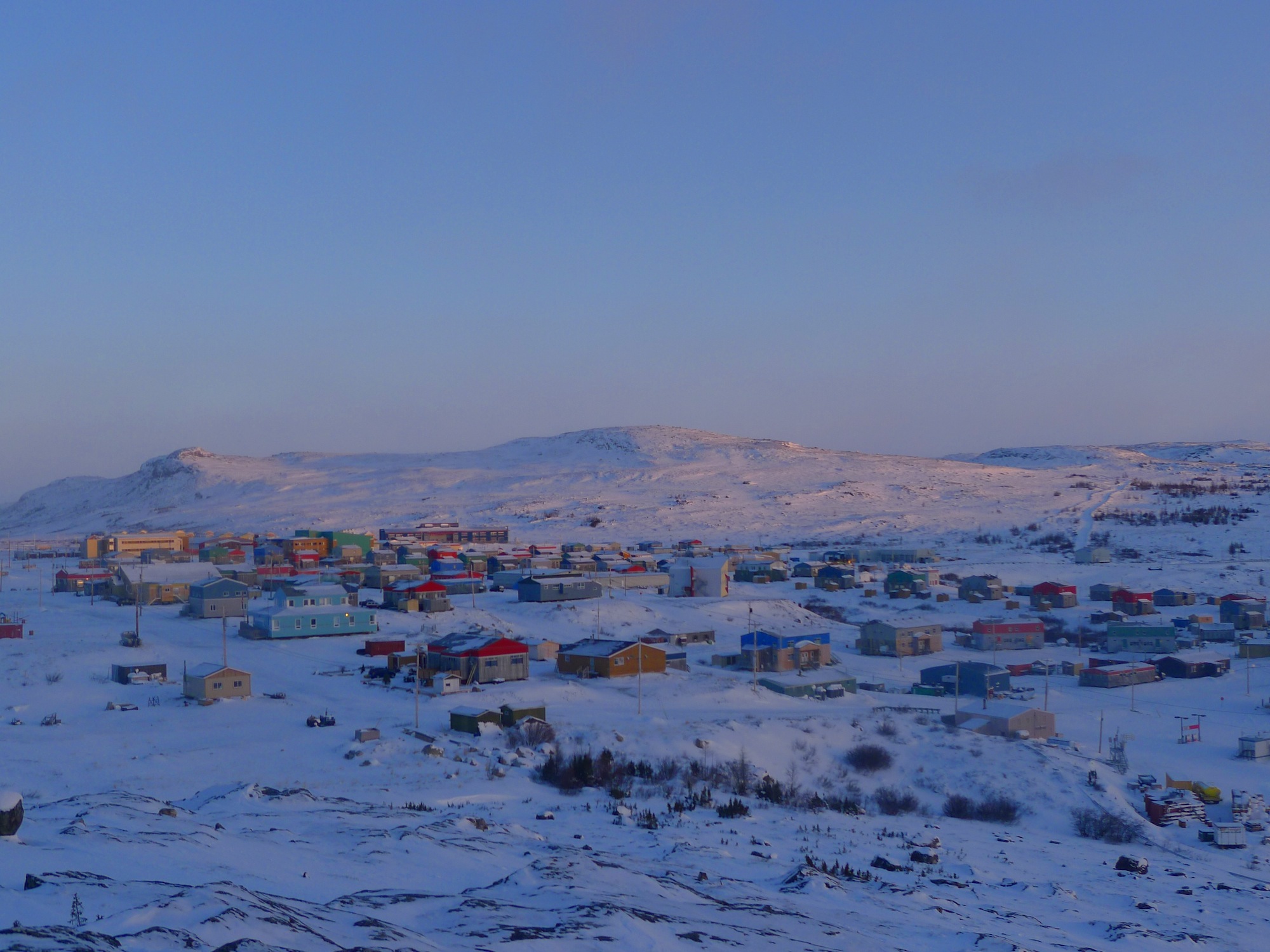
A view over Kangiqsualujjuaq. (PHOTO/ WIKIPEDIA COMMONS)
“It was quite an experience to be here and see the closeness of the families,” said Chrétien afterwards while he and I waited for the charter back to Kuujjuaq in Kangiqsualujjuaq’s small airport terminal — it was the kind of informal encounter that journalists can sometimes experience in the North with high-level politicians.
“It’s a moment that I will remember for a long time. I’m happy that I was able to be here because it was an absolutely exceptional occasion and it’s very moving to see the solidarity. It’s a large family, the village. They’re all here to support each other.”
Chrétien also made me laugh as he retold stories from his time as federal Indian affairs minister — but I didn’t take notes at that point. I just felt an enormous relief after living through that day.
After the funeral service, Chrétien, who seemed not to feel the cold, gave his gloves to a grieving family member. But my hands were frozen as I took photos. It felt like the coldest day of the winter — and one that I would relive later in 1999 at the coroner’s inquest into the avalanche.
Like an iceberg continues May 26.
You can read earlier instalments here:
Like an iceberg: on being a journalist in the Arctic
Like an iceberg, 1991…cont.
Like an iceberg, 1991…more
Like an iceberg, 1992, “Shots in the dark”
Like an iceberg, 1992, “Sad stories”
Like an iceberg, 1993, “Learning the language of the snows”
Like an iceberg, 1993 cont., “Spring”
Like an iceberg, 1993 cont., “Chesterfield Inlet”
Like an iceberg, 1993 cont., more “Chesterfield Inlet”
Like an iceberg, 1994: “Seals and more”
Like an iceberg, 1994, cont., “No news is good news”
Like an iceberg, 1994 cont., more “No news is good news”
Like an iceberg, 1994 cont., “A place with four names”
Like an iceberg, 1995, “More sad stories”
Like an iceberg, 1995 cont., “No place like Nome”
Like an iceberg, 1995 cont., “Greenland”
Like an iceberg, 1995, cont. “Secrets”
Like an iceberg, 1996, “Hard Lessons”
Like an iceberg, 1996 cont., “Working together”
Like an iceberg, 1996 cont., “At the edge of the world”
Like an iceberg, 1996, more “At the edge of the world”
Like an iceberg, 1996, cont. “Choices”
Like an iceberg, 1997, “Qaggiq”
Like an iceberg, 1997, more “Qaggiq”
Like an iceberg, 1997, “Qaggiq” cont.
Like an iceberg, 1997 cont., “Qaggiq and hockey”
Like an iceberg, 1997 cont., “Brain surgery in POV”
Like an iceberg, 1997 cont.: “Masks on an island”
Like an iceberg, 1997 cont., “Abusers on the pulpit”
Like an iceberg, 1998, “Bearing gifts”
Like an iceberg, 1998 cont., “At the top of the world”
Like an iceberg, 1998 cont., “A bad week”
Like an iceberg, 1998 cont.: more from “A bad week”
Like an iceberg, 1998 cont., “Memories”


 A date with Siku girl