Like an iceberg, 1999 cont., “Fossil hunting”

Like an iceberg, 1999 cont.: “Fossil hunting”

My destination in July, 1999: a huge windswept island, Axel Heiberg, located 700 kilometres south of the North Pole, just off Ellesmere Island.

You can see fossil litter on the top of a hill overlooking the valley on Axel Heiberg where we camp in July, 1999. (PHOTO BY JANE GEORGE)

You can see fossil litter on the top of a hill overlooking the valley on Axel Heiberg where we camp in July, 1999. (PHOTO BY JANE GEORGE)

On this remote High Arctic island, fossils were everywhere, and, by the edge of a fast-running river in July, 1999, I saw millions of years of nature tumbling down into the water. With little vegetation to hold the soil together, earth and rocks constantly broke off along the river’s edge, creating clouds of dust as they fall.

Each time this happened, the fossils of trees and plants that grew here more than 40 million years ago were lost, carried away to the ocean or slowly dissolved in the swift current. The fragments of fossil wood were batted around in the water or cast up on the shore. Boulders embossed with the imprints of leaves were piled along the bank.

The fossil material is grey and dry after millions of years in the cold storage of Axel Heiberg. (PHOTO BY JANE GEORGE)

The fossil material is grey and dry after millions of years in the cold storage of Axel Heiberg. (PHOTO BY JANE GEORGE)

“It’s like a fossil superstore,” said Yusheng Liu, a fossil plant biologist, originally from China, who was then studying on a fellowship with paleo-botanist Jim Basinger in Saskatoon, who had invited me to see his High Arctic research team at work in 1998.

Liu expertly hammered a thick gray rock into sheets and quickly uncovered several remnants of leaves, some in almost mint condition, that were hidden in the clay.

“Canada has so many fossils, but so few paleontologists,” said Liu. “We have so much to learn.”

While the quantity of fossils on Axel Heiberg was unusual, so was their quality because they weren’t petrified, or turned to stone, but rather mummified or simply pressed into clay.

While fossil gathering, we mainly concentrated on the rocks by the water and on exposed leaf litter that sticks out of the eroding outcrop above. We tried not to disturb any materials that aren’t already at risk from erosion. The only tools used were a small pickaxe, a knife and a magnifying glass. Some clay boulders contained a treasure trove of fossils. We examined each chunk for fossils, and foundseveral intact leaves.
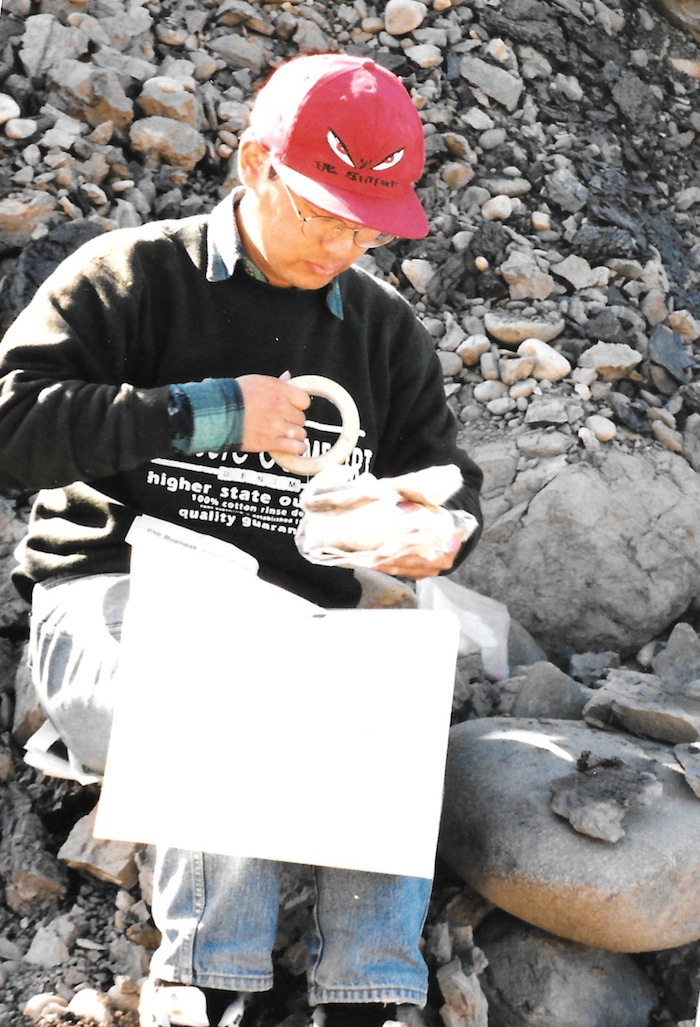
 Yusheng Liu carefully wraps up every interesting fossil when we are on Axel Heiberg in July, 1999. (PHOTO BY JANE GEORGE)

Yusheng Liu carefully wraps up every interesting fossil when we are on Axel Heiberg in July, 1999. (PHOTO BY JANE GEORGE)

Liu was especially pleased when he finds a well-preserved seed, cone or leaf. Most of the fossil leaves came from the huge Dawn Redwood, which flourished here during the warmer Eocene Era, some 45 million years ago.

This tall tree shed its leaves every year, casting thousands of its distinctive fronds on the ground, many of which survived the passage of time. Liu also found leaves from beech trees, kiwi-like seeds and cones from evergreens.

He said studying such fossils under an electron microscope could reveal what levels of oxygen and carbon dioxide existed in the atmosphere of that much warmer period and show how these plants differed from their modern counterparts.

“If we study these fossils, we can get an image of the paleo-vegetation and we can use it to reconstruct the climate because it’s a good indicator of the climate,” he said.

Every fossil selected for further study was sprayed with latex to keep the plant tissues fresh. Then,  the fossils were wrapped up in newspaper and taped, so that they would travel without breaking. Months later, the scientists would carefully unwrap the fossils.

After an afternoon by the river, we headed back to camp, weighed down by our load of heavy, clay rocks. We held hands as we forded across the water, which in the heat of the day, had risen with melt water from the nearby glaciers.
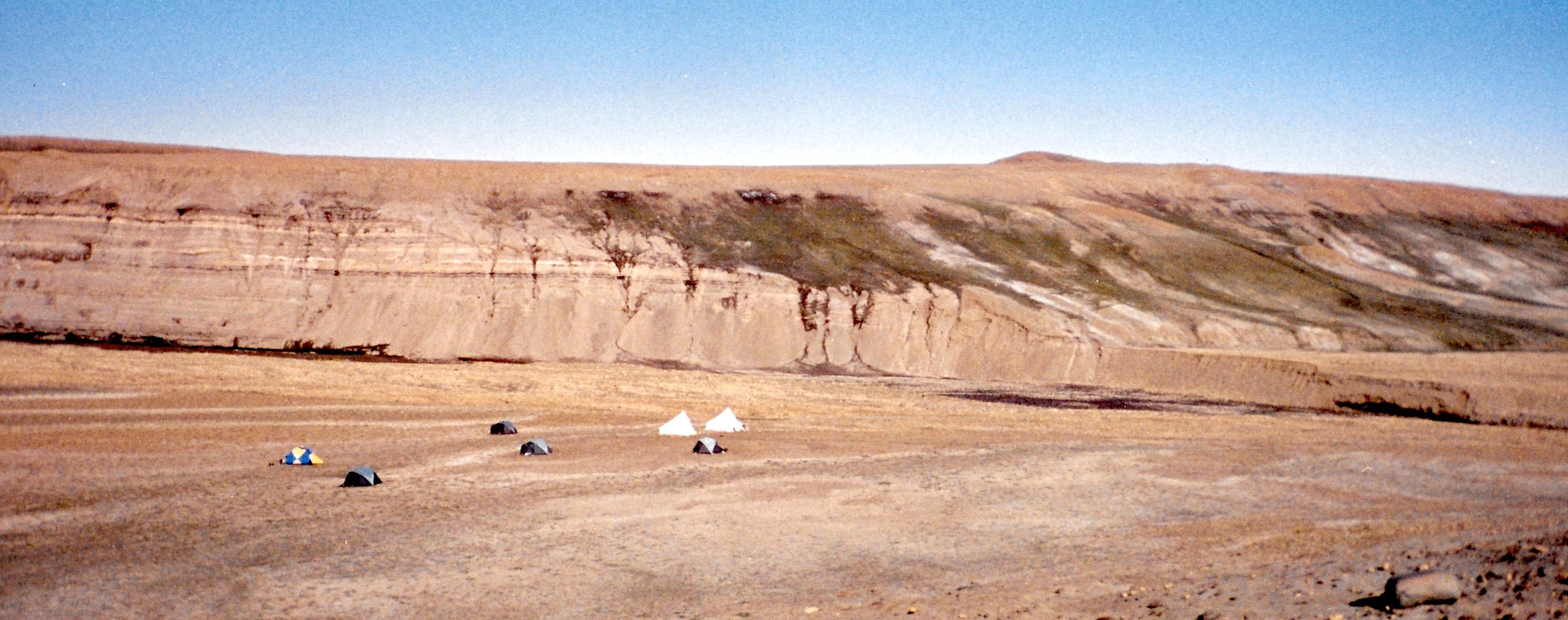
We camp out in a valley where the sun shines all day and night. (PHOTO BY JANE GEORGE)

We camp out in a valley where the sun shines all day and night. My tent is the blue and yellow one at the far left. (PHOTO BY JANE GEORGE)

Our field camp was a small group of tents pitched on a rocky slope. I had my own tent and — finally — I had invested in a warm sleeping bag. In the evening, along with the three other members of the team, we made a simple supper— Liu whipped up a Chinese-style soup based on the dry ingredients that could easily be stored in the camp refrigerator — a hole dug in the frozen ground — such as cabbage, carrots, onions and bacon.

After a couple of days by the river, we moved on to another site, by the Fossil Forest, where the stumps of 50-million-year-old trees were exposed.

That’s where the weather changed, from a 20 C to a windy, cold and snow-filled, and at the fossil forest, I also find a group of American scientists who were digging it up.

Like an iceberg continues May 30.

You can read earlier instalments here:

Like an iceberg: on being a journalist in the Arctic

Like an iceberg, 1991…cont.

Like an iceberg, 1991…more

Like an iceberg, 1992, “Shots in the dark” 

Like an iceberg, 1992, “Sad stories”

Like an iceberg, 1993, “Learning the language of the snows”

Like an iceberg, 1993 cont., “Spring”

Like an iceberg, 1993 cont., “Chesterfield Inlet”

Like an iceberg, 1993 cont., more “Chesterfield Inlet”

Like an iceberg, 1994: “Seals and more”

Like an iceberg, 1994, cont., “No news is good news”

Like an iceberg, 1994 cont., more “No news is good news”

Like an iceberg, 1994 cont., “A place with four names”

Like an iceberg, 1995, “More sad stories”

Like an iceberg, 1995 cont., “No place like Nome”

Like an iceberg, 1995 cont., “Greenland”

Like an iceberg, 1995, cont. “Secrets”

Like an iceberg, 1996, “Hard Lessons”

Like an iceberg, 1996 cont., “Working together”

Like an iceberg, 1996 cont., “At the edge of the world”

Like an iceberg, 1996, more “At the edge of the world”

Like an iceberg, 1996, cont. “Choices” 

Like an iceberg, 1997, “Qaggiq”

Like an iceberg, 1997, more “Qaggiq”

Like an iceberg, 1997, “Qaggiq” cont.

Like an iceberg, 1997 cont., “Qaggiq and hockey”

Like an iceberg, 1997 cont., “Brain surgery in POV”

Like an iceberg, 1997 cont.: “Masks on an island”

Like an iceberg, 1997 cont., “Abusers on the pulpit”

Like an iceberg, 1998, “Bearing gifts”

Like an iceberg, 1998 cont., “At the top of the world”

Like an iceberg, 1998 cont., “A bad week” 

Like an iceberg, 1998 cont.: more from “A bad week”

Like an iceberg, 1998 cont., “Memories”

Like an iceberg, 1999, “The avalanche”

Like an iceberg, 1999 cont., “An exorcism, followed by a penis cutting”

Like an iceberg, 1999 cont., more on “the Avalanche”

Like an iceberg, 1999 cont., “Robins in the Arctic”


Like an iceberg, 1999 cont., “Robins in the Arctic”

Like an iceberg, 1999 cont.: “Robins in the Arctic”

Here’s a story that cropped up everywhere after I wrote it in 1999 —  about birds that shouldn’t be found on Baffin Island.

Like brain surgery in Nunavik, robins didn’t seem to fit with anyone’s vision of the Arctic — and a well-known United States politician even claimed that Inuit have no word for robin (a claim that turned out to be false.)

“The Inuit language for 10,000 years never had a word for robin, and now there are robins all over their villages,” said Sen. John McCain.

Recognized everywhere in the South for their brightly coloured red breasts, robins first showed up in Iqaluit in 1999. That’s after the birds had already started to appear in Nunavik, where they were called ikkariliit, a name that echoed the sound of the robin’s song.

This robin is singing its heart out in Iqaluit. (PHOTO/ NUNATSIAQ NEWS)

This robin is singing its heart out in Iqaluit. (PHOTO/ NUNATSIAQ NEWS)

In June 1999, Iqaluit’s robins, numbering at least two adults and a juvenile, were seen several times since then near the cemetery and along the walking trail to Apex.

“The first time we saw one was near the beginning of June. We couldn’t believe it!” said Brenda Mowbray.

In 1999, Mowbray, a resident of Iqaluit for more than 20 years, lived by the beach next to the community’s cemetery. She maintained a bird feeder that ordinarily attracted birds, like snow buntings, commonly seen in the eastern Arctic.

The first visit by a male robin caught Mowbray and her husband off guard.

“We were amazed that it came. It looked as if it was foraging for nest materials,” she said.

Among the best known birds in North America, robins generally return to northern latitudes with the first warm spring weather, when temperatures rise above freezing.

But most bird population maps and reference books in 1999 say that robins aren’t supposed to even be found north of the tree line. The American robin, whose species is called Turdus migratorius, usually breeds north to Alaska and across Canada.

Yet it looked like that could be changing in 1999, as warmer temperatures in the North opened up new ranges for robins.

Dr. André Dhont, director of bird populations at the Cornell Laboratory of Ornithology in Ithaca, N.Y., told me that migrations enable birds or insects to adapt to climate change.

“We see this in a variety of animal groups where there is a response to global warming,” said Dhont.

A robin in Kuujjuaq where the grass is turning green in early June. (PHOTO BY JANE GEORGE)

A robin in Kuujjuaq where the grass is turning green in early June. (PHOTO BY JANE GEORGE)

Scientists had already noted birds and butterflies moving North in response to warmer weather in Europe and Great Britain.

But many robins don’t migrate at all. Those that do often end up in new environments where they can thrive.

“Some birds loose their way. They don’t go where they’re expected to go,” Dhont said.

The robins spotted in Iqaluit could have headed north for this reason, he suggested.

“That’s how bird ranges expand,” Dhont said. “You might say it’s an adaptive mistake. Those birds are more likely to respond to rapid change in the environment. They are more likely to have offspring. If you reach a place where there is food and no one else is there, you’re in excellent shape.”

Dhont called the robins’ move to Iqaluit “ambitious” and “novel”— and, for many, Iqaluit’s robins became a memorable sign that the planet’s climate is changing.

By 2014, robins and other southern birds were no longer infrequent visitors to Nunavut, with sightings reported as far north as Cambridge Bay on Victoria Island.

Climate change also brought skunks and moose to Kuujjuaraapik and air conditioners to Kuujjuaq, where the northern Quebec municipality bought 10 air conditioners in 2006 to cope with the summer heat inside the new town hall.

Reported first in the Nunatsiaq News, this bit of news led to headlines in other media like “Air Conditioning for Eskimos as the Arctic Warms Up.”

You can even find a robin in Cambridge Bay, Nunavut. (PHOTO/ NUNATSIAQ NEWS)

You can even find a robin in Cambridge Bay, Nunavut. (PHOTO/ NUNATSIAQ NEWS)

Like an iceberg continues May 29.

You can read earlier instalments here:

Like an iceberg: on being a journalist in the Arctic

Like an iceberg, 1991…cont.

Like an iceberg, 1991…more

Like an iceberg, 1992, “Shots in the dark” 

Like an iceberg, 1992, “Sad stories”

Like an iceberg, 1993, “Learning the language of the snows”

Like an iceberg, 1993 cont., “Spring”

Like an iceberg, 1993 cont., “Chesterfield Inlet”

Like an iceberg, 1993 cont., more “Chesterfield Inlet”

Like an iceberg, 1994: “Seals and more”

Like an iceberg, 1994, cont., “No news is good news”

Like an iceberg, 1994 cont., more “No news is good news”

Like an iceberg, 1994 cont., “A place with four names”

Like an iceberg, 1995, “More sad stories”

Like an iceberg, 1995 cont., “No place like Nome”

Like an iceberg, 1995 cont., “Greenland”

Like an iceberg, 1995, cont. “Secrets”

Like an iceberg, 1996, “Hard Lessons”

Like an iceberg, 1996 cont., “Working together”

Like an iceberg, 1996 cont., “At the edge of the world”

Like an iceberg, 1996, more “At the edge of the world”

Like an iceberg, 1996, cont. “Choices” 

Like an iceberg, 1997, “Qaggiq”

Like an iceberg, 1997, more “Qaggiq”

Like an iceberg, 1997, “Qaggiq” cont.

Like an iceberg, 1997 cont., “Qaggiq and hockey”

Like an iceberg, 1997 cont., “Brain surgery in POV”

Like an iceberg, 1997 cont.: “Masks on an island”

Like an iceberg, 1997 cont., “Abusers on the pulpit”

Like an iceberg, 1998, “Bearing gifts”

Like an iceberg, 1998 cont., “At the top of the world”

Like an iceberg, 1998 cont., “A bad week” 

Like an iceberg, 1998 cont.: more from “A bad week”

Like an iceberg, 1998 cont., “Memories”

Like an iceberg, 1999, “The avalanche”

Like an iceberg, 1999 cont., “An exorcism, followed by a penis cutting”

Like an iceberg, 1999 cont., more on “the Avalanche”