Mitä olen oppinut Suomessa … what I learn in Finland

I’m in Finland for two weeks, from May 31 to June 13.

And it’s not my first time in this Arctic country, located around the top of the world from northern Canada: when I was young I lived there and learned the language, which I talked about in an earlier “date.”

But here’s what I have learned so far during this trip — which I didn’t really expect to learn:

After years working as a broadcaster and journalist, I finally understand something I’ve been told, retold and then retold to others — that if you are writing a story about an issue, make it a story about people.

How do I finally really understand why this is so important?

Well, my reading skills in Finnish are at about a Grade Six level, so suddenly I’m in the situation of a person with low literacy.

But when I’m in Finland, I still try to practice reading.
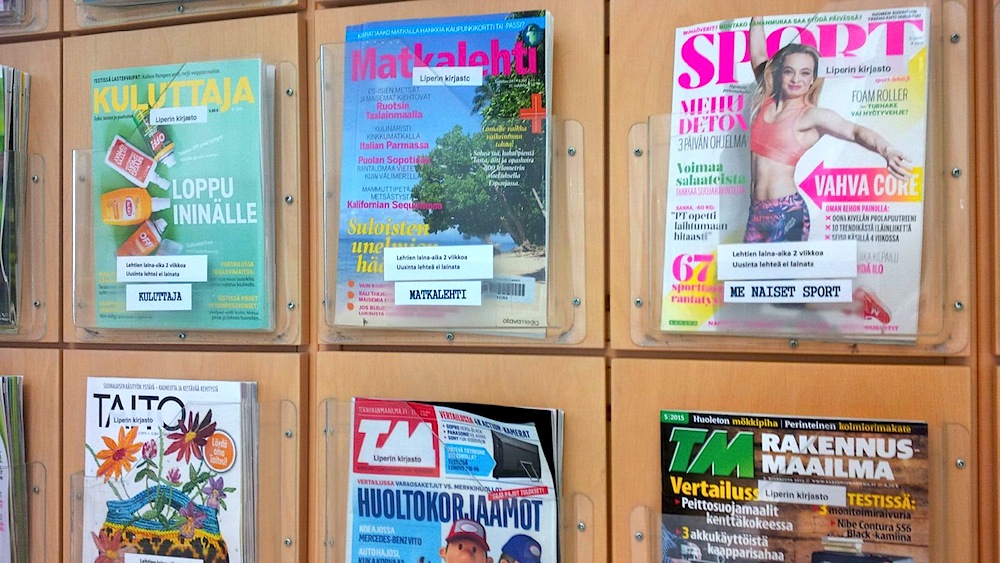
A selection of magazines that can be borrowed from a library in Finland. (PHOTO BY JANE GEORGE)

A selection of magazines that can be borrowed from a library in Finland. (PHOTO BY JANE GEORGE)

Here’s the kind of stories I read at first:

• a 22-year-old Finnish man is killed in Goa, India under mysterious circumstances;

• a couple’s premature baby struggles to survive;

• a woman who is overweight becomes a chaplain and then discovers she’s gay;

• Finnish celebrities, whose names mean nothing to me, talk about their divorces, affairs, tattoos, etc.; and,

• people who own and renovate a typical Finnish “mökki” or cottage show what they did.

Why do I read these? Because people-oriented stories are easier to read and far more interesting than others.

As my reading skills improve, I start to read stories about politics (Russia’s close presence makes Finns very nervous) and climate change (a journalist from the Helsingin Sanomat newspaper goes to California, where he finds a Finnish woman who talks about the state’s water crisis.)

If you want to buy Karelian patties, here's the place: but it still helps to know what the Finnish says. (PHOTO BY JANE GEORGE)

If you want to buy Karelian patties, here’s the place: but it still helps to know what the Finnish says. (PHOTO BY JANE GEORGE)

In the Nunatsiaq News, people stories also prove to be more popular — for readers, whose first language is often not English.

But we also have to encourage people to improve their reading skills, like me, so they’ll dare to read a story about something else, such as climate change, or even international politics.

Here’s what else I learn:

My brain keeps a lot of Finnish somewhere on its back-burner — but using the language and immersing myself in it is the key to bringing this out.

When I get on the airplane to go to Helsinki, I hear people speaking Finnish and the language sounds so strange, like Klingon almost… and yet, somehow, I understand it. But can I speak it after a year?

I don’t even ask the flight attendants for drinks in Finnish.

On Day One, I wish I’d brought a Finnish-English dictionary along as I stumble over the simplest explanations; by Day Two, I am able to baby-talk Finnish.

Someone asks me for directions on Day Three and I can answer. although I don’t know where they should go.
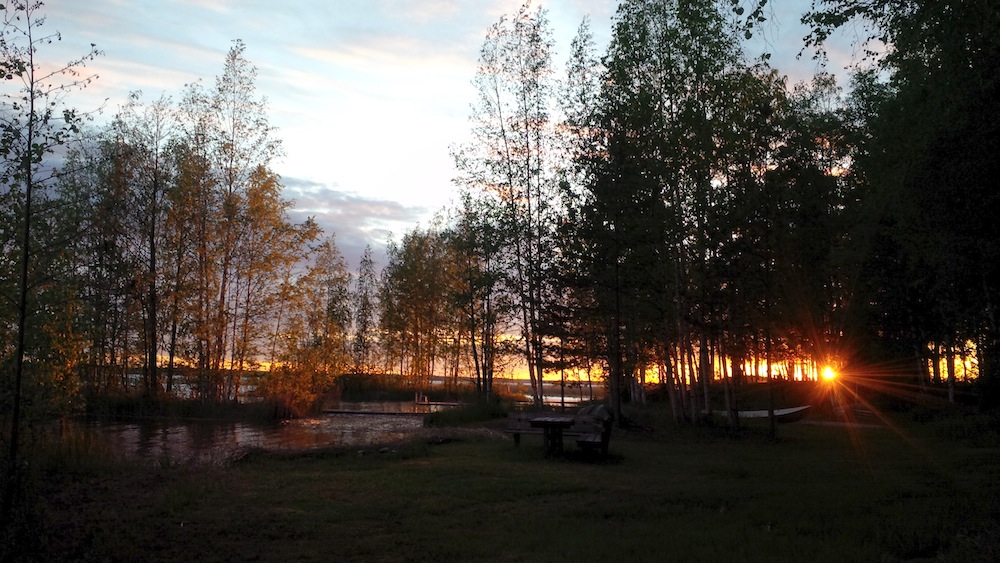
It's easy to stay up late when the sun doesn't set. (PHOTO BY JANE GEORGE)

It’s easy to stay up late when the sun doesn’t set. (PHOTO BY JANE GEORGE)

By Day Four I stay up with friends, until the sun is almost at the horizon (and ready to rise again.) I’m talking and making jokes in Finnish, with half-remembered  verbs somehow appearing again — verbs like cut down, suggest, disappear or suffer.

I also relearn, among many other words, the following: dandelion, rainbow, otter, design, crow, insurance, wheelbarrow and pine cone.

On Day Five I still look for right endings when faced with saying things like “in the house of my friend’s brother”  — ystäväni veljen talossa. Television, where everyone speaks fast, starts to make more sense, and I start to read magazine and newspapers more easily.

I talk to myself in Finnish sometimes and random words pop into my brain. Finnish now longer feels strange but more like the rushing water of a brook that I usually think about when I’m listening to Finnish or speaking it.

I wish I had more than two weeks here — what would that do for my language skills? I wish I had that same fluency in Inuktitut, which I’ve spent more than 20 years trying to learn. And I wish there were easy-to-read celebrity magazines in Inuktitut and more things that I would want to read — in Roman orthography.

Mint, lime, cucumber drink is a find from a Finnish magazine. (PHOTO BY JANE GEORE)

Mint, lime, cucumber drink is a find from a Finnish magazine. (PHOTO BY JANE GEORGE)

My best find from a Finnish magazine: a recipe for a cucumber-lime-mint drink.

Here’s how to make it:

Cut up four limes into circles and mash them in a bowl.

Add a bunch of fresh mint and continue to mash it up.

Press out the juice through a sieve. Put the juice in with a chopped up cucumber (English) into a blender.

The result is very green.

Kippis (cheers)
Part 5: You know you’ve never been to Iqaluit/Frobisher Bay when…

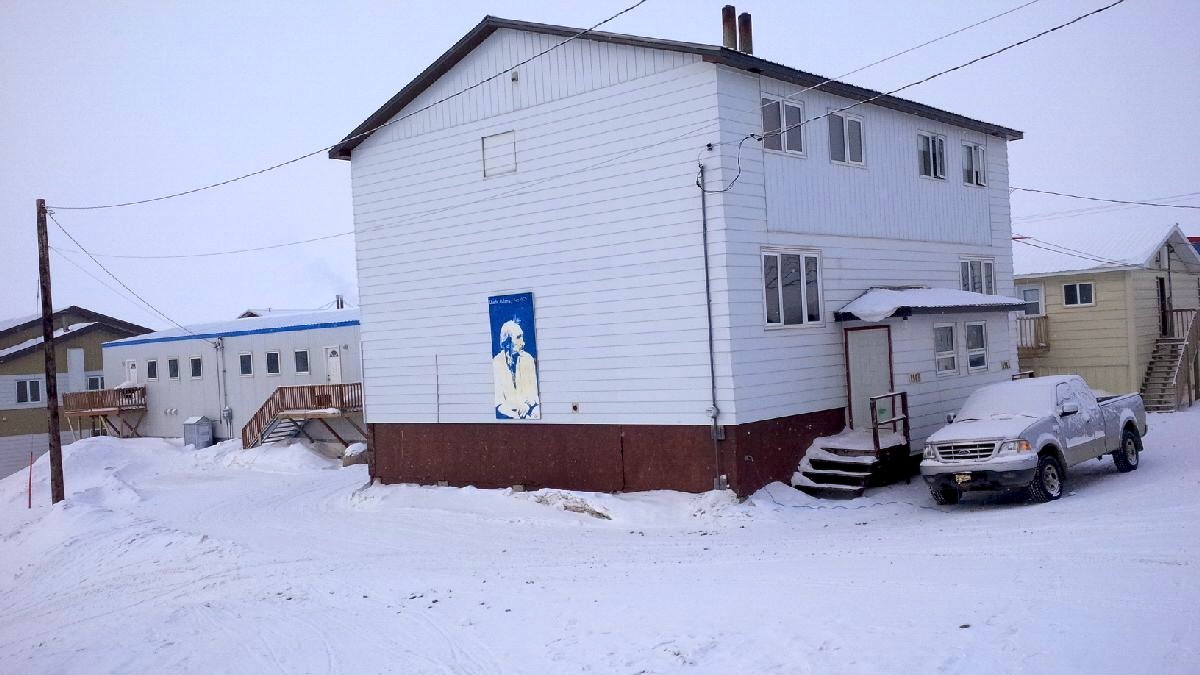
In my last blog post, you heard about some of the images on building walls around Iqaluit that show representations of people I have known or written about, such as singers Susa Aningmiuq and Jimmy Ekho. And, on another wall-image, there’s Nunavik singer and songwriter Charlie Adams, who died in 2008.

Charlie Adams as you walk towards Arctic Ventures. (PHOTO BY JANE GEORGE)

Charlie Adams as you walk towards Arctic Ventures. (PHOTO BY JANE GEORGE)

Charlie was 55 when he died in a Montreal hospital from complications related to injuries he had suffered in an accident in 2004.

But, before that, over a 30-year career, Charlie played at numerous music festivals throughout the eastern Arctic. He also toured the United States, England and the Netherlands where he performed for Queen Juliana. Adams was generous with his talent. Travellers (me, included) stuck at Iqaluit’s airport back during a February 1994 blizzard can recall how Charlie lifted our spirits by pulling out his guitar and inviting everyone to sing along with him in a version of his most famous song “Quviasupunga” (I’m Happy). You can hear that well-loved song here.

In 2003, Charlie also played and panhandled for spare change in Montreal, where he lived homeless and slept on the streets. Then, in July 2004, he suffered a near-fatal accident when a car drove over him while he lay in an alley. “I was lying there sleeping. The first wheel passed over me and I started yelling to the guy because I’m in pain and all that, and the second wheel stopped right on top of my stomach,” Charlie told me by telephone from his hospital bed in Montreal following the accident. “The first wheel broke my pelvis, and my intestines went out through my rectum and my stomach.” I think of Charlie, the gentle, talented singer, on my walk to work.

Then, there’s a striking mural, painted by Craig Clark, on the wall of the late Iqaluit Mayor Jimmy “Flash” Kilabuk’s house. I remember when it was mounted in 1998 just before the Arctic Council ministerial held that year, an informal get-together in the Anglican Parish Hall that was quite unlike the security-laden, heavily scripted event of this past April.

Jessie Oonark, Father Mary and Abe Okpik. (PHOTO BY JANE GEORGE)

Jessie Oonark, Father Mary and Abe Okpik, painted by Craig Clark. (PHOTO BY JANE GEORGE)

The three huge panels — eight feet by seven and a half feet — feature portraits of famed Baker Lake artist Jessie Oonark, Pond Inlet’s long-time priest and historian, Father Guy-Marie Rousellière, and community leader Abe Okpik. Okpik, who died in 1997, was active in getting relief to Inuit in the 1950s and 1960s. He also worked on Project Surname, which brought names, instead of disc numbers, to Inuit in the eastern Arctic. When I spoke to Okpik in the early 1990s, he gave me a leather duplicate of the E-disc he had worn. I recall he was gracious and took time to explain everything to a young reporter, who didn’t then realize what an historic role he had played in the eastern Arctic. Thank you, Abe, for your time. It was an honour to meet you.

Ataata Mary, known for his exhaustive research on Inuit history and language, died in a fire in 1994,  two weeks before I arrived  for my first visit to Pond Inlet. I later read many of the works that he had published, and picked up some at second-hand book stores: they’re now at the May Hakongak Library in Cambridge Bay with the rest of my collection of Arctic books.

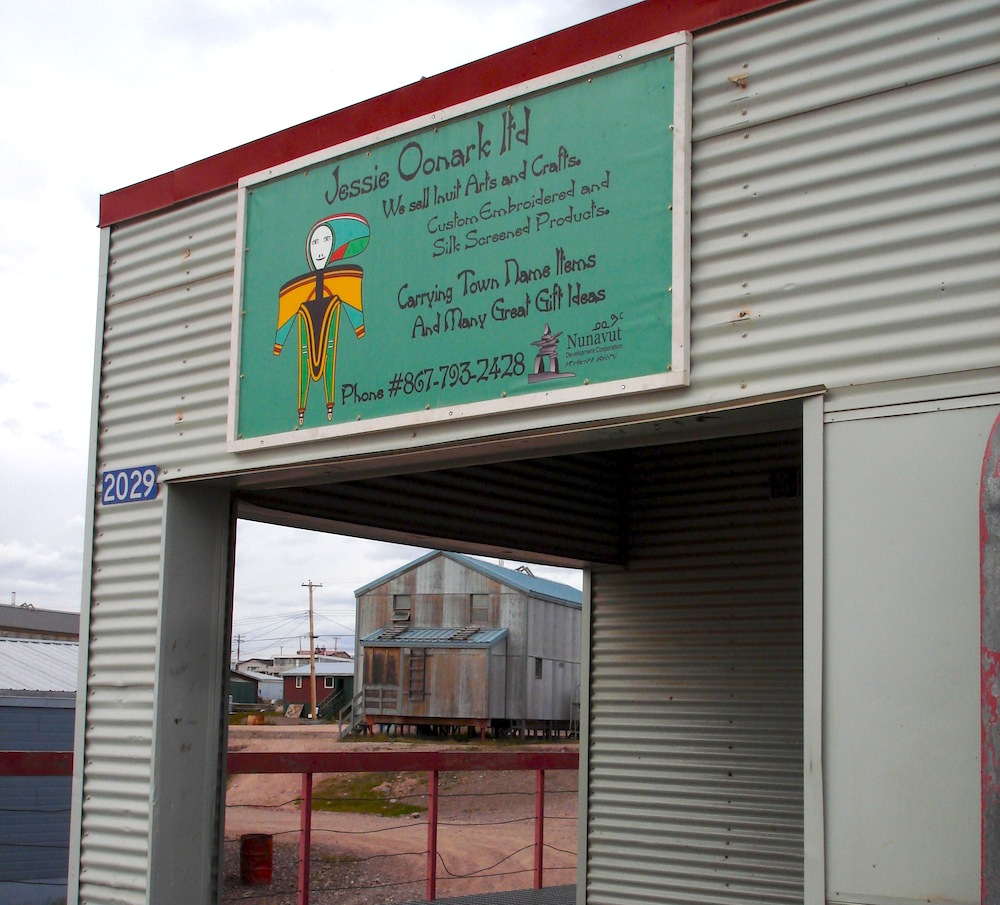
Jessie Oonark Ltd. in Baker Lake. (PHOTO BY JANE GEORGE)

Jessie Oonark Ltd. in Baker Lake. (PHOTO BY JANE GEORGE)

I never met Oonark, who died in 1985, but I spent many hours in the Nunavut legislature during sessions, looking at a colourful wall-hanging that she had stitched of geese going in many directions at once,  which was on display in the chamber. And, in 2009, I visited Baker Lake, where I stopped by the arts and crafts centre that bears her name.

This wraps up my little introduction to the people whose images you can see on the buildings around Iqaluit.

Did you read my other posts about Iqaluit? You can find all the links here: Part 4: You know you’ve never been to Iqaluit/Frobisher Bay when… And are you curious about the Canadian Arctic of the 1990s? You will want to read my “Like an iceberg” series of blog posts. You can find all the links here.