Today, Arctic explorers take cruise ships

More than 100 years after Norwegian explorer Roald Amundsen successfully traversed the Northwest Passage in 1905-06, there’s a new kind of sailor eager to accomplish that iconic voyage: the cruiser.

In 2014, five cruise ships — albeit some looking more like icebreakers than luxury liners — stopped by the western Nunavut of Cambridge Bay, where I’m staying this month, to start or finish their trip through the passage.

To see what kinds of well-heeled folks travel on those trips, which can cost $7,000 USD and more, I tracked a plane load of more than 100 passengers who arrived in the town of about 2,000 people to set off on their Adventure Canada trip through the Northwest Passage.

After landing Sept. 8, they spent an afternoon in the community, participating in activities led by Vicki Aitaok, who’s organized similar visits for several years.

Jessie Tologanak tells a group of cruisers the legend of Mt. Pelly, seen in the distance beyond. (PHOTO BY JANE GEORGE)

Jessie Tologanak tells a group of cruisers about the legend of Mt. Pelly, seen in the distance beyond. (PHOTO BY JANE GEORGE)

My group of cruisers set off to walk around town with Jessie Tologanak under sunny skies, heading down the muddy main street, past the hamlet office, the health centre, St. George’s Anglican Church and the visitors centre, down to where everyone could see across to Mt. Pelly, the 200-metre-high esker located 15 kilometres outside town.

“We call that Ovayuk,” she said, pointing to Mt. Pelly, relating the legend of how a starving giant laid down and died there.

Inuit legend says that Ovayuk and two smaller hills are a family of starving giants who were crossing Victoria Island looking for food.

The father, Ovayok, died first.

“His bladder burst and that’s water you see there,” Jessie said, pointing to the bay.

A cruiser takes a photo of an old Hudson Bay Co. building. (PHOTO BY JANE GEORGE)

A cruiser takes a photo of an old Hudson Bay Co. building. (PHOTO BY JANE GEORGE)

Visiting Nunavut and Greenland, where the cruise would end Sept. 22, is different from visiting Antarctica, a woman told me as Jessie spoke. That’s because there were only penguins in Antarctica, she told me — no people or communities.

Many in the group wore jackets from those trips marked “Antarctic,” and nearly all said they had been to the North before, to Alaska, Yukon or the Svalbards.

And, while I expected to find an elderly bunch of people, this gang was fit. Although I saw at least one hearing aid, these men and women didn’t appear to have any difficulties.

“You’ll find a well-travelled group here,” an Adventure Canada organizer told me. “It may be a trip of a lifetime to go through the passage, but they’ve been to lots of other places before.”

And the cruisers had researched their destinations and voyage beforehand. A woman told me how Adventure Canada had first cancelled the trip she was to embark on. That’s because the ship slated for this cruise, the Clipper Adventurer, which spectacularly ran in to a shoal near Kugluktuk in August 2010 during a previous Adventure Canada cruise, had broken down.

And it was only at the last minute that she and the other passengers had been offered a chance to travel on the Akademik Sergey Vavilov, docked outside Cambridge Bay.

The Russian-registered Akademik Sergey Vavilov, redubbed One Oceans Voyager by uneasy Canadians, at anchor Sept. 8 outside Cambridge Bay. (PHOTO BY JANE GEORGE)

The Russian-registered Akademik Sergey Vavilov, redubbed One Ocean Voyager by uneasy Canadians, lies anchored Sept. 8 outside Cambridge Bay. (PHOTO BY JANE GEORGE)

That the vessel is a Russian-run and registered ship, previously used to carry out Russian research, wasn’t something you read widely, she said — instead it was redubbed “The One Ocean Voyager,” during on a previous cruise.

That’s when its crew and passengers with One Ocean Expeditions and the Royal Canadian Geographical Society participated in Parks Canada’s effort to locate HMS Erebus and HMS Terror, the ships lost on Franklin’s 1845 expedition.

“I guess Harper didn’t want to be seen as using a Russian vessel on his Canadian mission to find the ships,” she said. (Harper announced Sept. 9 the discovery of one of Franklin’s two ships)
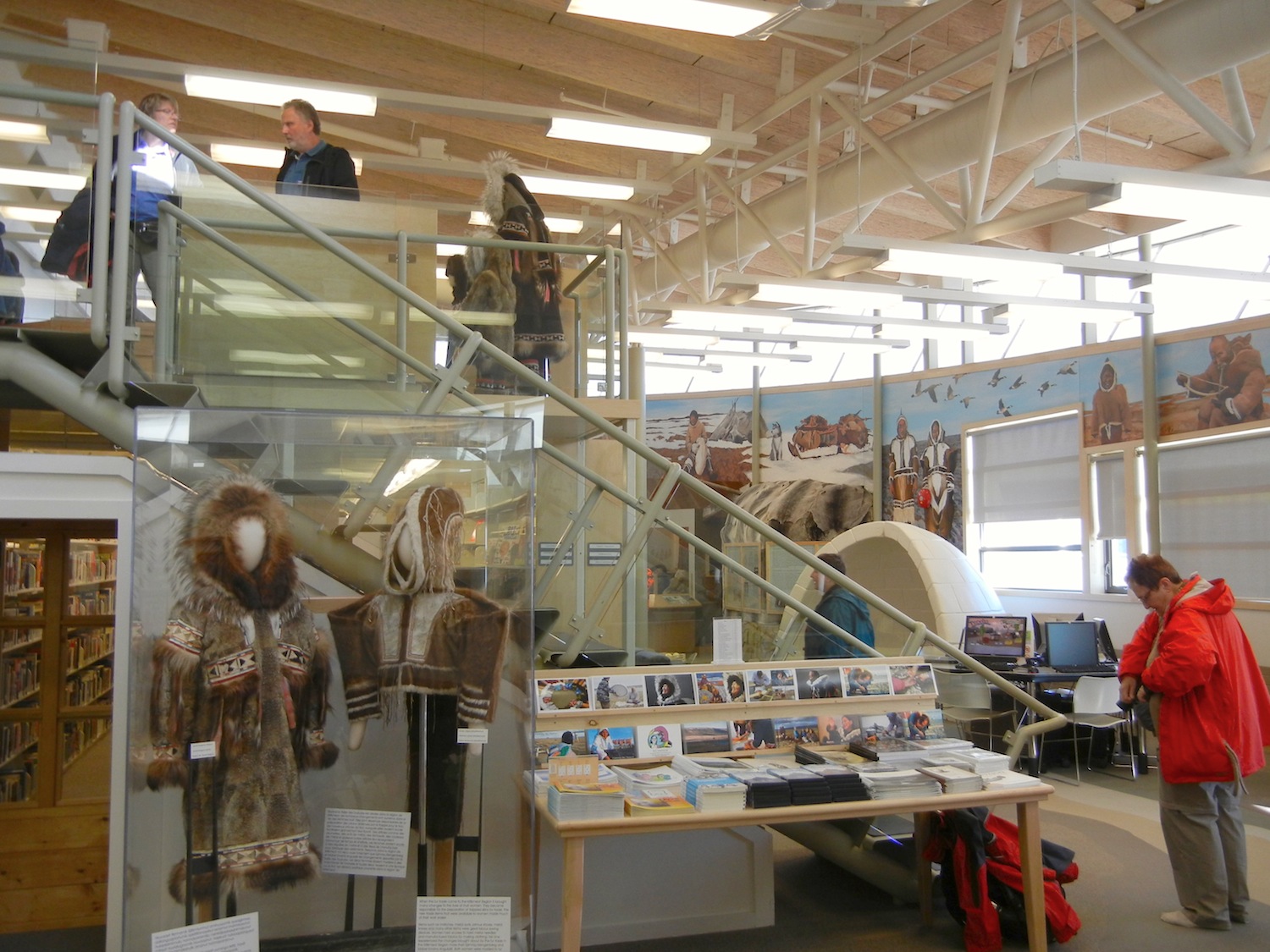
Cruisers take in the exhibits at the May Hakongak Community Library and Heritage Centre. (PHOTO BY JANE GEORGE)

Cruisers take in the exhibits at the May Hakongak Community Library and Heritage Centre. (PHOTO BY JANE GEORGE)

We continued back to the Kiilinik High School where there was time to peek into the May Hakongak community library and heritage centre before the start of a cultural performance, which included a qulliq lighting, local throat singers, drummers and dancers, and music from blind musician Ashlee Otokiak.

Dancers at the Sept. 8 cultural performance at Cambridge Bay's high school. (PHOTO BY JANE GEORGE)

Dancers at the Sept. 8 cultural performance at Cambridge Bay’s high school. (PHOTO BY JANE GEORGE)

Then they walked off down the hill to the bay to board the Akademik Sergey Vavilov on zodiacs.

But given the heavy ice conditions in the Northwest Passage this year, a passenger joked they could be back in Cambridge Bay next week.

“But it’s the trip, not the destination” — Kangerlussuaq, Greenland — that counts, he said.

Keep a look out for future posts from Cambridge Bay in A date with Siku girl.

A memorable junket, Part IV: my 2003 journey with the GG

As the days went on, some delegates on Governor General Adrienne Clarkson’s 2003 state visit to Finland and Iceland, started to worry about their weight. Not me: I ate little, drank nothing and concentrated on collecting a stash of the organic chocolate bars that were handed around the airplane after meals so I could take these home as gifts.

Polar Gambit, published Oct. 27, 2003 in Maclean's

Polar Gambit, published Oct. 27, 2003 in Maclean’s

I patched up things with Sheila Watt-Cloutier, then the president of the Inuit Circumpolar Conference (now Council), who was worried I’d somehow portray the presence of Inuit on the trip badly in my stories.

But because I was the only journalist on board, my presence also sparked a perceptible unease amongst Canada’s royal envoys — with John Ralston Saul, Clarkson’s husband, coming back to chat me up on the airplane, to quietly sound me out on how I had found the state visit.

While I toiled to finish my Maclean’s piece (due while I was in Iceland) and to meet my relentless Nunatsiaq News deadlines, I managed to fend off all other pressures — after all, I had experienced much worse in Nunavik.

But I also missed out on many opportunities during the state visit: for example, a lunch in Iceland where my table companions included noted photographer Ed Burtynsky and author Jane Urquhart. However, instead of talking to them about his art or her writing, we were obliged to make small talk with the other person at the table, the local mayor’s wife.

I attended only one or two of the many concerts or art exhibits which were included on the agenda as I tried to meet my deadlines.

And, much to my regret now, I don’t even remember meeting author and fellow delegate Wayne Johnston, whose books I continue to read.

However, while travelling on the airplane from point A to B, I did talk to the wild salmon marketers from B.C., Ontario wine producers and an architect from Toronto. Most of them weren’t even sure why they were asked to be on the trip.

And I also passed the time with many of the academics who had with an interest in the North, among them, François Trudel from Université Laval, Peter Johnson, then chair of the Polar Commission, and Shelagh Grant, author of many northern histories.

However, in my professional coverage of the trip, I managed to leave out its many high points for me (as a person, not a journalist) — which I still recall today:

  • talking on many occasions with Gen. Romeo Dallaire and his wife, Elizabeth Dallaire, (who were on the Finnish portion of the junket) about his experiences in Rwanda and post-traumatic stress;
  • returning to Helsinki again in the autumn, where the damp smell of wet yellow birch leaves reminded me of studying in Helsinki;
  • privately interviewing Finnish president Tarja Halonen and visiting the palace, which I used to walk by every day where I lived in Katajanokka;
  • catching a glimpse a Saami friend from Tromsø, Norway in Rovaniemi, Finland, from our bus (hei, Marit!) and talking briefly to her;
  • taking in the site of Iceland’s first parliament,Thingvelir, with its towering natural forum of rock; and, last, but not least,

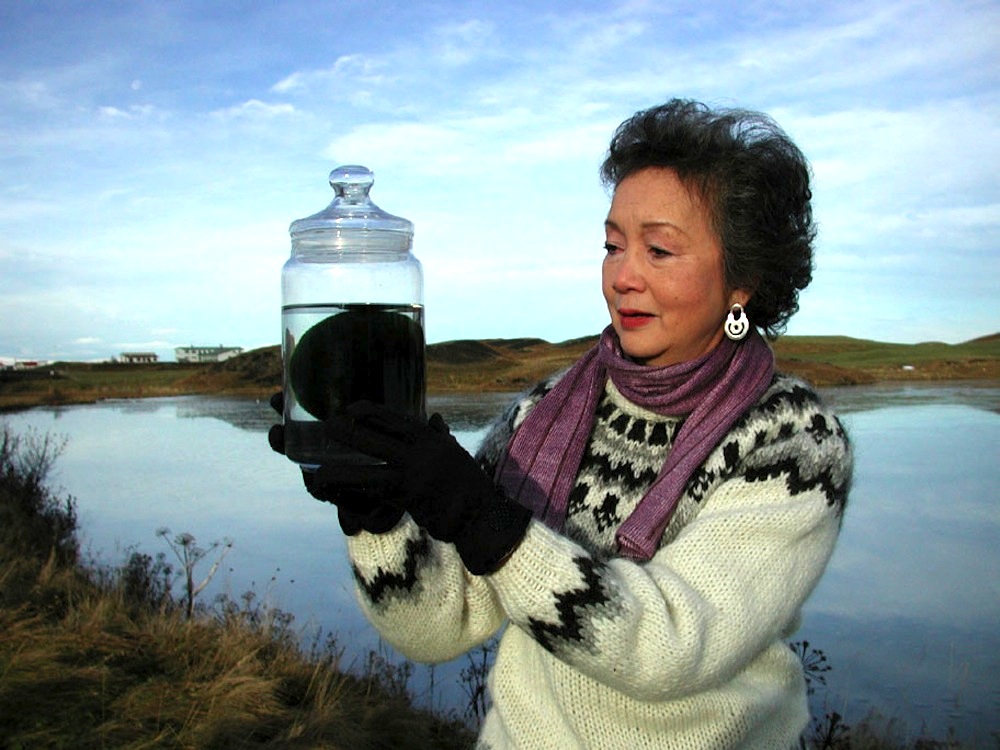
    Governor General Adrienne Clarkson holds an algae bar near Lake Myvatn, Iceland. (PHOTO BY JANE GEORGE)

    Governor General Adrienne Clarkson holds an algae bar near Lake Myvatn, Iceland. (PHOTO BY JANE GEORGE)

  • stopping in Myvatn in northern Iceland where I held an algae ball (priceless) and also encouraged Clarkson to do the same.

You might wonder why a glass jar with a silly algae ball somehow still sums up that 2003 state visit for me.

But you just had to love those “lake balls,” the strange, ball-shaped algae called “kúluskítur,” or “balls of shit” in Icelandic, or “Cladophora aegagropila” in Latin, which only exist in two lakes in the world: Lake Akan on Hokkaido Island in Japan, and in Myvatn.

Seeing those algae balls made up for all the frustrations and fatigue of the 2003 junket and made me smile— who could ask for more?

I hold a jar with an algae ball from Myvatn, Iceland. (PHOTO BY JANE GEORGE)

I hold a jar with an algae ball from Lake Myvatn, Iceland. (PHOTO BY JANE GEORGE)

You can read earlier instalments of A memorable junket here:

Remembering a memorable junket: Siku girl’s 2003 travels with the GG

Remembering a memorable junket, Part II: Siku girl’s 2003 travels with the GG

Remembering a memorable junket, Part III: Siku girl travels with the GG in 2003

Did you miss A Date with Siku girl’s Like an iceberg? You can read it all here:

Like an iceberg: on being a journalist in the Arctic

Like an iceberg, 1991…cont.

Like an iceberg, 1991…more

Like an iceberg, 1992, “Shots in the dark” 

Like an iceberg, 1992, “Sad stories”

Like an iceberg, 1993, “Learning the language of the snows”

Like an iceberg, 1993 cont., “Spring”

Like an iceberg, 1993 cont., “Chesterfield Inlet”

Like an iceberg, 1993 cont., more “Chesterfield Inlet”

Like an iceberg, 1994: “Seals and more”

Like an iceberg, 1994, cont., “No news is good news”

Like an iceberg, 1994 cont., more “No news is good news”

Like an iceberg, 1994 cont., “A place with four names”

Like an iceberg, 1995, “More sad stories”

Like an iceberg, 1995 cont., “No place like Nome”

Like an iceberg, 1995 cont., “Greenland”

Like an iceberg, 1995, cont. “Secrets”

Like an iceberg, 1996, “Hard Lessons”

Like an iceberg, 1996 cont., “Working together”

Like an iceberg, 1996 cont., “At the edge of the world”

Like an iceberg, 1996, more “At the edge of the world”

Like an iceberg, 1996, cont. “Choices” 

Like an iceberg, 1997, “Qaggiq”

Like an iceberg, 1997, more “Qaggiq”

Like an iceberg, 1997, “Qaggiq” cont.

Like an iceberg, 1997 cont., “Qaggiq and hockey”

Like an iceberg, 1997 cont., “Brain surgery in POV”

Like an iceberg, 1997 cont.: “Masks on an island”

Like an iceberg, 1997 cont., “Abusers on the pulpit”

Like an iceberg, 1998, “Bearing gifts”

Like an iceberg, 1998 cont., “At the top of the world”

Like an iceberg, 1998 cont., “A bad week” 

Like an iceberg, 1998 cont.: more from “A bad week”

Like an iceberg, 1998 cont., “Memories”

Like an iceberg, 1999, “The avalanche”

Like an iceberg, 1999 cont., “An exorcism, followed by a penis cutting”

Like an iceberg, 1999 cont., more on “the Avalanche”

Like an iceberg, 1999 cont., “Robins in the Arctic”

Like an iceberg, 1999 cont., “Fossil hunting”

Like an iceberg, 1999 cont., “Where forests grew” 

Like an iceberg, 1999 cont.,”And then there was Nunavut”

Like an iceberg … the end