Part 4: You know you’ve never been to Iqaluit/Frobisher Bay when…

I wanted to finish this post, the fourth in this series, before the April 24 Arctic Council ministerial meeting in Iqaluit — but suddenly there was no time and no mental energy. After the Arctic Council meeting, Iqaluit continued in a state of upheaval: a fire at the Ukkivik residence, then an armed standoff in the Happy Valley neighbourhood (where I was staying, just outside the barricades set up by police,) yet another armed standoff and then a bomb threat at the Nunavut Court of Justice.

But, knowing what I do now,  it was okay to let this post wait: no one in Iqaluit for the April 24 Arctic Council meeting would have seen much of the city — except for the Inuit village erected between the Nunavut legislature and the cadet Hhall, the two venues used that day for events and news conferences.

Looking out of the media room in the Cadet Hall, I could see the Inuit Village erected for the Arctic Council ministerial meeting. (PHOTO BY JANE GEORGE)

Looking out of the media room in the cadet hall, I could see the Inuit village set up  for the Arctic Council ministerial meeting. (PHOTO BY JANE GEORGE)

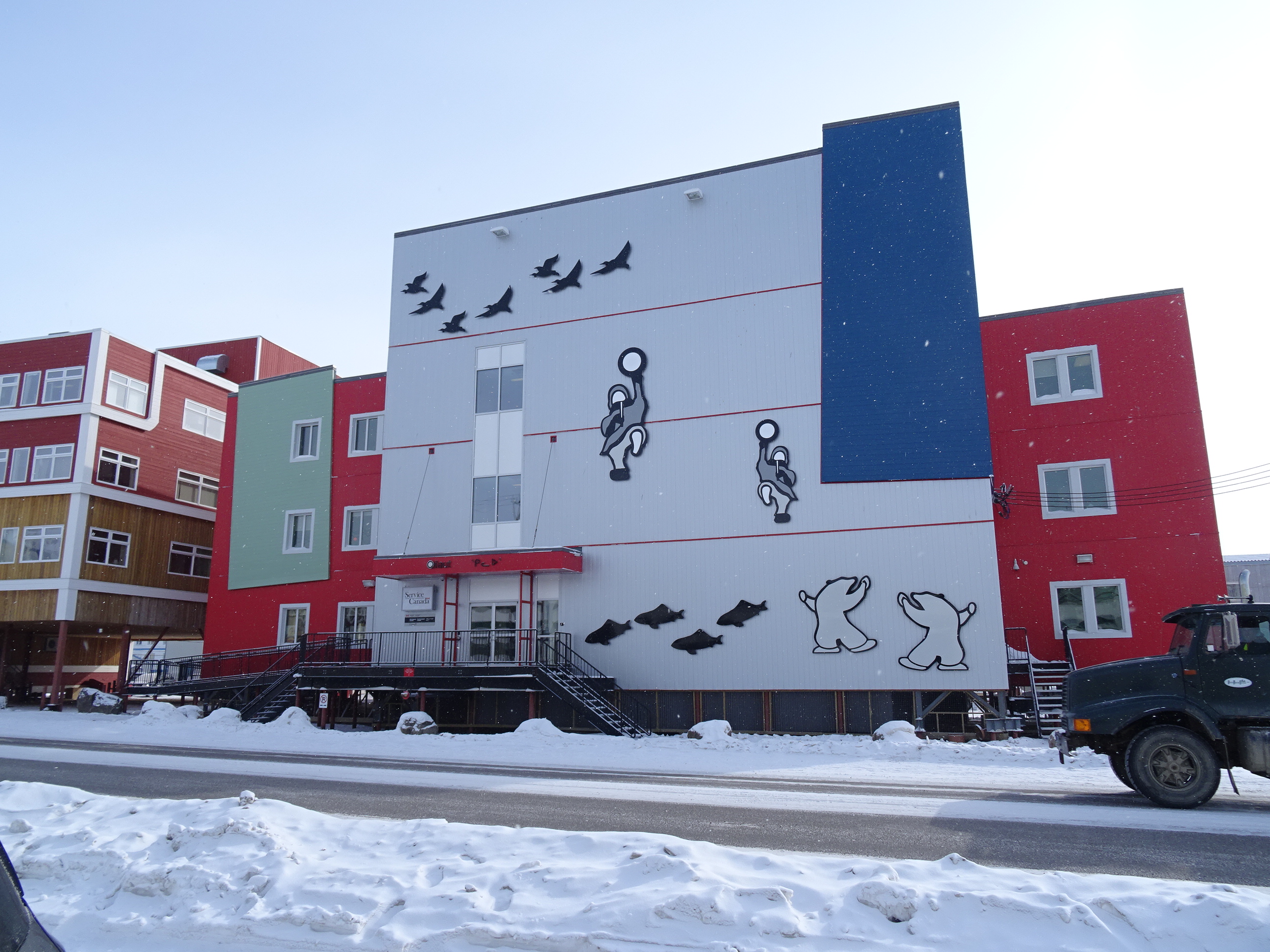
So surely, no Arctic Council ministers would have noticed the stencilled likeness of Susa Aningmiuq on the side of the Navigator Hotel (whose windows were unboarded for the dignitaries) as they drove from the airport to their meeting in the Nunavut legislature.

Susa Angnimiuq on the side of the Navigator Hotel. (PHOTO BY JANE GEORGE)

Susa Aningmiuq on the side of the Navigator Hotel. (PHOTO BY JANE GEORGE)

But the artwork on the sides of several houses in Iqaluit always brings back memories for me— because the images feature people I knew — or about whom I wrote, at the very least. Susa, postmistress in Pangnirtung, died in 2001 — but the 1990s song by Susa and her husband Etulu, called Upirngaani, or spring time, was one I listened to over and over again, because it was so cheerful — and easy to understand.

The song’s popularity endures: I heard someone singing this tune recently on a sunny day in Iqaluit. You can listen to it here. On another Iqaluit building, you can see an image of “Arctic Elvis,” Jimmy Ekho, who died in 2008 at 48.
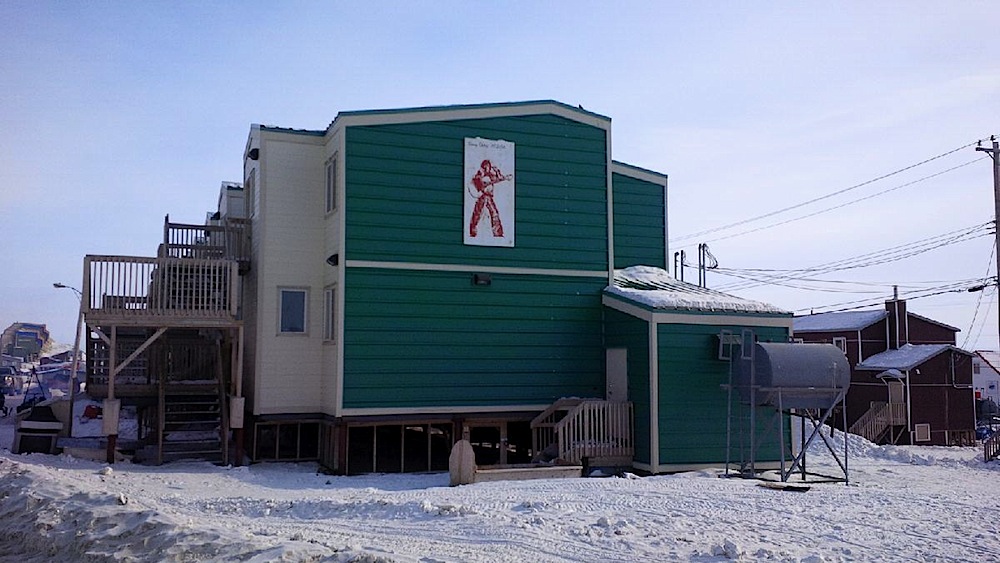
I see the image of Jimmy Ekho daily as I head to work. (PHOTO BY JANE GEORGE)

I see the image of Jimmy Ekho daily on my way to work. (PHOTO BY JANE GEORGE)

Jimmy was one of the people I used to visit and chat with regularly. He worked at the Nunatta Sunakkutaangit museum, where I’d drop by and we would talk about Inuit music. Jimmy always sang in Inuktitut and, for his performances,  he wore his signature sealskin outfit. But his best-known song, “Be-Bop-A-Lula,” was not even written by Elvis — actually by Gene Vincent. I remember Jimmy more for his 1993 song “Guti,” a poignant ballad about a young Iqaluit man who died of AIDs. You can listen to it here.

Jimmy Ekho's Guti CD

Jimmy Ekho’s Guti CD

In 2008, Akeego Ekho, his widow, contacted Nunatsiaq News: when she visited the Iqaluit cemetery and her husband’s gravesite, she was shocked to discover that thieves had made off with a piece of carved ivory that hung on the cross marking her late husband’s grave. The inscription on the ivory piece read: “Arctic Elvis. Jimmy Ekho, aged 48, 1960-2008.” Akeego said she spent $300 for the piece. “I really want it back,” she said.

But someone stole the unique carving, which had likely already been cut up into smaller pieces for use in making ivory jewelry by the time she spoke to me. “That person has no heart,” Akeego said, adding that the loss of the ivory increased the grief she felt over the loss of her husband.

What I saw at Jimmy's grave. (PHOTO BY JANE GEORGE)

What I saw at Jimmy’s grave. (PHOTO BY JANE GEORGE)

Whoever took the ivory left other items on the grave untouched: a pair of dark, aviator-style sunglasses and a plastic-wrapped quiz book about the life of Elvis. We’ll continue my little tour of wall-art and the people pictured there later… Did you read my other posts about Iqaluit? Part 3: You know you’ve never been to Iqaluit/Frobisher Bay when… Part 2: You know you’ve never been to Iqaluit/Frobisher Bay when… You know you’ve never been to Iqaluit/Frobisher Bay when… And are you curious about the Canadian Arctic of the 1990s? You will want to read my “Like an iceberg” series of blog posts. You can find all the links here.

Part 3: You know you’ve never been to Iqaluit/Frobisher Bay when…

Let’s go on a little tour of downtown Iqaluit, spurred on by what I read in a recent article more about the 1950-era dome-dream for Frobisher Bay, now known as Iqaluit.

This shows some of what was designed for the then-community of  Frobisher Bay.

This shows some of what was designed for the then-community of Frobisher Bay.

This would have been the biggest Arctic dome ever — “conceived in a manner similar to the gothic vaulting, but constructed in thin shell concrete with ribs radiating from a central pier, as a large fan vault,” reads the design information for “Frobisher Bay: The Design of Accommodation for a Community of 4,500 People.”

Does this seem incredible?

Well,  I am ready to take you to some equally fantastic buildings. But these you can see today in Iqaluit, Nunavut’s capital city whose population is now likely nearing 8,000.

The place to start our tour lies right in the heart of Iqaluit, at the Four Corners crossroads of Queen Elizabeth Way and the Federal Rd. with Mivvik St. and Niaqunngusiaq Rd. It’s a location which, over the past few years, has morphed into a strikingly unattractive place where southern architects’ fancies, or blunders, are still played out.

I can’t help thinking that when the Arctic Council’s top ministers for its eight circumpolar nation members and their entourages pour into Iqaluit at the end of April, they will be whisked from the airport through this — but maybe they can keep their eyes closed and think about climate change.

Heads above all those new structures is the Qamutiq building, which an Inuk friend of mine calls “Noah’s Ark” due to its shape.

The Noah's Ark of Iqaluit. (PHOTO BY JANE GEORGE)

The Noah’s Ark of Iqaluit. (PHOTO BY JANE GEORGE)

But you may note there are many things to reflect on here with this building:

• its shape — why the ultra-high roof? and why red?

• the name — the huge syllabics are correct, but the Roman orthography is wrong and should be “qamutik.”

You can't miss the misspelling even at night. (PHOTO BY JANE GEORGE)

You can’t miss the misspelling even at night. (PHOTO BY JANE GEORGE)

• the location — why not hide this building somewhere instead of putting it in the centre of town where the late domed restaurant, the Kamotiq (also a misspelling), once stood? What’s more, you can see the “Qamutiq” from all over town because of its relatively enormous height.

Iqaluit's Kamotiq Inn, now demolished. (PHOTO/NUNATSIAQ NEWS)

Iqaluit’s Kamotiq Inn, now demolished. (PHOTO/NUNATSIAQ NEWS)

Next door to the Qamutiq stands another brand-new and equally unappealing building called the Qilaut, or drum in Inuktitut, which also features some decorations as well weird multi-coloured wings. Why? That’s all I’d like to know.

Iqaluit's Qilaut building and its topsy-turvy annex, March 2015. (PHOTO BY JANE GEORGE)

Iqaluit’s Qilaut building and its topsy-turvy wings, March 2015. (PHOTO BY JANE GEORGE)

Kitty-corner to these two buildings lies the nondescript Igluvut building where the T-1 building, which used to house the Nunatsiaq News office, once stood.

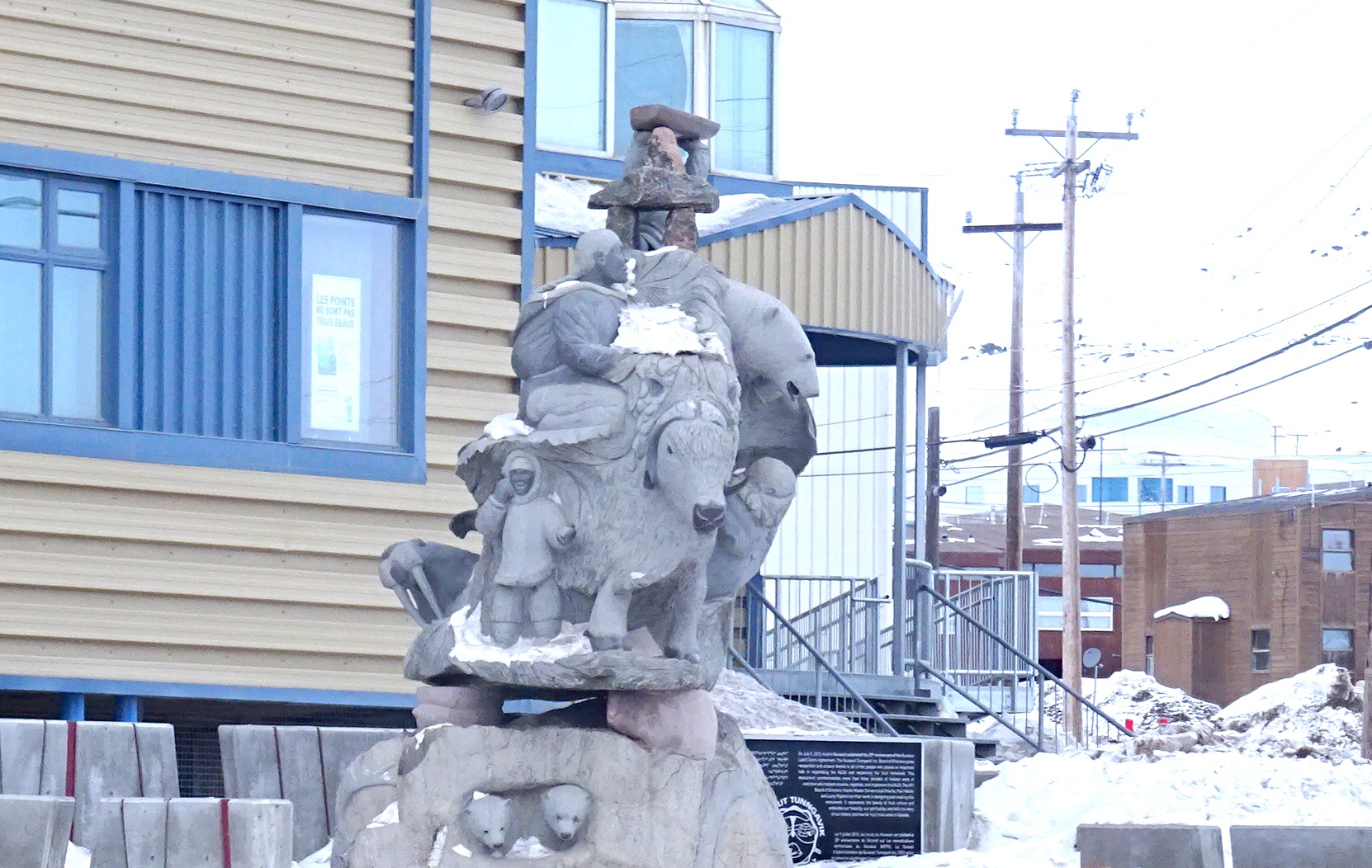
Here you can’t miss the giant-sized carving, unveiled in 2013 in honour of the 20th anniversary of the proclamation of the Nunavut Land Claims Agreement on July 9, 1993. The commissioning this monument, a collaboration of carvers from Nunavut’s three regions — may have seemed like a good idea at the time. But the end result done by three talented carvers, looks like an Arctic nightmare  — a mish-mash of every polar animal and symbol of Inuit culture.

From every angle there's something new on this huge carving about the Igluvut building in Iqaluit. (PHOTO BY JANE GEORGE)

From every angle there’s something new on this huge carving in front of the Igluvut building in Iqaluit. (PHOTO BY JANE GEORGE)

Nearby stands the Hotel Arctic, featuring colours best described as mustard and ketchup, and a strange igloo-dome appendage on top. Can you tell me what this is? Enough said.

Here at the Four Corners intersection lies the red and mustard-coloured Hotel Arctic with its dome-ish decorated roof. (PHOTO BY JANE GEORGE)

Here at the Four Corners intersection lies the red and mustard-coloured Hotel Arctic with its dome-ish decorated roof. (PHOTO BY JANE GEORGE)

Across the street, the low-key, boxy Parnaivik building, whose parking lot lies on the site of Iqaluit’s long-gone mini-golf course.

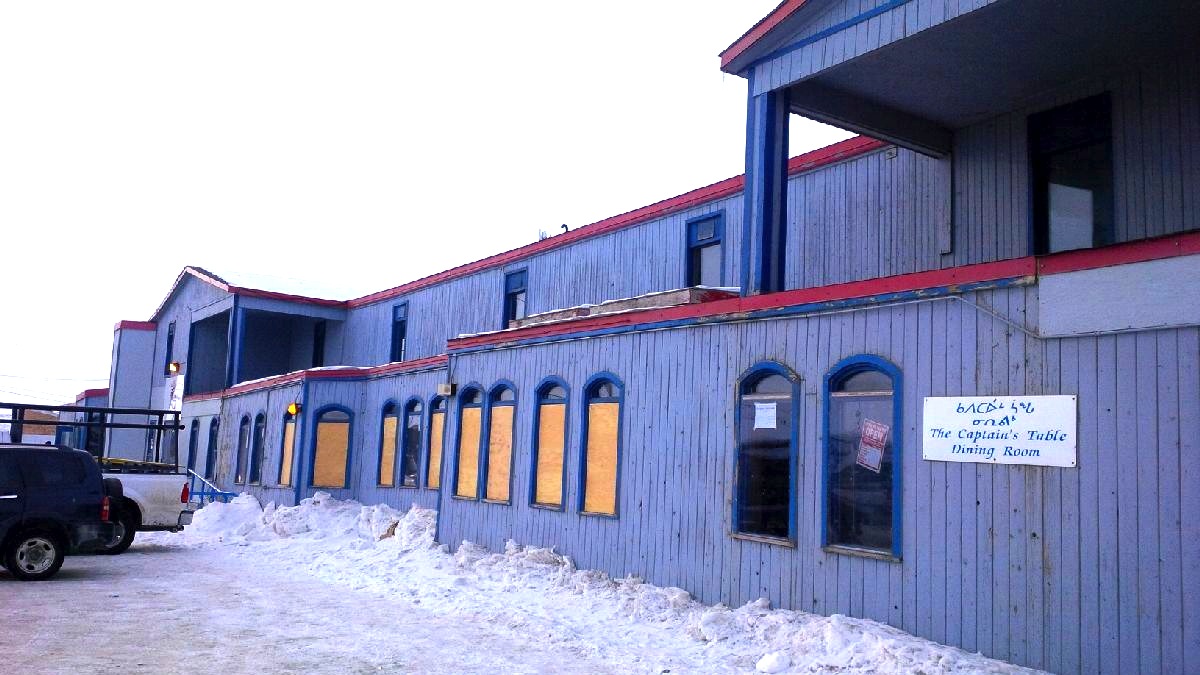
If you head down the street, looking for other sights, you’ll wonder at the boarded-up, but still operating hotel, bar and restaurant, the Navigator Inn.

Not a lot of natural light these days at the Navigator in Iqaluit. (PHOTO BY JANE GEORGE)

Not a lot of natural light these days at the Navigator in Iqaluit. (PHOTO BY JANE GEORGE)

I’ll let you decide if you dare to venture inside. A comment on Trip Advisor from a few years ago might make you think twice about this: “Can’t believe that they call this a hotel. The front door locks at 11 and there is nobody running this zoo until the next morning… I’ve been here for 4 nights now and the chambermaid hasn’t been to my room once. Its probably for the better as I have heard of several things walking out of peoples rooms.”

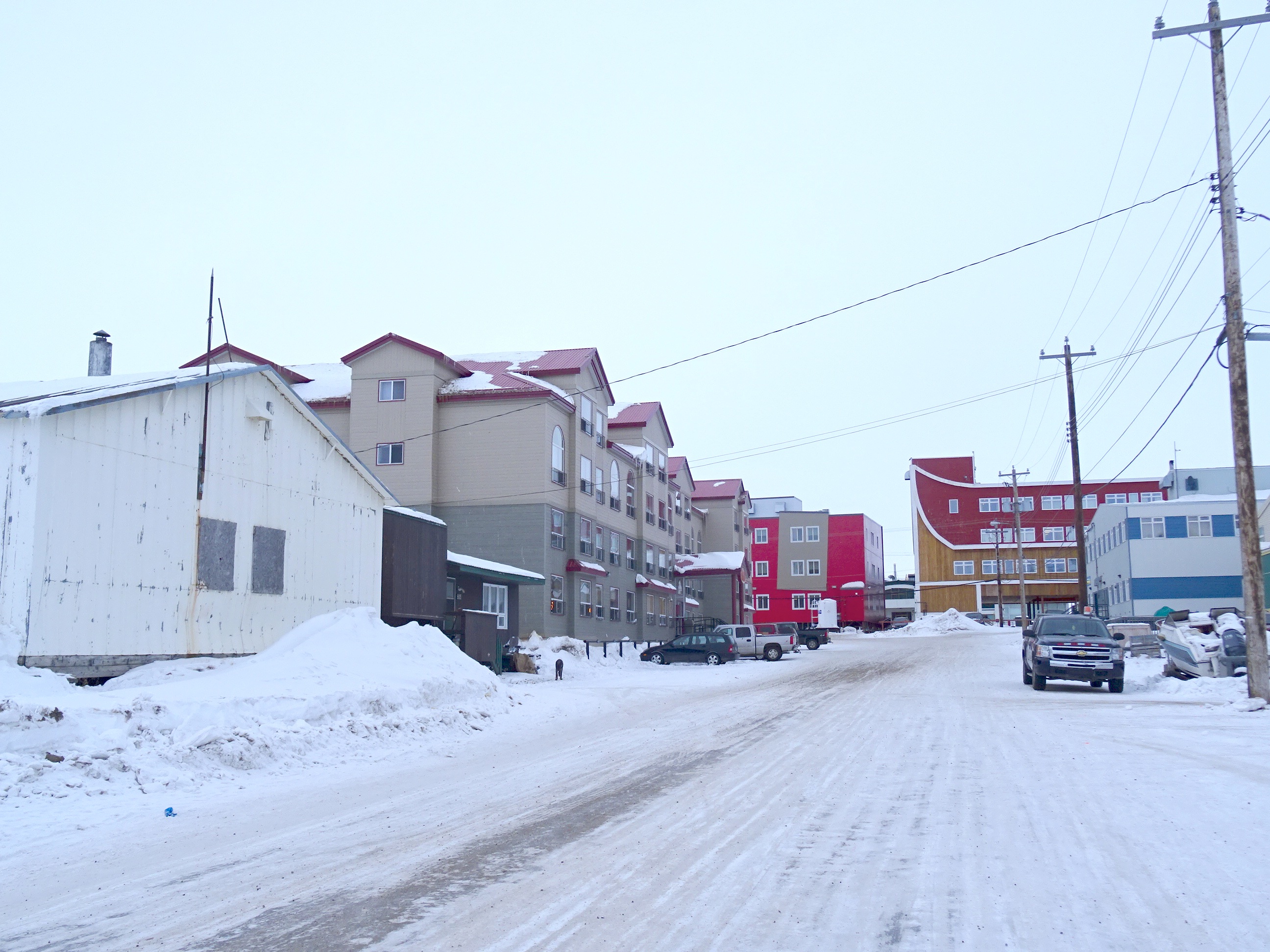
Nearby you can see the Iqaluit of yesterday and today: in the foreground to the right the sole remaining Butler building, former military accomodation from Frobisher Bay’s Cold War beginnings that last served as government staff housing, in the foreground, and, at the end of the street, the Qamutiq.

Looking down this street you travel through time, from the Butler building of the early 1960s to the Qamutiq of today,

Looking down this street you travel through time, from the Butler building of the early 1960s to the Qamutiq of today. (PHOTO BY JANE GEORGE)

And that’s enough for today’s tour of Iqaluit.

Did you read my first posts about Iqaluit?

Part 2: You know you’ve never been to Iqaluit/Frobisher Bay when

You know you’ve never been to Iqaluit/Frobisher Bay when…

And are you curious about the Canadian Arctic of the 1990s?

You will want to read my “Like an iceberg” series of blog posts. You can find all the links here.