Yellowknife — a capital city with no national newspapers

Saturday: that’s the day in the week that I traditionally reserve for the reading of as many print editions of newspapers as possible.

But in Yellowknife, I discovered that you can no longer buy any daily print newspapers from the South — that means there’s no Globe and Mail, no National Post, not even an Edmonton Journal. Not on Saturdays and not on any other day of the week.

A woman at a Yellowknife pharmacy where I used to find newspapers during previous visits told me that it’s been nearly a year since the distributor for daily newspapers from the South went out of business. Since then, no one’s picked up the distribution, she said.

And that’s in a city of 20,000, the capital of the Northwest Territories.

Yellowknife, lots of people, buildings and no national newspapers. (PHOTO BY JANE GEORGE)

Yellowknife, lots of people, buildings and no national newspapers. (PHOTO BY JANE GEORGE)

You might think there would be enough people in this city to support newspaper distribution — especially since it’s still costly for many to gain access to internet that’s fast enough to read the online editions of southern dailies with ease.

But I’m even more shocked because even in Iqaluit — Nunavut’s capital, which lies further to the north — you can buy newspapers such as La Presse, Ottawa Citizen, Montreal Gazette and Globe and Mail to the Sunday New York Times — although the Sunday edition arrives a day late — and Yellowknife, unlike Iqaluit, is connected to the southern road network and is served by many more flights in and out of the South than Iqaluit.

Newspaper-wise, all you can find in Yellowknife to read are copies of the Nunatsiaq News or local Yellowknife papers.
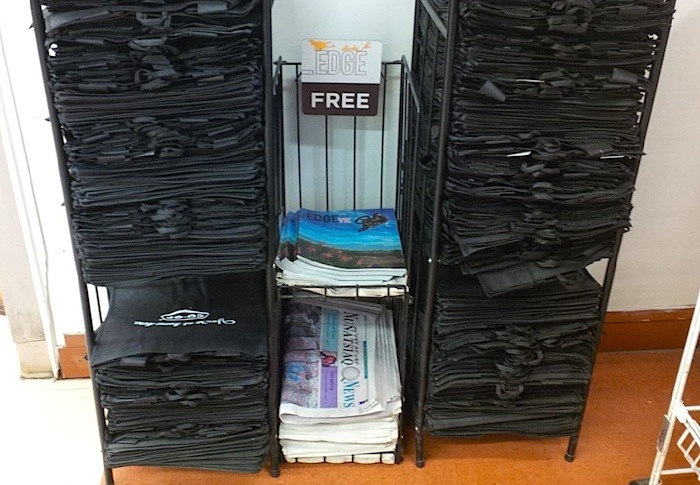
At the local co-op store in Yellowknife, I find a Nunatsiaq News. (PHOTO BY JANE GEORGE)

At the local co-op store in Yellowknife, I find Nunatsiaq News. (PHOTO BY JANE GEORGE)

That’s fair enough, because people need to know what’s going on in the city and the North, but it’s disturbing to think that people in Yellowknife — many of whom are also newcomers from other countries — are left out of the larger Canadian dialogue on politics and other national issues, particularly during a federal election period.

With no newspapers to read, here’s what you can do on a Saturday in Yellowknife:

  • shop for food (reasonable compared to other places in the North or at Walmart (with same the stuff as in the South) or buy alcohol at the liquor shop (impossible to do in most other places in the North);
  • take a walk to admire the houseboats on Great Slave Lake, the changing leaves on the trees and still-blooming flowers;
    The birch trees turn a bright yellow colour at this time of year, reminding me of Finland. (PHOTO BY JANE GEORGE)
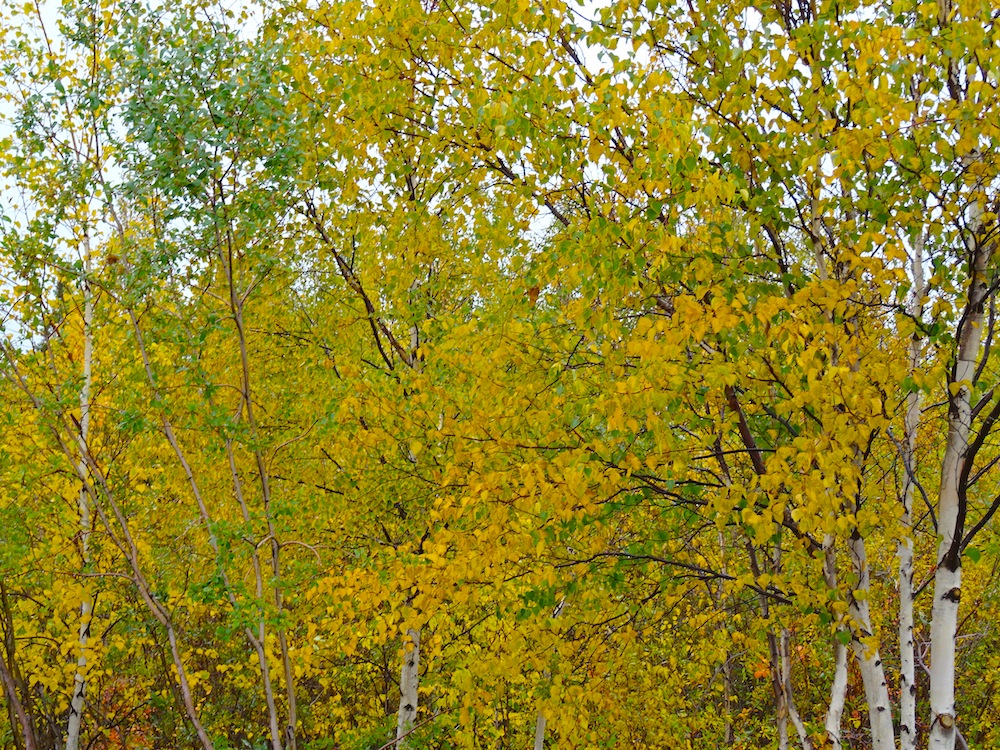
    The birch trees turn a bright yellow colour at this time of year, reminding me of Finland. (PHOTO BY JANE GEORGE)

  • visit the Prince of Wales Northern Heritage Centre; and,
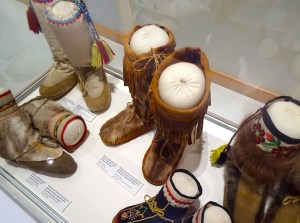
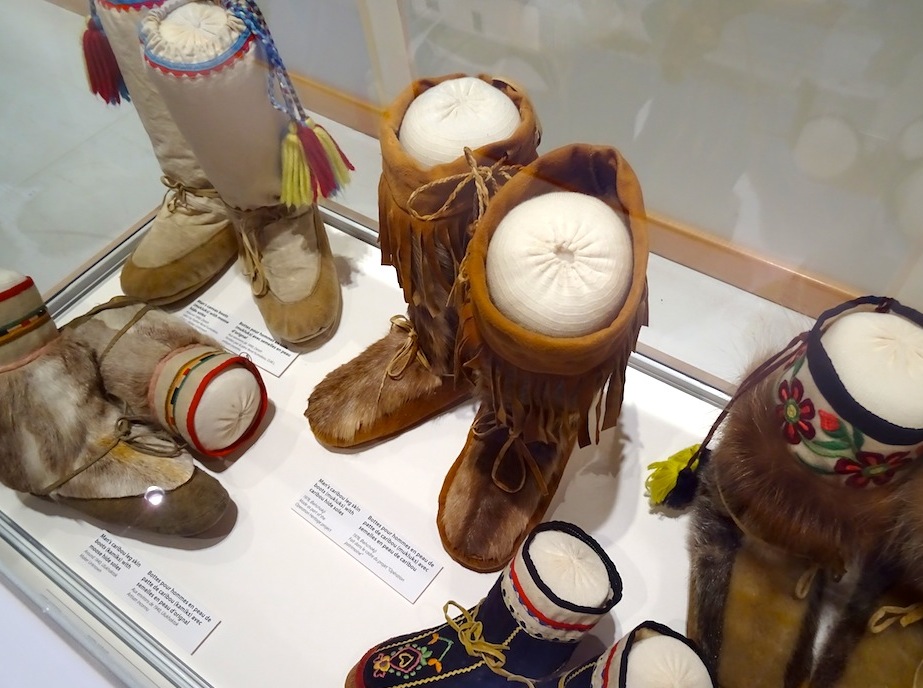
    A display of northern footwear at the Prince of Wales Norther Heritage Centre. (PHOTO BY JANE GEORGE)

    A display of northern footwear at the Prince of Wales Norther Heritage Centre. (PHOTO BY JANE GEORGE)

  • eat some Ethiopian food at a recently-opened restaurant.

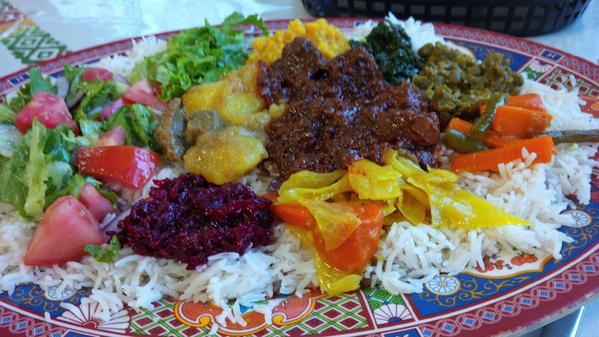
    A mixed platter at the Zehabesha restaurant in Yellowknife. (PHOTO BY JANE GEORGE)
    A mixed platter at the Zehabesha restaurant in Yellowknife. (PHOTO BY JANE GEORGE)
You can also sample a variety of fast-foods, drink all the Tim Horton’s coffee you want or drive on paved roads with stop-lights.

You’ll also see buses, recycling bins, trash cans — in short, a lot of the service trappings of a fully-functional southern Canadian city.

You might think that this makes Yellowknife a better to live than colder, treeless and expensive Nunavut, but this makes it even more scary in my opinion that in Yellowknife, because there are no newspapers, many residents don’t know what’s going on outside the city — unless they listen to the radio and watch television.

In any case, they’re basically shortchanged of access to a news medium that, despite its financial challenges, is still thriving and which Canadians living in territorial and provincial capitals take for granted.

Is this your first time reading this blog? If so, check out earlier posts, including my “Like an iceberg” series on being a journalist in the Arctic during the 1990s. You can find all the links to that here.
Part 5: You know you’ve never been to Iqaluit/Frobisher Bay when…

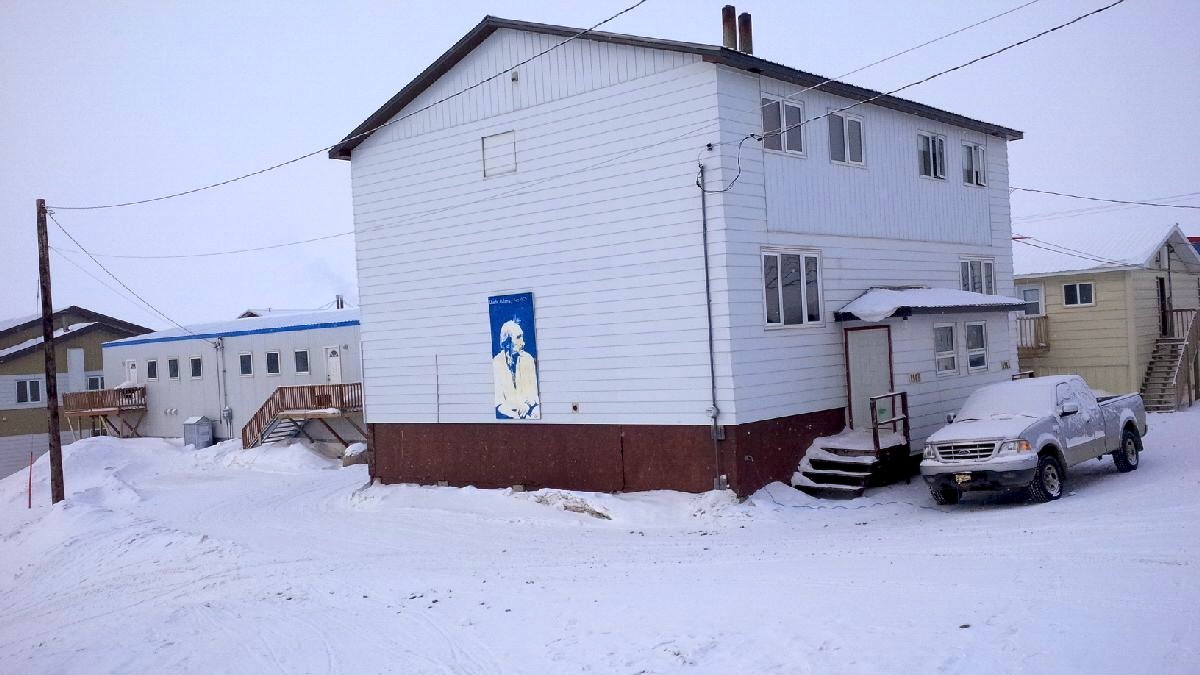
In my last blog post, you heard about some of the images on building walls around Iqaluit that show representations of people I have known or written about, such as singers Susa Aningmiuq and Jimmy Ekho. And, on another wall-image, there’s Nunavik singer and songwriter Charlie Adams, who died in 2008.

Charlie Adams as you walk towards Arctic Ventures. (PHOTO BY JANE GEORGE)

Charlie Adams as you walk towards Arctic Ventures. (PHOTO BY JANE GEORGE)

Charlie was 55 when he died in a Montreal hospital from complications related to injuries he had suffered in an accident in 2004.

But, before that, over a 30-year career, Charlie played at numerous music festivals throughout the eastern Arctic. He also toured the United States, England and the Netherlands where he performed for Queen Juliana. Adams was generous with his talent. Travellers (me, included) stuck at Iqaluit’s airport back during a February 1994 blizzard can recall how Charlie lifted our spirits by pulling out his guitar and inviting everyone to sing along with him in a version of his most famous song “Quviasupunga” (I’m Happy). You can hear that well-loved song here.

In 2003, Charlie also played and panhandled for spare change in Montreal, where he lived homeless and slept on the streets. Then, in July 2004, he suffered a near-fatal accident when a car drove over him while he lay in an alley. “I was lying there sleeping. The first wheel passed over me and I started yelling to the guy because I’m in pain and all that, and the second wheel stopped right on top of my stomach,” Charlie told me by telephone from his hospital bed in Montreal following the accident. “The first wheel broke my pelvis, and my intestines went out through my rectum and my stomach.” I think of Charlie, the gentle, talented singer, on my walk to work.

Then, there’s a striking mural, painted by Craig Clark, on the wall of the late Iqaluit Mayor Jimmy “Flash” Kilabuk’s house. I remember when it was mounted in 1998 just before the Arctic Council ministerial held that year, an informal get-together in the Anglican Parish Hall that was quite unlike the security-laden, heavily scripted event of this past April.

Jessie Oonark, Father Mary and Abe Okpik. (PHOTO BY JANE GEORGE)

Jessie Oonark, Father Mary and Abe Okpik, painted by Craig Clark. (PHOTO BY JANE GEORGE)

The three huge panels — eight feet by seven and a half feet — feature portraits of famed Baker Lake artist Jessie Oonark, Pond Inlet’s long-time priest and historian, Father Guy-Marie Rousellière, and community leader Abe Okpik. Okpik, who died in 1997, was active in getting relief to Inuit in the 1950s and 1960s. He also worked on Project Surname, which brought names, instead of disc numbers, to Inuit in the eastern Arctic. When I spoke to Okpik in the early 1990s, he gave me a leather duplicate of the E-disc he had worn. I recall he was gracious and took time to explain everything to a young reporter, who didn’t then realize what an historic role he had played in the eastern Arctic. Thank you, Abe, for your time. It was an honour to meet you.

Ataata Mary, known for his exhaustive research on Inuit history and language, died in a fire in 1994,  two weeks before I arrived  for my first visit to Pond Inlet. I later read many of the works that he had published, and picked up some at second-hand book stores: they’re now at the May Hakongak Library in Cambridge Bay with the rest of my collection of Arctic books.

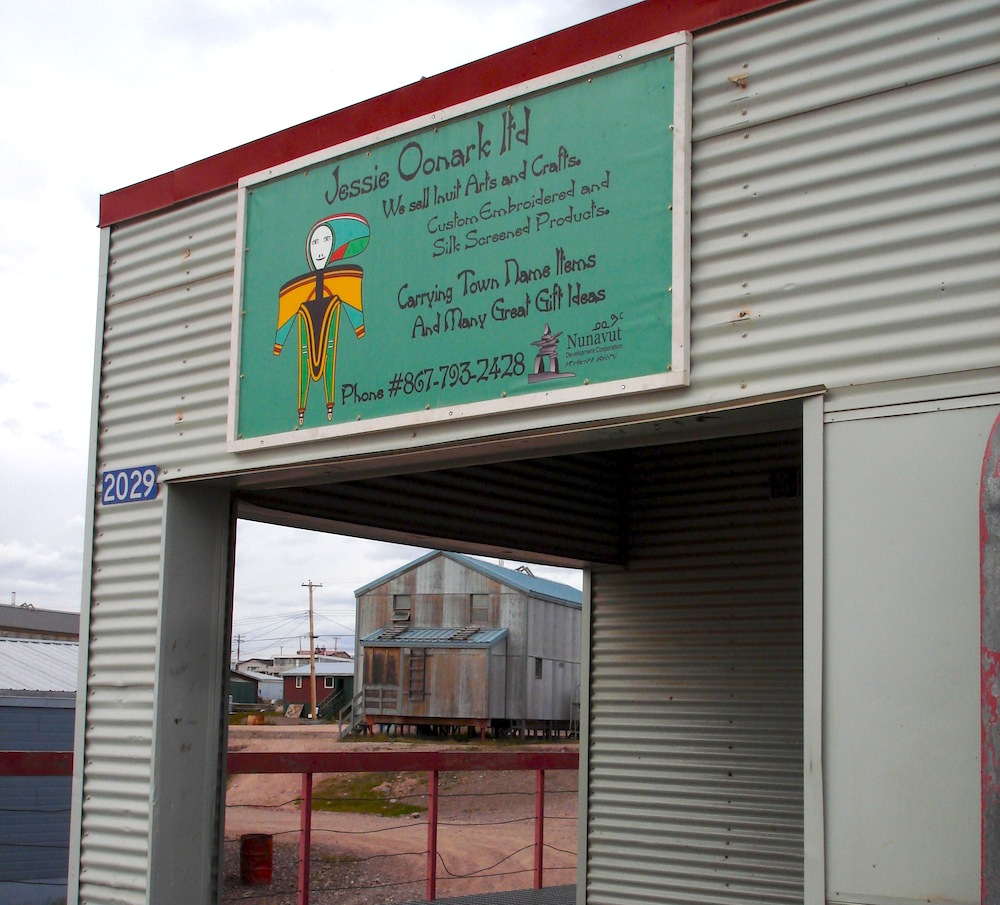
Jessie Oonark Ltd. in Baker Lake. (PHOTO BY JANE GEORGE)

Jessie Oonark Ltd. in Baker Lake. (PHOTO BY JANE GEORGE)

I never met Oonark, who died in 1985, but I spent many hours in the Nunavut legislature during sessions, looking at a colourful wall-hanging that she had stitched of geese going in many directions at once,  which was on display in the chamber. And, in 2009, I visited Baker Lake, where I stopped by the arts and crafts centre that bears her name.

This wraps up my little introduction to the people whose images you can see on the buildings around Iqaluit.

Did you read my other posts about Iqaluit? You can find all the links here: Part 4: You know you’ve never been to Iqaluit/Frobisher Bay when… And are you curious about the Canadian Arctic of the 1990s? You will want to read my “Like an iceberg” series of blog posts. You can find all the links here.