The federal election, Nunavut-style

No one looks to Nunavut’s sprawling federal riding for a bellwether community to predict voter tendencies during an election — but if there were such a Nunavut community to look at during this past federal election, it would have been Cambridge Bay.

It was in this western Nunavut town that former Nunavut MP and Conservative cabinet minister Leona Aglukkaq started her political career as a hamlet councillor In 2011, she easily carried the community — and Nunavut —  in the same way that the Tories won the national vote.
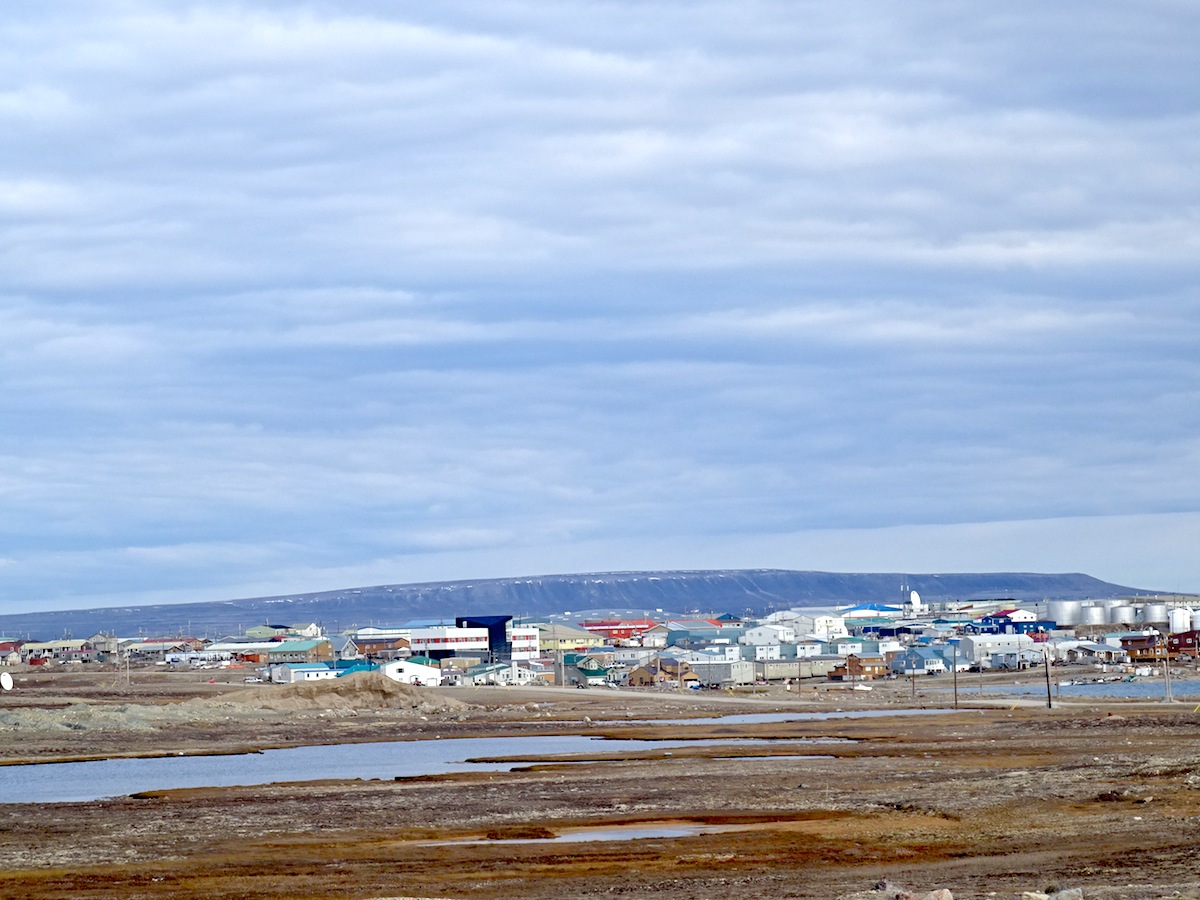
This is how Cambridge Bay, population 2,000, looked in mid-September, with Mt. Pelly, 20 kilometres away, peering from behind. (PHOTO BY JANE GEORGE)

This is how Cambridge Bay, population 2,000, looked in mid-September, with Mt. Pelly, 20 kilometres away, peering from behind. (PHOTO BY JANE GEORGE)

Cambridge Bay, which is never short of news (and previous blog post inspiration) and where I have many friends, seemed like a good place to sit out this federal election.

So I arrived in Cambridge Bay on Sept. 13 and left Oct. 20, the day after the votes were counted.

In Cambridge Bay on Oct. 19, voters decided to support Liberal candidate Hunter Tootoo and the New Democratic Party’s Jack Anawak, leaving the Tories and Aglukkaq in third place in Cambridge Bay (361 for Tootoo, 170 for Anawak, 164 for Aglukkaq and 10 for the Green party.)

How the Oct. 19 vote would shape up in Cambridge Bay became clear to me over the weeks as I watched the scenery change and the ice solidify — like opinions among voters.

When I arrived, Cambridge Bay was still in the last days of its longer-than-usual summer. Then, the days became colder.

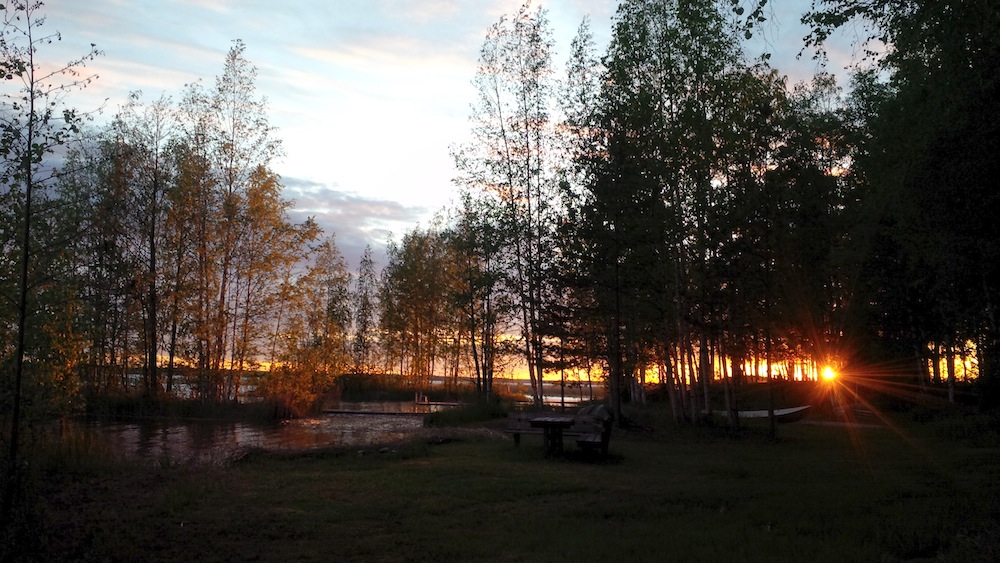
Sunset in October by the shore. (PHOTO BY JANE GEORGE)

Sunset in October by the shore. (PHOTO BY JANE GEORGE)

One afternoon I spotted a field of frost flowers, spreading over the thin ice.
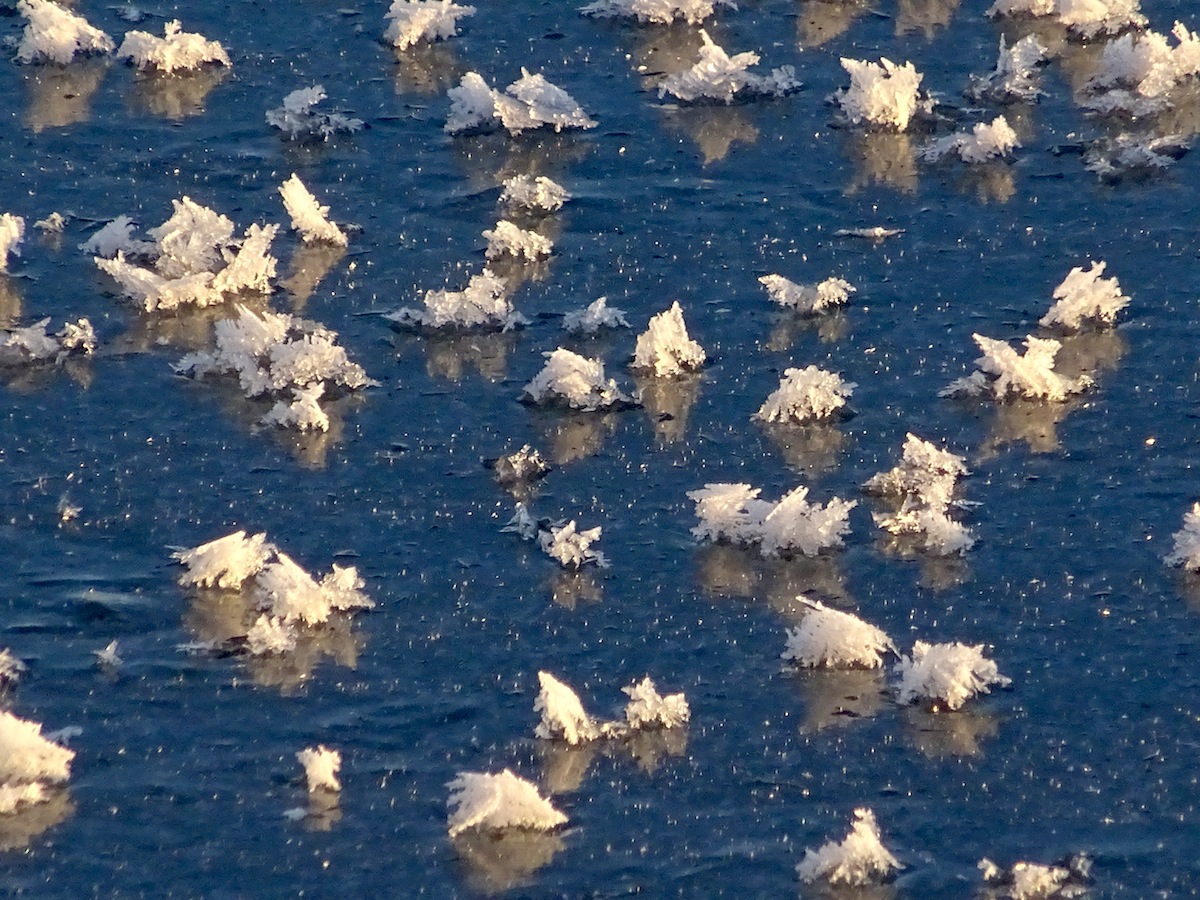
I spotted this frost flowers — formed when conditions are calm and there's a 15 C temperature difference between the air and the water. (PHOTO BY JANE GEORGE)

I spotted these frost flowers — formed when conditions are calm and there’s a 15 C temperature difference between the air and the water. You can see the field in the top of this post. (PHOTO BY JANE GEORGE)

A view to Mt. Pelly in October at sunset. (photo by JANE GEORGE)

A view to Mt. Pelly in October at sunset. (photo by JANE GEORGE)

The sunsets began to turn unreal shades, with a layer of bright pink mist over a darker blue sky.

In mid-October, the weather turned even colder, just around the time when Liberal leader (and now Prime Minister) Justin Trudeau visited Iqaluit.

There, among other things, he served up stew to hungry people at a community feast.

In Cambridge Bay, everything iced up and the foxes started to turn white.

A fox scampers across the ice in mid-October. (PHOTO BY JANE GEORGE)

A fox scampers across the ice in mid-October. (PHOTO BY JANE GEORGE)

Meanwhile, the three main party candidates also visited Cambridge Bay to campaign — Aglukkaq keeping a low profile, but the Liberals’ Tootoo and the NDP’s Anawak getting out and meeting people.

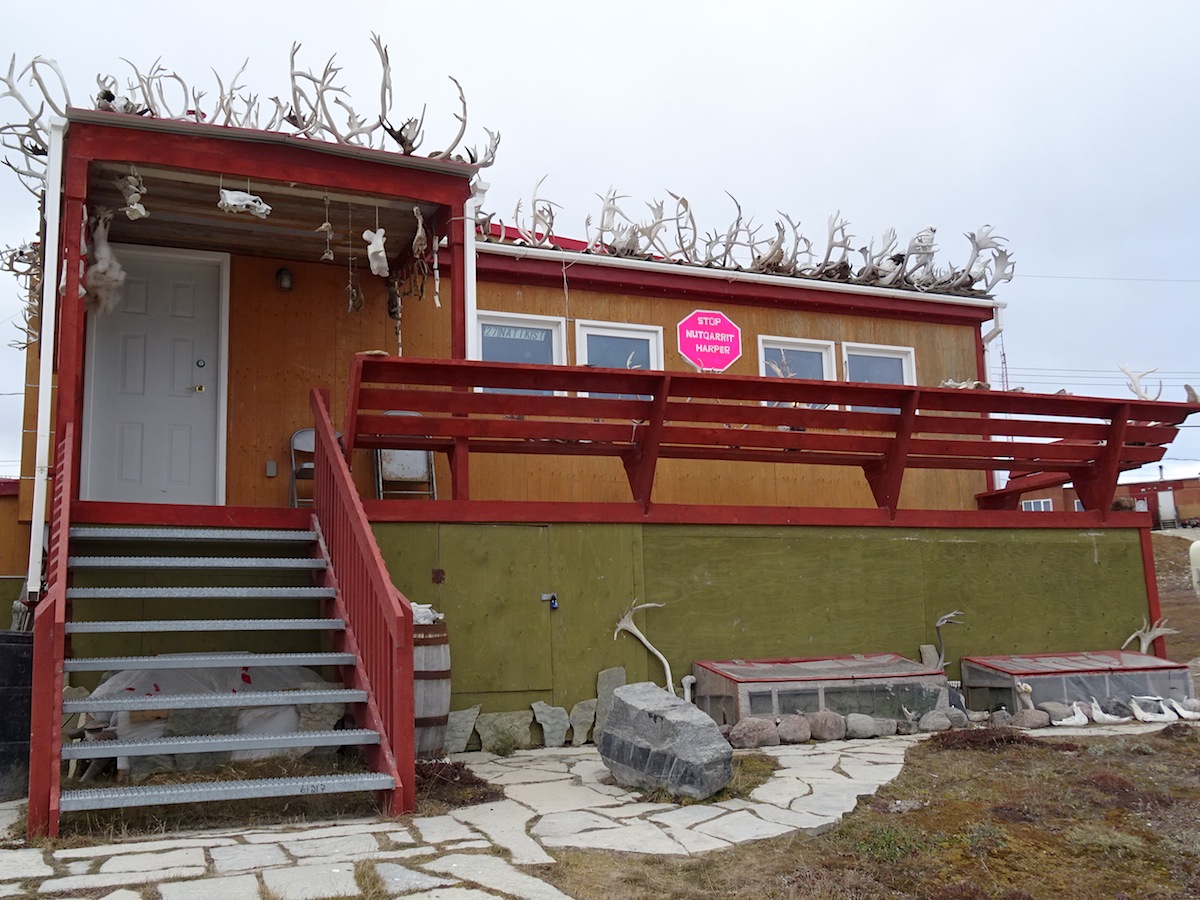
Signs for Tootoo cropped up over town. A homeowner kept a “Stop Harper/ Nutqarrit” sign posted on his house.
The

The “Stop Harper” sign is bilingual, with “Nutqarrit” meaning “stop” in Inuinnaqtun. (PHOTO BY JANE GEORGE)

Students at the local high school voted for the NDP in mock election. And many people talked to me about wanting change.

I decided to write a story for the Nunatsiaq News Oct. 18 about the the mood in Cambridge Bay, and that this Tory stronghold was leaning to the Liberals and NDP,  as story which you can read here.

And on election day I went to the community hall to speak to voters after they cast ballots. I took a photo of elders after they came to vote, a photo that circulated among thousands of people on Twitter.

A

A “This is how we vote in Canada” tweet, along with this photo, from Nunatsiaq News’ managing editor Lisa Gregoire saw my photo of elders circulate among thousands of people. (PHOTO BY JANE GEORGE)

I was careful to tell everyone I spoke to who I was (if they didn’t know me) and ask them only why they felt it was important to vote — not who they voted for.

A couple with a small child told me “we need help.” The North is crying out for help, they said, because they can’t survive on the $1,300 they receive every month from social assistance. “There’s nowhere to turn for help,” they said.

And the cost of food is so high that why said they couldn’t afford even a pound of hamburger, so they and others turn to the dump to scavenge for food.

I didn’t have to ask which party they voted for.

Throughout the day a steady stream of voters came to vote — and the numbers would show later that, while Aglukkaq held on to her vote from 2011, turnout increased, and three times as many voters in Cambridge Bay came out to support the Liberals and the NDP than the Tories.
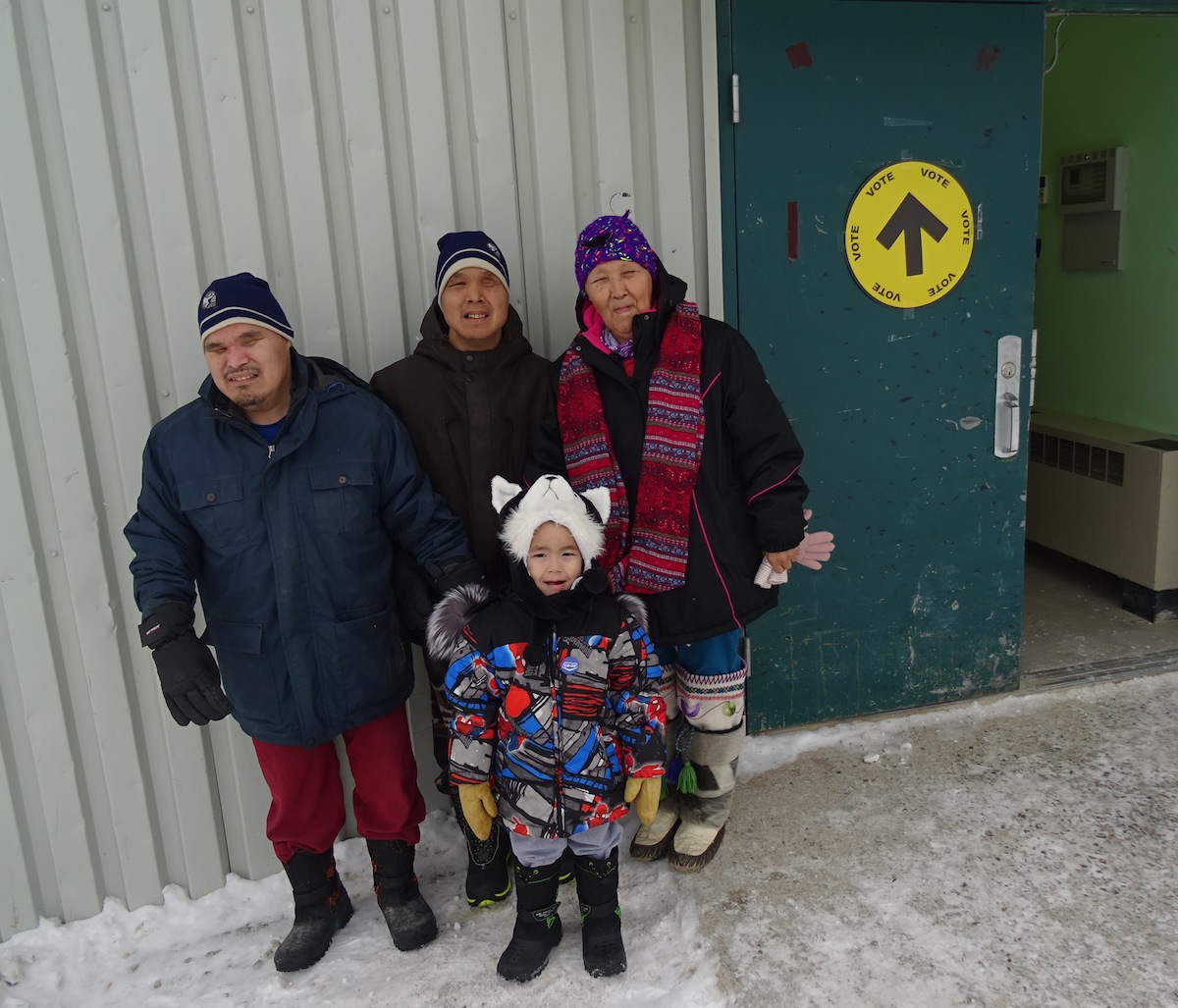
I helped my friend Eva Kakolak Avadluk bring her two sons, Anthony and Ashlee, who are blind to the polling station so they could vote, using Braille ballots. (PHOTO BY JANE GEORGE)

I helped my friend Eva Kakolak Avadluk bring her two sons, Anthony and Ashlee, who are blind, to the polling station so they could vote using Braille ballots. (PHOTO BY JANE GEORGE)

So, more than 500 voters were happy Oct. 20 — but not Aglukkaq’s friends and supporters. One woman wrote me a couple of unpleasant messages and then a comment on Facebook — that made me think again how it’s much harder to report the news in Canada’s North than not.

After I posted the photo of my friends on my Facebook feed, I received this comment Oct. 20 from a friend and supporter of the former Nunavut MP Leona Aglukkaq.

After I posted the photo of my friends voting on my Facebook feed, I received this comment Oct. 20 from a friend and supporter of the former Nunavut MP Leona Aglukkaq.

I was able to delete the comment and block the woman on Facebook: sort of a solution.

But I was reminded again that, in a small Arctic community, you live beside people who may dislike you and bully you into being quiet — a tough situation for people who can’t leave (but one I saw in the 1990s and you can read about here or in a recent two-part series by Nunatsiaq News reporter Thomas Rohner).
Mitä olen oppinut Suomessa … what I learn in Finland

I’m in Finland for two weeks, from May 31 to June 13.

And it’s not my first time in this Arctic country, located around the top of the world from northern Canada: when I was young I lived there and learned the language, which I talked about in an earlier “date.”

But here’s what I have learned so far during this trip — which I didn’t really expect to learn:

After years working as a broadcaster and journalist, I finally understand something I’ve been told, retold and then retold to others — that if you are writing a story about an issue, make it a story about people.

How do I finally really understand why this is so important?

Well, my reading skills in Finnish are at about a Grade Six level, so suddenly I’m in the situation of a person with low literacy.

But when I’m in Finland, I still try to practice reading.

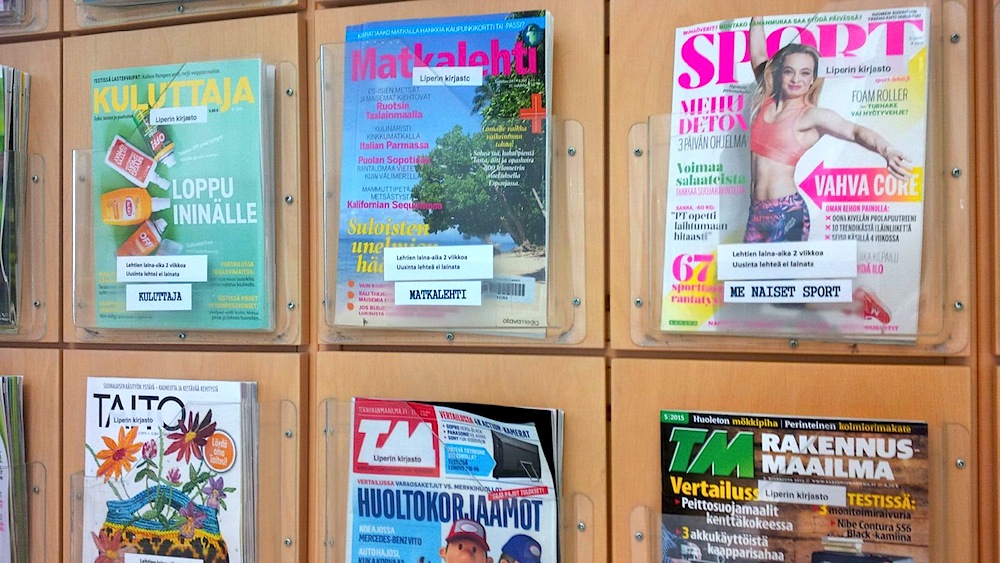
A selection of magazines that can be borrowed from a library in Finland. (PHOTO BY JANE GEORGE)

A selection of magazines that can be borrowed from a library in Finland. (PHOTO BY JANE GEORGE)

Here’s the kind of stories I read at first:

• a 22-year-old Finnish man is killed in Goa, India under mysterious circumstances;

• a couple’s premature baby struggles to survive;

• a woman who is overweight becomes a chaplain and then discovers she’s gay;

• Finnish celebrities, whose names mean nothing to me, talk about their divorces, affairs, tattoos, etc.; and,

• people who own and renovate a typical Finnish “mökki” or cottage show what they did.

Why do I read these? Because people-oriented stories are easier to read and far more interesting than others.

As my reading skills improve, I start to read stories about politics (Russia’s close presence makes Finns very nervous) and climate change (a journalist from the Helsingin Sanomat newspaper goes to California, where he finds a Finnish woman who talks about the state’s water crisis.)

If you want to buy Karelian patties, here's the place: but it still helps to know what the Finnish says. (PHOTO BY JANE GEORGE)

If you want to buy Karelian patties, here’s the place: but it still helps to know what the Finnish says. (PHOTO BY JANE GEORGE)

In the Nunatsiaq News, people stories also prove to be more popular — for readers, whose first language is often not English.

But we also have to encourage people to improve their reading skills, like me, so they’ll dare to read a story about something else, such as climate change, or even international politics.

Here’s what else I learn:

My brain keeps a lot of Finnish somewhere on its back-burner — but using the language and immersing myself in it is the key to bringing this out.

When I get on the airplane to go to Helsinki, I hear people speaking Finnish and the language sounds so strange, like Klingon almost… and yet, somehow, I understand it. But can I speak it after a year?

I don’t even ask the flight attendants for drinks in Finnish.

On Day One, I wish I’d brought a Finnish-English dictionary along as I stumble over the simplest explanations; by Day Two, I am able to baby-talk Finnish.

Someone asks me for directions on Day Three and I can answer. although I don’t know where they should go.

It's easy to stay up late when the sun doesn't set. (PHOTO BY JANE GEORGE)

It’s easy to stay up late when the sun doesn’t set. (PHOTO BY JANE GEORGE)

By Day Four I stay up with friends, until the sun is almost at the horizon (and ready to rise again.) I’m talking and making jokes in Finnish, with half-remembered  verbs somehow appearing again — verbs like cut down, suggest, disappear or suffer.

I also relearn, among many other words, the following: dandelion, rainbow, otter, design, crow, insurance, wheelbarrow and pine cone.

On Day Five I still look for right endings when faced with saying things like “in the house of my friend’s brother”  — ystäväni veljen talossa. Television, where everyone speaks fast, starts to make more sense, and I start to read magazine and newspapers more easily.

I talk to myself in Finnish sometimes and random words pop into my brain. Finnish now longer feels strange but more like the rushing water of a brook that I usually think about when I’m listening to Finnish or speaking it.

I wish I had more than two weeks here — what would that do for my language skills? I wish I had that same fluency in Inuktitut, which I’ve spent more than 20 years trying to learn. And I wish there were easy-to-read celebrity magazines in Inuktitut and more things that I would want to read — in Roman orthography.

Mint, lime, cucumber drink is a find from a Finnish magazine. (PHOTO BY JANE GEORE)

Mint, lime, cucumber drink is a find from a Finnish magazine. (PHOTO BY JANE GEORGE)

My best find from a Finnish magazine: a recipe for a cucumber-lime-mint drink.

Here’s how to make it:

Cut up four limes into circles and mash them in a bowl.

Add a bunch of fresh mint and continue to mash it up.

Press out the juice through a sieve. Put the juice in with a chopped up cucumber (English) into a blender.

The result is very green.

Kippis (cheers)