Mitä olen oppinut Suomessa … what I learn in Finland

I’m in Finland for two weeks, from May 31 to June 13.

And it’s not my first time in this Arctic country, located around the top of the world from northern Canada: when I was young I lived there and learned the language, which I talked about in an earlier “date.”

But here’s what I have learned so far during this trip — which I didn’t really expect to learn:

After years working as a broadcaster and journalist, I finally understand something I’ve been told, retold and then retold to others — that if you are writing a story about an issue, make it a story about people.

How do I finally really understand why this is so important?

Well, my reading skills in Finnish are at about a Grade Six level, so suddenly I’m in the situation of a person with low literacy.

But when I’m in Finland, I still try to practice reading.
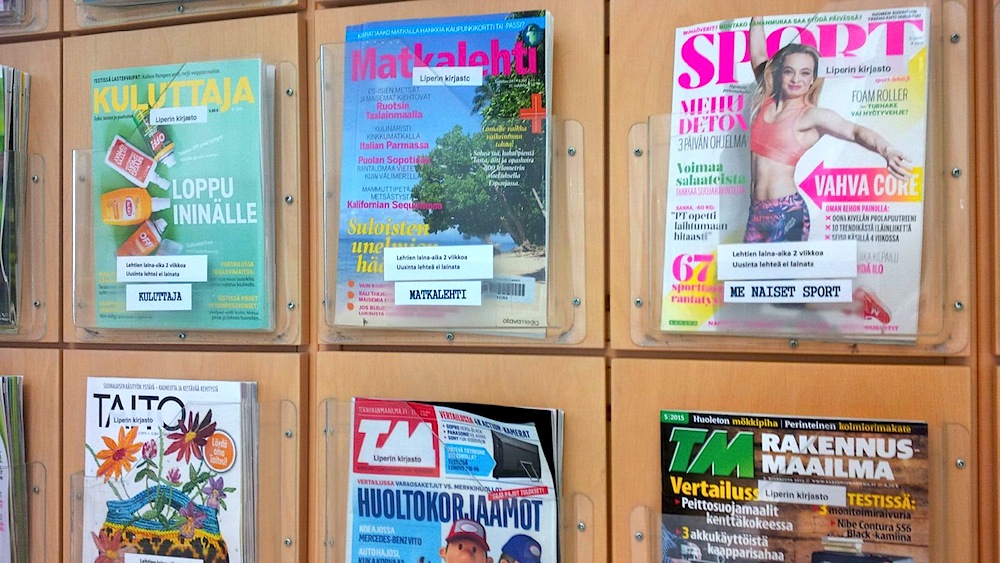
A selection of magazines that can be borrowed from a library in Finland. (PHOTO BY JANE GEORGE)

A selection of magazines that can be borrowed from a library in Finland. (PHOTO BY JANE GEORGE)

Here’s the kind of stories I read at first:

• a 22-year-old Finnish man is killed in Goa, India under mysterious circumstances;

• a couple’s premature baby struggles to survive;

• a woman who is overweight becomes a chaplain and then discovers she’s gay;

• Finnish celebrities, whose names mean nothing to me, talk about their divorces, affairs, tattoos, etc.; and,

• people who own and renovate a typical Finnish “mökki” or cottage show what they did.

Why do I read these? Because people-oriented stories are easier to read and far more interesting than others.

As my reading skills improve, I start to read stories about politics (Russia’s close presence makes Finns very nervous) and climate change (a journalist from the Helsingin Sanomat newspaper goes to California, where he finds a Finnish woman who talks about the state’s water crisis.)

If you want to buy Karelian patties, here's the place: but it still helps to know what the Finnish says. (PHOTO BY JANE GEORGE)

If you want to buy Karelian patties, here’s the place: but it still helps to know what the Finnish says. (PHOTO BY JANE GEORGE)

In the Nunatsiaq News, people stories also prove to be more popular — for readers, whose first language is often not English.

But we also have to encourage people to improve their reading skills, like me, so they’ll dare to read a story about something else, such as climate change, or even international politics.

Here’s what else I learn:

My brain keeps a lot of Finnish somewhere on its back-burner — but using the language and immersing myself in it is the key to bringing this out.

When I get on the airplane to go to Helsinki, I hear people speaking Finnish and the language sounds so strange, like Klingon almost… and yet, somehow, I understand it. But can I speak it after a year?

I don’t even ask the flight attendants for drinks in Finnish.

On Day One, I wish I’d brought a Finnish-English dictionary along as I stumble over the simplest explanations; by Day Two, I am able to baby-talk Finnish.

Someone asks me for directions on Day Three and I can answer. although I don’t know where they should go.
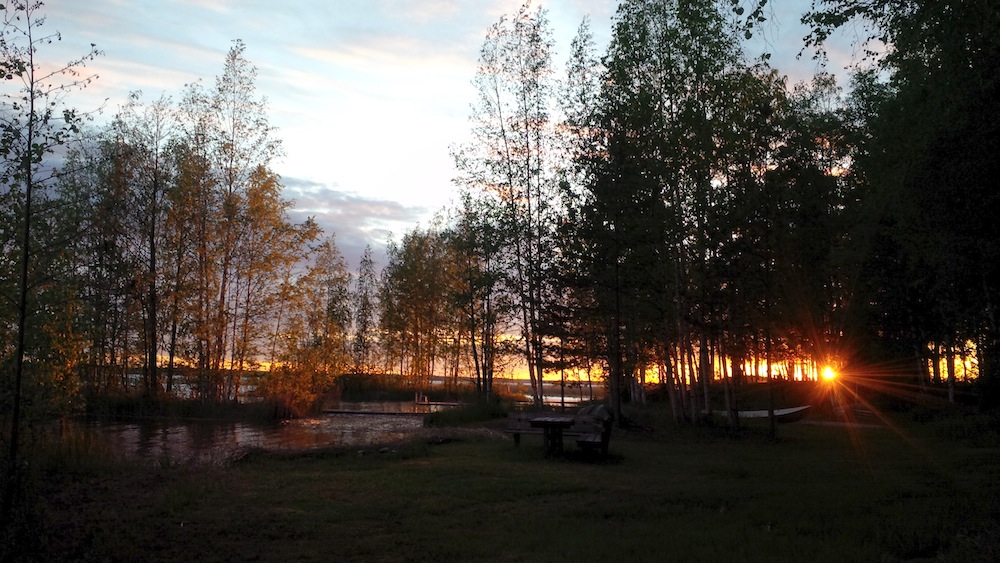
It's easy to stay up late when the sun doesn't set. (PHOTO BY JANE GEORGE)

It’s easy to stay up late when the sun doesn’t set. (PHOTO BY JANE GEORGE)

By Day Four I stay up with friends, until the sun is almost at the horizon (and ready to rise again.) I’m talking and making jokes in Finnish, with half-remembered  verbs somehow appearing again — verbs like cut down, suggest, disappear or suffer.

I also relearn, among many other words, the following: dandelion, rainbow, otter, design, crow, insurance, wheelbarrow and pine cone.

On Day Five I still look for right endings when faced with saying things like “in the house of my friend’s brother”  — ystäväni veljen talossa. Television, where everyone speaks fast, starts to make more sense, and I start to read magazine and newspapers more easily.

I talk to myself in Finnish sometimes and random words pop into my brain. Finnish now longer feels strange but more like the rushing water of a brook that I usually think about when I’m listening to Finnish or speaking it.

I wish I had more than two weeks here — what would that do for my language skills? I wish I had that same fluency in Inuktitut, which I’ve spent more than 20 years trying to learn. And I wish there were easy-to-read celebrity magazines in Inuktitut and more things that I would want to read — in Roman orthography.

Mint, lime, cucumber drink is a find from a Finnish magazine. (PHOTO BY JANE GEORE)

Mint, lime, cucumber drink is a find from a Finnish magazine. (PHOTO BY JANE GEORGE)

My best find from a Finnish magazine: a recipe for a cucumber-lime-mint drink.

Here’s how to make it:

Cut up four limes into circles and mash them in a bowl.

Add a bunch of fresh mint and continue to mash it up.

Press out the juice through a sieve. Put the juice in with a chopped up cucumber (English) into a blender.

The result is very green.

Kippis (cheers)

Part 2: You know you’ve never been to Iqaluit/Frobisher Bay when…

Will I be happy in Happy Valley? Is everyone happy here?

Happy Valley, Iqaluit, March, 2015. (PHOTO BY JANE GEORGE)

Happy Valley, Iqaluit, March, 2015. (PHOTO BY JANE GEORGE)

That’s the name of the neighbourhood in Iqaluit where I’m staying. Despite its name, it seems no more happy than any other area in this city, which has known more than its share of change and loss.

And the “happy” valley has now been filled by houses.

As I walk to town, the view on the clear sunny days, which are now the norm for this month of April, includes the  Creekside Village housing complex.

Creekside Village, Iqaluit, March 2015. (PHOTO BY JANE GEORGE)

Creekside Village, Iqaluit, March 2015. (PHOTO BY JANE GEORGE)

The Creekside blocks, known informally as “White Row housing,” built  back in the 1970s, hug the space between the hill and the road circling the centre of Iqaluit. An entire building burned down in February 2012 and I stood there in minus 50 C temperature until 3 a.m. watching the fire, which took two lives and left 300 temporarily homeless.

Fire ravages the block of Creekside Village housing in Iqaluit, Feb. 27,  2012. (PHOTO BY JANE GEORGE)

Fire ravages the block of Creekside Village housing in Iqaluit, Feb. 27, 2012. (PHOTO BY JANE GEORGE)

Ash, probably toxic, rained down on me but I didn’t notice.

Three weeks after that deadly fire, grieving friends and family said goodbye to the two siblings who died in the blaze, Andrew Papatsie, 27, and Connie Papatsie, 25, at a joint funeral in the Cadet Hall.

Wreaths of artificial and — rare in cold Iqaluit — real arrangements of flowers overflowed atop a nearby table.

During the bilingual service, retired Anglican minister Mike Gardener tried to comfort the assembled, saying their presence would be a “great help” to the Papatsie family. Hymns sung during the service, “There is a happy land,” “Blessed assurance, “Abide with me,” and “God leads us along,” also carried messages of comfort.

But, during and after the final hymn, at the repeated line of “God leads his dear children along,” many broke down in tears…

It was not easy to cover this event. And the context of the changed city scenery sticks with me as I walk around today.

This is how the still smoking site of the Feb. 27 fire looked in early March of that year. (PHOTO BY JANE GEORGE)

This is how the still smoking site of the Feb. 27 fire looked in early March of that year. (PHOTO BY JANE GEORGE)

Down the hill towards the beach lies the Nunatsiaq News newspaper office: formerly a pharmacy, and a far cry from the cigarette-smoke filled building where the staff worked when I met first them in the early 1990s.

This blue building houses the office of the Nunatsiaq News. (PHOTO BY JANE GEORGE)

This blue building houses the office of the Nunatsiaq News. (PHOTO BY JANE GEORGE)

But, on this 2015 tour, let’s just backtrack a bit — to a noteworthy Arctic dome, which I forgot about in a previous blog post. Although it’s not geodesic, this dome is probably the most beautiful building in the city today. You will be able to judge for yourself that later when I show some of the other photos of what passes for architecture in future blog posts.

It’s the St. Jude’s Anglican Cathedral, which famously burned by arson in 2005 and was then rebuilt for about $8 million. The new, metal clad dome is much larger — and likely far more fire-resistant — than the iconic, white-domed, wooden building from the 1970s.

St. Jude's Anglican Cathedral in Iqaluit. (PHOTO BY JANE GEORGE)

St. Jude’s Anglican Cathedral in Iqaluit. (PHOTO BY JANE GEORGE)

And if you’re looking for some welcome spiritual renewal or just something to do on Sunday in Iqaluit, it’s also the place to admire the building’s structure. Inside the nave, where the congregation sits, you can look straight up more than 40 feet high into the skylight.

This is how St, Jude's looked before it burned down in 2005. (HANDOUT PHOTO)

This is how St. Jude’s looked before it burned down in 2005. (HANDOUT PHOTO)

On Palm Sunday that’s where I end up, listening to songs by the red-amauti-clad Inuksuk high school choir. I’m also in for a welcome surprise: Rev. Gardener, whose voice always manages to be both melodic, comforting and authoritative in English and Inukitut, is serving as minister.

Rev. Mike Gardener, March 28, in  today's St. Jude's Anglican Cathedral. (PHOTO BY JANE GEORGE)

Rev. Mike Gardener, March 28, in today’s St. Jude’s Anglican Cathedral. (PHOTO BY JANE GEORGE)

During the service, he encourages children to wave their palm fronds and asks them what animal Jesus rode: not a camel or a whale, but a donkey.

Soon the service is over. It’s back out into the bright light of a cold Sunday and more walks around the city.

Did you read my first post about Iqaluit?

You know you’ve never been to Iqaluit/Frobisher Bay when…

Curious about the Canadian Arctic of the 1990s? You will want to read my Like an iceberg series of blog posts. You can find all the links here.

VIEW OF ST. JUDES