Like an iceberg, 1997, “Qaggiq” cont.

Like an iceberg, 1997, “Qaggiq” cont.

At midday, as the month of January progressed in Igloolik, the white landscape lit up with the sun, although the full moon was still visible far up in the sky. The Return of the Sun celebration was over and done. Finally, I could see where I was going.
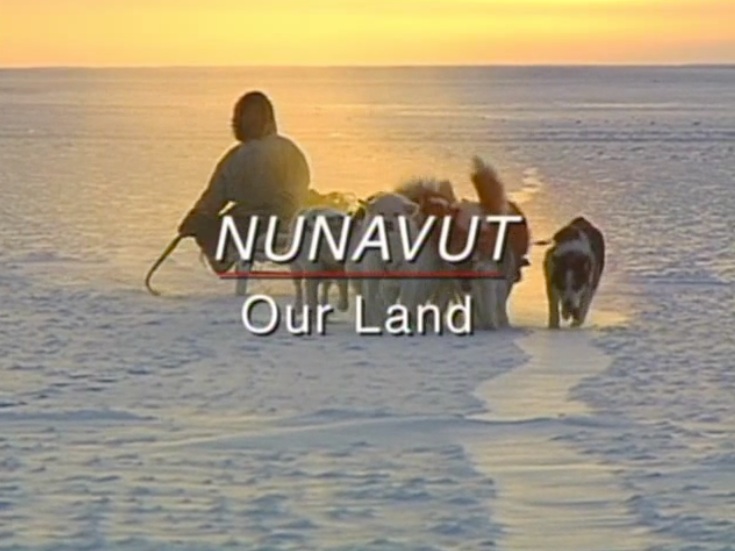
Images leading into each episode of Nunavut: Our Land

Images leading into each episode of Nunavut: Our Land

Kept from leaving Igloolik by storm after storm, I had lots of time prepare other stories: I met Zacharias Kunuk, producer and director of the 13-part, 1995 series Nunavut: Our Land, whose 2001 Inuktitut-language feature film Atanardjuat would go on to win many awards.

Nunavut shows long, beautiful shots of hunting and other activities around Igloolik as the series follows a group of Inuit around Igloolik in the mid-1940s through a year-long cycle.

In  episode six (which you can now watch online on Isuma TV) the action takes place in the spring of 1946.

It's time for tea in episode six of Nunavut: Our Land

It’s time for tea in episode six of Nunavut: Our Land

“It is the season of never-ending days. Two dog teams searching the spring ice, men and boys hunting day and night. Seals are everywhere: at the breathing holes, sleeping under the warm sun.”

Such images had helped draw me to Igloolik.

And, for me, the opening shots of Nunavut, with the dogs steaming ahead over the ice, always seemed to capture all the energy of moving towards the new territory’s creation in 1999.

When I met Kunuk in his Isuma Igloolik office building, he was not yet that well-known outside the North, where Nunavut had been broadcast on northern television networks.

We talked about how Kunuk first got started in film — by recording elders on a hand-held video cam.

“I didn’t think that when I videotaped something, five years [later], they’re dead and you still see their image talking. That’s when I got it — that it’s very important to record them now, because what they’re saying is going to become important years down the road,” Kunuk said.

His first real film production in 1988 was called Qaggiq, about a drum dance celebration in a big igloo.

Working with elders on Qaggiq, which required repeated takes, was not always easy.

“You have to do it again and again. There’s an old lady inside an igloo, and my job is to have her do it again. We don’t normally order our elders, but this time, we’re saying, ‘do it again,'” Kunuk said.

There was no script, no set dialogue. Everything was based on an “idea,” Kunuk told me.

“Back before we got this new way of living, pop and chocolate bars, our parents used to tell us legends and that was like being in the movies. It’s always here. You just have to visualize it,” he said.

And, dressed in traditional clothing, the actors, all locals,  just picked up on that and improvised.

In the end, they forgot they were acting, Kunuk said, “because they’re really doing it. They’re preserving the culture. This is one way of preserving the culture.”

Opening of Nunavut: Our Land in syllabicsAt one point during the production of Nunavut, Kunuk learned a polar bear had been killed on an island, after the polar bear had been attacking hunters camping there. Kunuk got all the actors into costume and went to the scene.

“It became the best Nunavut series. It was not play. It just happened. We made the best use of it.”

But the staging sometimes required for filming didn’t bother him because “everything we see on TV is staged.”

Kunuk, who started working full-time on his films in 1991,  vowed in 1997 to make films that would be different — like his Inuktitut-language Nunavut series (now subtitled) — and which would have an “Inuk perspective.”

“To make them now is my career,” Kunuk said. “While our elders are still here, while the knowledge is here because it’s rapidly going.”

It’s all about Inuit self-respect, he said — “You have a goal. Our goal is to do it for real.”

Many films on the North and on Inuit offend him, Kunuk said. That’s because in films there’s usually a Qallunaaq (non-Inuk) who is the centre of the action. In Nunavut, a missionary (played by Kunuk’s longtime collaborator, Nunavut producer and director of photography Norm Cohn)  took on a cameo role: that was all.

“I get offended. Every time there’s a movie, Inuit get the backstage,” Kunuk said.

Producer and director of photography Norm Cohn plays a priest in Nunavut: Our Land.

Producer and director of photography Norm Cohn plays a priest in Nunavut: Our Land.

To make Nunavut the most authentic as possible, that meant building a qammaq or sod hut: “an old woman directed her family to build this. She was directing others, do this, do that. She remembered how to build it.”

Before any production, there was a lot of research, talk with elders and consultation with a cultural advisor to make sure the sets would be accurate.

“We wanted something that would stay around for a long time,” Kunuk said. “We wanted to do it. They wanted to preserve.”

The message, about maintaining traditions, can be found right there in Nunavut‘s second episode: “Igloolik, Spring 1945. Many changes have taken place. On the hill above the tents, they now find a wooden church and a priest. Sharing the fresh caribou feast, telling stories, Inuit are interrupted by the bell ringing. Inside the church the sermon is clear: Paul 4:22, ‘Turn away from your old way of life.'”

Nunavut‘s filming itself was also challenging, requiring Kunuk and the crew to run around with the heavy cameras on komatik sleds alongside the dog teams and load all their gear into boats.

Batteries and tapes often froze during filming.  Sometimes the viewfinder would stop working due to the cold, “so the camera still works, but you don’t know what you’re filming.” Boats broke down. And, during a walrus-hunting sequence for Nunavut, the camera almost fell into the water.

Kunuk’s Isuma Igloolik productions office was so cold that we then ended our conversation on that day in January 1997.

But later I thought what Kunuk wanted to do and what I wanted to do were not that different: He was set on preserving the past for the future, so Inuit would know what life was like, while I recorded the present so people would see how today fit in with what happened yesterday and what would take place tomorrow.

Read more from Like an iceberg’s “Qaggiq” May 8.

You can read earlier instalments here:

Like an iceberg: on being a journalist in the Arctic

Like an iceberg, 1991…cont.

Like an iceberg, 1991…more

Like an iceberg, 1992, “Shots in the dark” 

Like an iceberg, 1992, “Sad stories”

Like an iceberg, 1993, “Learning the language of the snows”

Like an iceberg, 1993 cont., “Spring”

Like an iceberg, 1993 cont., “Chesterfield Inlet”

Like an iceberg, 1993 cont., more “Chesterfield Inlet”

Like an iceberg, 1994: “Seals and more”

Like an iceberg, 1994, cont., “No news is good news”

Like an iceberg, 1994 cont., more “No news is good news”

Like an iceberg, 1994 cont., “A place with four names”

Like an iceberg, 1995, “More sad stories”

Like an iceberg, 1995 cont., “No place like Nome”

Like an iceberg, 1995 cont., “Greenland”

Like an iceberg, 1995, cont. “Secrets”

Like an iceberg, 1996, “Hard Lessons”

Like an iceberg, 1996 cont., “Working together”

Like an iceberg, 1996 cont., “At the edge of the world”

Like an iceberg, 1996, more “At the edge of the world”

Like an iceberg, 1996, cont. “Choices” 

Like an iceberg, 1997, “Qaggiq”

Like an iceberg, 1997, more “Qaggiq”


Like an iceberg, 1996, more “At the edge of the world”

Like an iceberg, 1996: more “At the edge of the world”

June in Pond Inlet meant going out on the land. Long wooden qamutik sleds were attached to skidoos, then lashed down with gear. They took off down Eclipse Sound, one by one.

A heavily-laden komatik pulled by a snowmobile heads out of Pond Inlet on the ice in the mid-1990s. (PHOTO BY JANE GEORGE)

A heavily-laden komatik pulled by a snowmobile heads out of Pond Inlet on the ice in the mid-1990s. (PHOTO BY JANE GEORGE)

Snowmobiling over the ice was wet business. In June 1996, when I was in Pond Inlet for my second visit, this time in late June, we plowed through pools of turquoise water with a thin layer of ice on top.

Occasionally a water-filled lead in the ice stopped our progress. When possible, we shot over it on the snowmobile. Other times, we took the qamutik and sent it over the crack first. Heavily-loaded, its back end almost tipped and fell into the water.

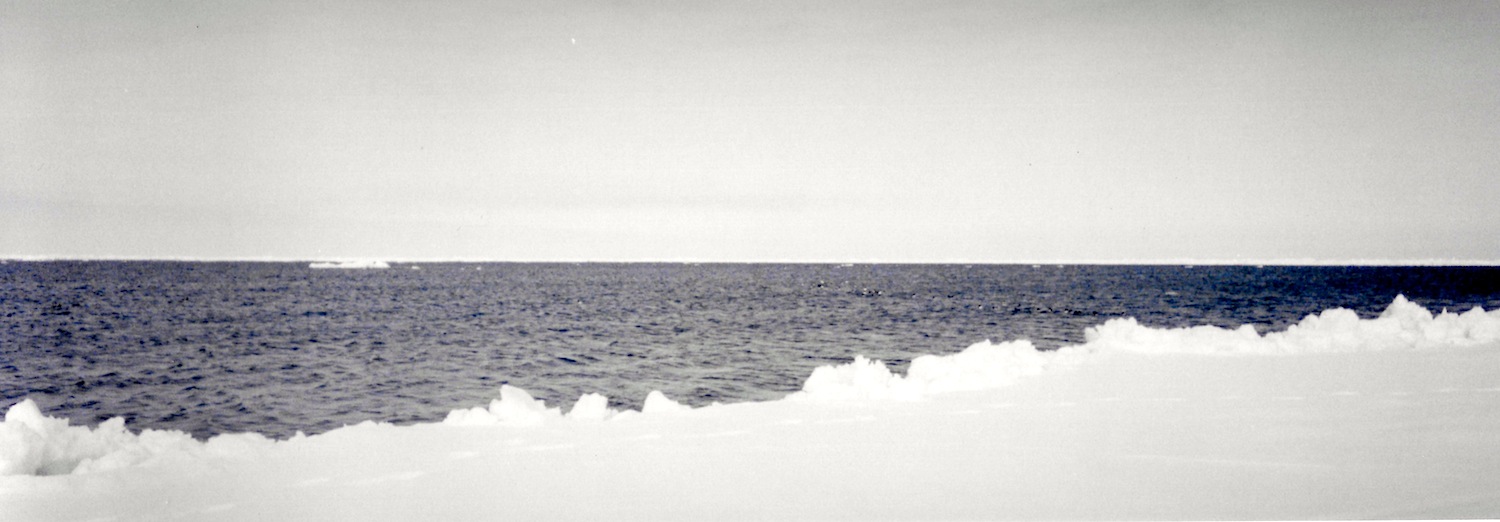
Finally, after a few hours of travel, approaching the floe edge, beyond Bylot Island, the air turned moist, and while gulls had been flying around, suddenly, there were many other birds.  The air was heavy. Steam rose from the edge where water met the ice. Reaching the floe edge was like arriving at the edge of the world. Beyond the ice, blue water seemed to go on forever, to somewhere — or nowhere.


At the flow edge off Bylot Island. Narwhals surface to the night. (PHOTO BY JANE GEORGE)

At the flow edge off Bylot Island. Narwhals surface to the night. (PHOTO BY JANE GEORGE)

At about 8 p.m. on the following evening we were standing outside our tents, talking in the sun. Our faces are slathered in suntan lotion.

We camped out only a few steps from the point where salty, slushy water met a thick plate of slowly rotting sea ice. Shadowy mountains in the distance, an expanse of ice and the sky filled the vista, all in shades of blue and white. In Inuktitut, I recalled that blue and green are the same word.

Being there was like being at the hub of life, as sun, water, ice, people and animals passed the long days in motion. Camping on the ice, we spotted seals who dipped into their holes in the ice as we approached. Black and white murres sped out like city commuters every morning past the floe edge towards the open water, hordes of them, all in a hurry, and returned in equal haste in the late evening.

Our komatik and snowmobile by the towering cliffs of Bylot Island, home to hundreds and thousands of migratory birds. (PHOTO BY JANE GEORGE)

Our komatik and snowmobile by the towering cliffs of Bylot Island, home to hundreds and thousands of migratory birds. (PHOTO BY JANE GEORGE)

Not far from our camp, a family set up two tents. Children played in a rowboat pulled up on the ice. A couple of snowmobiles with sleds were in back. It was…a holiday scene on ice. And as we stood there outside the tents, one of my companions became silent.

“I hear a narwhal,” he said.

There, in the open water I spotted the narwhal’s large, oval shape, gliding by, looking like a log on the water, 2,000 kilometres north of the tree line.

Panuli, our guide from the Toonoonik Sahoonik Co-op, was in the cooking tent.

“I see a whale!” I ran in to tell him in Inuktitut. Panuli stuck his head out of the tent, but then went back inside, maybe in frustration.

Hunters waited for days to see  a narwhal within such short range. Panuli had his gun, but he was not allowed to hunt when he was out with a group.

I knew he liked to eat narwhal mataaq  — he dug up a plastic garbage bag buried in the ice the other night where he stored his country foods and sliced me some.

We watched the narwhal as it disappeared, then resurfaced, finally flipping its tail into the air and diving deep below the surface. We never saw its tusk.

We didn’t catch up either with the polar bear that left giant paw prints along the floe edge. We saw lots of seals, and occasionally Panuli got out his gun and focus on them, but he never shot.

“Too old, too big,” he said. apologetically. “Baby seals, now, they’re the good ones.”

Not cute, he meant, but delectable. Like murre or snow geese eggs. After a long, dark winter, being out on the ice was like wandering in a succulent, frozen garden:  We admired the wildlife, Panuli appreciated their taste.

Panuli stands near the komatik which takes us out to the floe edge. (PHOTO BY JANE GEORGE)

Panuli stands near the komatik that takes us out to the floe edge. (PHOTO BY JANE GEORGE)

We all dined on char, rice and cookies in the tent. With constant sun, our schedule was erratic and a late supper at 10:30 p.m. was not out of the question. I fell asleep later in the tent, then when I woke up — and it was still bright enough to read.

I fiddled with my watch, trying to make sense of what time it was, in a place where time really didn’t matter. Outside, wind was blowing off the water and I finally fell back asleep to the sound of crashing ice.

The next day found me standing on the top of a ledge somewhere on Bylot Island. In the distance, against a sunny, deep blue sky, was a view of mountains streaked with lines of still-frozen snow.

It was totally quiet. The only sound is the powerful beating of my heart.

I looked down to the valley below me, at the wide rocky river bed, edged by enormous sandstone forms. Panuli called me to join him at the bottom. The steep slope looked suddenly very scary.

“Help me!” I cried to him in Inuktitut.

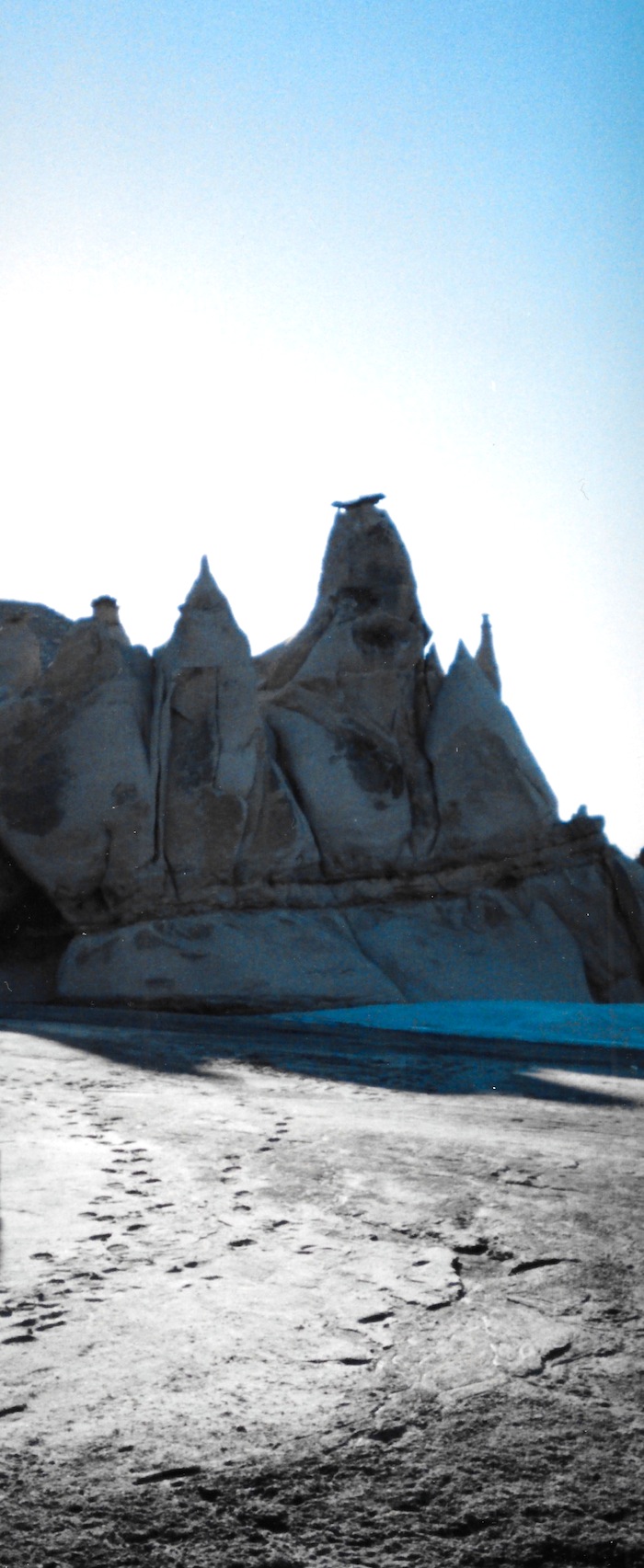
Panuli scrambled up, and hand-in-hand we half slid, half ran down. At the bottom, I measured the full height of those natural, sandstone forms called “hoodoos.” They were towering above me.

In the hoodoos of Bylot Island, I see many shapes, forms. (PHOTO BY JANE GEORGE)

In the hoodoos of Bylot Island, I see many shapes, forms. (PHOTO BY JANE GEORGE)

For the past few days, we’d been talking about coming here — but I thought maybe there was one hoodoo or maybe two, not this hidden valley of giant pillars.

I suddenly remembered that we left our companions somewhere on the top of the ledge as we raced along.

Panuli went back up, and then, I was totally alone with the hoodoos.

Africans used to call these land- form oddities hoodoos because they thought they contained the spirits of animals and evil demons. Hoodoos looked like “stone babies” to Amerindians and “fairy chimneys” to ancient Turks.

Looking around, I saw stars at the top of hoodoos, crosses and crescents, the bulbous, onion-shapes of Russian Orthodox churches.

I saw a narwhal and what looked like the rounded haunches of a Stone Age fertility goddess. All the deepest, most universal shapes of humankind seemed to be reflected in these wind-carved shapes.

The sun shone out from behind the line of hoodoos, casting long shadows along the valley floor.

The return of Panuli with the others did little to end my reverie. Icy river water coming from the mountains moved quickly over the rocks, like music, drowning our conversation.

I finally climbed back up, stopping for a last view over the valley before beginning the hike back to our camp. We’d set up camp on the ice, not far from a smaller group of hoodoos, many inscribed with Inuktitut syllabics. “Matteusi,” a common boy’s name, was etched into one.

I sprawled on the shore on the buoyant cushion of tiny Arctic willows that covered the ground. Small purple flowers surrounded us, while a snow bunting chirped not far away. I looked over Eclipse Sound, to the thin, blue-white line of mountains in the distance.

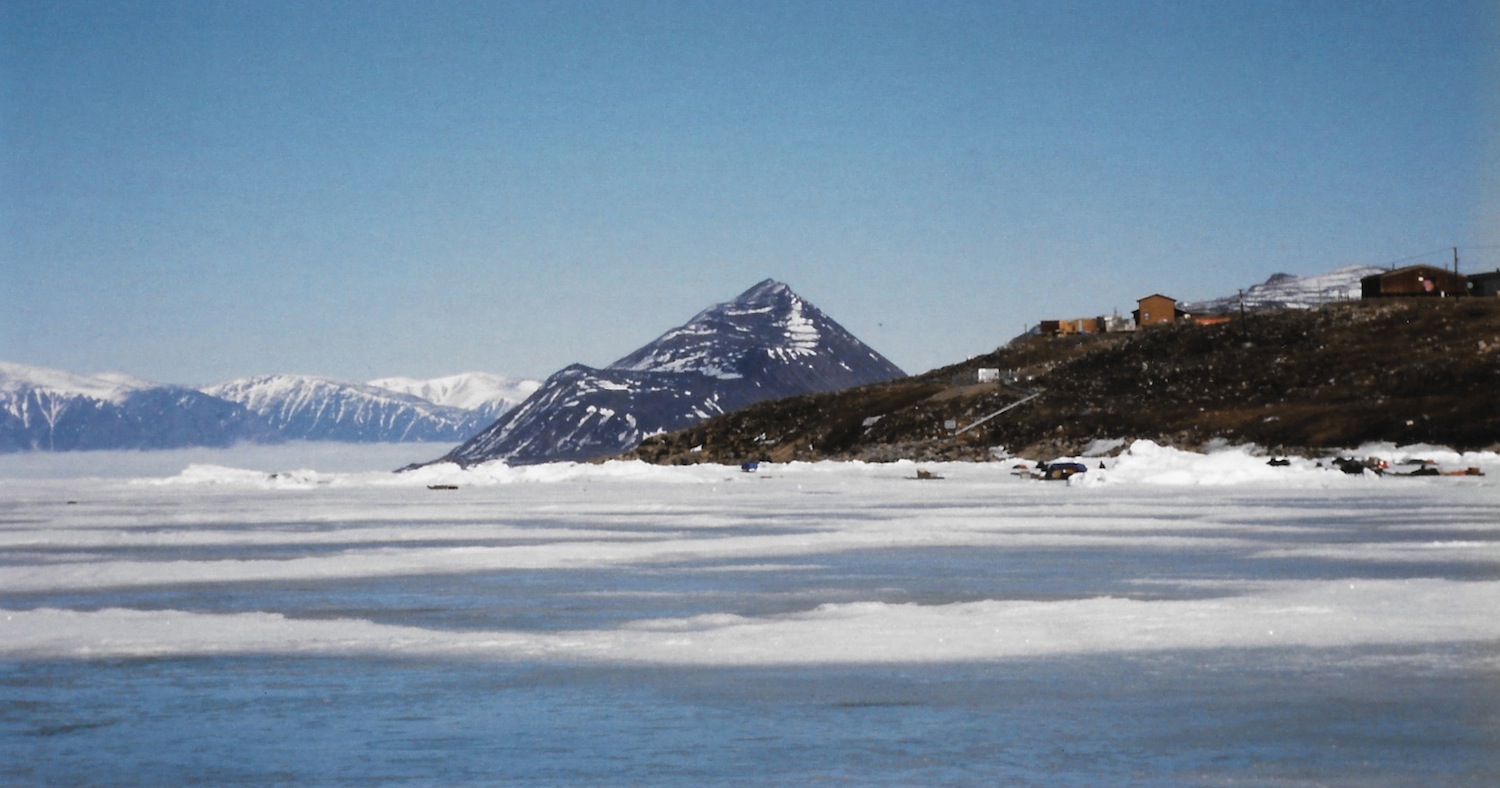
I experienced the same perfect feeling looking down from the top of Mt. Herodier, a few kilometres outside Pond Inlet.

On a clear day you can see Mt. Herodier from Pond Inlet. (PHOTO BY JANE GEORGE)

On a clear day you can see 434-metre-high Mt. Herodier from Pond Inlet. (PHOTO BY JANE GEORGE)

After climbing up steep, rocky slopes, we reached the summit, marked by a small cairn. The view took in Bylot Island, rugged cliffs to the other side and a dizzying descent to the frozen surface of Eclipse Sound. The huge cracks in the ice that we crossed to get here looked small.

Midway down, we stopped, sitting in silence in the sun. A stream had opened under the rocks and we listened to the water. Tiny yellow flowers were opening up between the rocks, and last year’s Arctic cotton, with soft tufts like dandelions, was emerging from the quickly melting snow.

A slight smell of moss was in the air. Below us, a vast beach of rounded stones, left by an ancient glacial river. Many were piled into traditional Inuit graves at the bottom of the mountain. At that moment, I was glad to be alive.

The next blog instalment of “Like an iceberg” goes live May 1.

Missed the first part of “At the edge of the world”? Read it here.

Previous posts can be found here:

Like an iceberg: on being a journalist in the Arctic

Like an iceberg, 1991…cont.

Like an iceberg, 1991…more

Like an iceberg, 1992, “Shots in the dark” 

Like an iceberg, 1992, “Sad stories”

Like an iceberg, 1993, “Learning the language of the snows”

Like an iceberg, 1993 cont., “Spring”

Like an iceberg, 1993 cont., “Chesterfield Inlet”

Like an iceberg, 1993 cont., more “Chesterfield Inlet”

Like an iceberg, 1994: “Seals and more”

Like an iceberg, 1994, cont., “No news is good news”

Like an iceberg, 1994 cont., more “No news is good news”

Like an iceberg, 1994 cont., “A place with four names”

Like an iceberg, 1995, “More sad stories”

Like an iceberg, 1995 cont., “No place like Nome”

Like an iceberg, 1995 cont., “Greenland”

Like an iceberg, 1995, cont. “Secrets”

Like an iceberg, 1996, “Hard Lessons”

Like an iceberg, 1996 cont., “Working together”

Like an iceberg, 1996 cont., “At the edge of the world”

At the edge of the world in June 1996. (PHOTO BY JANE GEORGE)

Near the edge of the world in June 1996. (PHOTO BY JANE GEORGE)