A memorable junket: my 2003 journey with the GG

How many glasses of Canadian wine and how many rich meals can a journalist from Iqaluit consume?

The surprising — perhaps — answer to that, which I found during ex-Governor General Adrienne Clarkson’s 2003 state visit to Finland and Iceland, is not that many.

A few days into the 10-day junket I couldn’t face one more official toast, banquet or multi-course airplane meal.

John Ralston Saul quaffs win at a Helsinki wine tasting of Canadian wines during the 2003 state visit to Russia, Finland and Iceland. (PHOTO BY JANE GEORGE)

John Ralston Saul quaffs wine at a Helsinki wine tasting of Canadian wines during the 2003 state visit to Russia, Finland and Iceland. (PHOTO BY JANE GEORGE)

While the food and booze came my way non-stop , I didn’t forget the state visit was funded by taxpayers.

And I remembered that, thanks only to the Department of Foreign and International Affairs, which covered my costs, I was the only journalist along for the ride (allowed to come because I worked for northern news organization and, while on the state visit, wanted to explore the interest for the Siku circumpolar news service, which Greenlandic broadcaster Inga Hansen and I tried to develop.)

So, unlike some other “delegates” on the state visit, who could party late and hard, I tried to keep my mind clear for reporting for the newspaper I work for, Nunatsiaq Newsand Maclean’s (to which I had pitched a column about the trip, eventually called Polar Gambit): being a journalist along for the ride was not always easy or even fun.

Now, more than 10 years later, I can look back at the stories I wrote on this state visit and be grateful for my sleepless nights: if I hadn’t written these stories, and somehow sent them via tediously slow internet connections, I wouldn’t remember a lot of what happened.

Why did I keep all the pieces of paper we received on the journey, every schedule, speech, briefing paper and menu? Their existence surprised me when I was going through my files, which are now at the Arctic Institute of North America in Calgary, Alberta, where you can also find the rest of my photos, notes and other northern paraphernalia from 20 years of working as a journalist and broadcaster in the Arctic.

But if I hadn’t kept those menus — those food offerings seemed stupendously over-the-top at the time — how would I recall that meal in Inari, Finland: salted white fish and trout “à la Inari,” fried reindeer sirloin, “lappish potatoes” and cloudberry cream jelly — with a selections of wine, of course.

Menus from two meals during the 2003 tour.

Menus from two meals during the 2003 tour.

Most of the 30-plus members of the official delegation, who spent five days in Finland and then another five days in Iceland in October, 2003, weren’t even from what most Canadian northerners would consider the North.

They were from Ontario, Quebec or British Columbia. The delegation included winemakers, authors, architects, musicians and a smattering of artists, officials and academics.

But Clarkson and her husband, John Ralston Saul, said all Canadians are northerners.

“Where do you draw a line? It’s not just two pieces. There’s Ellesmere Island and it’s definitely not in Iqaluit. Iqaluit isn’t Whitehorse or Yellowknife. There are many Norths in Canada,” Saul said at the time.

Canada, Saul and Clarkson said, is much like Finland and most other circumpolar nations, with a “North-North” and a “South-North.”

Helsinki, the capital of Finland, is, for example, 1,200 kilometres south of Utsjoki, a Saami community at the northern border of Finland.

Clarkson and Saul suggested to me that Canadians should start identifying themselves as northerners to share with each other and support each other.

“The whole of our country is a northern country,” Clarkson said. “You don’t want to segment out different parts of it.”
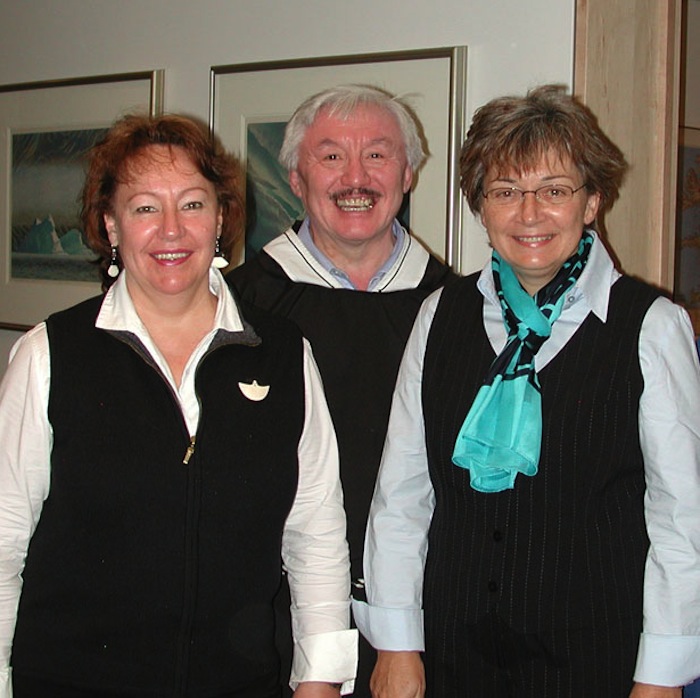
My tour companions: Shelia Watt-Cloutier, then president of the Inuit Circumpolar Conference, Nunavut's  former commissioner Peter Irniq, Mary May Simon, who was the time Canada's Acrtic Ambassador. (PHOTO BY JANE GEORGE)

My tour companions: Shelia Watt-Cloutier, then president of the Inuit Circumpolar Conference (now Council), Nunavut’s first commissioner Peter Irniq, Mary May Simon, who was at that time Canada’s Arctic Ambassador. (PHOTO BY JANE GEORGE)

But if hadn’t been for the presence of Inuit  — Sheila Watt-Cloutier, then president of the Inuit Circumpolar Conference (now Council), who later would be nominated for a Nobel Peace Prize for her work on climate change, Nunavut’s first commissioner Peter Irniq. and Mary May Simon, who was at that time Canada’s Arctic Ambassador, one might have thought folks from Vancouver and Toronto or the careful, Anglo-Canadian accents of the GG couple or wine-tastings defined Canada’s North.

Alarmed by word that this state visit, which started in Russia and would end more than three weeks later in Iceland, would cost more than $1 million, the House of Commons standing committee on operations and estimates started to examine its spending. The price tag of the visit would eventually come in at more than $5 million.

That’s a cost estimate I had no trouble believing as we wined and dined our way through Finland and Iceland.

Read more later on A date with Siku girl about the 2003 journey from Ottawa to Helsinki, Oulu, Rovaniemi, Inari, Reykjavik, Akureyri and back to Ottawa.

On learning Finnish

Babies can’t recall the first words they speak, but I can remember the first words that  I spoke in Finnish: “please pass the butter.”

Everyone around the table stopped talking and looked at me in wonder.

“She can talk now!”

My memorable speech in Finnish took place during the second summer I spent as a girl in Finland with the family I think of today, more than four decades later, as my own.

The fact that I couldn’t speak Finnish when I first arrived to stay with them at their farm didn’t matter: I would be able to help my Finnish “sister” practice English.

And Mummo, then the grandmother and matriarch of the multi-generational-family, didn’t care at all if I understood her: she spoke to me non-stop, as you do with babies, as she cooked, worked in the vegetable garden or milked the cow.

Where I learned to speak Finnish. (PHOTO BY JANE GEORGE)

The farm where I learned to speak Finnish. (PHOTO BY JANE GEORGE)

I wanted to understand her and the others in the family, but I had no choice but to listen mutely. That is, until that day when suddenly the flow of words around me started to make sense to me and I was able to surprise everyone — and myself — by talking.

“Saanko voita” (please pass the butter) — those being my first, unforgettable two words — showed that my brain had somehow, like that of a young baby, absorbed some important grammatical elements of Finnish.: “Saa” being the root for the verb (receive), “n” the marker for the first person singular, “ko” the interrogative ending, “voi” the stem for “butter” and “ta” the ending meaning “some.”

Of course, I wasn’t aware of any of that. I just somehow knew how to say it, after listening to conversations for weeks and hearing little English during that period.

The summer when I first opened my mouth and Finnish came out marked the beginning of what turned out to be a talkative summer, during which I asked what things were called and constantly added to my vocabulary.

I also figured out more grammatical issues in Finnish. I recall suddenly realizing that “mitä” (what) and “missä (where) came from the same base “mi” with place endings which I would soon see cropping up everywhere attached to nouns.

Harder for me was the realization that “kuka” (who) and “kenen” (of whom) were also the same, but I was on my way towards sliding through the changing roots and multiple cases which, to many learners of Finnish — or similar languages like Inuktitut or Saami, which also use similar endings for possession, movement and location — seem impossible to master.

I worked in Marimekko clothing stores to improve my Finnish. (PHOTO BY JANE GEORGE)

I worked in Marimekko clothing stores in Finland to improve my Finnish. (PHOTO BY JANE GEORGE)

Verbs also required another way of thinking: for example, to add make “haluan” or “I want” into a conditional verb I needed to tack onto a marker at the end of the root, not put a word in the front to show conditionality — “haluaisin” or “I would like/want.”

I also became aware that there was no future tense in Finnish.

So, I still invented novel ways to talk about the future in Finnish that would leave Finnish-speakers wondering what part of the country I came from because I had little accent but such an odd way of saying things.

I didn’t actually study Finnish grammar until years later at the University of Helsinki, when I took three levels of “Finnish for Foreigners” simultaneously. These courses settled some of the questions I had about Finnish grammar — along with a handwritten book on Finnish that a Swedish-Finnish friend wrote for me to help me understand issues that had stumped her, such as ‘He needed no money (Hän ei tarvinnut rahaa)’, but ‘He didn’t need to borrow money (Hänen ei tarvinnut lainata rahaa)’, which require different grammatical constructions.

To build up my vocabulary I would read simple stories and look up words for hours on end.

Easy-to-read Seitsämän päivää, the TV guide that's right at my level.

Easy-to-read Seitsämän päivää, the TV guide that’s right at my level.

Today, even ‘though I sometimes hear no Finnish for three years at a time, I can still speak and understand Finnish well although I still have trouble with the complex grammar of the written language seen in newspapers such as the Helsingin Sanomat which is different than that of the “puhekieli” or spoken language.

This leaves me stuck reading a lot of magazines aimed for Finns with low literacy — but reading these still helps me (and amuses me).

But it’s a gift to speak and understand Finnish, which to me feels like water bubbling over stones.

While I get to show off my Finnish occasionally at conferences with visiting academics, Finnish has also proven to be useful on visits in Norway. There, many Saami along the northern border with Finland also speak fluent Finnish in addition to Saami. My Finnish enabled me, for example, to spend a memorable evening in Karasjok, Norway with new Saami acquaintances, making jokes in the two languages.

A boat, a lake, sunny skies in Finland. (PHOTO BY JANE GEORGE)

A boat, a lake, sunny skies in Finland. En tarvitse mitään muuta. All I need. (PHOTO BY JANE GEORGE)

And I can relish contact with older Finnish-speakers. This includes listening to songs which my Finnish “mother,” now 89, often breaks into when something happens or reminds her of a song.

Speaking to her in her own language is a gift that I took away from her family,  which offered me a language and world view which I still honour today.

In a future post, I’ll talk about what this language-learning experience says about learning languages like Finnish (or Inuktitut), languages related in the past through the common Uralo-Siberian language proposed by linguist Michael Fortescue.

(Finnish, by the way, is ranked number four amongst the 10 most difficult languages in the world for English-speakers to master before Hungarian, in a list that does not include other similar Uralo-Siberian-related languages such as Saami or, for that matter, Inuktitut.)

Did you read my previous post on Saami, Finnish, Inuktitut, ancient cousins once removed?