Like an iceberg, 1993, “Learning the language of the snows”

Like an iceberg, 1993: “Learning the language of the snows”

In May 1993 I was in Iqaluit, the largest community on Baffin Island, a place that I couldn’t find on a map two years before on my first trip north in Canada.

I was already on my second visit to Iqaluit, the first, only two months earlier, to work on a radio documentary on the creation of Nunavut, still six years away. And I was still throwing together radio and print freelance contracts to cover the cost of my travel and try to earn a living.

Work on radio documentaries for CBC’s national network, Radio-Canada, the Globe and Mail and other media allowed me to attend a three-week intensive Inuktitut program at Nunavut Arctic College.

Nunavut Arctic College in Iqaluit, May, 1993, (PHOTO BY JANE GEORGE)

Nunavut Arctic College in Iqaluit, May, 1993, (PHOTO BY JANE GEORGE)

There, I hung out in the hallways between classes, with that dazed feeling I hadn’t felt since high school. By 9 p.m., when the last class ended, with my brain full of Inuktitut, I could barely see straight. But then it was time to hit the books.

The group of 18 students was a teacher’s dream: We were patient and we listened attentively. That’s because we all wanted  to learn Inuktitut.

I’d already studied Inuktitut for a year with help from anthropologist and Inuktitut-speaker Louis-Jacques Dorais at Université Laval. Most of my fellow students at Arctic College also had a basic knowledge of the language.

“You’re crazy to waste your time learning Inuktitut,” more than one person told me. “Isn’t it enough to speak English and French in Canada?”

But they’d obviously never visited a small Arctic community where all of the social life is conducted in Inuktitut. All of us in this class had been hampered by not knowing what’s going on or being able to join in.

I believed then that Inuktitut would become the language of tomorrow’s Arctic, because the creation of Nunavut was just around the corner: In 1999, Nunavut was to be carved out of the Northwest Territories.

My classmates included a few teachers from remote areas of Baffin Island — they wanted to be able to speak with students and their parents, a research scientist who spent months in the North out on the ice floes,with Inuit companions he’d like very much to talk with and learn from, an Anglican minister who needed to read the psalm book printed in Inuktitut syllabics to his congregation, two business managers and a company executive who wanted to talk to employees in their own language and understand what was happening on the job.

I wanted to understand older Inuit who rarely speak English. I wanted to more creatively pass away my hours spent waiting for the weather to lift by practicing Inuktitut. I wanted to know what’s happening. I kept thinking about Peter Murdoch and the other non-Inuit I knew who speak Inuktitut — if they could do it, I could, too.

In this class we learned, according to our text book, that Inuktitut has a complicated grammar whose many conjugations rival those of Finnish, a language that I learned just by hearing it spoken every day.

However, as adults, mastering how to speak clearly in Inuktitut about where we’re coming from and where we’ve been took hours.

One of our instructors — we hd four every day, teaching in shifts — got us down on the floor. We each chose a conveyance — an airplane, a snowmobile, a truck, a boat, a canoe or a dog sled, which we had to navigate in Inuktitut across mountains, over rivers and to and from various places — places such as Pond Inlet, whose Inuktitut name means where the hunter Mittima lived.

We became children again in this exercise, wrestling with such phrases as “Going by Twin Otter, I was on my way to Pangnirtung,” the place with bull caribou.

Every day, we dreaded dictation. A typical day’s 15 words included nunanngunngaujunga, the innocuous, but impossible, “I am going to his land.”

But we had fun, too, writing a soap opera whose action took place on the floe edge. And, to learn how Inuktitut answers a negative question, we sang “Oh yes, we have no bananas” in Inuktitut — that was a favourite teaching tool of our teacher Mick Mallon, who first learned Inuktitut in Puvirnituq in the 1960s.

My fellow student Stuart Innis, a research scientist with the Department of Fisheries, who died in a helicopter crash near Resolute Bay, Nunavut in 2000, and Mick Mallon, longtime Inuktitut teacher, relax after a day in the intensive Inuktitut course held at Nunavut Arctic College in Iqaluit in 1993. (PHOTO BY JANE GEORGE)

My fellow student Stuart Innis, a research scientist with the Department of Fisheries, who died in a helicopter crash near Resolute Bay, Nunavut in 2000, and Mick Mallon, longtime Inuktitut teacher, relax after a day in the intensive Inuktitut course held at Nunavut Arctic College in Iqaluit in 1993. (PHOTO BY JANE GEORGE)

At the same time, we learned that the grammar of sentences in Inuktitut wasn’t always the same, even within one paragraph: Some elements are left dangling, their context being the reality outside, which the speakers intuitively know, and make reference to.

Alexina Kublu speaks to students in the intensive Inuktitut class at Nunavut Arctic College in 1993. (PHOTO BY JANE GEORGE)

Alexina Kublu, who would later become Nunavut’s official languages commissioner, speaks to students in the intensive Inuktitut class at Nunavut Arctic College in 1993. (PHOTO BY JANE GEORGE)

Another  instructor, Alexina Kublu, who worked with Mallon on the textbook that serves as our guide, spent a lot of time trying to explain family relationships. She explained that each Inuk bears the name of a dead relative and actually becomes that dead person, inheriting his or her relationships as well.

“I would like my mother to live in Igloolik,” an Inuk uncle might say to a new mother, she said, giving her baby his late mother’s name. And, if your daughter has your great-aunt’s name, you might end up calling her “Mother,” especially if that aunt was like a mother to you.

The southerners, called Qallunaat in Inuktitut, imposed a new naming system. First, it was new names from missionaries, followed by government-issued numbers on “Eskimo” tags in the 1950s, and finally by new surnames in the 1970s.

Because family names were assigned almost at random, closely related families may bear completely different names today. That confused what was, to Inuit, an entirely understandable system.

“Do these relationships make it hard for a mother to discipline someone who is her grandfather?” asked a teacher-classmate, mulling over problems in his community.

I was thinking, if I ever understand this language, will I see the North more clearly?

Mary Wilman teaches the Inuktitut names for the parts of the body during an intermediate class in Inuktitut at Nunavut Arctic College in 1999. (PHOTO BY JANE GEORGE)
Mary Wilman, who would later serve as the mayor of Iqaluit. teaches the Inuktitut names for the parts of the body during an intermediate class in Inuktitut at Nunavut Arctic College in 1999. (PHOTO BY JANE GEORGE)


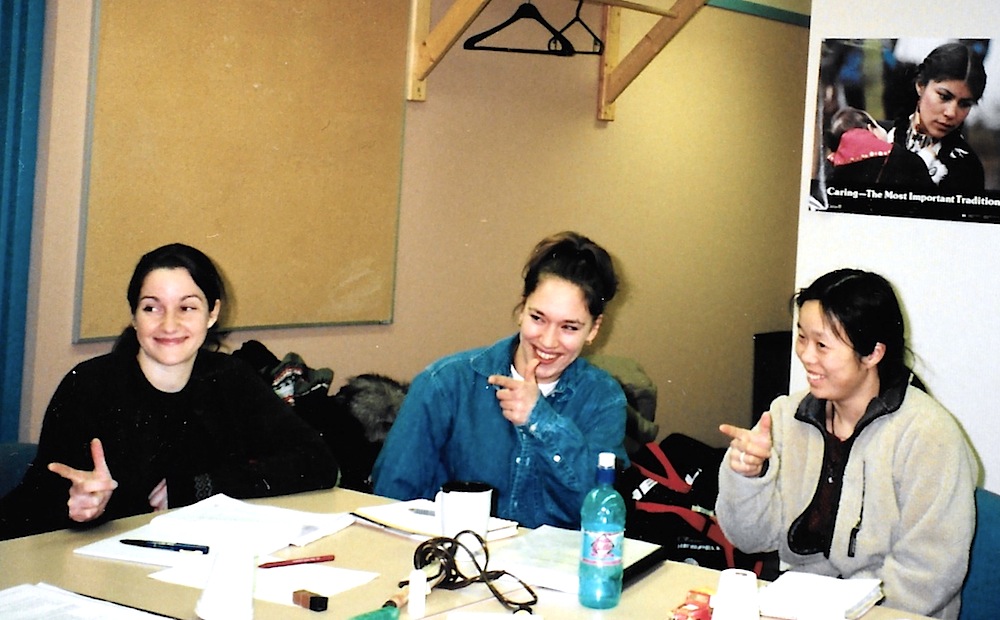
Jocelyn Barrett, Sylvia Cloutier and Siu-Ling Han participate in an exercise during the 1999 Intermediate Inuktitut class at Nunavut Arctic College in Iqaluit, which involves "shooting" the right person, according to the command in Inuktitut. (PHOTO BY JANE GEORGE)

Jocelyn Barrett, Sylvia Cloutier and Siu-Ling Han participate in an exercise during the 1999 Intermediate Inuktitut class at Nunavut Arctic College in Iqaluit, which involves “shooting” the right person, according to the command in Inuktitut. (PHOTO BY JANE GEORGE)


A few years later, I took another course at Arctic College at an intermediate level, with a small group of students taught by Mary Wilman of Iqaluit and Mallon.

After this course, I could listen to the radio more easily, watch television, have a simple conversation, even take down Inuktitut telephone messages and put a trilingual message on my voice mail message.

My improved understanding of the Inuit language did save me one day, when at an airport in Nunavik, I heard the Air Inuit agent saying that there is only one more seat on the small airplane, but there were many people on the stand-by list — which included me. I dashed up to the counter and made the flight.

I upgraded my skills in Inuktitut enough to understand the flow of comments at meetings and to answer questions. Once I sat in the bar in Kuujjuaq, Nunavik’s largest community, where you hear more Inuktitut than in Iqaluit, and struck up a conversation with the woman sitting next to me in Inuktitut.

“But you don’t look like you speak Inuktitut,” she said.

My teachers at the intensive Inuktitut course held at Nunavut Arctic College in 1993: Alexina Kublu, who went on to become Nunavut's Official Languages Commissioner, and Mick Mallon, who pioneered Inuktitut teaching in the Eastern Arctic. (PHOTO BY JANE GEORGE)

My teachers at the intensive Inuktitut course held at Nunavut Arctic College in 1993: Alexina Kublu and Mick Mallon, who pioneered Inuktitut teaching in the eastern Arctic. (PHOTO BY JANE GEORGE)

The next instalment of “Like an Iceberg” goes live on April 9.

You can read the first blog entry from April 2 here.

You can find previous instalments here:

Like an iceberg, 1991…cont.

Like an iceberg, 1991…more

Like an iceberg, 1992, “Shots in the dark” 

Like an iceberg, 1992, “Sad stories”
 

Like an iceberg, 1991…more

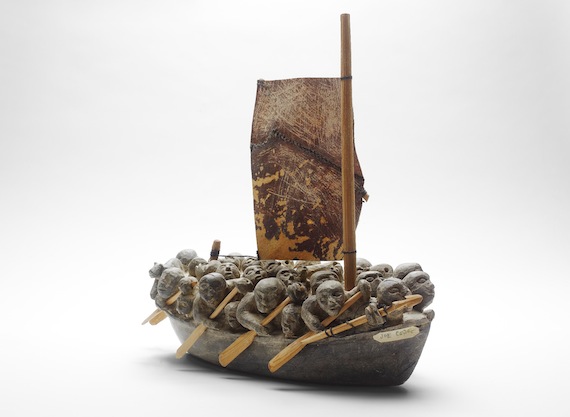
The Migration by Puvirnituq carver and printmaker Joe Talirunili. Talirunili's carving depicts an event when the boat on which he was travelling was nearly trapped by crushing ice in Hudson Bay. (PHOTO/ART GALLERY OF ONTARIO)

The Migration by Puvirnituq carver and printmaker Joe Talirunili. Talirunili’s carving depicts an event when the boat on which he was travelling was nearly trapped by crushing ice in Hudson Bay. (PHOTO/ART GALLERY OF ONTARIO)

1991: cont. from April 3

The night I met Peter Murdoch it was frigid and windy. I looked out of the window at J.’s apartment in Puvirnituq, and I could barely see the lights from the nearby houses. I’d arranged to meet Murdoch at the hotel, but I didn’t know where it was, so J. called the hospital van, which picked me up.

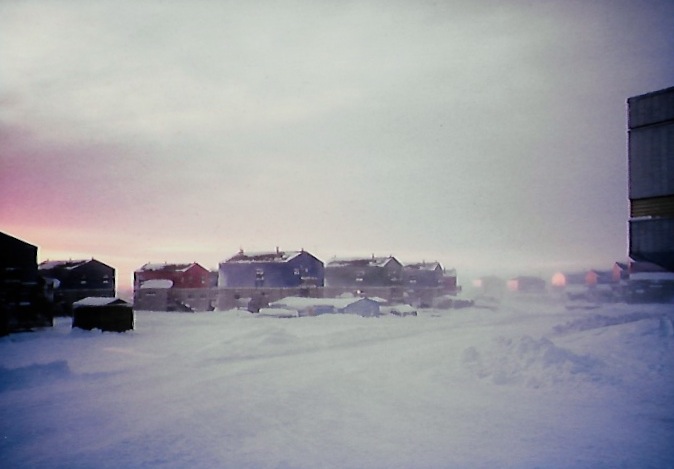
A view down a street in Puvirnituq with the Inuulitsivik Health Centre to the right. (PHOTO BY JANE GEORGE)

A view down a street in Puvirnituq, with the Inuulitsivik Health Centre to the right. (PHOTO BY JANE GEORGE)

I pushed the heavy metal doors, and headed tentatively down the narrow, carpeted hallway to what seemed to be the hotel’s communal kitchen.

“I’m looking for Peter Murdoch?” I said.

“You’ve found him,” said an older non-Inuit man, who resumed speaking Inuktitut to a younger Inuk.

“You speak Inuktitut!” I said.

“Even five-year-olds here speak it. So what’s so unusual about me?” Murdoch said.

We went into his small hotel room to talk, just a narrow bed, chest of drawers, a lamp, snow layered against the single window on the outside wall. Murdoch  — a tall man, maybe in his 60s, balding hair and a nervous habit of clearing his throat that I ended up editing out of every taped interview. I knew nothing about Murdoch, so he told me about himself.

In 1991, he was the general manager of the Fédération des Co-opératives du Nouveau-Québec, then an association of 12 co-operatives in northern Quebec.

But he had started off as a Hudson’s Bay Co. employee back in the 1940s. Then, as a young man from Newfoundland, he was sent to Baffin Island to run trading posts. And, he learned Inuktitut and the Inuit way of life.

“I enjoyed hunting a lot, going out with people, seeing the way they lived,” Murdoch said. “Visiting in tents, learning the language. I never tried to learn it. If someone told me something, I just remembered it.”

Often he was the only white man in a settlement. In Pond Inlet, on the northern coast of Baffin Island, he’d spend the long days of spring and summer out on the land, sometimes walking for days. He found a people with values he admired.

“When I first came to the North I was lucky. I came early enough to see people living the old type of life,” Murdoch said. “Their ability to accept people as they were, their ability to share, to be completely non-judgmental, let everyone be what they wanted, their ability to live with time — if there was nothing to do, they did it gracefully, did it well and enjoyed it. When things were tough, no one complained. You accepted your life as it came and I felt then that we could have learned a lot from the Inuit and the ways they relate to each other.”

As he spoke, I was brought back to a North that seemed almost a perfect society.

“The only thing that made a person an outcast,” Murdoch said, “was if he was a danger to the rest of the people. Then, they would react to get rid of that person. You didn’t see problems until after people moved into communities in the ‘50s.”

Murdoch first came to Puvirnituq with the Hudson Bay Co. in the early 1950s, when people were still living on the land in camps, not far from the trading post. In Pond Inlet, thousands of seals could be found on the ice year-round, but in Puvirnituq, he found a much poorer environment.

The fledgling community then consisted of a trading post, a dwelling, a small shack and a couple of snow houses. That’s all there was. Two small camps were located within walking distance, one with eight or 10 snow houses, the other with four or five. People were hungry. There was a lot of sickness. At that time people would sell a small carving for tea, the next day for flour or lard to make bannock.

“Sort of a dead-end sort of life,” he told me.

Murdoch walked around the camps, bringing medicine, getting to know the people.

“Here you had a group of Inuit living for the next meal. Just what you can get for the next meal. Yet, in talking, they were articulate, intelligent. So, we tried to find a better way.”

That better way was to try and pool resources to invest in purchases that would improve the standard of living for everyone, like buying a new boat or more ammunition.

Part of all sales from carvings would be used collectively — and the camps would decide what do. An election was held, and the camps voted a leader. It was all self-motivated, Murdoch said. It was the beginning of the co-operative movement in northern Quebec.

“It was never,” he said with emphasis, “a community development project” — the kind of government-sponsored projects that are imposed from the South by people from the South.

The market for soapstone carvings was just beginning in the South when Murdoch visited those camps. And sales of carvings would be the base of the co-operatives that grew up at the same time that Inuit were moving off the land, into communities. Inuit in Puvirnituq were good carvers, he said.

“They idealized hunting because there was so little game. It came out in the art and Puvirnituq became quite quickly known for its realism, with a dream-like quality.”

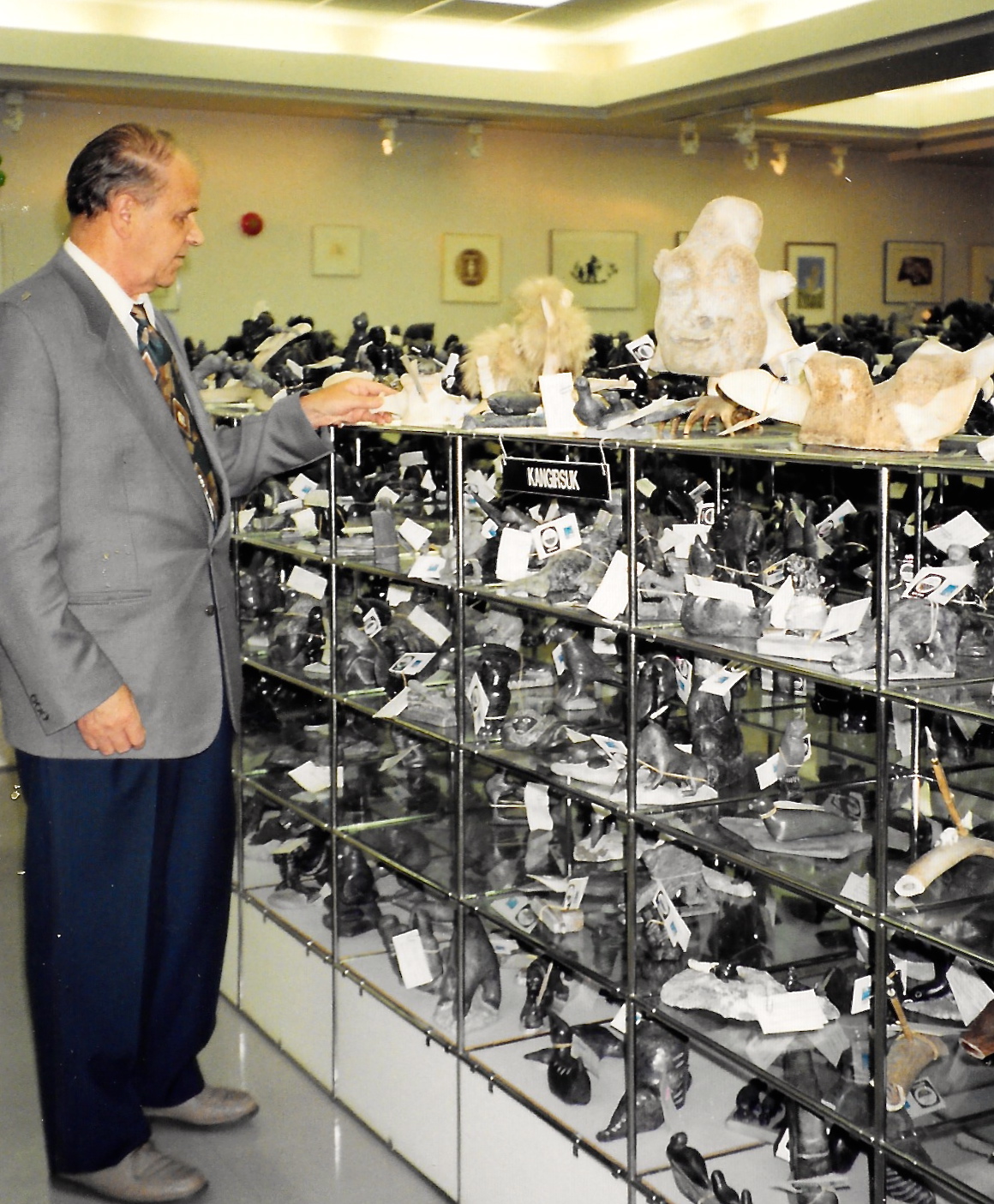
Peter Murdoch in 1992, then the general manager of the Fédération des co-operatives du Nouveau-Québec, stands by a shelf full of carvings from the Nunavik community of Kangirsuk on display at the showroom of the FCNQ headquarters in Baie d'Urfé, Quebec. (PHOTO BY JANE GEORGE)

Peter Murdoch in 1992, then the general manager of the Fédération des Co-opératives du Nouveau-Québec, stands by a shelf full of carvings from the Nunavik community of Kangirsuk on display at the showroom of the FCNQ headquarters in Baie d’Urfé, Quebec. (PHOTO BY JANE GEORGE)

I knew little about Inuit art the night I spoke with Murdoch, but I was wondering why the print shop closed. I had climbed through snowdrifts to reach this small building, now locked and boarded over.

Murdoch told me that it was because welfare pays more than art today. The recession in the South had cut art sales. Printing was an expensive operation, so it was the first casualty. Now, the co-operatives couldn’t afford to buy all the carvings that are produced, so people were giving up carving, too. There had been 60 carvers in Puvirnituq a few years earlier. When I met Murdoch, only about 10 men seriously carved.

“If this was happening to wheat farmers, there would be something done,” Murdoch said. “But there is nothing done for the Inuit, nothing. Here, we see a whole way of life, a whole group of people turning from being self-supporting to a welfare society. There is no economy except what they can do with their hands or tourism. Everything is tied to the southern economy, and it’s magnified in the North.”

The co-ops were suffering too in 1991, because, to keep consumer prices reasonable, they needed to have some other source of revenue as a subsidy, Murdoch said.

But the co-operative way of doing things, he said, was no longer being encouraged by government, as it was in the 1960’s, and Inuit themselves were becoming drawn to the new development corporations that feed on land-claim settlement money.

That night Murdoch brought me from an idyllic past where Inuit life was tough, but pure, almost a reflection of the stereotypical soapstone imagery, back to today’s difficult, modern reality. He was telling me that there was a battle being fought between big forces, different ways of thinking, of living, of doing business. Inuit may be the casualties, and no one’s doing or saying anything, he said. Inuit strengths are disappearing. Murdoch’s disillusionment struck through me, like a bolt.

“We can destroy them very easily as a people,” he said. “Or we could help them. We could see their value. We could develop that, help them. I don’t think that we are that concerned about their survival. If we don’t change that, there is no future for the Inuit, as a race, as a culture. They are finished.”

After two hours of listening to Murdoch, I ended the interview. I didn’t know much then about Inuit and the co-operative movement he worked for, but I was moved by his vision. On my way back from the hotel to J.’s, I almost got lost, stumbling through the snow, following the pale lights from the windows of houses and the howling dogs as guides.

I did my first short radio documentary for the Canadian Broadcasting Corp.’s national radio network on Peter Murdoch and the plight of Inuit carvers in the North.

But a producer in Toronto said “why should we care about this? A few Inuit that don’t have enough money for new snowmobiles?” and killed the piece.

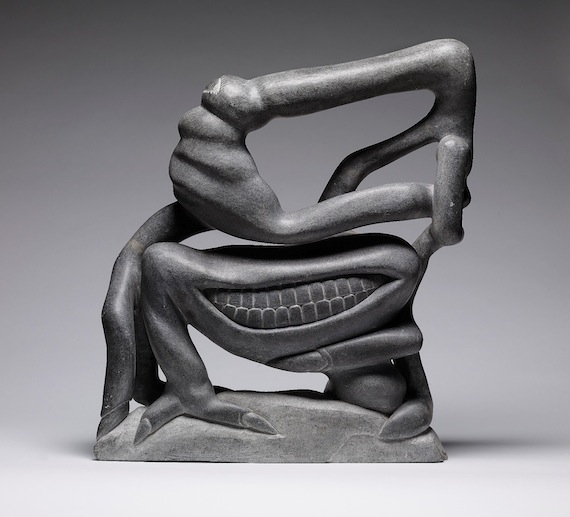
The late Puvirnituq sculptor Eli Sallualu Qinuajua explored surrealism in many of his carvings, which include this carving called “Fantastic Figure." (IMAGE/ AGO)

The late Puvirnituq sculptor Eli Sallualu Qinuajua explored surrealism in many of his carvings, which include this carving called “Fantastic Figure.” (IMAGE/ AGO)

Like an iceberg continues April 5 with 1992, “Shots in the dark.”

You can read the first entry here.