Arctic-Caribbean links: shared inaction

Climate change comes with a high human cost: true.

That’s why an international group of non-governmental organizations, which represents small island states and the Arctic,  called  Many Strong Voices,  has lobbied for deep cuts to global greenhouse gas emissions to keep climate change and its impacts in check.

But you can’t underestimate the value of people taking action, such as recycling and reusing, says Caribbean expert Lennox Honychurch.

Unfortunately, little guidance from the Indigenous knowledge, besides respect for nature and for the natural world, can be applied now on the island of Barbados, where I recently spoke with Honychurch, who is known for his studies of Amerindians in Caribbean islands.

firstbowlsvillage

An Amer-Indian village in the Caribbean.

That’s due to people’s expectations and demands for services, Honychurch said.

The world has changed: Once there were 2,000 people living on Barbados and resources were sufficient.

Now there’s a population of 270,000 people and 120,000 vehicles, which are stressing the small island.

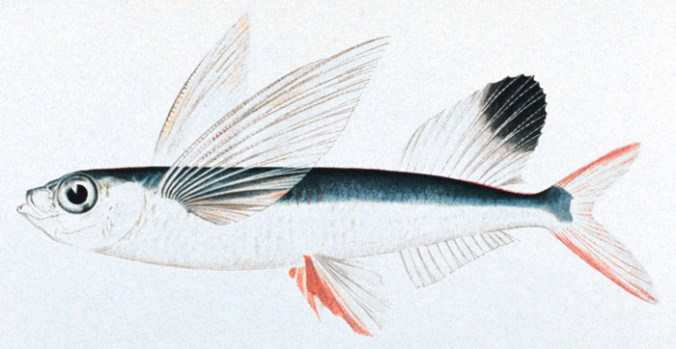
In the surrounding waters, over-fishing threatens the stocks of flying fish.

As tasty as they are unusual, these fish with wings are as iconic in Barbados as narwhals are in the Arctic — but they’re now more scarce and more expensive than ever before.
Sailfin_flyingfish

A flying fish, a food stable in Barbados, is now becoming increasingly rare due to changing currents and over-fishing. (IMAGE/ WIKIPEDIA COMMONS)

Yet positive change isn’t impossible, Honychurch said.

He’s involved with a Caribbean Broadcasting Corp. television series on trees, whose goal is to raise awareness about the positive role trees play in Barbados.

You can check out “Trees: the Silent Sentinels” here on YouTube (and, for a low-budget series on the environment, you can’t find a better one.)

There are other signs of change around Barbados: A company, called  Caribbean LED Lighting, that manufactures light-emitting diode lights, aims to reduce energy consumption on the island — like the Government of Nunavut, which announced recently that it plans to install LED streetlights in Iqaluit to cut energy costs by 30 per cent.

A local recycler in Barbados also wants to teach people to reuse and recycle with the goal of establishing a privately-owned recycling business.

But the solution to today’s energy and environmental woes won’t be simple: Honychurch said places like Barbados need a “revolution” in how people act in their own lives so they become more personally responsible for these big problems.

“There’s a perception that the state looks after everything,” Honychurch said.

You can find other similarities between the Arctic and the tropics.

For example, many on Barbados also suffer from NCD’s — non-communicable diseases like high blood pressure, heart ailments, diabetes and obesity.

Crime involving firearms is common.

And, you don’t have to look far to hear stories of interpersonal violence, as well. A widely-read, and controversial, website called “Naked Departure” is devoted to tales of sexual and child abuse and other forms of violence or corruption on Barbados.

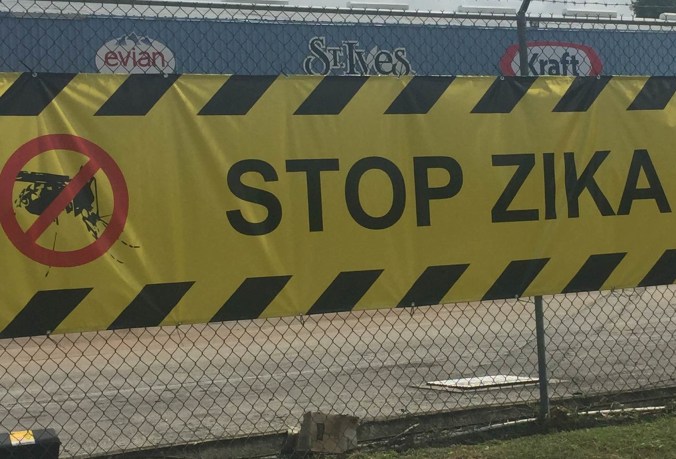
As the warmer world unfolds, regions like cold Nunavut and hot Barbados may also be linked through shared illnesses as well — like Zika, linked to microencephaly and adult paralysis, which experts believe may be spread north by sexual contact and mosquitos.
IMG_5228

This billboard in Barbados promotes pesticides to kill mosquito larvae. (PHOTO BY L. RATINEN)

So, right now, due to the Zika virus, if you’re planning to start or add to your family, you probably wouldn’t even want to visit Barbados where there are at least — and likely more — 300 suspected and confirmed cases of Zika.

For now, this marks the end of this Arctic-Caribbean series — as I to back to looking north.

But you can read the first two parts of the Arctic-Caribbean series here:

Arctic-Caribbean links: climate change, garbage, water

Arctic-Caribbean links: erosion


Arctic-Caribbean links: climate change, garbage, water

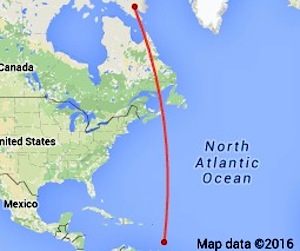
Draw a line due south of Iqaluit and keep going for 5,669 kilometres: you’ll reach a Caribbean island where the winter temperature is often 60 degrees C warmer than in Nunavut’s capital.bdosmap copy

Barbados is also much smaller than the two-million square km that Nunavut covers: Barbados, only 34 km by 24 km, comes in at only 430 sq km.

But despite the island’s tiny size, its tropical location and much larger population, about 270,000 vs 37,000, people on Barbados face many of the same challenges that people in Nunavut and other places in the Arctic face.

Top among these similar challenges: climate change, originating from North America, Europe and Asia.

That’s according to Dr. Lennox Honychurch, one of the Caribbean’s most noted historians, who is also a broadcaster, artist and politician.

12742739_1124268874290283_882045458505289634_n

Dr. Lennox Honychurch, next to an African tulip tree in Barbados, in a scene from  a Caribbean Broadcasting Corp. production.

Climate change “isn’t anything that you have created or that you can stop,” Honychurch said during a recent interview in Barbados. “You are not in control.”

And that statement could have come from a resident of the Arctic, where people also have little control over the larger causes and impacts of climate change.

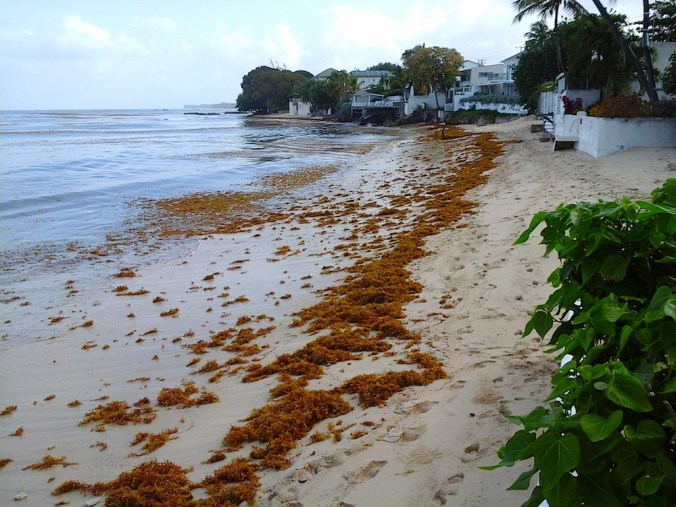
Here’s what climate change means in Barbados: unpredictable weather, including higher temperatures and less rain, and changing ocean currents, which brought in blankets of stinky Sargassum seaweed to its beaches last year.

20150426_075611

This photo shows some of the seaweed that washed up on the beaches of Barbados in 2015. (PHOTO BY A. SEALY)

Drought, heat and seaweed are among those tropical versions of the Arctic’s disappearing glaciers, melting ice and changing vegetation — and we’ll see more of these things unless the world changes radically, Honychurch suggested.

Against this background of climate change, if and when you move beyond the picture-perfect scenes of luxury resorts and mansions which most visitors see, you’ll run into the top two everyday problems for people in Barbados: garbage and water, singled out by Honychurch as among the biggest threats to the island’s wellbeing.

DSC03668

Garbage awaits pick-up by the side of a busy road in Barbados. (PHOTO BY J. GEORGE)

You often hear people — and the media — in Barbados talk about the same things as in Nunavut: how to manage solid waste and ensure a supply of clean water.

And these public debates unfold against the same background: limited infrastructure,  a stagnant economy and a growing population.

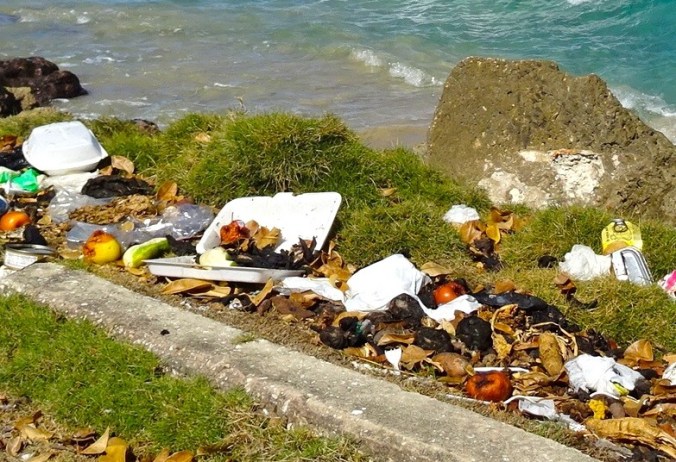
Garbage, as in every Canadian Arctic community, is a huge concern on Barbados: There’s an overflowing landfill, many illegal dump sites, and no wide-scale, officially-supported recycling program.

DSC03649

A beach in Barbados is littered with plastic and styrofoam containers — some of the 4.75 kilograms of garbage produced daily by every resident of this island. (PHOTO BY J. GEORGE)

A proposed $240 million gasification plant would turn waste into power on Barbados, where electrical power, as in Nunavut, is still diesel-generated.

But the plant would need to bring in more garbage, from cruise ships, for example, to build volume and pay for itself, while its emissions would throw cancer-causing dioxin particles into the air.

DSC03462

A cruise ship heads away from Barbados at sunset — the island wants to increase its cruise-ship traffic and use ship-offloaded refuse to help fund a new incinerator. (PHOTO BY J. GEORGE)

As for recycling, this presents the same challenges as in Nunavut. First, you have to educate people about recycling, and, then, what do you do with the recycled materials you collect without a local recycled-materials industry?

Meanwhile, there’s no ban on plastic bags and take-out from food trucks and restaurants is always served in styrofoam boxes.

The result is that you see as much litter on the beaches and streets, if not more, in Barbados as in Nunavut when the snow melts.

DSC03743

There’s a lot happening in this photo. The road has been closed due to erosion from waves  over the rocks, which have taken out part of the pavement. You can also see garbage lying by the side of the road and neatly tied in plastic bags on a tree.  (PHOTO BY J. GEORGE)

Then, there’s the question of keeping water clean so they don’t end up with a polluted or insufficient water supply.

In  Barbados, water quality and supply has already suffered. The drought has water-starved wells pulling up salty or silty water or silty water and farmers are looking at parched fields.

DSC03674

This advertisement in a Barbados newspaper wants to sell water tanks to worried consumers. But some suggest these may also be breeding grounds for the mosquitos that spread the Zika virus.

Due to the drought in Barbados, a new water prohibition aims to stop people from washing their cars and watering their lawns until May 31 with the threat of big fines.

But the aging and poor infrastructure, along with no water saving measures for tourists staying in hotels — means there’s much water wasted. Most waste water and sewage continues to be dumped directly into the sea, with no treatment.

Seen and heard enough? You can read more tomorrow about the Arctic-Caribbean links on a Date with Siku girl.

DSC03744 copy