Like an iceberg, 1994, cont., “No news is good news”

Like an iceberg, 1994, cont: “No news is good news”

After I’d spent three years poking around the North, people in Nunavik started to get feedback from the stories I’d written and from my radio documentaries that aired across Canada, mainly in the South, in English or French.

“At the municipal council, we have been receiving a number of calls from people outside the community, checking to see if it was still safe to come to Puvirnituq after all the news broadcasts earlier this year … I now believe that news, especially bad news, should never be transmitted without the consent of the municipal council.”

The mayor of Puvirnituq (then still known as Povungnituk) said this edict was needed because of articles I wrote about his community in 1993 and 1994.
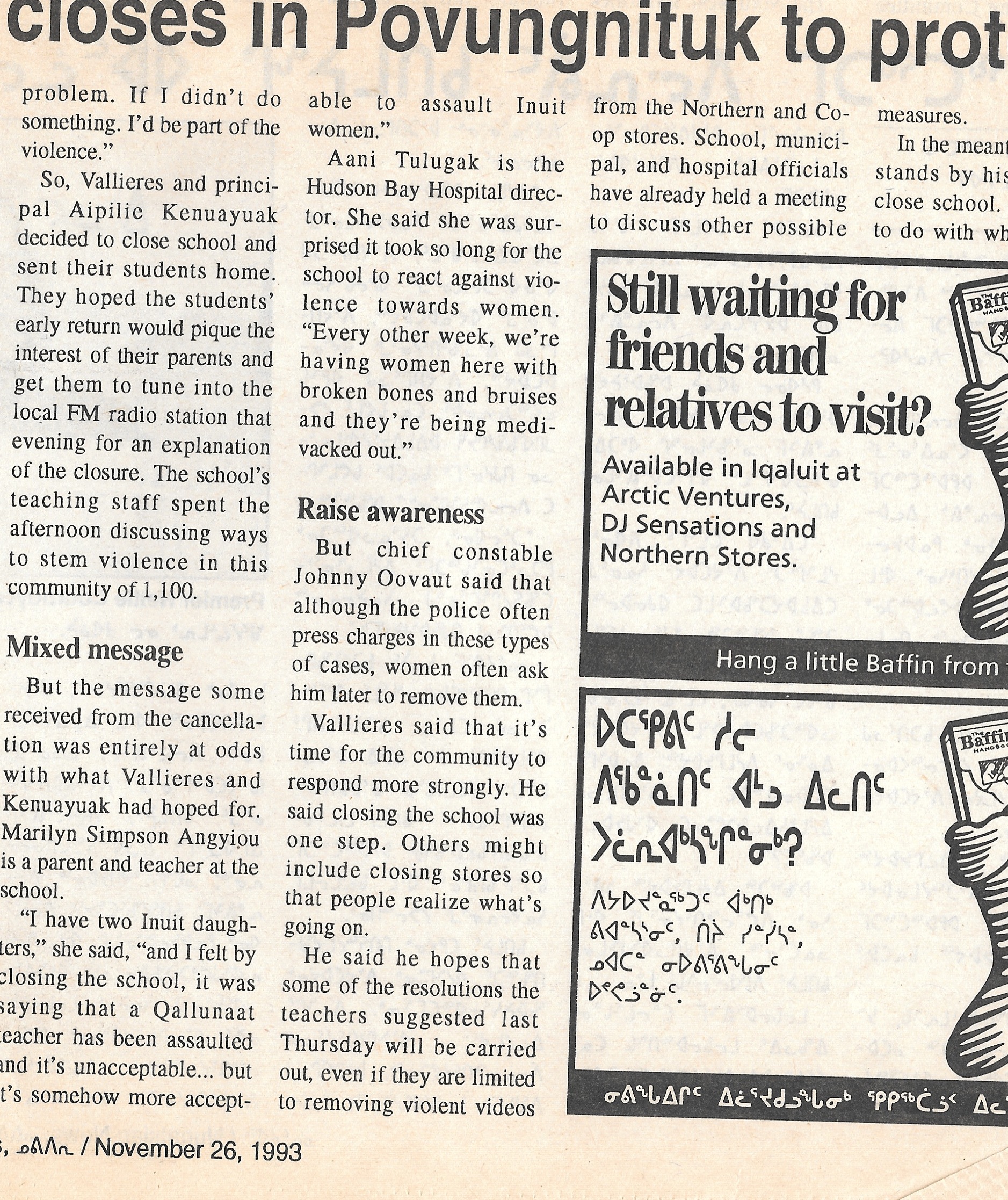
An excerpt from a news story in the Nunatsiaq News from November 2003, one of several which angered municipal officials.

An excerpt from a news story in the Nunatsiaq News from November 1993, one of several that angered municipal officials.

This is how things went: A female teacher from the South was brutally assaulted by a local man and left the community.

Although the new $7-million school had opened 29 days late, the school principal and the school facility director decided to close the school for yet another day.

“It’s nothing to do with white or Inuit,” Claude Vallières, the facility director, said in a story I wrote for the Nunatsiaq News.

“It’s about violence and I can’t let it go on for the sake of the children.”

This incident was soon followed by violence that affected all southern teachers who returned to Puvirnituq from Christmas holidays in early 1994. They found their homes had been trashed: ketchup spread on the walls, doors torn off, televisions smashed. The teachers refused to return to work unless the damage was repaired, appealing through the media — me — to call attention to their plight.

The outraged mayor then told the teachers in an official letter to stop all communication with members of the media.

Of course, it’s exactly this kind of violence and reaction which are considered as “news” by southern-style media and are always reported on. But the role of a free press and this new way of circulating news was still foreign in the 1990s — before the 1970s, any journalistic coverage  of anything was completely unknown in the eastern Arctic.

“Is the media in the North making it worse by exploiting the lives of abusers?” wrote a woman to the Nunatsiaq News. “When you give a name right on the front page or on the radio and what the person did, you are also affecting the child, wife, husband, grandparent and relatives.”

I subscribed to this Iqaluit-based weekly newspaper after picking it up a few times on trips in northern Quebec. In fact, I made my first telephone call to Iqaluit, to the newspaper’s office, to do this.

Before I called, I had to look on a map to see where Iqaluit is. For months afterwards, I read the newspaper every week when it arrived, trying to figure out where all the communities mentioned were located and to understand the issues.

In 1992, I submitted my first story to the Nunatsiaq News — on a topic that wouldn’t interest any media in the South, about a business dispute brewing in northern Quebec over fuel distribution rights.

I didn’t actually meet anyone on the staff of the newspaper until several months later, when I finally did make it to Iqaluit. Although I’d been reading the newspaper, the news didn’t prepare me for the first breath of minus 45 C air that hit me as I stepped off the plane in Iqaluit in March, 1993.

Even worse, the morning of my arrival, in Montreal, I had racked my glasses in half, and spent the first couple of days in Iqaluit almost blind, trying to find my way around in sub-zero temperatures until someone at the Nunavut Arctic College fine arts studio joined the two pieces together with a screw.

I found the office of the Nunatsiaq News in a renovated building called T-1, originally used by the United States Air Force, at an intersection in Iqaluit now known as the Four Corners.

Too small for the staff, the trailer’s walls looked as if they were held up by mounds of leftover newspapers. The air in the office was smoke-filled and stale. Old brown paper bags from take-out orders were stuck in between the stacks of newspapers.

Every table and desk held a computer or some other piece of equipment, but the paper was fed  to Ottawa for translation, layout and printing. The newspaper arrived  every Friday afternoon on the daily jet from Ottawa and was sent to communities all over the eastern Arctic. Printed in Inuktitut and English, it was then often the only current information available.

Whenever I returned to Iqaluit, even when I was working for CBC or other media, I stopped by the Nunatsiaq News office. I occasionally interviewed the staff for various reports I was doing. For a long time, I contributed only sporadically to the newspaper.
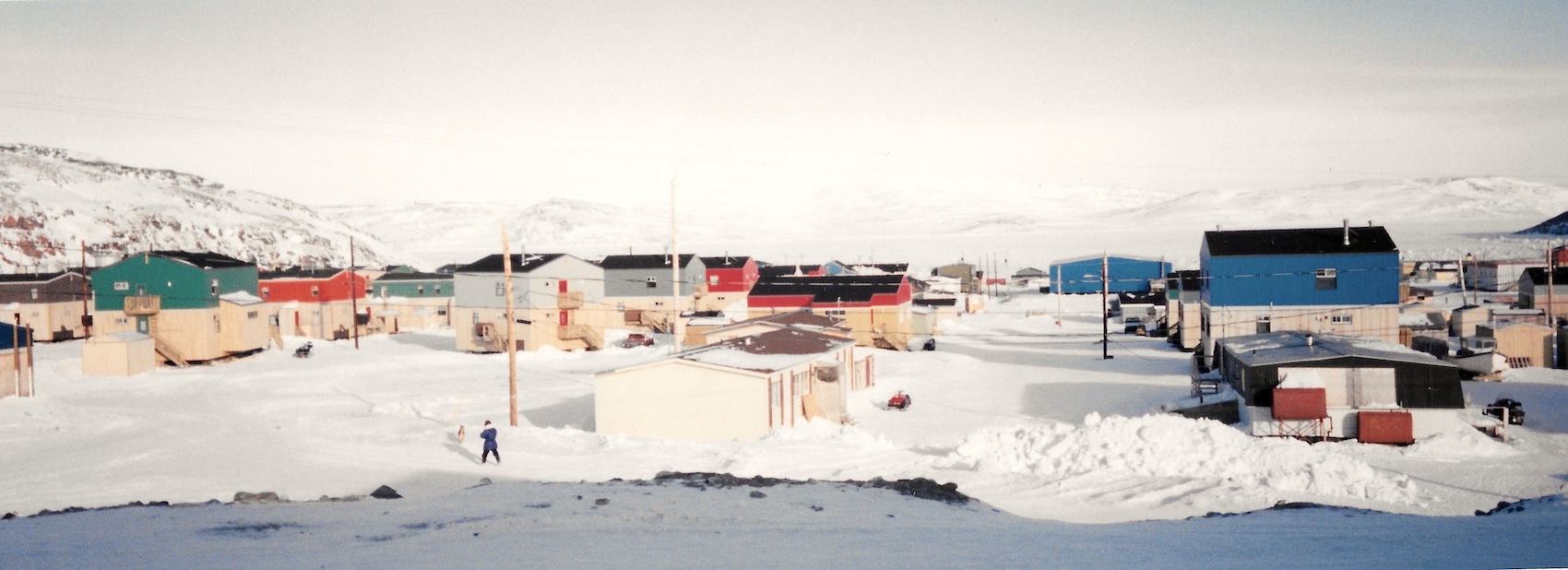
The Nunavik community of Salluit on Hudson Strait, April 1994. (PHOTO BY JANE GEORGE)

The Nunavik community of Salluit on Hudson Strait, April 1994. (PHOTO BY JANE GEORGE)

But there I was in 1994, sitting in the broom closet at Ikusik School in Salluit, mulling over what I’d write for the newspaper. I’d retreated to this bleak space after being kicked out of the meeting I was covering in this Hudson Strait community. I was armed with a set of earphones for interpretation. So, I sat with the mops and bails, listening in to “closed-door” discussions.

Although I’d been to Salluit before, its airport still seemed like the terminal at the end of the universe to me: huge, eroded mountains of rock, partially snow-covered and icy. You saw nothing of the community below.

But the who’s-who of 8,000 Inuit from communities in northern Quebec had come there to attend Makivik Corp.’s annual get-together — its annual general meeting.

Makivik administers land claims settlement funds for Inuit in northern Quebec. But in 1994 only a little over $120 million of the nearly $130 million  the organization had received after 1975 in compensation remained, a fact leaders had a hard time explaining — and they certainly didn’t want to talk at all about the state of their finances with any members of the media present.makivik_story_one
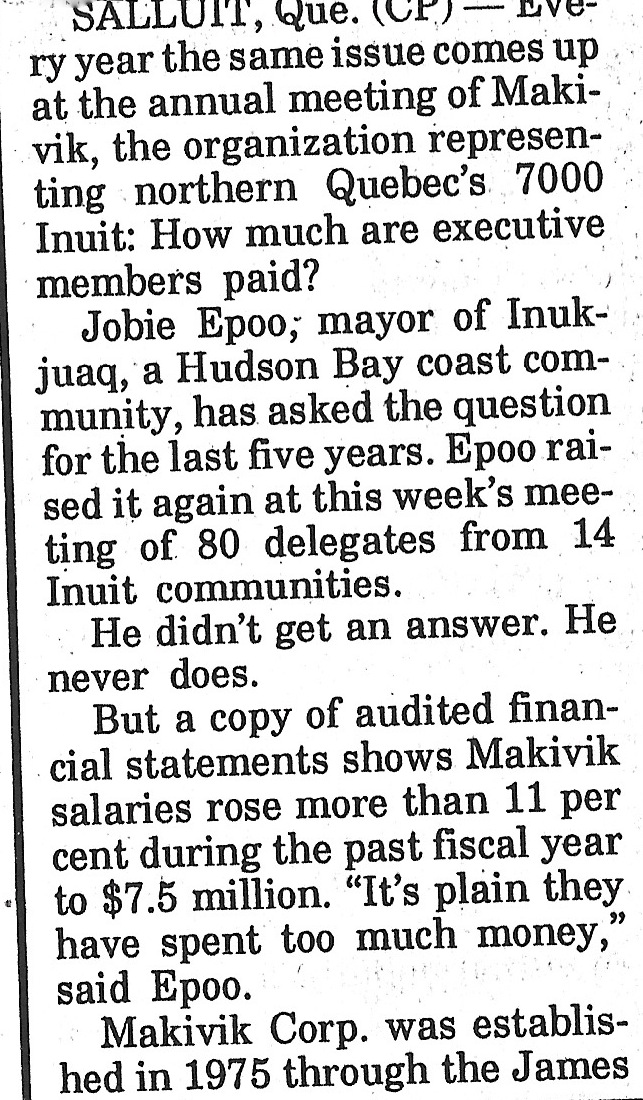
So journalists were told straight off that they were not welcome to sit in the meeting room, and would not receive a copy of audited financial statements, as in previous years’ annual general meetings.

But a careless delegate left a copy of the financial statements in the bathroom, where I picked it up.

I decide to duck into a broom closet next door to the bathroom. There, surrounded by mops and pails, in a small space I could visualize more than 20 years later, I continued to listen to the closed discussions on my headset.

It was clear that some people were upset that their capital had dropped $6 million in two years. They complained that too much of their money was spent in the South.

“If we spend a lot in the South, it’s the people there who are getting rich,” said one speaker. “And the situation here isn’t getting any better.”

“They’re getting rich, while people here are living like dogs,” another speaker said.

The stickler? Makivik had purchased a home for its incumbent president, Senator Charlie Watt, on the West Island area of Montreal. In the wake of a story about Watt, his property and business affairs by investigative  journalist Stevie Cameron for Macleans, which appeared just before the meeting and was distributed via fax throughout Nunavik, Watt lost his re-election vote. Scan 46

My own coverage before the meeting and about what took place there helped to spur more debate in Nunavik.

But not long after that meeting in Salluit, I began to experience harassment. These took the form of a hostile call to me at my office from a Makivik staffer, as well as letters and calls to my various employers.

Some publicly-elected officials in Nunavik also started to hang up on me, and I was told that all employees of a major organization in northern Quebec had been advised not to speak to me.

As well, a major story I was working on for a newspaper in the South was dropped: I couldn’t get both official sides of the story, I was told, because the some spokespeople from Makivik wouldn’t speak to me anymore.

The editor at this southern newspaper decided to listen more to my critics than to me — after all, I was just a freelancer.

The Nunatsiaq News stood by me, although I was only a very minor contributor. The staff members there had many similar stories of their own about harassment. I realized that I had a lot in common with everyone at the newspaper.

The next instalment of “Like an Iceberg” goes live April 15.

You can read the first blog entry of “Like an iceberg” from April 2 here.

You can previous instalments here:

Like an iceberg: on being a journalist in the Arctic

Like an iceberg, 1991…cont.

Like an iceberg, 1991…more

Like an iceberg, 1992, “Shots in the dark” 

Like an iceberg, 1992, “Sad stories”

Like an iceberg, 1993, “Learning the language of the snows”

Like an iceberg, 1993 cont., “Spring”

Like an iceberg, 1993 cont., “Chesterfield Inlet”

Like an iceberg, 1993 cont., more “Chesterfield Inlet”

Like an iceberg, 1994: “Seals and more”


Like an iceberg, 1993, “Learning the language of the snows”

Like an iceberg, 1993: “Learning the language of the snows”

In May 1993 I was in Iqaluit, the largest community on Baffin Island, a place that I couldn’t find on a map two years before on my first trip north in Canada.

I was already on my second visit to Iqaluit, the first, only two months earlier, to work on a radio documentary on the creation of Nunavut, still six years away. And I was still throwing together radio and print freelance contracts to cover the cost of my travel and try to earn a living.

Work on radio documentaries for CBC’s national network, Radio-Canada, the Globe and Mail and other media allowed me to attend a three-week intensive Inuktitut program at Nunavut Arctic College.

Nunavut Arctic College in Iqaluit, May, 1993, (PHOTO BY JANE GEORGE)

Nunavut Arctic College in Iqaluit, May, 1993, (PHOTO BY JANE GEORGE)

There, I hung out in the hallways between classes, with that dazed feeling I hadn’t felt since high school. By 9 p.m., when the last class ended, with my brain full of Inuktitut, I could barely see straight. But then it was time to hit the books.

The group of 18 students was a teacher’s dream: We were patient and we listened attentively. That’s because we all wanted  to learn Inuktitut.

I’d already studied Inuktitut for a year with help from anthropologist and Inuktitut-speaker Louis-Jacques Dorais at Université Laval. Most of my fellow students at Arctic College also had a basic knowledge of the language.

“You’re crazy to waste your time learning Inuktitut,” more than one person told me. “Isn’t it enough to speak English and French in Canada?”

But they’d obviously never visited a small Arctic community where all of the social life is conducted in Inuktitut. All of us in this class had been hampered by not knowing what’s going on or being able to join in.

I believed then that Inuktitut would become the language of tomorrow’s Arctic, because the creation of Nunavut was just around the corner: In 1999, Nunavut was to be carved out of the Northwest Territories.

My classmates included a few teachers from remote areas of Baffin Island — they wanted to be able to speak with students and their parents, a research scientist who spent months in the North out on the ice floes,with Inuit companions he’d like very much to talk with and learn from, an Anglican minister who needed to read the psalm book printed in Inuktitut syllabics to his congregation, two business managers and a company executive who wanted to talk to employees in their own language and understand what was happening on the job.

I wanted to understand older Inuit who rarely speak English. I wanted to more creatively pass away my hours spent waiting for the weather to lift by practicing Inuktitut. I wanted to know what’s happening. I kept thinking about Peter Murdoch and the other non-Inuit I knew who speak Inuktitut — if they could do it, I could, too.

In this class we learned, according to our text book, that Inuktitut has a complicated grammar whose many conjugations rival those of Finnish, a language that I learned just by hearing it spoken every day.

However, as adults, mastering how to speak clearly in Inuktitut about where we’re coming from and where we’ve been took hours.

One of our instructors — we hd four every day, teaching in shifts — got us down on the floor. We each chose a conveyance — an airplane, a snowmobile, a truck, a boat, a canoe or a dog sled, which we had to navigate in Inuktitut across mountains, over rivers and to and from various places — places such as Pond Inlet, whose Inuktitut name means where the hunter Mittima lived.

We became children again in this exercise, wrestling with such phrases as “Going by Twin Otter, I was on my way to Pangnirtung,” the place with bull caribou.

Every day, we dreaded dictation. A typical day’s 15 words included nunanngunngaujunga, the innocuous, but impossible, “I am going to his land.”

But we had fun, too, writing a soap opera whose action took place on the floe edge. And, to learn how Inuktitut answers a negative question, we sang “Oh yes, we have no bananas” in Inuktitut — that was a favourite teaching tool of our teacher Mick Mallon, who first learned Inuktitut in Puvirnituq in the 1960s.

My fellow student Stuart Innis, a research scientist with the Department of Fisheries, who died in a helicopter crash near Resolute Bay, Nunavut in 2000, and Mick Mallon, longtime Inuktitut teacher, relax after a day in the intensive Inuktitut course held at Nunavut Arctic College in Iqaluit in 1993. (PHOTO BY JANE GEORGE)

My fellow student Stuart Innis, a research scientist with the Department of Fisheries, who died in a helicopter crash near Resolute Bay, Nunavut in 2000, and Mick Mallon, longtime Inuktitut teacher, relax after a day in the intensive Inuktitut course held at Nunavut Arctic College in Iqaluit in 1993. (PHOTO BY JANE GEORGE)

At the same time, we learned that the grammar of sentences in Inuktitut wasn’t always the same, even within one paragraph: Some elements are left dangling, their context being the reality outside, which the speakers intuitively know, and make reference to.

Alexina Kublu speaks to students in the intensive Inuktitut class at Nunavut Arctic College in 1993. (PHOTO BY JANE GEORGE)

Alexina Kublu, who would later become Nunavut’s official languages commissioner, speaks to students in the intensive Inuktitut class at Nunavut Arctic College in 1993. (PHOTO BY JANE GEORGE)

Another  instructor, Alexina Kublu, who worked with Mallon on the textbook that serves as our guide, spent a lot of time trying to explain family relationships. She explained that each Inuk bears the name of a dead relative and actually becomes that dead person, inheriting his or her relationships as well.

“I would like my mother to live in Igloolik,” an Inuk uncle might say to a new mother, she said, giving her baby his late mother’s name. And, if your daughter has your great-aunt’s name, you might end up calling her “Mother,” especially if that aunt was like a mother to you.

The southerners, called Qallunaat in Inuktitut, imposed a new naming system. First, it was new names from missionaries, followed by government-issued numbers on “Eskimo” tags in the 1950s, and finally by new surnames in the 1970s.

Because family names were assigned almost at random, closely related families may bear completely different names today. That confused what was, to Inuit, an entirely understandable system.

“Do these relationships make it hard for a mother to discipline someone who is her grandfather?” asked a teacher-classmate, mulling over problems in his community.

I was thinking, if I ever understand this language, will I see the North more clearly?

Mary Wilman teaches the Inuktitut names for the parts of the body during an intermediate class in Inuktitut at Nunavut Arctic College in 1999. (PHOTO BY JANE GEORGE)

Mary Wilman, who would later serve as the mayor of Iqaluit. teaches the Inuktitut names for the parts of the body during an intermediate class in Inuktitut at Nunavut Arctic College in 1999. (PHOTO BY JANE GEORGE)


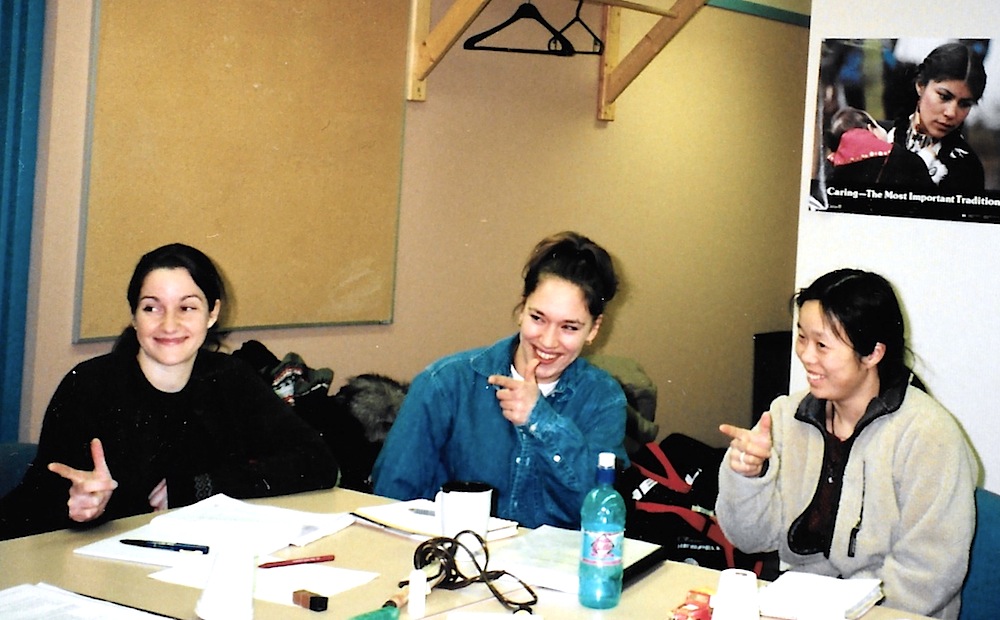
Jocelyn Barrett, Sylvia Cloutier and Siu-Ling Han participate in an exercise during the 1999 Intermediate Inuktitut class at Nunavut Arctic College in Iqaluit, which involves "shooting" the right person, according to the command in Inuktitut. (PHOTO BY JANE GEORGE)

Jocelyn Barrett, Sylvia Cloutier and Siu-Ling Han participate in an exercise during the 1999 Intermediate Inuktitut class at Nunavut Arctic College in Iqaluit, which involves “shooting” the right person, according to the command in Inuktitut. (PHOTO BY JANE GEORGE)


A few years later, I took another course at Arctic College at an intermediate level, with a small group of students taught by Mary Wilman of Iqaluit and Mallon.

After this course, I could listen to the radio more easily, watch television, have a simple conversation, even take down Inuktitut telephone messages and put a trilingual message on my voice mail message.

My improved understanding of the Inuit language did save me one day, when at an airport in Nunavik, I heard the Air Inuit agent saying that there is only one more seat on the small airplane, but there were many people on the stand-by list — which included me. I dashed up to the counter and made the flight.

I upgraded my skills in Inuktitut enough to understand the flow of comments at meetings and to answer questions. Once I sat in the bar in Kuujjuaq, Nunavik’s largest community, where you hear more Inuktitut than in Iqaluit, and struck up a conversation with the woman sitting next to me in Inuktitut.

“But you don’t look like you speak Inuktitut,” she said.

My teachers at the intensive Inuktitut course held at Nunavut Arctic College in 1993: Alexina Kublu, who went on to become Nunavut's Official Languages Commissioner, and Mick Mallon, who pioneered Inuktitut teaching in the Eastern Arctic. (PHOTO BY JANE GEORGE)

My teachers at the intensive Inuktitut course held at Nunavut Arctic College in 1993: Alexina Kublu and Mick Mallon, who pioneered Inuktitut teaching in the eastern Arctic. (PHOTO BY JANE GEORGE)

The next instalment of “Like an Iceberg” goes live on April 9.

You can read the first blog entry from April 2 here.

You can find previous instalments here:

Like an iceberg, 1991…cont.

Like an iceberg, 1991…more

Like an iceberg, 1992, “Shots in the dark” 

Like an iceberg, 1992, “Sad stories”