New roof, new life for CamBay’s old stone church

An old stone church, a landmark in the western Nunavut community of Cambridge Bay, celebrated its 60th anniversary — and new roof — with a barbecue Sept. 12, just two days shy of the anniversary date of its first mass: Sept. 14, 1954.

Here you can see the new roof of the old stone church and the plywood now covering the windows. (PHOTO BY JANE GEORGE)

Here you can see the new roof of the old stone church and the plywood now covering its windows. (PHOTO BY JANE GEORGE)

Father André Pierre Marie Steinmann, an Oblate missionary much better known for his years in northern Quebec, built the church, which had fallen into disrepair.

But this past summer Cambridge Bay Coast Guard auxiliary was able to carry out $100,000-worth of renovation work, which is still not complete.

And they undertook the project with no government assistance — raising the needed money only through fundraising.

“Rocks and mortar — we knew we could do it on our own,” said Wilf Wilcox, a local businessman and member of the local Roman Catholic congregation. “We had the blessing of the community and the church.

And we didn’t want any red-tape.”

Wilcox’s mother, Bella, who attended the Sept. 12 BBQ, is among those who still remember when the church was used.

Nine parishioners attended its first mass on Sept. 14, 1954.
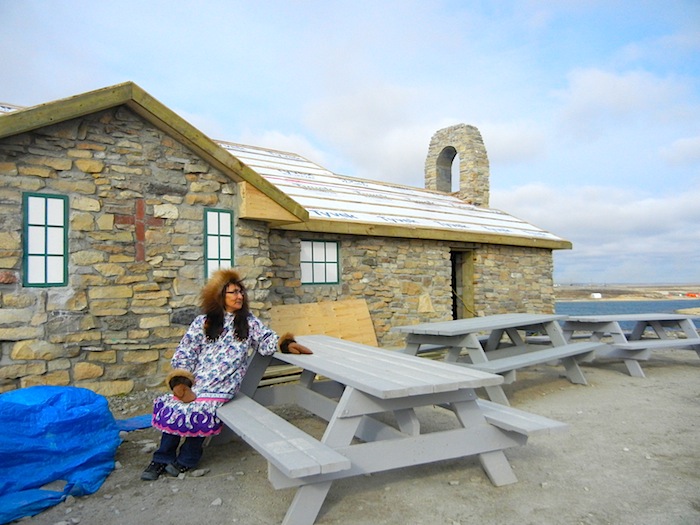
Ida Neglak sits in front of the newly-renovated old stone church.  (PHOTO BY JANE GEORGE)

Ida Neglak sits in front of the newly-renovated old stone church. (PHOTO BY JANE GEORGE)

After Father Steinmann’s arrival in Cambridge Bay from northern Quebec in 1953, he worked with local parishioners and two fellow missionaries, Fathers Lemer and Menez, to build the church.

Their materials: seal oil and clay as mortar and broken rocks for the walls — plentiful around Cambridge Bay.

Built for warmth, the church retained heat with an insulating layer of caribou fur between two layers of stone walls.

But soon after its completion, Father Steinmann left the western Arctic.

After several attempts to reconstruct the crumbling structure — not easy because of the original mortar used, vandals set fire to the church in 2006.
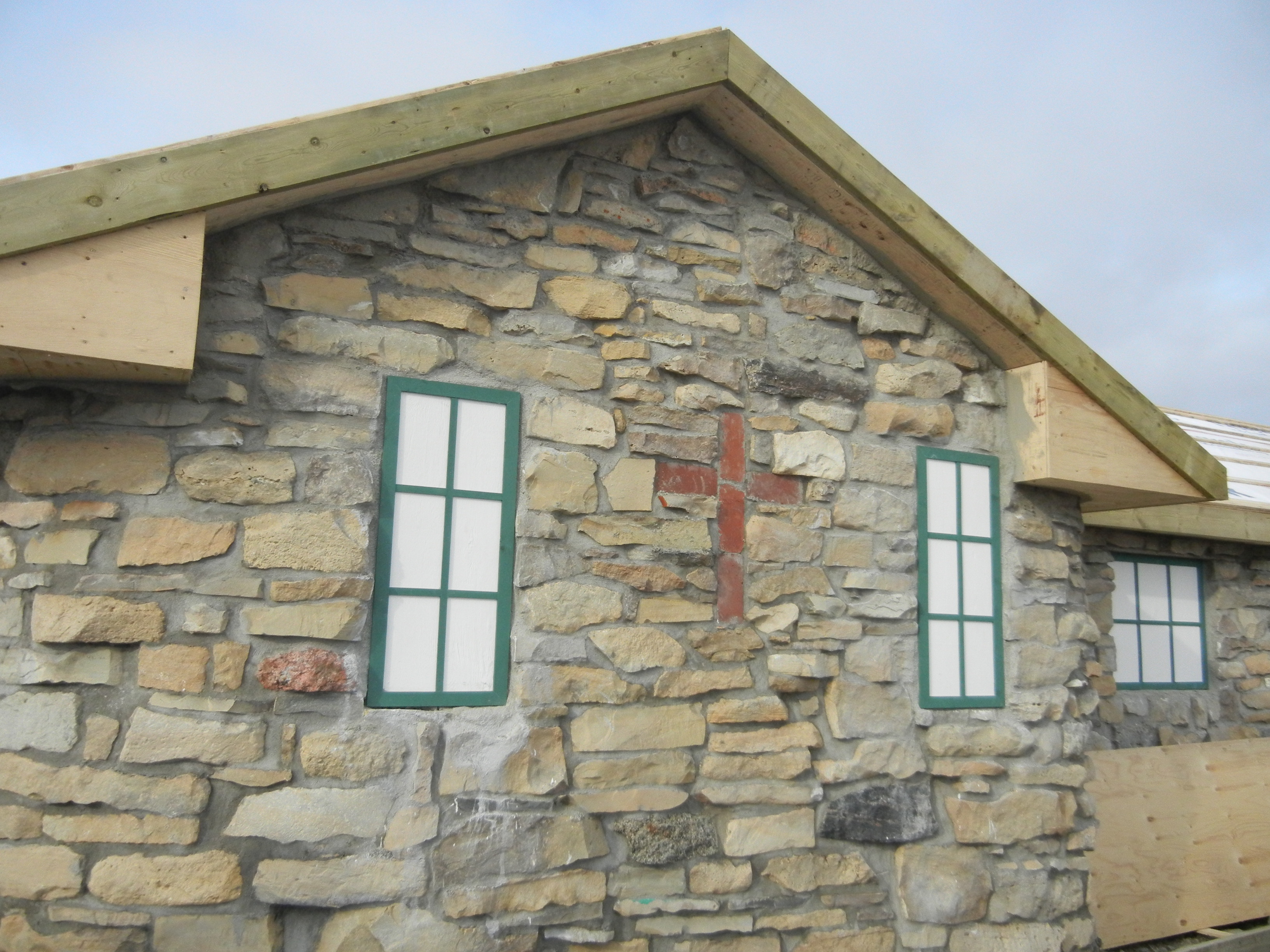
A cross on a wall in front of the old stone church. (PHOTO BY JANE GEORGE)

A cross on a wall in front of the old stone church. (PHOTO BY JANE GEORGE)

While the roof and interior burned completely that day, snow still clung to the outside as the fire blazed and didn’t melt, due to the insulation from the double walls and fur lining.

The stone church isn’t the only legacy of Father Steinmann to be found today in Cambridge Bay.

In 1954, Father Steinmann purchased the Eagle, a small longline fishing boat, said to have been towed from Tuktoyaktok to Cambridge Bay, leaking all the way.

Father Steinmann's boat, the Eagle, as it sits today in Cambridge Bay. (PHOTO BY JANE GEORGE)

Father Steinmann’s boat, the Eagle, as it sits today in Cambridge Bay. (PHOTO BY JANE GEORGE)

When the Eagle arrived, Steinmann had left for northern Quebec, where he had already spent the years between 1938 and the early 1950s, in Wakeham Bay (now Kangiqsujuaq), Sugluk (now Salluit) and Koartak (now Quaqtaq).

There’s no record of what he intended to use the Eagle for, so the boat stayed on the beach, not far from the semi-submerged hulk of the Maud, once sailed by Norwegian Roald Amundsen, the first European adventurer to successfully voyage through the Northwest Passage.

In the Nunavik community of Puvirnituq, then called Povungnituk or POV, Father Steinmann and Pitaaluk, the tall, Inuktitut-speaking Hudson’s Bay Co. manager Peter Murdoch, worked with Inuit living in camps around today’s community to set up a new way of trading and buying goods — which would eventually grow into today’s co-operatives in Nunavik and serve as an inspiration to those in Nunavut.

During the 1950s and 1960s, Father Steinmann encouraged artists, such as the great artist Davidialuk Alasuak, to portray Inuit legends and humour in his carvings and prints.

Father Steinmann himself was said to have owned “the best examples of erotic Eskimo carvings to be found in the world,” according to an article on Inuit art and co-operatives by anthropologist Nelson Graburn, which was published in the journal Museum Anthropology in 2000.

Father Steinmann’s cramped quarters were said to be crammed with “mythological carvings and humorous nudes.”

Some say Father Steinmann’s earthiness was intended to draw Inuit away from the strait-laced Anglicans towards Roman Catholicism.

But others in Puvirnituq have told me that Steinmann, like some other Oblate missionaries and Roman Catholic priests, including Eric Dejaeger, sentenced this Sept. 12,  was banished from northern Quebec after he had abused youth there.

This practice he picked up again on his return to the region, according to many in that Hudson Bay community, and one which produced a legacy of child sex abuse.

Cambridge Bay Catholics now worship at our Lady of the Arctic, built in the 1970s.  They hope the old stone church will be used for special events, such weddings or baptisms.

Look for further posts from A date with Siku girl from Cambridge Bay.

Recent posts include:

Two Arctic ships, two explorers, Franklin and Amundsen

Today, Arctic explorers take cruise ships

Parts of this post were previously published in a Nunatsiaq News feature from 2011.

A view of the church with its new roof on. (PHOTO BY JANE GEORGE)

A view of the church with its new roof. (PHOTO BY JANE GEORGE)

A memorable junket, Part IV: my 2003 journey with the GG

As the days went on, some delegates on Governor General Adrienne Clarkson’s 2003 state visit to Finland and Iceland, started to worry about their weight. Not me: I ate little, drank nothing and concentrated on collecting a stash of the organic chocolate bars that were handed around the airplane after meals so I could take these home as gifts.

Polar Gambit, published Oct. 27, 2003 in Maclean's

Polar Gambit, published Oct. 27, 2003 in Maclean’s

I patched up things with Sheila Watt-Cloutier, then the president of the Inuit Circumpolar Conference (now Council), who was worried I’d somehow portray the presence of Inuit on the trip badly in my stories.

But because I was the only journalist on board, my presence also sparked a perceptible unease amongst Canada’s royal envoys — with John Ralston Saul, Clarkson’s husband, coming back to chat me up on the airplane, to quietly sound me out on how I had found the state visit.

While I toiled to finish my Maclean’s piece (due while I was in Iceland) and to meet my relentless Nunatsiaq News deadlines, I managed to fend off all other pressures — after all, I had experienced much worse in Nunavik.

But I also missed out on many opportunities during the state visit: for example, a lunch in Iceland where my table companions included noted photographer Ed Burtynsky and author Jane Urquhart. However, instead of talking to them about his art or her writing, we were obliged to make small talk with the other person at the table, the local mayor’s wife.

I attended only one or two of the many concerts or art exhibits which were included on the agenda as I tried to meet my deadlines.

And, much to my regret now, I don’t even remember meeting author and fellow delegate Wayne Johnston, whose books I continue to read.

However, while travelling on the airplane from point A to B, I did talk to the wild salmon marketers from B.C., Ontario wine producers and an architect from Toronto. Most of them weren’t even sure why they were asked to be on the trip.

And I also passed the time with many of the academics who had with an interest in the North, among them, François Trudel from Université Laval, Peter Johnson, then chair of the Polar Commission, and Shelagh Grant, author of many northern histories.

However, in my professional coverage of the trip, I managed to leave out its many high points for me (as a person, not a journalist) — which I still recall today:

  • talking on many occasions with Gen. Romeo Dallaire and his wife, Elizabeth Dallaire, (who were on the Finnish portion of the junket) about his experiences in Rwanda and post-traumatic stress;
  • returning to Helsinki again in the autumn, where the damp smell of wet yellow birch leaves reminded me of studying in Helsinki;
  • privately interviewing Finnish president Tarja Halonen and visiting the palace, which I used to walk by every day where I lived in Katajanokka;
  • catching a glimpse a Saami friend from Tromsø, Norway in Rovaniemi, Finland, from our bus (hei, Marit!) and talking briefly to her;
  • taking in the site of Iceland’s first parliament,Thingvelir, with its towering natural forum of rock; and, last, but not least,

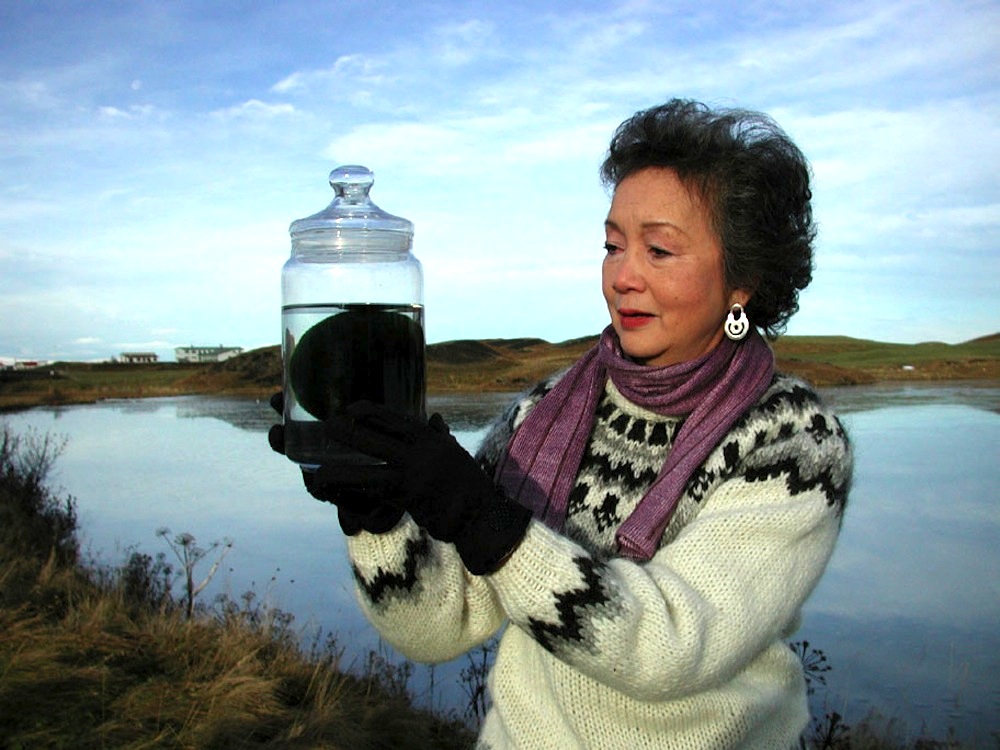
    Governor General Adrienne Clarkson holds an algae bar near Lake Myvatn, Iceland. (PHOTO BY JANE GEORGE)

    Governor General Adrienne Clarkson holds an algae bar near Lake Myvatn, Iceland. (PHOTO BY JANE GEORGE)

  • stopping in Myvatn in northern Iceland where I held an algae ball (priceless) and also encouraged Clarkson to do the same.

You might wonder why a glass jar with a silly algae ball somehow still sums up that 2003 state visit for me.

But you just had to love those “lake balls,” the strange, ball-shaped algae called “kúluskítur,” or “balls of shit” in Icelandic, or “Cladophora aegagropila” in Latin, which only exist in two lakes in the world: Lake Akan on Hokkaido Island in Japan, and in Myvatn.

Seeing those algae balls made up for all the frustrations and fatigue of the 2003 junket and made me smile— who could ask for more?

I hold a jar with an algae ball from Myvatn, Iceland. (PHOTO BY JANE GEORGE)

I hold a jar with an algae ball from Lake Myvatn, Iceland. (PHOTO BY JANE GEORGE)

You can read earlier instalments of A memorable junket here:

Remembering a memorable junket: Siku girl’s 2003 travels with the GG

Remembering a memorable junket, Part II: Siku girl’s 2003 travels with the GG

Remembering a memorable junket, Part III: Siku girl travels with the GG in 2003

Did you miss A Date with Siku girl’s Like an iceberg? You can read it all here:

Like an iceberg: on being a journalist in the Arctic

Like an iceberg, 1991…cont.

Like an iceberg, 1991…more

Like an iceberg, 1992, “Shots in the dark” 

Like an iceberg, 1992, “Sad stories”

Like an iceberg, 1993, “Learning the language of the snows”

Like an iceberg, 1993 cont., “Spring”

Like an iceberg, 1993 cont., “Chesterfield Inlet”

Like an iceberg, 1993 cont., more “Chesterfield Inlet”

Like an iceberg, 1994: “Seals and more”

Like an iceberg, 1994, cont., “No news is good news”

Like an iceberg, 1994 cont., more “No news is good news”

Like an iceberg, 1994 cont., “A place with four names”

Like an iceberg, 1995, “More sad stories”

Like an iceberg, 1995 cont., “No place like Nome”

Like an iceberg, 1995 cont., “Greenland”

Like an iceberg, 1995, cont. “Secrets”

Like an iceberg, 1996, “Hard Lessons”

Like an iceberg, 1996 cont., “Working together”

Like an iceberg, 1996 cont., “At the edge of the world”

Like an iceberg, 1996, more “At the edge of the world”

Like an iceberg, 1996, cont. “Choices” 

Like an iceberg, 1997, “Qaggiq”

Like an iceberg, 1997, more “Qaggiq”

Like an iceberg, 1997, “Qaggiq” cont.

Like an iceberg, 1997 cont., “Qaggiq and hockey”

Like an iceberg, 1997 cont., “Brain surgery in POV”

Like an iceberg, 1997 cont.: “Masks on an island”

Like an iceberg, 1997 cont., “Abusers on the pulpit”

Like an iceberg, 1998, “Bearing gifts”

Like an iceberg, 1998 cont., “At the top of the world”

Like an iceberg, 1998 cont., “A bad week” 

Like an iceberg, 1998 cont.: more from “A bad week”

Like an iceberg, 1998 cont., “Memories”

Like an iceberg, 1999, “The avalanche”

Like an iceberg, 1999 cont., “An exorcism, followed by a penis cutting”

Like an iceberg, 1999 cont., more on “the Avalanche”

Like an iceberg, 1999 cont., “Robins in the Arctic”

Like an iceberg, 1999 cont., “Fossil hunting”

Like an iceberg, 1999 cont., “Where forests grew” 

Like an iceberg, 1999 cont.,”And then there was Nunavut”

Like an iceberg … the end