You know you’ve never been to Iqaluit/Frobisher Bay when…

One of my favourite Facebook pages is called “You know you’re from Iqaluit/Frobisher Bay when….”

There, you can see photos from the 1970s and 1980s and even earlier that you won’t see elsewhere showing how this city, now with close to 8,000 residents, has so radically changed.

But you can only appreciate these photos if you have lived or stayed in Frobisher Bay, now known as Iqaluit.

So, for those of you who haven’t visited Iqaluit or are planning to come, or will never come due to the cost and distance of the trip, or who are simply tired of Arctic ice photos, I plan to post photos to give you glimpses of the city during the coming month — usually the best period of the year for outdoor photography thanks to the sun and snow.

Flying in from Kuujjuaq in Nunavik, in Quebec, about an hour away by jet, you could see easily see the land below; there was not a cloud in the sky on March 27.

And I was fascinated by the view through my window of lines in the snow-covered rocky slopes below me.
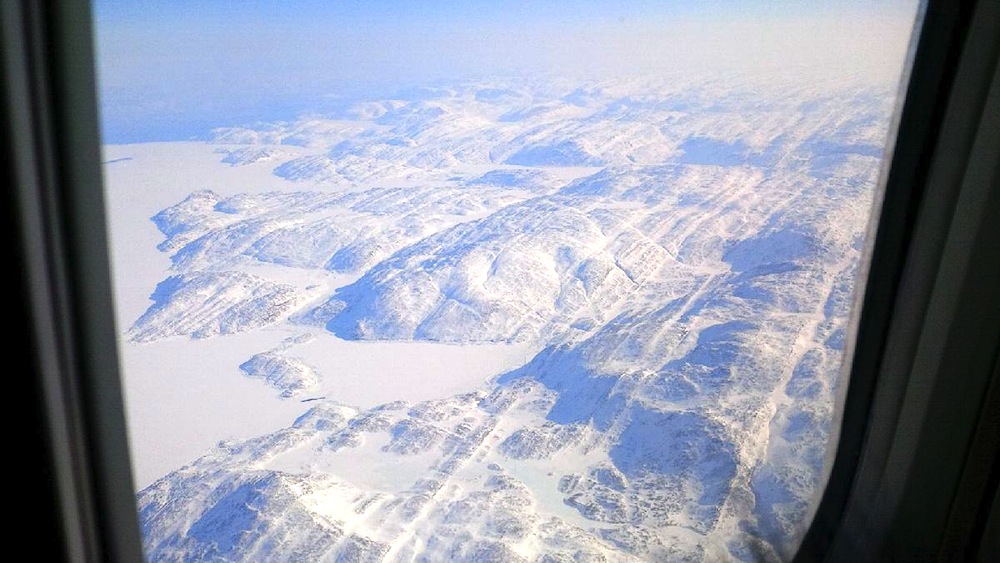
This is what I saw as we were approaching Iqaluit. (PHOT BY JANE GEORGE)

This is what I saw as we were approaching Iqaluit. (PHOT BY JANE GEORGE)

Sitting on the right side of the jet, I was able to get a great look at Iqaluit as we approached the airport. Actually, everything appears better from this altitude and at this time of year when the snow makes everything look clean. And if I had been seated on the other side of the aircraft, I would have been looking down at the dump.
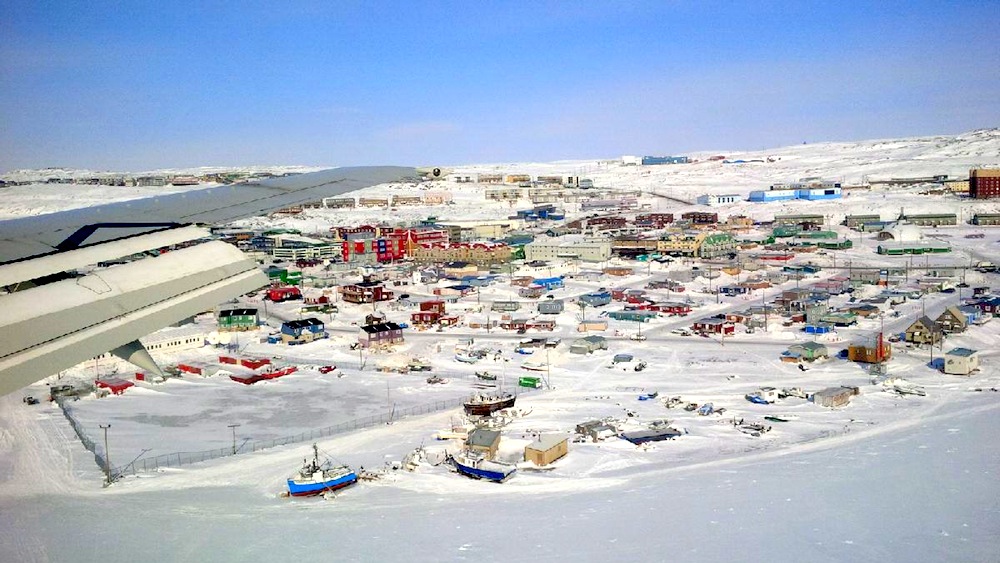
Iqaluit looks cute as we prepare for landing in March 27. (PHOTO BY JANE GEORGE)

Iqaluit actually looks cute as we prepare for landing in March 27. (PHOTO BY JANE GEORGE)

After landing, I took a photo of Iqaluit’s “yellow submarine” airport when I walked out of the plane. Just because it looked bright and cheerful, and because, for once, it was warm enough to take my mittens off to take a photo.

I don't think I have ever taken a photo of this airport before. But with my new phone's camera, anything is possible. (PHOTO BY JANE GEORGE)

I don’t think I have ever taken a photo of this airport before. But with my new phone’s camera, anything is possible. (PHOTO BY JANE GEORGE)

In my previous blog post, you read about Arctic domes. Well, you won’t see any of these in my future posts about Iqaluit, because the domes of Iqaluit have all been torn down, but I’ll show you some more of today’s city and its other strange buildings.

Everything is pretty new, so you won’t see anything like the bus-home that I recently saw posted on that Frobisher Bay Facebook page and which is long gone….

Dwelling like this one from a Facebook page on Frobisher Bay, now Iqaluit, are a thing of the past.

Dwelling like this one from a Facebook page on Frobisher Bay, now Iqaluit, are a thing of the past.

Curious about the Canadian Arctic of the 1990s? You will want to read my “Like an iceberg” series. You can find all the links here.


A memorable junket, Part II: my 2003 journey with the GG

Here was the real treat for me as I tagged along on the 2003 state visit with Governor General Adrienne Clarkson to Finland and Iceland. This state visit took me back to Inari, a Saami centre of in northern Finland with a population of about 2,200. The stop there offered a chance for Saami, Inuit — three on that leg of the trip — and the other Canadian visitors to learn more about Saami culture, and share.

The discussions in Inari stuck closely to the issues such as people, culture, the land and animals, in contrast to the previous stops in Finland. In Helsinki, Clarkson’s husband, author-philosopher John Ralston Saul, presided over a noon-ish wine tasting — of Canadian wines — at the downtown Sipuli restaurant that left me dizzy. And, in the city of Oulu, Finland’s northern high-tech centre, officials seemed puzzled about why the Canadians, who mispronounced the city’s name (oh-loo) as oooo-looo or ow-loo, were there at all… although the Oululaiset knew what to serve for lunch: wild mushroom soup, moose steak and berry mousse.

From the Kaleva, Oct. 9, 2003

From the Kaleva, Oct. 9, 2003

Oulu’s daily newspaper, the Kaleva, took pains to describe Clarkson’s visit as well as her role in Canada. A journalist from that newspaper had even visited Iqaluit before the GG’s visit as a way of informing readers in Oulu about Canada’s North, and also interviewed me in Finnish — which I had learned as a young girl.

But Oulu’s vision of what a state visit should look like appeared to be an event designed around trade-deal signings rather than talk, as was the case in 2003: at a discussion at the University of Oulu on “Change and Development in the Changing World,” presentations and comments came largely from Canadians or non-Finns, and few students attended the open session.

A Canadian government official on the state visit maintained that it was important, despite the lukewarm connection, to show Finland that Canada isn’t simply about hockey and snow. Instead, I thought, it would be perceived as a land of wine, haute cuisine and academic talk?

As for Clarkson, at the next stop further north in Inari, the focus on good food continued as she asked what reindeer usually eat. That question came as a Saami herder fed a plump animal.

“They like birch leaves and mushrooms. This summer, there were plenty of mushrooms so they’re well-prepared for winter he said.

Governor General Adrienne Clarkson (at right) learns about reindeer near Inari in October, 2003. (PHOTO BY JANE GEORGE)

Governor General Adrienne Clarkson (at right) learns about reindeer near Inari in October, 2003. (PHOTO BY JANE GEORGE)

At the reindeer farm outside Inari, inside a fire-lit tent called a lavvu, Into and Marit Ann Paadar accompanied their traditional drummer, the romppu, and performed Saami songs or joiks. Into and Marit explained that Saami in Finland have three very different ways to say thank-you, depending on which Saami group they come from — giittu, takk or spasi. When the couple married 30 years earlier, they said couldn’t understand each others’ dialects, so they adopted Finnish as their common language.

We also visited Inari’s Saami museum, called the Siida or “village,” where young Saami singers provided the entertainment and Saul and Clarkson received gifts of Saami capes.

“Clarkson gushed over the thrill of finally meeting people dressed like the colourfully dressed ‘Lapps’ she’d read about in history books as a child,” I finally wrote in Maclean’s. “Woops,” I thought at the time — that was like calling Canadian Inuit “Eskimos” — but the polite Saami smiles only froze at Clarkson’s gaffe.

Finland's Saami leader Pekka Aikio gives John Ralson Saul and his wife, Governor General Adrienne Clarkson, a  luhkka, a traditional article of clothing, which can be worn outside a fur coat or by itself in warmer weather. (PHOTO BY JANE GEORGE)

Finland’s Saami leader Pekka Aikio gives John Ralston Saul and his wife, Governor General Adrienne Clarkson, a luhkka, a traditional article of clothing, which can be worn outside a fur coat or by itself in warmer weather. (PHOTO BY JANE GEORGE)

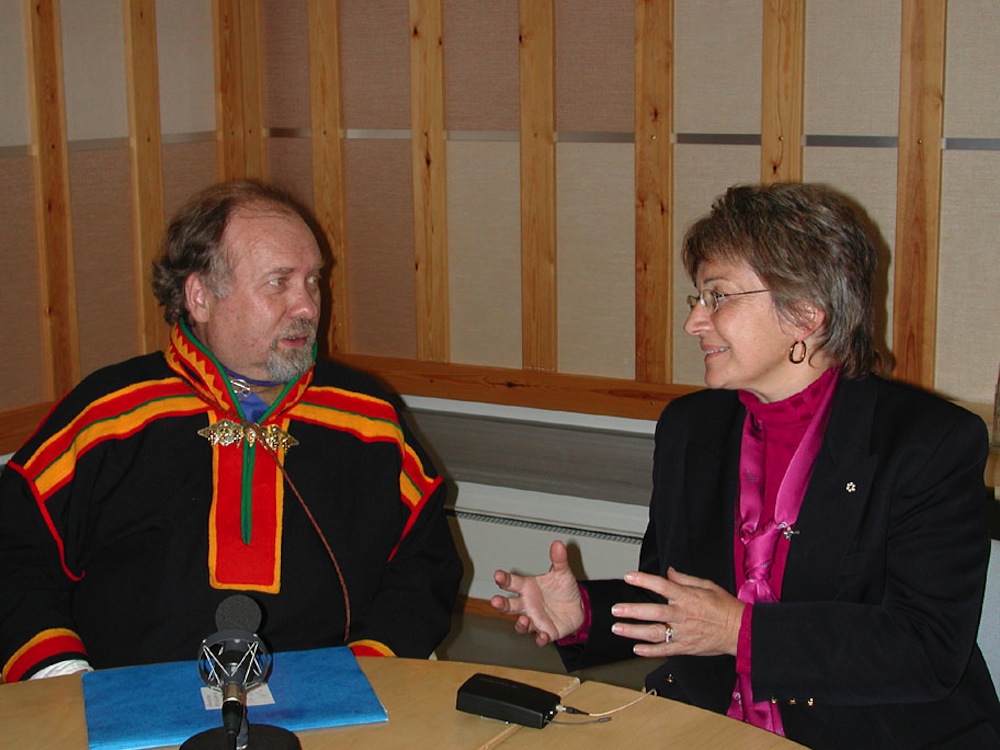
Later in Inari, Sheila Watt-Cloutier, then the president of the Inuit Circumpolar Conference (now Council), Piita Irniq, who was the Nunavut commissioner, Mary May Simon, Canada’s first Arctic Ambassador, and Clarkson joined the president of Finnish Saami parliament, Pekka Aikio, someone I’d first met 10 years earlier, at the Saami radio station for a discussion that aired on Saami radio and television.

Finnish Saami parliament, Pekka Aikio  and Mary May Simon, Canada's first Arctic Ambassador, participate in an October 2003 round-table discussion for the Saami radio network in Inari, Finland. (PHOTO BY JANE GEORGE)

Finnish Saami parliament, Pekka Aikio and Mary May Simon, Canada’s first Arctic Ambassador, participate in an October 2003 round-table discussion for the Saami radio network in Inari, Finland. (PHOTO BY JANE GEORGE)

The importance of the reindeer, said Irniq, reminded him of the importance of the seals in Inuit culture.

But unlike Inuit in Canada, Finnish Saami, whose parliament has only advisory powers, have no rights over their land, Aikio said.

“We would like to have the situation of Canadians,” Aikio said. “It’s fantastic what you have in Nunavut.”

But there wasn’t much time to think about that as we rushed from Inari to the Ivalo airport and back to Rovaniemi for the night and then, the next morning, to Iceland.

Read more about Siku girl’s 2003 state visit to Finland and Iceland on A Date with Siku girl.

You can read the first instalment here.