Like an iceberg, 1993 cont., “Spring”

Like an iceberg, 1993, continued: “Spring”

From a look-out near Iqaluit,  where I was studying Inuktitut at Nunavut Arctic College, there was a view over the mountains across the bay. The mountains were topped with an icy sheen where the horizon met their peaks. Out on the bay below, furious, frozen waves. These seemed to be rolling towards half-buried plywood shacks in the ice along the beach.

A week ago, the outside temperature had dipped to a blustery windchill of minus 50 C. A thin haze of snow whipped about, making it hard to see anything — an “almost blizzard” in Inuktitut. In the South, blizzards come from the sky. In the Arctic, they seemed to rise out of the land on the wind.

This time of year is called “pre-spring” in Inuktitut, a state of being more than a fixed period of time. One morning revealed a bright and warmer May sun. By midday, the roads actually began to steam, puddles and potholes appearing from quickly melting ice. In the afternoon sun, snow vanished around rocks and left impossible looking sand castles out of sand formerly caught in drifts.

On the streets, children rode their bikes unsteadily. Parkas were exchanged for windbreakers, and sealskin kamiit boots for rubber boots. Behind the Navigator Hotel, a merry group in bathing suits brought out a portable hot tub. They basked in the sun. The sky was totally cloudless, a pale, almost transparent blue.

The weather held, and I decided to go to Pangnirtung, a community about an hour by air up the eastern Baffin Island coast, where I was to stay at the home of a friend. I’d never been out of Iqaluit at that point, and never further north.
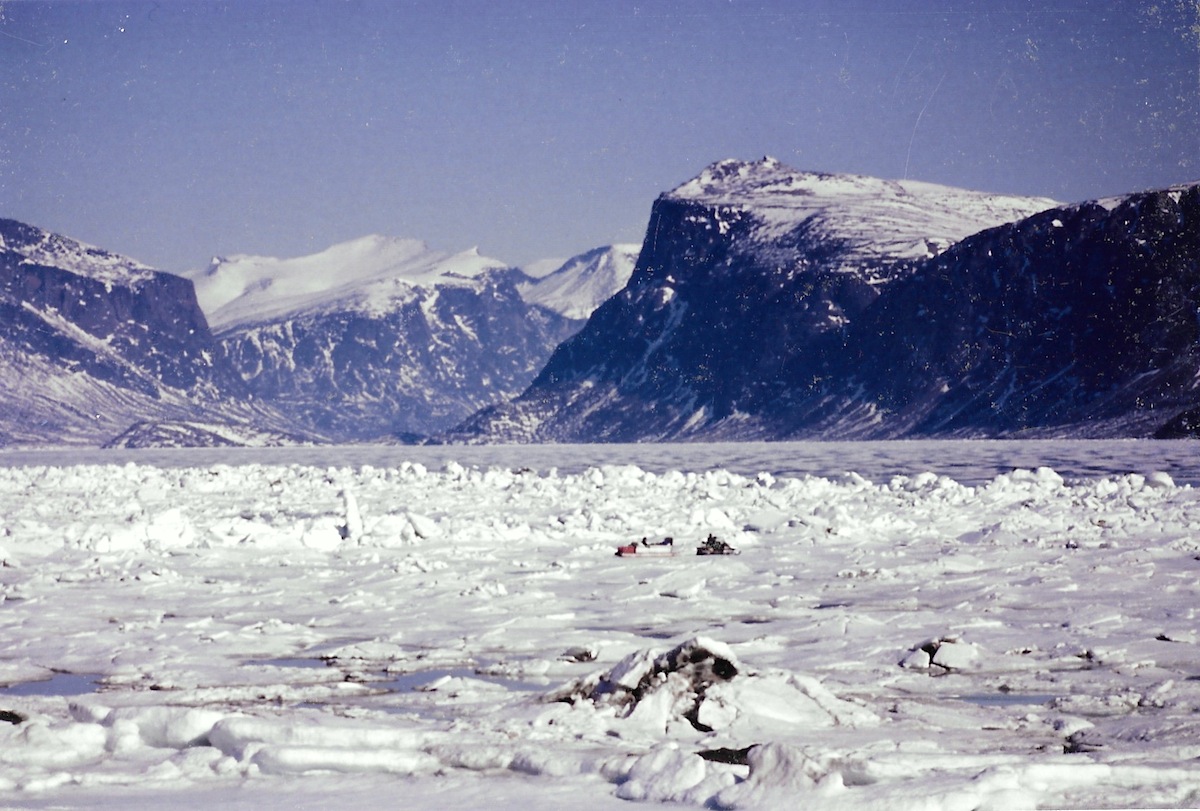
A snowmobile heads out over the sea ice on Pangnirtung's fiord in May 1993. (PHOTO BY JANE GEORGE)

A snowmobile heads out over the sea ice on Pangnirtung’s fiord in May 1993. (PHOTO BY JANE GEORGE)

The small plane flew for more than an hour, low over the rounded, rocky surface of Baffin Island. I was sitting there in the front with the pilot when he pointed out an opening in the cliffs ahead. These cliffs, even from a distance, formed a high wall of rock, a steep edge around the ice. We approached them, then darted into a fiord carved between the rocks. Before us, the high mountains of Auyuittuq National Park, the place that never melts.

We made an abrupt turn and came in along one side of the fiord to land on a strip in the middle of Pangnirtung. A cold smell of spring, sand and cold water hit me as I get off the plane. As I began the walk to my friend’s home, kids shout to me in Inuktitut: Kinauvit? “Who are you?”

In the afternoon, I walked all around town, down by the shore where blocks of ice were banked up into the air. On the ice, which was already beginning to open up into cracks, families on snowmobiles headed off down the fiord for a weekend of hunting or ice fishing. The exhaust from the machines mixed with the clean perfume of melting snow.

Scene from Pangnirtung, May 1993. (PHOTO BY JANE GEORGE)

Scene from Pangnirtung, May 1993. (PHOTO BY JANE GEORGE)

Many families were already out on the land, hunting seals. The seals had already birthed their young. They carved out snug caves for their pups under the snow, around the air holes in the ice.

Hunters said they looked for small indentations in the snow, the telltale trace of these caves. They’d jump on any small mound they find, closing the air hole below. The seal pup would be waiting by the hole for its mother will appear. It was then tied to a line, the air hole was reopened and the hunters dangled the tethered young seal down under the water. When the mother grabbed her pup, the two would be dragged out and killed.

Soon, the young seals would no longer be nursing. The snow was disappearing fast. The seals would move into the water. Then, hunters would station themselves at the exposed air holes on the ice waiting for the young, out-of-breath seals to come up for air.

“You sit by the holes, the sun is shining. There is absolutely no noise. Maybe a little wind. You stare into the hole. Your friends are waiting around you. It’s a peaceful feeling,” said M. a young man I met in Iqaluit.

Depending on the seal’s age or his hunger, M. said he would eat his catch boiled or raw. For him, seal hunting on the ice meant spring: the return of light, life and food. And the sealskins, made into warm boots, would keep him and his family warm during the winter.
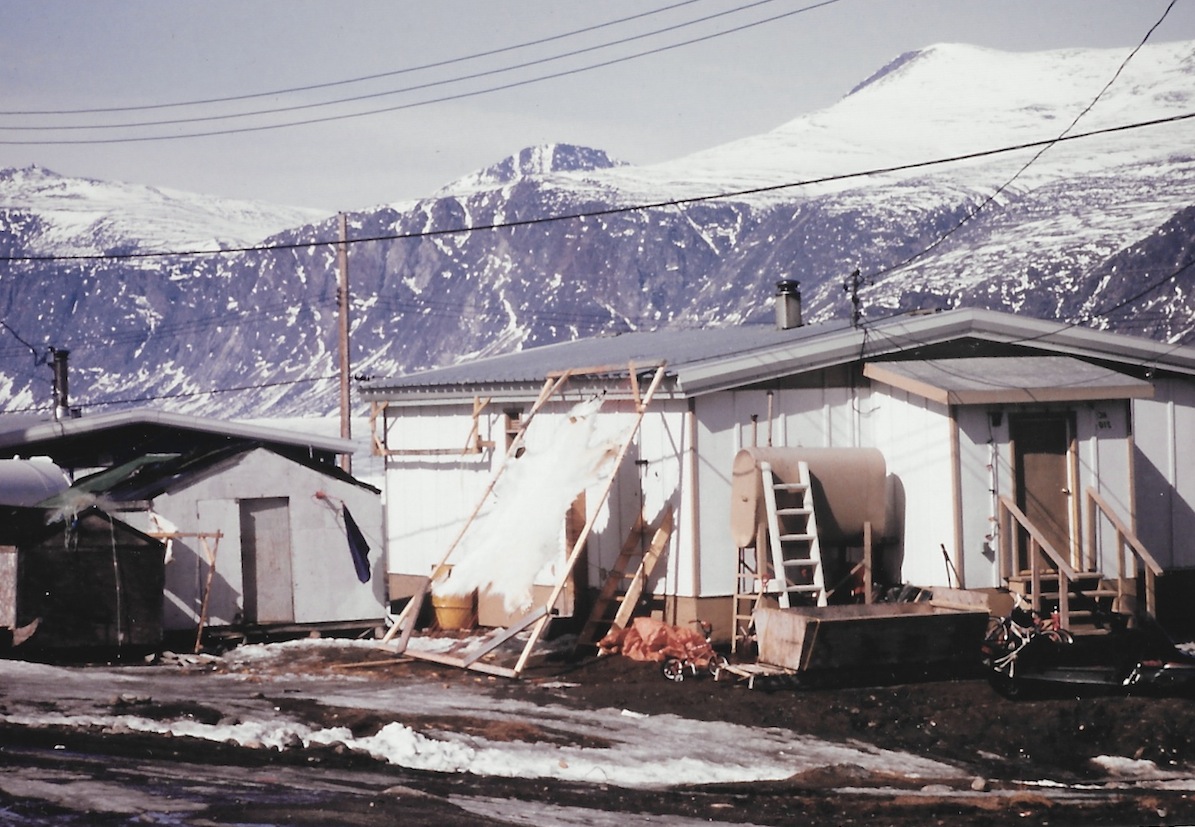
A polar bear skin is stretched out against the side of a house in Pangnirtung, May 1993. (PHOTO BY JANE GEORGE)

A polar bear skin is stretched out against the side of a house in Pangnirtung, May 1993. (PHOTO BY JANE GEORGE)

On that spring day in Pangnirtung— a place better known by its short name of “Pang”— everyone I met was smiling. Silatsiaparaaluk or “What a great day!” we said in greeting.

I managed to find a spot on the shore where nothing of today’s community could be seen. I  saw only the spare red and white lines of the old blubber station where Inuit women once flensed the whalers’ catch.

In the background, three mountains, whose intersection in ridges of shadows and snow formed the same view that the first visitors to Pang saw more than a century before.

The red and white Blubber Station in Pangnirtung, May 1993. (PHOTO BY JANE GEORGE)

The red and white Blubber Station in Pangnirtung, May 1993. (PHOTO BY JANE GEORGE)

I decided to pay a visit to the visitors’ centre that houses a library, museum and elders’ room.  I was talking to Margaret Karpik, who then ran the centre, when a short, white-haired old man came out of the elders’ room.

“I just don’t understand,” he said. “Why do they call me luttaakuluk? What does that “kuluk” mean?”

“It means “cute, little”,” I suggested, fresh out of my Inuktitut course.

“But I’m sure I never heard that expression when I lived here,” he said.

His name was Otto Schaefer, a retired doctor from Edmonton, who, some 40 years earlier, had lived in Pang. Then, Inuit still lived out in camps around the Cumberland Sound area. They were often sick, and Dr. Schaefer would visit them. He was back in Pang, he said, for a final visit, to see his dear friend Etooangat, who used to take him to the camps. Etooangat, by then, was in his 90s, the oldest man on Baffin Island and the last of Pang’s whalers.

I had my camera with me and I asked the two old friends if they’d like a photo of their reunion. The two sat side-by-side on the couch, the doctor, with his glasses, flannel shirt and sports coat, Etooangat in a bright spring parka. In the photo, the doctor has his arm around his friend, both men with smiles on their faces. The shared pleasure in the moment was clear, and I kept this photo of the two happy, elderly men on my desk long after that day. Years later, I learned that Etooangat had finally passed away.

Etooangat and Dr. Otto Schaefer, who worked together to combat illness around Pangnirtung during the 1950s, sit together in the community elders' centre in May 1993. (PHOTO BY JANE GEORGE)

Etooangat and Dr. Otto Schaefer, who worked together to combat illness around Pangnirtung during the 1950s, sit together in the community elders’ centre in May 1993. (PHOTO BY JANE GEORGE)

Over the years I also learned more about Schaefer, too, that he was the first to systematically study northern health, after coming to Canada from Germany in 1951. In Aklavik, and then in Pangnirtung, he fought epidemics of tuberculosis, German measles and meningitis with every medical tool available to him.

Schaefer, who died in 2009, also wanted to understand and conquer what he called the increasing number of “diseases of civilization” affecting Inuit — tooth decay, fetal alcohol syndrome, diabetes, and anemia.

Schaefer and Etooangat worked together at Pang’s St. Luke Hospital.

During one epidemic Etooangat worked for three days without sleep, helping to give inoculations and transport the sick to the hospital.

“When you see so many sick people, you want to help in whatever way you can,” Etooangat said.

Both devoted to relieving misery, Etooangat and Schaefer formed a tireless pair, working closely together in 1956 and 1957, when the doctor and his young family lived full-time in Pangnirtung.

As the two travelled to the 14 camps in the vicinity twice a year by dog team, journeys of 2,000 kilometres, they became fast friends. Etooangat helped the doctor and his wife Didi learn Inuktitut, and taught them Inuit ways. When Schaefer’s daughter was born in Pangnirtung, she was called Taoya, after Etooangat’s daughter. Schaefer recalled a Christmas which the two families spent together as “the happiest of all.”

“His knowledge of weather, ocean, land and ice conditions and his skills in living on the land have helped the Inuit survive during a period of rapid and tumultuous change,” said Governor General Roméo Leblanc when he presented Etooangat with the Order of Canada in 1995.

After leaving the elders’ centre that day, I walked to the far end of the community. There, the air was filled with the rushing sound of water. The bridge ran over a river where water is bubbling over a thick layer of green and blue ice. I went home very late that day. The following morning Margaret Karpik took me on a tour of the blubber station. Although we stayed in contact and I sent her a large copy of the photo of Schaefer and Etooangat, I wouldn’t see her again for many months.

The next instalment of “Like an iceberg” goes live on April 10.

You can read the first blog entry of “Like an iceberg”  from April 2 here.

Other previous instalments are here:

Like an iceberg, 1991…cont.

Like an iceberg, 1991…more

Like an iceberg, 1992, “Shots in the dark” 

Like an iceberg, 1992, “Sad stories”

Like an iceberg, 1993, “Learning the language of the snows”


Like an iceberg, 1993, “Learning the language of the snows”

Like an iceberg, 1993: “Learning the language of the snows”

In May 1993 I was in Iqaluit, the largest community on Baffin Island, a place that I couldn’t find on a map two years before on my first trip north in Canada.

I was already on my second visit to Iqaluit, the first, only two months earlier, to work on a radio documentary on the creation of Nunavut, still six years away. And I was still throwing together radio and print freelance contracts to cover the cost of my travel and try to earn a living.

Work on radio documentaries for CBC’s national network, Radio-Canada, the Globe and Mail and other media allowed me to attend a three-week intensive Inuktitut program at Nunavut Arctic College.

Nunavut Arctic College in Iqaluit, May, 1993, (PHOTO BY JANE GEORGE)

Nunavut Arctic College in Iqaluit, May, 1993, (PHOTO BY JANE GEORGE)

There, I hung out in the hallways between classes, with that dazed feeling I hadn’t felt since high school. By 9 p.m., when the last class ended, with my brain full of Inuktitut, I could barely see straight. But then it was time to hit the books.

The group of 18 students was a teacher’s dream: We were patient and we listened attentively. That’s because we all wanted  to learn Inuktitut.

I’d already studied Inuktitut for a year with help from anthropologist and Inuktitut-speaker Louis-Jacques Dorais at Université Laval. Most of my fellow students at Arctic College also had a basic knowledge of the language.

“You’re crazy to waste your time learning Inuktitut,” more than one person told me. “Isn’t it enough to speak English and French in Canada?”

But they’d obviously never visited a small Arctic community where all of the social life is conducted in Inuktitut. All of us in this class had been hampered by not knowing what’s going on or being able to join in.

I believed then that Inuktitut would become the language of tomorrow’s Arctic, because the creation of Nunavut was just around the corner: In 1999, Nunavut was to be carved out of the Northwest Territories.

My classmates included a few teachers from remote areas of Baffin Island — they wanted to be able to speak with students and their parents, a research scientist who spent months in the North out on the ice floes,with Inuit companions he’d like very much to talk with and learn from, an Anglican minister who needed to read the psalm book printed in Inuktitut syllabics to his congregation, two business managers and a company executive who wanted to talk to employees in their own language and understand what was happening on the job.

I wanted to understand older Inuit who rarely speak English. I wanted to more creatively pass away my hours spent waiting for the weather to lift by practicing Inuktitut. I wanted to know what’s happening. I kept thinking about Peter Murdoch and the other non-Inuit I knew who speak Inuktitut — if they could do it, I could, too.

In this class we learned, according to our text book, that Inuktitut has a complicated grammar whose many conjugations rival those of Finnish, a language that I learned just by hearing it spoken every day.

However, as adults, mastering how to speak clearly in Inuktitut about where we’re coming from and where we’ve been took hours.

One of our instructors — we hd four every day, teaching in shifts — got us down on the floor. We each chose a conveyance — an airplane, a snowmobile, a truck, a boat, a canoe or a dog sled, which we had to navigate in Inuktitut across mountains, over rivers and to and from various places — places such as Pond Inlet, whose Inuktitut name means where the hunter Mittima lived.

We became children again in this exercise, wrestling with such phrases as “Going by Twin Otter, I was on my way to Pangnirtung,” the place with bull caribou.

Every day, we dreaded dictation. A typical day’s 15 words included nunanngunngaujunga, the innocuous, but impossible, “I am going to his land.”

But we had fun, too, writing a soap opera whose action took place on the floe edge. And, to learn how Inuktitut answers a negative question, we sang “Oh yes, we have no bananas” in Inuktitut — that was a favourite teaching tool of our teacher Mick Mallon, who first learned Inuktitut in Puvirnituq in the 1960s.

My fellow student Stuart Innis, a research scientist with the Department of Fisheries, who died in a helicopter crash near Resolute Bay, Nunavut in 2000, and Mick Mallon, longtime Inuktitut teacher, relax after a day in the intensive Inuktitut course held at Nunavut Arctic College in Iqaluit in 1993. (PHOTO BY JANE GEORGE)

My fellow student Stuart Innis, a research scientist with the Department of Fisheries, who died in a helicopter crash near Resolute Bay, Nunavut in 2000, and Mick Mallon, longtime Inuktitut teacher, relax after a day in the intensive Inuktitut course held at Nunavut Arctic College in Iqaluit in 1993. (PHOTO BY JANE GEORGE)

At the same time, we learned that the grammar of sentences in Inuktitut wasn’t always the same, even within one paragraph: Some elements are left dangling, their context being the reality outside, which the speakers intuitively know, and make reference to.

Alexina Kublu speaks to students in the intensive Inuktitut class at Nunavut Arctic College in 1993. (PHOTO BY JANE GEORGE)

Alexina Kublu, who would later become Nunavut’s official languages commissioner, speaks to students in the intensive Inuktitut class at Nunavut Arctic College in 1993. (PHOTO BY JANE GEORGE)

Another  instructor, Alexina Kublu, who worked with Mallon on the textbook that serves as our guide, spent a lot of time trying to explain family relationships. She explained that each Inuk bears the name of a dead relative and actually becomes that dead person, inheriting his or her relationships as well.

“I would like my mother to live in Igloolik,” an Inuk uncle might say to a new mother, she said, giving her baby his late mother’s name. And, if your daughter has your great-aunt’s name, you might end up calling her “Mother,” especially if that aunt was like a mother to you.

The southerners, called Qallunaat in Inuktitut, imposed a new naming system. First, it was new names from missionaries, followed by government-issued numbers on “Eskimo” tags in the 1950s, and finally by new surnames in the 1970s.

Because family names were assigned almost at random, closely related families may bear completely different names today. That confused what was, to Inuit, an entirely understandable system.

“Do these relationships make it hard for a mother to discipline someone who is her grandfather?” asked a teacher-classmate, mulling over problems in his community.

I was thinking, if I ever understand this language, will I see the North more clearly?

Mary Wilman teaches the Inuktitut names for the parts of the body during an intermediate class in Inuktitut at Nunavut Arctic College in 1999. (PHOTO BY JANE GEORGE)

Mary Wilman, who would later serve as the mayor of Iqaluit. teaches the Inuktitut names for the parts of the body during an intermediate class in Inuktitut at Nunavut Arctic College in 1999. (PHOTO BY JANE GEORGE)


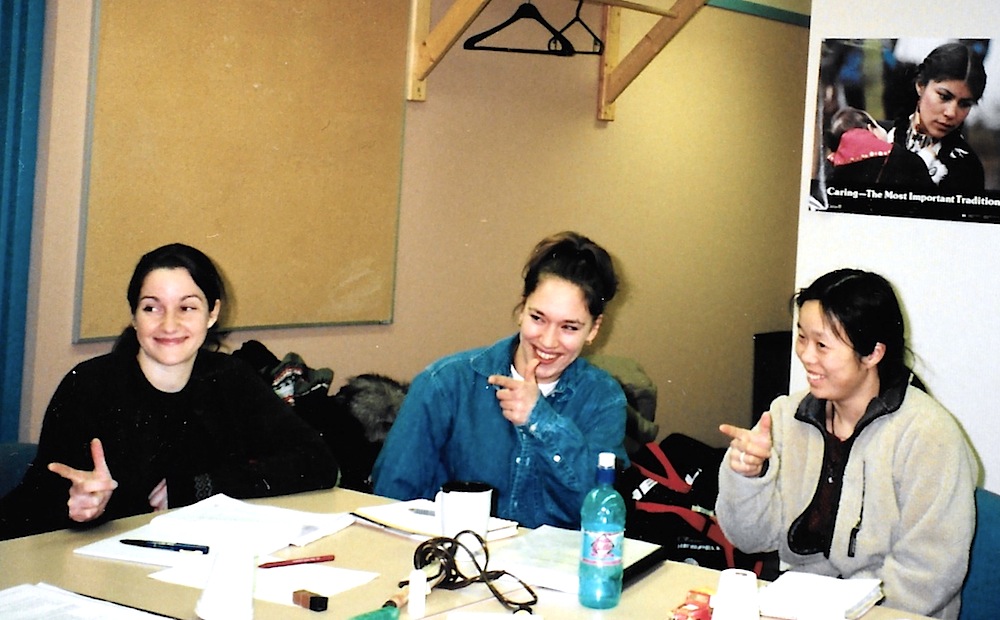
Jocelyn Barrett, Sylvia Cloutier and Siu-Ling Han participate in an exercise during the 1999 Intermediate Inuktitut class at Nunavut Arctic College in Iqaluit, which involves "shooting" the right person, according to the command in Inuktitut. (PHOTO BY JANE GEORGE)

Jocelyn Barrett, Sylvia Cloutier and Siu-Ling Han participate in an exercise during the 1999 Intermediate Inuktitut class at Nunavut Arctic College in Iqaluit, which involves “shooting” the right person, according to the command in Inuktitut. (PHOTO BY JANE GEORGE)


A few years later, I took another course at Arctic College at an intermediate level, with a small group of students taught by Mary Wilman of Iqaluit and Mallon.

After this course, I could listen to the radio more easily, watch television, have a simple conversation, even take down Inuktitut telephone messages and put a trilingual message on my voice mail message.

My improved understanding of the Inuit language did save me one day, when at an airport in Nunavik, I heard the Air Inuit agent saying that there is only one more seat on the small airplane, but there were many people on the stand-by list — which included me. I dashed up to the counter and made the flight.

I upgraded my skills in Inuktitut enough to understand the flow of comments at meetings and to answer questions. Once I sat in the bar in Kuujjuaq, Nunavik’s largest community, where you hear more Inuktitut than in Iqaluit, and struck up a conversation with the woman sitting next to me in Inuktitut.

“But you don’t look like you speak Inuktitut,” she said.

My teachers at the intensive Inuktitut course held at Nunavut Arctic College in 1993: Alexina Kublu, who went on to become Nunavut's Official Languages Commissioner, and Mick Mallon, who pioneered Inuktitut teaching in the Eastern Arctic. (PHOTO BY JANE GEORGE)

My teachers at the intensive Inuktitut course held at Nunavut Arctic College in 1993: Alexina Kublu and Mick Mallon, who pioneered Inuktitut teaching in the eastern Arctic. (PHOTO BY JANE GEORGE)

The next instalment of “Like an Iceberg” goes live on April 9.

You can read the first blog entry from April 2 here.

You can find previous instalments here:

Like an iceberg, 1991…cont.

Like an iceberg, 1991…more

Like an iceberg, 1992, “Shots in the dark” 

Like an iceberg, 1992, “Sad stories”