Two Arctic ships, two explorers: Franklin and Amundsen

As Prime Minister Stephen Harper touted the Sept. 9 discovery of  one of Sir John Franklin’s ships, located after more than 160 years, Jan Wanggaard of the Maud Returns Home project couldn’t help thinking about the parallels between Franklin’s newly-relocated ship and the vessel that he and a group of Norwegian investors plan to bring back to Norway.

That’s the Maud, sailed by Norway’s polar exploration hero, Roald Amundsen, who in 1906 was the first European explorer to sail through the Northwest Passage.

Amundsen left Norway in 1918 with the Maud, planning to drift westwards with the ice across the Northeast Passage, now called the Northern Sea Route, and over the North Pole — but never completed that journey and the Maud eventually ended up outside Cambridge Bay, Nunavut, where it sunk.

In the forefront, a cairn built by Jan Wanggaard, the half-submerged Maud and the town of Cambridge Bay. (PHOTO BY JANE GEORGE)

In the forefront, a cairn built by Jan Wanggaard, the half-submerged Maud and the town of Cambridge Bay. (PHOTO BY JANE GEORGE)

The Maud, at 36.5 metres, was about the same size as the Franklin ship.

But there the parallels end, Jan Wanggaard told me in Cambridge Bay where I’m visiting this month.

First of all, there’s been no mystery surrounding the Maud. That’s because everyone in Cambridge Bay knows where the ship is located because part of the hull is still visible above the water.
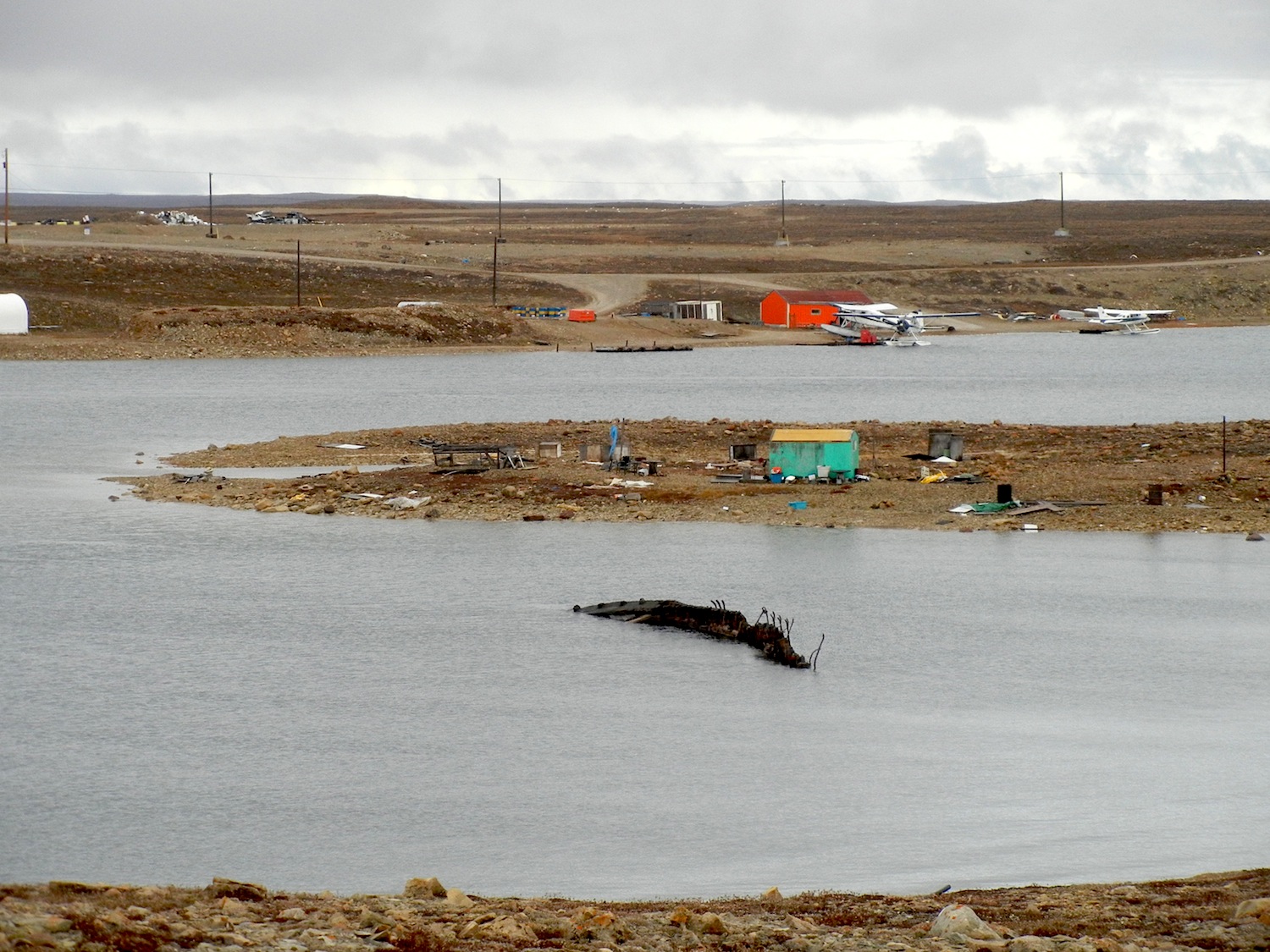
Part of the Maud, shown here in September, 2014. sticks up through the water. (PHOTO BY JANE GEORGE)

Part of the Maud, shown here in September, 2014. sticks up through the water. (PHOTO BY JANE GEORGE)

And unlike Sir John Franklin’s two ships, the history and location of Amundsen’s ship is well known.

And there’s another big difference: the Maud was designed to avoid the kinds of mistakes made during the disastrous voyage of the Terror and Erebus. The round hull of Amundsen’s vessel was designed to avoid being crushed by ice and he travelled with a small crew, well versed in Arctic survival skills, which Amundson learned from Inuit, Wanggaard said.

“Amundsen learned from other people’s mistakes,” he said.

And then there’s the way that Norwegians have gone about retrieving the Maud.

A private investment company, Tandberg Eindom, is underwriting a modest project to bring the Maud back to Norway — a low-key effort, now four years old, that employs a handful of people, unlike the huge multi-year Franklin ship search launched by the Canadian government.

“If we had to work with a government, it [the effort to bring the Maud to Norway] would not happen,” Wangaard said. “When there’s too many people in the kitchen, it will be a mess.”

So, what will happen to the Franklin ship? Wanggaard thinks its fate will be discussed for years, because it’s also connected to political issues, although the technical work of studying the vessel could be done quickly, he said.
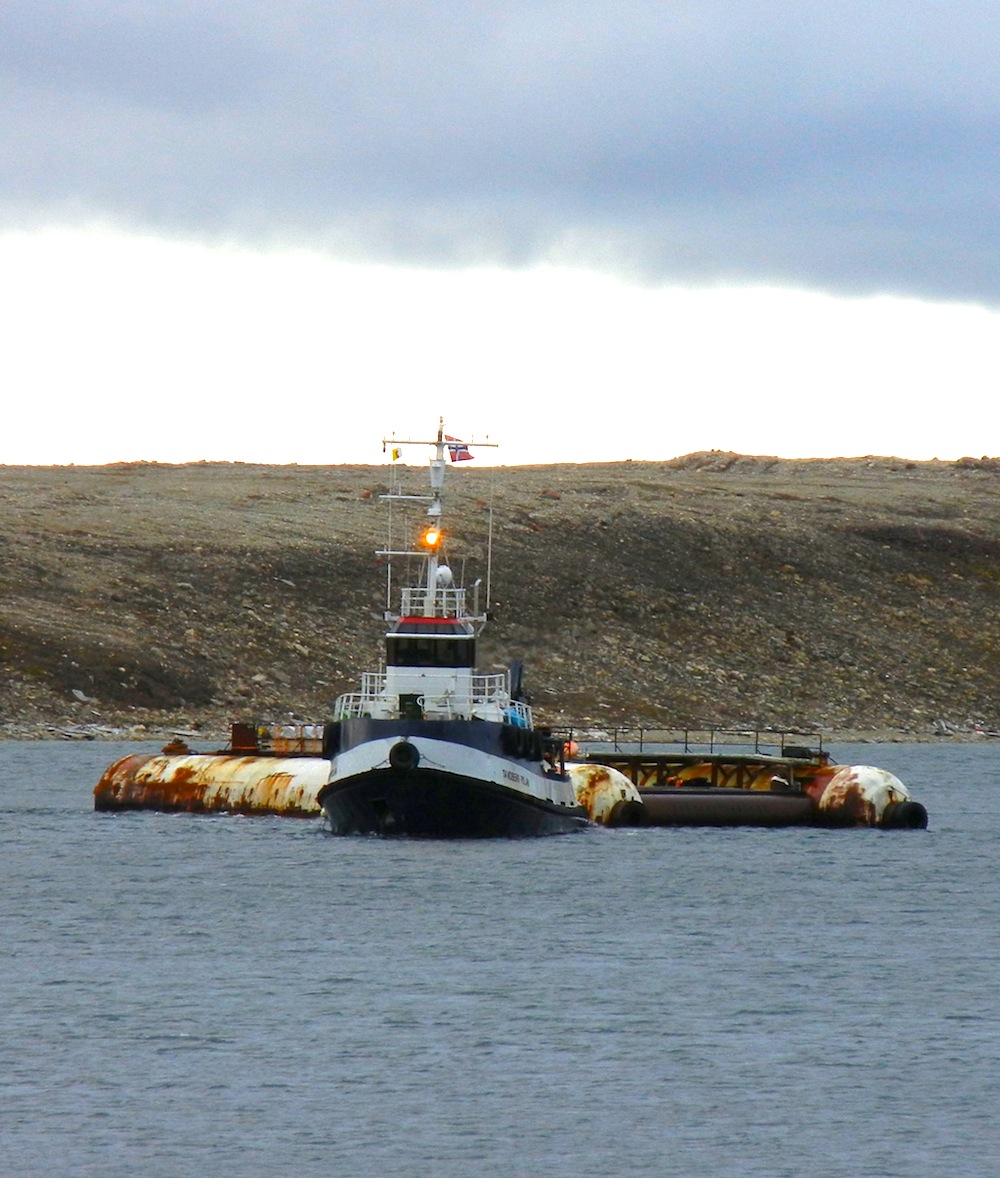
The Tandberg Polar tug arrives in Cambridge Bay with the pontoon barge which will help raise the Maud to the surface. (PHOTO BY JANE GEORGE)

The Tandberg Polar tug arrives in Cambridge Bay with the pontoon barge which will help raise the Maud to the surface. (PHOTO BY JANE GEORGE)

This summer, the Norwegians, who obtained an export permit to move the Maud in 2012, moved close to bringing the ship back with the arrival of the Tandberg Polar tug and barge in Cambridge Bay.

They plan to raise the Maud with balloons, drag the hulk over to a barge, lift it into a kind of “cradle” in the barge, raise it out of the water, slowly, to avoid any stress, and then tow it back to Norway — a 7,000-kilometre journey, Wanggaard said.

The Maud is to be exhibited at a museum in Asker, a suburb of Oslo, from which the Maud was launched on its first voyage.

But, with the short ice-free season of 2014 moving to a close, Wanggaard plans to let the Maud stay where it is until 2015.

“We can’t risk having a problem in the middle of the procedure of lifting,” he said.

And how long will it take to move the Maud onto the submerged barge?

That’s similar to the question of how much time it would take the team to travel from Norway to Nunavut, Wanggaard  said. In the end, due to bad ice conditions in the Northwest Passage, that journey took three months — more than anticipated.

But, if bringing the Maud back to Norway takes just a few years, that’s a much shorter period of time than any similar government effort would take, he said.

Look regularly at A date with Siku girl for most posts from Cambridge Bay, Nunavut.

Did you miss Today, Arctic explorers take cruise ships?


Today, Arctic explorers take cruise ships

More than 100 years after Norwegian explorer Roald Amundsen successfully traversed the Northwest Passage in 1905-06, there’s a new kind of sailor eager to accomplish that iconic voyage: the cruiser.

In 2014, five cruise ships — albeit some looking more like icebreakers than luxury liners — stopped by the western Nunavut of Cambridge Bay, where I’m staying this month, to start or finish their trip through the passage.

To see what kinds of well-heeled folks travel on those trips, which can cost $7,000 USD and more, I tracked a plane load of more than 100 passengers who arrived in the town of about 2,000 people to set off on their Adventure Canada trip through the Northwest Passage.

After landing Sept. 8, they spent an afternoon in the community, participating in activities led by Vicki Aitaok, who’s organized similar visits for several years.

Jessie Tologanak tells a group of cruisers the legend of Mt. Pelly, seen in the distance beyond. (PHOTO BY JANE GEORGE)

Jessie Tologanak tells a group of cruisers about the legend of Mt. Pelly, seen in the distance beyond. (PHOTO BY JANE GEORGE)

My group of cruisers set off to walk around town with Jessie Tologanak under sunny skies, heading down the muddy main street, past the hamlet office, the health centre, St. George’s Anglican Church and the visitors centre, down to where everyone could see across to Mt. Pelly, the 200-metre-high esker located 15 kilometres outside town.

“We call that Ovayuk,” she said, pointing to Mt. Pelly, relating the legend of how a starving giant laid down and died there.

Inuit legend says that Ovayuk and two smaller hills are a family of starving giants who were crossing Victoria Island looking for food.

The father, Ovayok, died first.

“His bladder burst and that’s water you see there,” Jessie said, pointing to the bay.

A cruiser takes a photo of an old Hudson Bay Co. building. (PHOTO BY JANE GEORGE)

A cruiser takes a photo of an old Hudson Bay Co. building. (PHOTO BY JANE GEORGE)

Visiting Nunavut and Greenland, where the cruise would end Sept. 22, is different from visiting Antarctica, a woman told me as Jessie spoke. That’s because there were only penguins in Antarctica, she told me — no people or communities.

Many in the group wore jackets from those trips marked “Antarctic,” and nearly all said they had been to the North before, to Alaska, Yukon or the Svalbards.

And, while I expected to find an elderly bunch of people, this gang was fit. Although I saw at least one hearing aid, these men and women didn’t appear to have any difficulties.

“You’ll find a well-travelled group here,” an Adventure Canada organizer told me. “It may be a trip of a lifetime to go through the passage, but they’ve been to lots of other places before.”

And the cruisers had researched their destinations and voyage beforehand. A woman told me how Adventure Canada had first cancelled the trip she was to embark on. That’s because the ship slated for this cruise, the Clipper Adventurer, which spectacularly ran in to a shoal near Kugluktuk in August 2010 during a previous Adventure Canada cruise, had broken down.

And it was only at the last minute that she and the other passengers had been offered a chance to travel on the Akademik Sergey Vavilov, docked outside Cambridge Bay.

The Russian-registered Akademik Sergey Vavilov, redubbed One Oceans Voyager by uneasy Canadians, at anchor Sept. 8 outside Cambridge Bay. (PHOTO BY JANE GEORGE)

The Russian-registered Akademik Sergey Vavilov, redubbed One Ocean Voyager by uneasy Canadians, lies anchored Sept. 8 outside Cambridge Bay. (PHOTO BY JANE GEORGE)

That the vessel is a Russian-run and registered ship, previously used to carry out Russian research, wasn’t something you read widely, she said — instead it was redubbed “The One Ocean Voyager,” during on a previous cruise.

That’s when its crew and passengers with One Ocean Expeditions and the Royal Canadian Geographical Society participated in Parks Canada’s effort to locate HMS Erebus and HMS Terror, the ships lost on Franklin’s 1845 expedition.

“I guess Harper didn’t want to be seen as using a Russian vessel on his Canadian mission to find the ships,” she said. (Harper announced Sept. 9 the discovery of one of Franklin’s two ships)

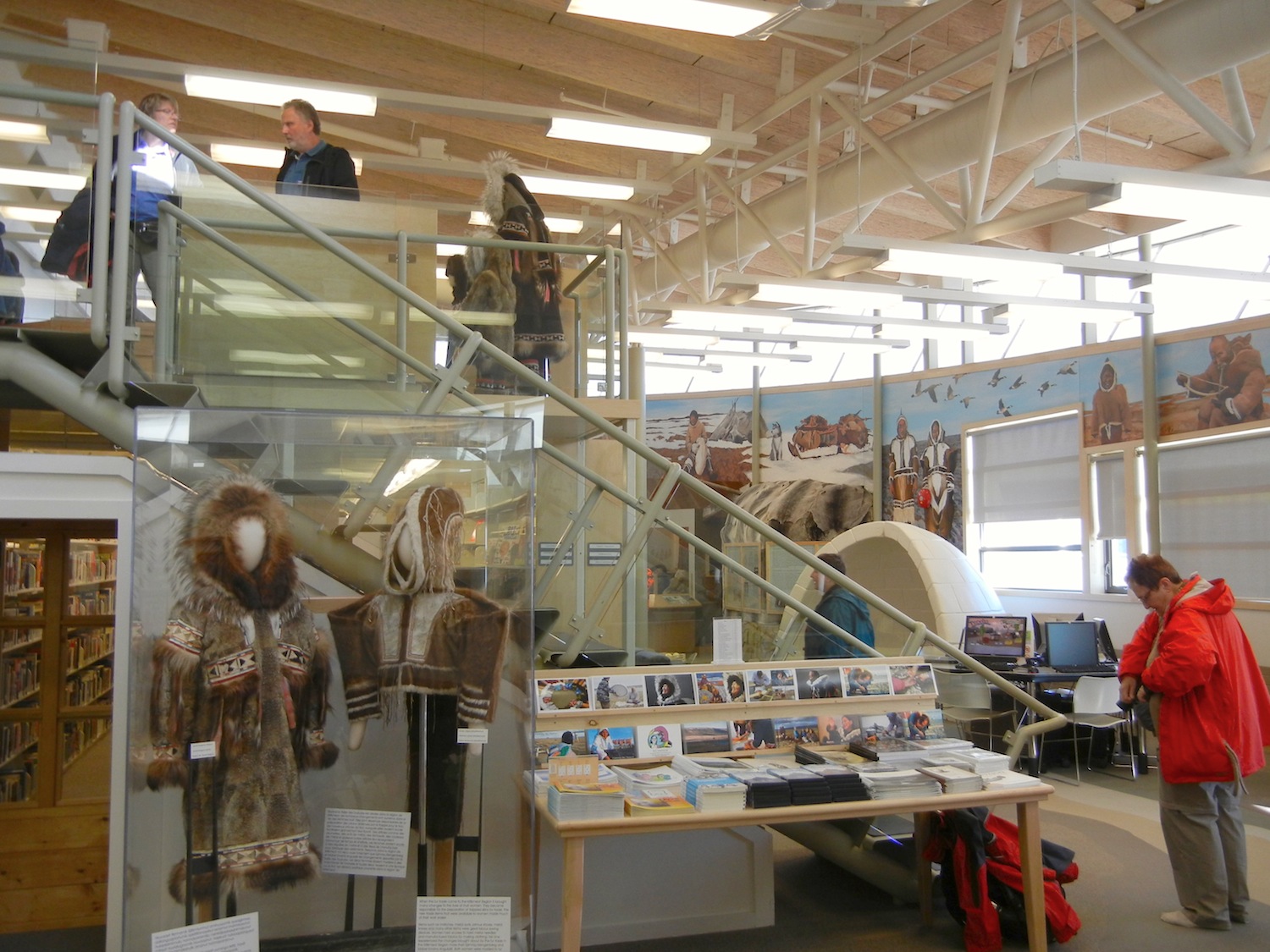
Cruisers take in the exhibits at the May Hakongak Community Library and Heritage Centre. (PHOTO BY JANE GEORGE)

Cruisers take in the exhibits at the May Hakongak Community Library and Heritage Centre. (PHOTO BY JANE GEORGE)

We continued back to the Kiilinik High School where there was time to peek into the May Hakongak community library and heritage centre before the start of a cultural performance, which included a qulliq lighting, local throat singers, drummers and dancers, and music from blind musician Ashlee Otokiak.

Dancers at the Sept. 8 cultural performance at Cambridge Bay's high school. (PHOTO BY JANE GEORGE)

Dancers at the Sept. 8 cultural performance at Cambridge Bay’s high school. (PHOTO BY JANE GEORGE)

Then they walked off down the hill to the bay to board the Akademik Sergey Vavilov on zodiacs.

But given the heavy ice conditions in the Northwest Passage this year, a passenger joked they could be back in Cambridge Bay next week.

“But it’s the trip, not the destination” — Kangerlussuaq, Greenland — that counts, he said.

Keep a look out for future posts from Cambridge Bay in A date with Siku girl.