Like an iceberg, 1995 cont., “Greenland”
I felt as if I’d visited Greenland before when I stepped off an airplane there in September 1995. But I couldn’t decide what Greenland’s capital city of Nuuk reminded me of.
It was a bit like the place I just left, Iqaluit, but at some point in the future. In 1995, Nuuk had more than three times the population of Iqaluit (then about 4,300,) paved roads, buses and even street lights. And stressed-looking commuters with briefcases. Instead of wearing big-hooded parkas to carry their babies, Inuit mothers in Nuuk pushed baby carriages.

The main store in the centre of Nuuk in 1995, Brugsen, a Danish supermarket chain. (PHOTO BY JANE GEORGE)
Or maybe, Nuuk made me think about Newfoundland: there was something familiar about the scenery — rocks and no trees. Nuuk resembled Cornerbrook, but with higher prices: a cup of coffee cost, by my calculations, $4.50, a beer $9.
Then, again, I was reminded of Scandinavia.
Down by the shore in Nuuk I discovered the old town of Godthab, as the Danes who settled here in the 1700s used to call Nuuk, with its mustard and red- coloured houses with steep roofs.
Downtown, the stores sold dense Danish bread, salty black licorice and even my favourite liqueur, a bitter drink by the name of Gammel Dansk, the Old Dane.
I climbed to the top of a small hill in the centre of Old Nuuk, with a bronze statue looking out over the water of Hans Egede, the first missionary, who came to Greenland in 1721.
Icebergs sailed by in the cold water. Their path was marked by turquoise froth where white ice met the water’s surface. Across the water, a ridge of low mountains, sprinkled with snow. At this time of year, belugas and seals would pass by, and I strained my eyes to try to see some. The Sermitsiaq mountain rose up in a spiky point to touch the high clouds.

A view over to the Old Town of Nuuk, Greenland. (PHOTO BY JANE GEORGE)
In a cemetery, the white wooden cribs around the plots were falling over: long grass covers old graves. Not far away, in front of the former hospital, there was a row of shiny kayaks. Some skin-covered ones were in the museum, but just next door, at the Kayak Club, young men were touching up the frame of a homemade kayak. For us, it’s just a hobby, they told me.

Kids play chess in a Nuuk recreation centre, 1995. (PHOTO BY JANE GEORGE)
At the back of Santa’s Post Office down by the shore, I found a six-metre high plastic pacifier filled with tiny pacifiers. When a Greenlandic child no longer needed a pacifier, he or she would deposit it here.
A stop at a sealskin workshop brought me back to reality. A group of women were sitting around a table, making tiny kamiit, the sealskin boots worn across the Arctic. Although these women spoke a Greenlandic dialect of the Inuit language, I could understand them fairly well.

A man cuts up caribou at a country foods market in Nuuk. (PHOTO BY JANE GEORGE)
And, like Inuit in Canada, Greenlanders appeared to share a taste for country foods. Seal, walrus, local meats and whale blubber were sold in large slabs at the market.
But Nuuk’s reality was definitely more urban than anything I’d seen in the North of Canada, with its giant apartment blocks housing up to 900 people each.

A view of one of the many huge apartment blocks in Nuuk, Greenland. (PHOTO BY JANE GEORGE)
I made a visit with a friend to the apartment where his mother lived: graffiti lined the stairwells, the walls were paper-thin, even the windows seemed more to offer a barrier to privacy than a view on the world.
The per capita suicide rate in one such building is the highest in the world, I was told. Clean laundry, a bicycle and pieces of seal meat dangled from balconies on strings, like mobiles, the last links to the land.

Laundry and seal meat hang from the balcony of this Nuuk apartment in 1995. (PHOTO BY JANE GEORGE)
During the day, I got caught up with café life and icebergs. I saw friends, musicians here in town, and we talk about spiritual healing, Thai spices and CDs: If it hadn’t been for the view, you’d have thought we were on St. Denis Street back in Montreal. After dark, Nuuk was not so different from the seedier sections of Ste. Catherine St., with bars reeking of stale cigarettes and beer.
“Look around us at all the plastic, all those things brought thousands of kilometres, over the ocean,” said a Greenlandic singer and songwriter.
I’d met with him for a CBC radio documentary on Greenlandic music that I was preparing.
“I’m the only thing that hasn’t been brought here,” he said.
I looked at a spiky plastic cactus impaled between two windows of the western-style bar we were sitting in.
“All this, it’s hard to live with,” he said.
But I didn’t want to dwell on trauma, despair and hopelessness — not that night. That was familiar enough. I liked being in a North with Tuborg beer and cappuccino.
The next morning, I saw my tired face in the mirror and remembered I was supposed to be looking at the justice system here for another story.
I had visited my first jail in the Nunavik community of Puvirnituq a few years ago. The second northern jail I’d seen was in Iqaluit, the Baffin Correctional Centre. There, a heavy-set guard, with a shaved head and beard, sat at the entrance.
The employees on duty the day when I visited are all white, while the inmates were all Inuit. Some of the prisoners couldn’t speak any English. When I asked a guard why more Inuit weren’t working at BCC he says “because they aren’t very hard-working” — as if I would agree with this reflection.
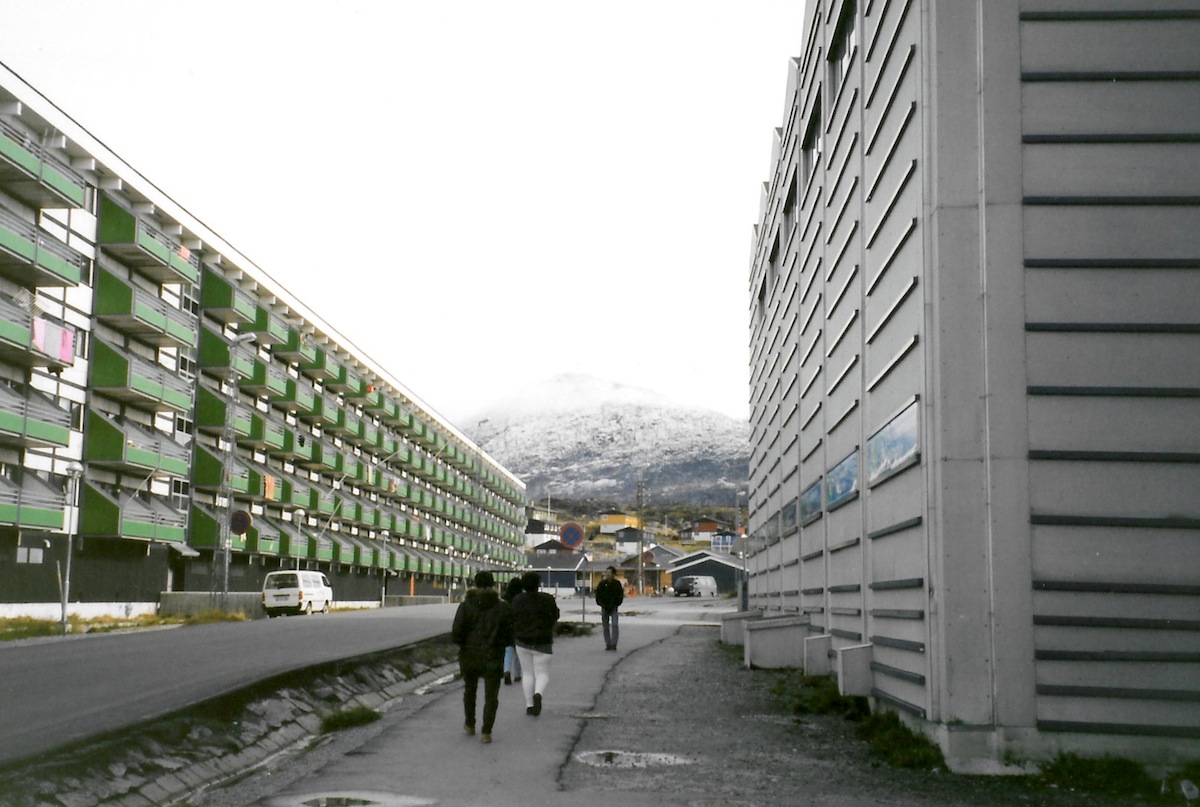
A look down one of Nuuk’s streets in 1995. (PHOTO BY JANE GEORGE)
The third jail I visited was in Nuuk. It wasn’t even called a jail — but a “correctional residence.” In one room, a man doing time showed me his artwork, drawings of glaciers calving into the ocean, of a kayaker finding his way through ice floes. In the neighbouring room, two men were sharing a cup of coffee by candlelight.
In nearly every room, there were computers, television sets and stereos. Windows looked out over the fiord, while doors could be locked, from the inside, for privacy. One resident was introduced to me as an “investment counselor.”
A Greenlandic friend later told me that this man killed two other men over a financial dispute a few years ago. Since then, he’d been held at the corrections residence.
From there, this model inmate managed to engineer a money-making scam to import 250 kilos of hash. It was the lead story in the Nuuk’s newspaper the week I was there, and many people said they were upset because they lost money in the deal.
A guard showed me the menu for the residents’ evening meal, cold plates with pâté, cheese and fish. It looked better than what I’d been eating in town. Residents had return to eat after work, but on weekends and three nights a week, they could go back out and visit friends or family. They were expected to come back sober. For all this, they paif about $175 per week.
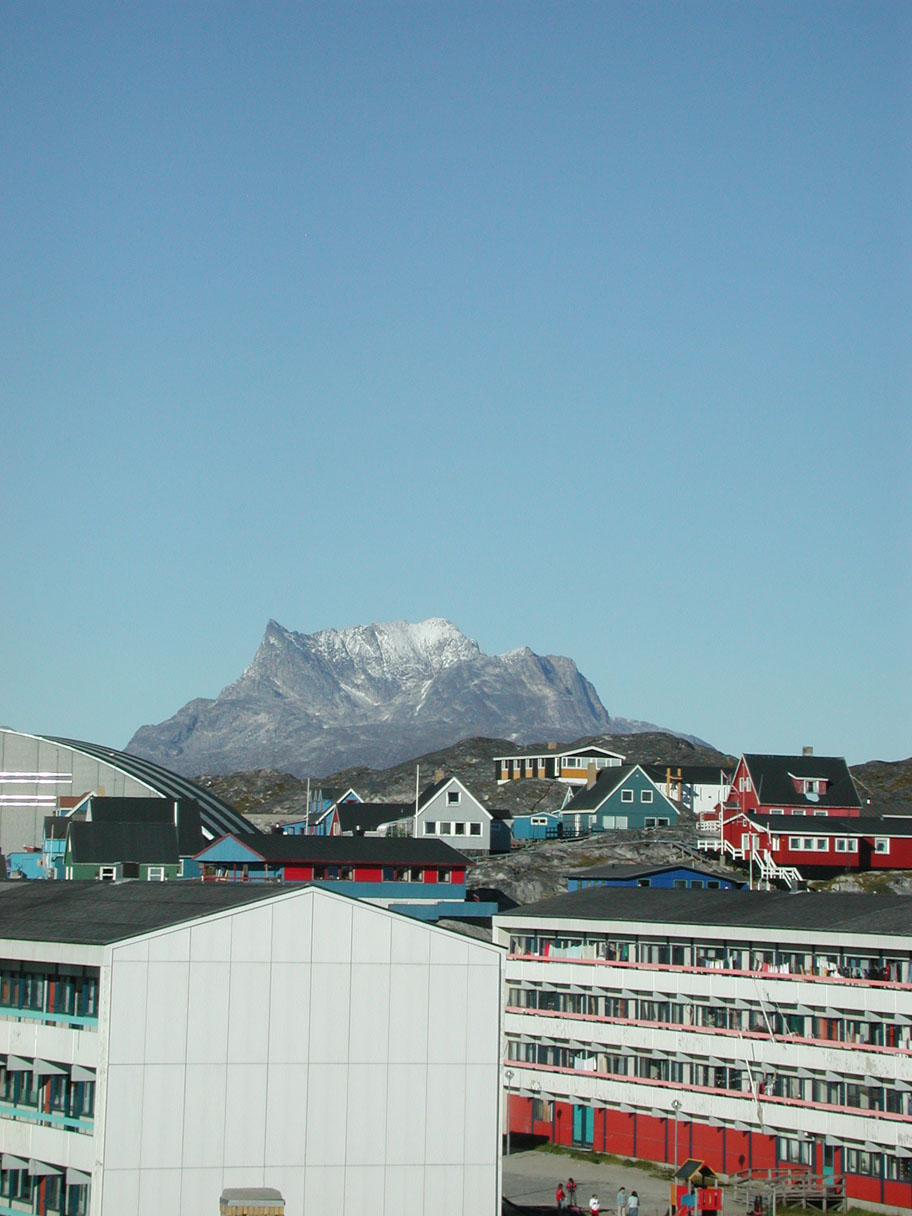
The Sermitsiaq mountain is a landmark around Nuuk. (PHOTO BY JANE GEORGE)
So, that’s how crime and punishment worked in Greenland — it didn’t look too bad, at least from the criminals’ point of view.
Re-socialization was the aim here in Greenland, not punishment: There were almost no professional judges, lawyers or police. Most communities had lay judges, and what they called “assessors” for lawyers and “bailiffs” for policemen.
At a typical hearing, like the one I attended, there was a judge, the accused and two assessors. A couple of pieces of evidence were introduced.
The accused, like 90 per cent of all Greenlanders who end up in court, pleaded guilty to the charge of rape, was fined and sentenced to a few months in the corrections residence.
The advantages: The case was handled within weeks of the incident and it only took one and a half hours — not months — to decide. But any presumption of innocence seemed to be a moot point, although there was practically no evidence presented.
I started to wonder about the process. It didn’t seem like the guy had much chance to mount a defence — but he wasn’t going to suffer much of a punishment either. What about the victim?
How would she feel when she runs into this guy around town? Only about two out of every 2,000 women who made calls or come to the women’s shelter there pressed charges, a staff person at the shelter said.

Flowers are left on the steps of a bar where a young man died in an assault. (PHOTO BY JANE GEORGE)
Sentences for assault were lenient. Most women returned home. And with waiting lists of more than 10 years for apartments, there was nowhere else to go.
“It reminds me of Namibia in South Africa. Even those regular apartment blocks look like work camp housing. Who cares if you can leave the jail at will? Nuuk might as well be a jail because even law-abiding people can’t get out,” said a Canadian RCMP officer I talked with in Nuuk, which is accessible only by sea or air.
Maybe the Danish elite in Greenland didn’t care what the Greenlanders did to themselves, he said, or perhaps Denmark was just delivering the cheapest form of justice possible.
But, on the plus side, fly-in justice, seen throughout northern Canada, didn’t exist there. Instead, there was a court and judge of some sort in every community.
And people actually seemed proud of their system. They respected it. When I told my Greenlandic friends that I was looking into how justice works here, they would say “how interesting,” with no scathing criticism about how bad things were.
I was puzzled, though, that drug trafficking took place in plain view in downtown Nuuk. And, in fact, it was going on right down the street while at the other end the police were holding a recruiting drive, with a display of guns and even black riot gear.
Did they ever use that stuff there? And why did’t the police just look up the street? If there was lawlessness there, it didn’t seem to bother the locals much.
Unless, of course, Greenlanders just accepted things as they were. With that same attitude that once helped Inuit survive storms and famines, ajurngarmat, that expression, spanning the Inuit world, meaning it can’t be helped.
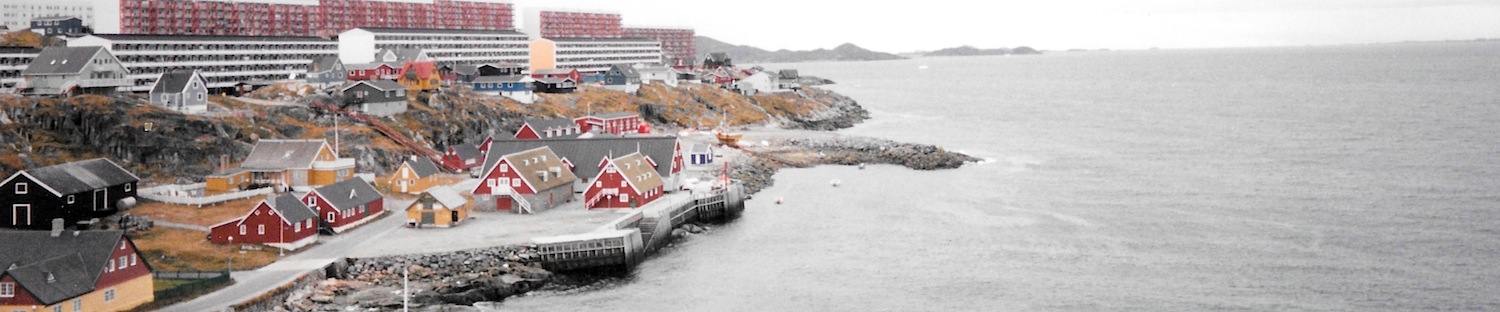
View over Nuuk, July 1995. (PHOTO BY JANE GEORGE)
The next instalment of “Like an iceberg” goes live April 24.
You can read previous instalments here:
Like an iceberg: on being a journalist in the Arctic
Like an iceberg, 1991…cont.
Like an iceberg, 1991…more
Like an iceberg, 1992, “Shots in the dark”
Like an iceberg, 1992, “Sad stories”
Like an iceberg, 1993, “Learning the language of the snows”
Like an iceberg, 1993 cont., “Spring”
Like an iceberg, 1993 cont., “Chesterfield Inlet”
Like an iceberg, 1993 cont., more “Chesterfield Inlet”
Like an iceberg, 1994: “Seals and more”
Like an iceberg, 1994, cont., “No news is good news”
Like an iceberg, 1994 cont., more “No news is good news”
Like an iceberg, 1994 cont., “A place with four names”
Like an iceberg, 1995, “More sad stories”
Like an iceberg, 1995 cont., “No place like Nome”
Like an iceberg, 1995 cont., “Greenland”


 A date with Siku girl