Like an iceberg, 1995 cont., “No place like Nome”

Like an iceberg, 1995 cont.: “No place like Nome”

In July 1995 in Nome, Alaska, the Kingikmiut Dancers of Alaska took to the stage, moving to the beat of drums. This group from King Island, or Ukivok, had revived Inupiat songs, dances and drumming not seen or heard for more than 50 years since the United States Bureau of Indian Affairs closed the school on Ukivok, leaving the children to attend classes on mainland Alaska.

By 1970, all King Island people had moved to mainland Alaska to live year round.

Occasionally the Kingikmiut drummers stopped the catch the beat of songs they were relearning and the dancing stopped.

But the Inuit audience in Nome cheered wildly, rising to join in with the dance. So did I.

The main street in Nome, Alaska, 1995. (PHOTO BY JANE GEORGE)

The main street in Nome, Alaska, 1995. (PHOTO BY JANE GEORGE)

I’d come to Nome because Inuit from Canada, Alaska, Greenland and Russia were there to discuss the Inuit way of life at the general assembly of the Inuit Circumpolar Conference (now Council,) representing the 150,000 or so Inuit living within four nation-states.

Long white banners stretched above the main street in Inuktitut, Yupik, Inupiat, Greenlandic, French, English, Danish and Russian — the languages spoken by Inuit across the Arctic region.

“We must continue to reach out to each other,” said Alaskan speaker George Ahmoagak to the assembly delegates. “We are all northern peoples who have survived quantum leaps into the future by holding on to the past.”

Inuit Circumpolar Conference meeting takes place in the high school gymnasium in Nome, Alaska, in July, 1995. (PHOTO BY JANE GEORGE)

Inuit Circumpolar Conference meeting takes place in the high school gymnasium in Nome, Alaska, in July, 1995. (PHOTO BY JANE GEORGE)

At the meeting, held in a local school gymnasium, he shards his vision of how Inuit from Russia to Greenland could be strong in their own backyards by working with private enterprise, not through community-based efforts. Ahmoagak’s speech, spoken in his all-American English accent, struck a positive note among delegates — but the view outside sent a different message to me.

Nome’s wide main street, lined with flat wooden buildings, looked more like a frontier Gold Rush outpost than a modern town of 4,000. In Nome, unpaved roads, deep in mud, led through a maze of aging houses. “Nome is a great junkyard, perhaps the world’s greatest dump heap per capita,” a traveler wrote in the 1930s.
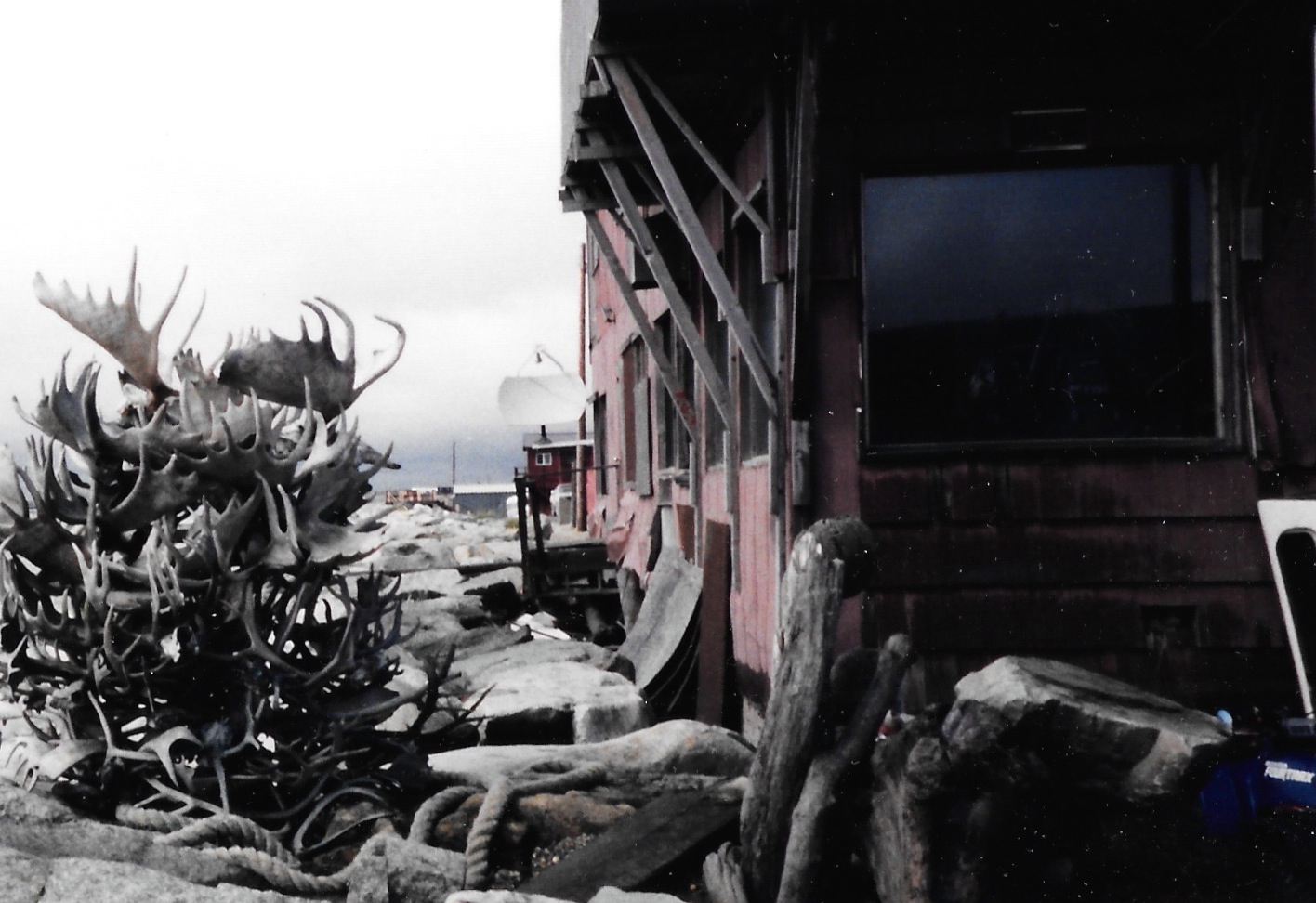
Antlers are stacked up by the shore of the Bering Sea in Nome, Alaska. (PHOTO BY JANE GEORGE)

Antlers are stacked up by the shore of the Bering Sea in Nome, Alaska. (PHOTO BY JANE GEORGE)

Things were still pretty much the same more than 50 years later. As I walked around the rusting trucks, snowmobiles, pieces of mining equipment and whalebones strewn between the houses, I couldn’t help thinking that history can be hard to change.

The Russian Inuit visiting Nome cried out for help: No one was paying salaries anymore, people had no money for hunting equipment and even small children were drinking.

“It is a catastrophe. If we share our problems, maybe we can find our solutions,” said the deputy mayor of the Chukotka community of Provideniya to ICC delegates.

Meanwhile, every evening the Polaris, which Nomites had dubbed “the hotel from hell,” offered a distraction from my own problems. In those pre-email days, work was driving me crazy because the four-hour time zone difference between Alaska and eastern Canada made it hard to meet deadlines or communicate with editors.

Every day I went to the Polaris late in the evening when I couldn’t work any longer, usually sitting with members of the Canadian delegation and the Greenlandic cultural delegation.

At the Polaris, a three-piece band always played country music under flashing Christmas lights. It was a lively place, with lots of beer flowing: A delegate from Labrador even passed out under the table one night.

On another evening, a tall Greenlander dressed in black gave me an appraising look as I settled at the table with a beer. I suddenly feel embarrassed to be a journalist, at a bar, but Kuupik Kleist  — who later became the premier of Greenland  from 2009 to 2013 — said only that “it’s good to see journalists out.”

The Polaris Bar in Nome, Alaska, as shown on the website of the Polaris Hotel

The Polaris Bar in Nome, Alaska, as shown on the website of the Polaris Hotel.

When I stepped outside the Polaris, it was way past midnight, but the sun was shining brightly. I had more fun at the Polaris than back where I was staying, crammed into a corner on the floor with four other journalists: The contacts I make at the Polaris were lasting.

As for the assembly, that was a roller-coaster, even more for me because I knew only a few of the players in 1995. Aqqaluk Lynge of Greenland, a poet and politician, described by some ICC delegates as a man of strong contrasts and convictions, and by others as a “desperate and bitter” man, was set to become the international president of the ICC.

Aqqaluk Lynge makes his pitch to ICC delegates in Nome in July, 1995. (PHOTO BY JANE GEORGE)

Aqqaluk Lynge makes his pitch to ICC delegates in Nome in July, 1995. (PHOTO BY JANE GEORGE)

But the Alaskans and Russians were uneasy about his socialist politics and reputation as a hard drinker.  The Canadian Inuit promoted Rosemarie Kuptana as a compromise president —a Canadian who would promote unity among Inuit, they said.

But Kuptana, who comes from the Inuvialuit region of Canada’s western Arctic, didn’t speak Inuktitut and Lynge, who spoke several languages fluently, played on that — “I will not be taken by the English language to adopt resolutions with ICC,” he told the ICC delegates in his pitch for votes.

Lynge also urged delegates not to worry about the personal lives of candidates, as he suggested they vote with their hearts for the best future president.

“The kissing time is over,” Lynge said before the voting started. “We’ve been married [since the ICC was founded in the 1980s] for over 15 years, and you know what kind of problem that is.”

On the third ballot, Kuptana won. Later, in 1996, citing personal and health reasons, Kuptana resigned, and Lynge, then the ICC vice-president, assumed the position of ICC president that he was denied in Nome, remaining there until 2006. And in 2010 Lynge once again was chosen as ICC president.

On the 13-hour charter flight back to Iqaluit in July 1995, I was sitting next to Lynge, whom I would get to know well only later. However, we didn’t speak at all. Lynge looked exhausted, muttered something I couldn’t understand, and crawled under a blanket to sleep for the entire flight.

Outside Nome, Alaska in July, 1995. (PHOTO BY JANE GEORGE)

Outside Nome, Alaska in July, 1995. (PHOTO BY JANE GEORGE)

The next instalment of “Like an iceberg” goes live April 23.

Did you miss the first blog post of “Like an iceberg”? You can find it here.

You can read other instalments here:

Like an iceberg, 1991…cont.

Like an iceberg, 1991…more

Like an iceberg, 1992, “Shots in the dark” 

Like an iceberg, 1992, “Sad stories”

Like an iceberg, 1993, “Learning the language of the snows”

Like an iceberg, 1993 cont., “Spring”

Like an iceberg, 1993 cont., “Chesterfield Inlet”

Like an iceberg, 1993 cont., more “Chesterfield Inlet”

Like an iceberg, 1994: “Seals and more”

Like an iceberg, 1994, cont., “No news is good news”

Like an iceberg, 1994 cont., more “No news is good news”

Like an iceberg, 1994 cont., “A place with four names”

Like an iceberg, 1995, “More sad stories”
 

Like an iceberg, 1994 cont., “A place with four names”

 Like an iceberg, 1994, cont.: “A place with four names”

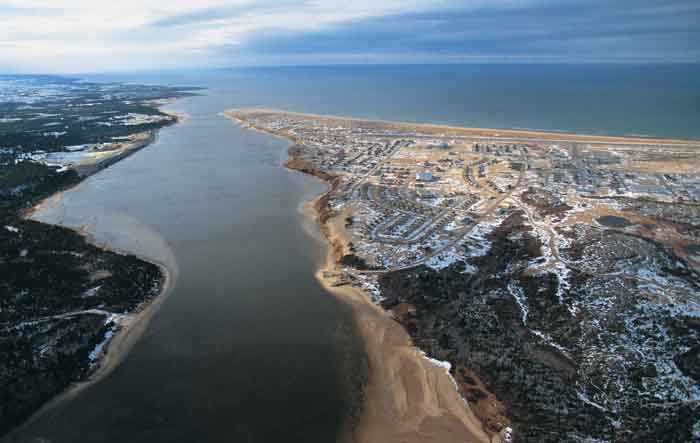
It was a smooth trip: I left Montreal at 9:40 a.m. and the jet arrived in Great Whale on the tip of James Bay in northern Quebec by 1 p.m. But the cloud ceiling was low, so we made a wide circle over the Great Whale River and then over the long beach that runs up the Hudson Bay coast, north and out of sight.

An aerial view of the Great Whale river at the site of the community of Kuujjuaraapik and Whapmagoostui. (PHOTO/ NUNAVIK-TOURISM)

An aerial view of the Great Whale river at the site of the community of Kuujjuaraapik and Whapmagoostui. (PHOTO/ NUNAVIK-TOURISM)

Rain swept across the runway in Great Whale, the community called Kuujjuaraapik by Inuit, Whapmagoostui by Cree and Poste-de-la-Baleine by Québécois. Some called it the “Miami of the Arctic,” but I was cold and dripping wet after riding to a friend’s house from the airport on her all-terrain vehicle.

My arrival coincided with Quebec election day: Sept. 12, 1994, which saw a Parti Québécois win. In the community’s triple gymnasium, three polling stations were set up, for Cree, for Inuit and for non-Aboriginals, a reminder that these three groups generally live dseparate lives despite being neighbours.

No Cree had voted by mid-afternoon, although the Inuit and non-Aboriginal turnout was good.

In pouring rain, I walked to the band council office where I ran into the chief, Matthew Mukash. He says he’s not voting, although a Parti Québécois win didn’t worry him.

Mukash said a PQ victory could put more focus on outstanding issues between Quebec and the Cree — such as Cree political autonomy and the $13.3-billion hydro-electric complex that its power corporation, Hydro Québec, wanted to build on the Great Whale River.

The Great Whale river in 1994. (PHOTO BY JANE GEORGE)

The Great Whale river in 1994. (PHOTO BY JANE GEORGE)

“I think we’re possibly looking at a resolution of some kind in regards to this issue of separation. Their issue of separation involves our right to separate,” Mukash said.

Mukash and four other Cree were on their way to Nemaska Lake in the heart of the James Bay Cree region. On the day after the Quebec election, they planned to hold a special gathering to talk about their future at Old Nemaska, a campsite more than an hour and a half away by truck and boat from today’s Nemaska. It was a place which Hydro Québec planned to flood for the project: Cree opposition to the project was why their meeting was to take place there.

I decided to accept an invitation to tag along. So I was back at the airport the next morning when the sun was shining — at least.

My Cree traveling companions arrived. They brought their own stoves along with a tent, and our bush float-plane was loaded to the top with gear. After we finally landed  on the lake, I had a moment of uncertainty as I took my bag off the shore to find tent space to sleep in: What was I doing?

There was no electricity, no phones, no way to file a story or even talk to an editor or producer, so I decided the next day to head back to Nemaska, a community that was all sand, towering pine trees and birches by the shores of smooth, blue Champion Lake.

The Cree Regional Authority building in Nemaska. (PHOTO BY JANE GEORGE)

The Cree Regional Authority building in Nemaska. (PHOTO BY JANE GEORGE)

At the goose-shaped Cree Regional Authority headquarters, I ran into Ted Moses, the Cree ambassador to the United Nations. On my first trip north in 1991, I had gone spring goose hunting with Moses and his family. This time, we weren’t talking about the how-to of goose hunting, but about self-determination.

“They say we have no more rights, which is a bunch of bullshit,” Moses said. “Can you hand over such things to an institution?”

Later that afternoon, the truck ride back to the place where we will catch the boat to Old Nemaska felt endless on the grey, bumpy road. Then, there was the boat ride — again — to bring us over the lake to the camp.

I arrived too late for supper but someone offered me a roasted goose breast. I crawled into my sleeping bag on a cushion of evergreen branches to spend a restless night. The tent fire went out, the temperature dropped, and  I was barely warm enough.

Dawn in Old Nemaska, September 1994. (PHOTO BY JANE GEORGE)

Dawn in Old Nemaska, September 1994. (PHOTO BY JANE GEORGE)

In the morning the rising run gave the fog an orange tinge. A boat with a fisherman drifted by. Plumes of fragrant smoke rose from the stoves in every white tent.

In the afternoon, a few long tables were set up in a blue and white tent for the delegates, people of all ages, all Cree.

“Our government is not the provincial government, not the federal government, but us here,” said an elder.

“The question facing us is can we govern ourselves if Quebec becomes independent? The answer is yes,” Moses told them.

I then headed back to Nemaska, again a three-hour round-trip, to file another story.

Canoes approach the camp in Old Nemaska. (PHOTO BY JANE GEORGE)

Canoes approach the camp in Old Nemaska. (PHOTO BY JANE GEORGE)

A sunny day for the next day: a line of canoes arrived across the lake from another community, small dots that finally grew bigger, and then landed. The slapping of the water combined with a prayer of thanks for their safe arrival filled the air.

Talks continued: a Cree declaration of self-determination would be the next step.

At the feast that night there was sturgeon, moose and smoked bear paw on the menu. Later the weather changes, and rain and wind battered the tent. No plane could land to take us back.

In the morning, I headed across the lake in the small boat overloaded with people, crouching under a plastic tarp, hoping we wouldn’t capsize, to hitch a ride on a truck back to Nemaska. I was beginning to recognize every turn in that long road road.

In Nemaska for the night, I spoke to Mukash again.

“The power of the mind can make miracles,” Mukash said. “The Great Whale hydro project will never be built. Hydro Québec has made a mistake, although they won’t admit it.”

Mukash sketched a picture of the mind, with the conscious, sub-conscious and super-conscious: it turned out that he was a fan of Swiss psychiatrist Carl Jung.

“They will never build it.”

A delayed plane arrival also led to a talk with Robbie Dick, a former band chief of Whapmagoostui. Cree, he said are “guardians of the land.”

“If you take a plane from the southern part of the United States up to the North, you’ll see the difference between north and south. This excavating, this raping of Mother Earth has to stop.”

Makivik Corp. president Simiunie Nalukturuk and vice-president Zebedee Nungak at the 1994 signing of an agreement-in-principle on the future construction of the Great Whale hydroelectric project. (PHOTO BY JANE GEORGE)

Makivik Corp. president Simiunie Nalukturuk and vice-president Zebedee Nungak at the 1994 signing of a $500-million agreement-in-principle on the future construction of the Great Whale hydro-electric project. (PHOTO BY JANE GEORGE)

We finally took off to Great Whale. There, I spent the afternoon walking around, heading down to the river. If that power project went ahead, the river’s flow would be diverted 40 kilometres upstream and the river would be reduced to a trickle.

Inuit had already signed an agreement-in-principle, worth $500 million, to allow the project to move forward — but the newly-elected PQ premier, Jacques Parizeau, put the project on ice in November 1994.

Before heading off to Nemaska with the Cree, I had been planning to fly on to Sanikiluaq to visit a former classmate in the intensive Inuktitut course in Iqaluit. But the yearly season of autumn fog descended and flight after flight was cancelled. So I finally decided to return to Montreal.

The next instalment of “Like an iceberg” goes live April 18.

You can read previous instalments here:

Like an iceberg: on being a journalist in the Arctic

Like an iceberg, 1991…cont.

Like an iceberg, 1991…more

Like an iceberg, 1992, “Shots in the dark” 

Like an iceberg, 1992, “Sad stories”

Like an iceberg, 1993, “Learning the language of the snows”

Like an iceberg, 1993 cont., “Spring”

Like an iceberg, 1993 cont., “Chesterfield Inlet”

Like an iceberg, 1993 cont., more “Chesterfield Inlet”

Like an iceberg, 1994: “Seals and more”

Like an iceberg, 1994, cont., “No news is good news”

Like an iceberg, 1994 cont., more “No news is good news”