Like an iceberg, 1996 cont., “At the edge of the world”

Like an iceberg, 1996 cont.: “At the edge of the world”

In June 1996 I headed out to the ice edge near Pond Inlet, something I’ve wanted to do since 1994 when I first visited the North Baffin community…

“Is this your first time traveling to Pond Inlet?” Rebecca had asked me in 1994, as we bumped along in the open back of a truck.Clyde River

It was 1 a.m. that June day and we were returning to the airport in Clyde River in northern Baffin Island where our airplane had broken down earlier.I told her I’d been traveling since 4 a.m. that morning, for 22 hours already.

“Now, you know how long it takes to get to Pond,” she joked.

In 1994, it was already possible to leave Montreal in the morning and arrive via Iqaluit to Pond Inlet by 8 p.m., but, on my first trip to Pond Inlet the plane ran into mechanical problems at a stopover in Clyde River.

The mountains beyond Clyde River were somewhat gold, completely clear and still in the cool late night air. I walked around the tarmac, contemplating icebergs out in the bay beyond — a set of blocks and triangles in ice.

Finally, we were ready to leave. It was nearly 3 a.m. by the time we landed in Pond Inlet. A few snowflakes were falling. Bylot Island, across from Pond Inlet, was shrouded in heavy fog. But it was still as light as midday here: I was 644 kilometres north of the Arctic Circle where the sun shines constantly from May to July.

The next morning the clouds completely vanished, and I ventured out into Pond Inlet. An Arctic combination of sun, ice and sand gave a cold-beach lift to each breath.

In my mind, I carried a picture of this community as it was in the 1950’s when Peter Murdoch managed the Hudson Bay trading post here.
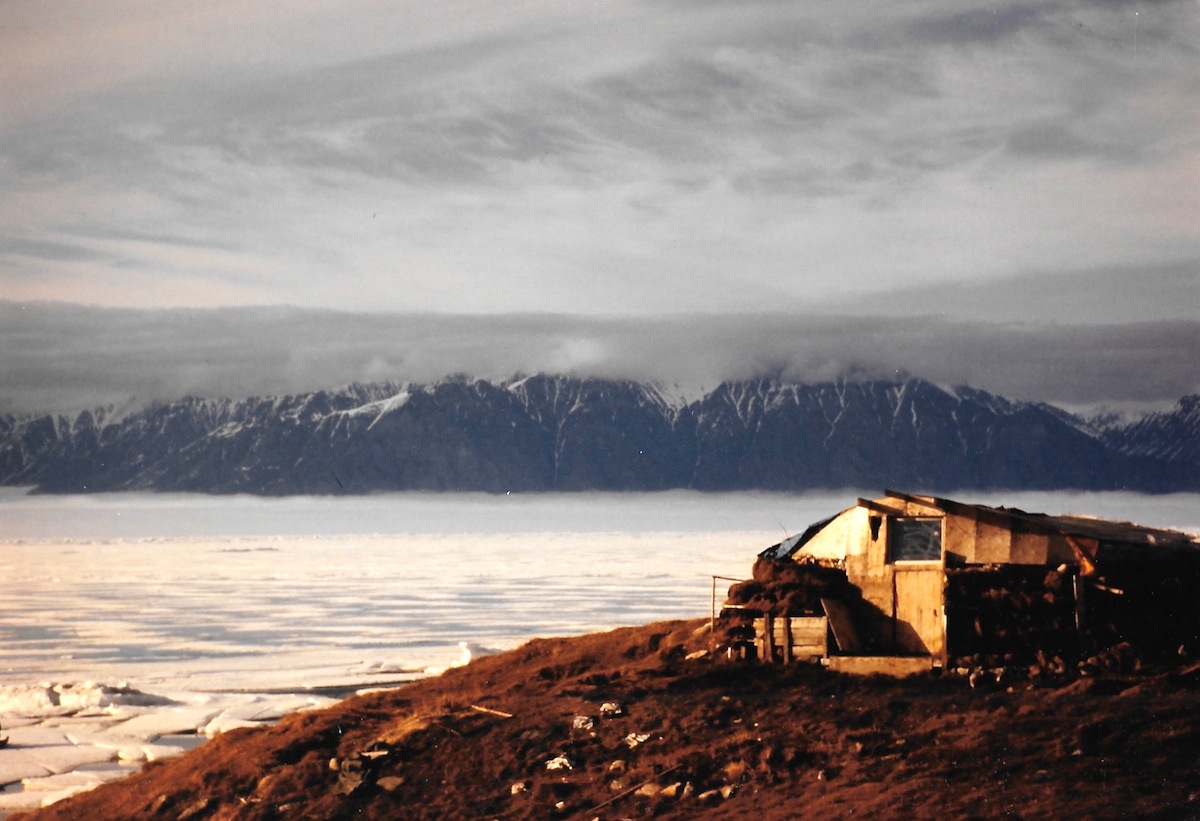
A qammaq in 1994 in Pond Inlet is a reminder of how the community looked like in the 1950s when Peter Murdoch lived there. (PHOTO BY JANE GEORGE)

A qammaq in 1994 in Pond Inlet is a reminder of how the community looked like in the 1950s when Peter Murdoch lived there. (PHOTO BY JANE GEORGE)

I remembered his stories of dog-teaming across the ice, of hikes on the tundra. In those days, only the white clapboard trading post and a few other buildings hugged the edge of the water. Inuit still lived off the land, in tents in the summer and snow houses in the winter. On the hill overlooking the sparsely populated shore, a huge sign spelled out “Pond Inlet” in white stones.

In 1994, this sprawling community of  about 1,100 filled the shoreline. There were two schools a library, government offices, a shopping mall, stores and homes built along the beach, up the hill and beyond.

A view down the street in Pond Inlet to the mountains beyond, 1994. (PHOTO BY JANE GEORGE)

A view down the street in Pond Inlet to the mountains beyond, 1994. (PHOTO BY JANE GEORGE)

And only a shadow of the sign that read “Pond Inlet” remained. The stones had tumbled out of place, down the hill to the shore.

Bylot Island, whose mountains face the community, though never changed. The steep cliffs appeared to completely fill the view on some clear days. Glacial rivers of ice flowed down through the peaks to the frozen waters of Eclipse Sound — like they always have done.

Many snowmobiles were parked on the ice along the beach, and the few teams of sled dogs were hitched a bit further out.

They ran no risk of sinking through the ice. At this time of the year, the surface of the ice melted under the 24-hour sunlight, yet it was still several feet thick and strong enough to hold considerable weight.

Even so, deep crevasses were opening up, filling with streams of water. I had to leap from edge to edge on one late-night walk.

My goal: a huge iceberg. (PHOTO BY JANE GEORGE)

My goal: a huge iceberg. (PHOTO BY JANE GEORGE)

My destination was an enormous iceberg with an elegant, curved top, but I never made it. Instead, I wandered around in maze of islands made by the water on the ice, before suddenly noticing the hour — almost midnight.

The next day, I decided to visit my travel companion, Rebecca, at her home. An elder, Isipi Qanguk, joined us. I wanted to interview him on what it’s like to live in a place where people spend months in the dark, and months in the light —  for a CBC radio documentary.

But our talk turned to life and death, and his memories of this time of year when he was a young boy.

Then, Qanguk told me, his parents left to go hunting in the spring. They left him in the care of his grandparents, planning to return for him.

“But they didn’t come back,” Qanguk said.

His parents were much later found dead in a snow house.

“I always expected that they would [come back]. For years and years, I still waited,” he said.

The return of light, he said, reminds him of a pathway to heaven.

Two days after we talk, Qanguk suffered a heart attack and died, and I worried about the story he told me that morning: Did he know he was going to die somehow?

Years later, I still can’t bear to read the transcript of that interview.

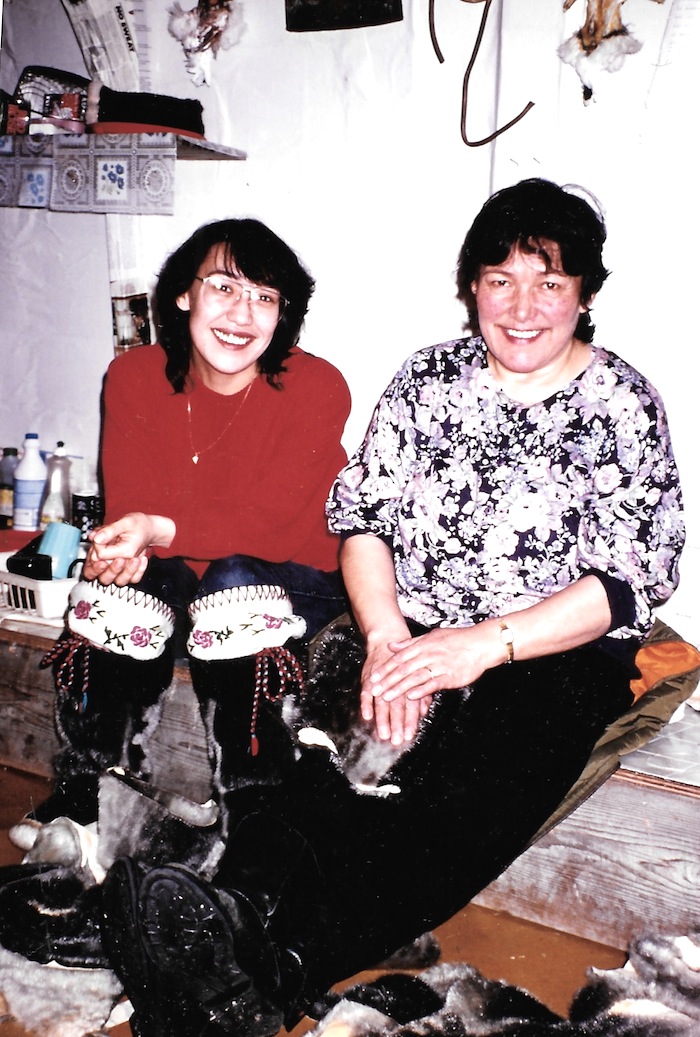
Among the others I met in Pond Inlet — a woman whom Murdoch asked me to look out for and send his greetings to. I can no longer recall her name. But I took a photo of her with her grandchildren in 1994 and made sure Murdoch got a copy later.

I run into this woman, a friend of Peter Murdoch, who lived there in the 1950s, who posed for a photo with her two grandchildren. (PHOTO BY JANE GEORGE)

I run into this woman, a friend of Peter Murdoch, who lived in Pond Inlet in the 1950s. She poses here for a photo with her two grandchildren. (PHOTO BY JANE GEORGE)

During that visit, an Inuk woman who works for the federal government, came to find me. Her business? She had heard I was talking to people around town. Do I have a permit to talk to them, she wanted to know.

I told her, no.

I am a journalist, I explained, working on stories that will be shared with the community and that, in Canada, Canadians are allowed speak to each other and to members of the media without needing permits to speak to each other — even in the North.

Like an iceberg’s “At the edge of the world” continues April 30.
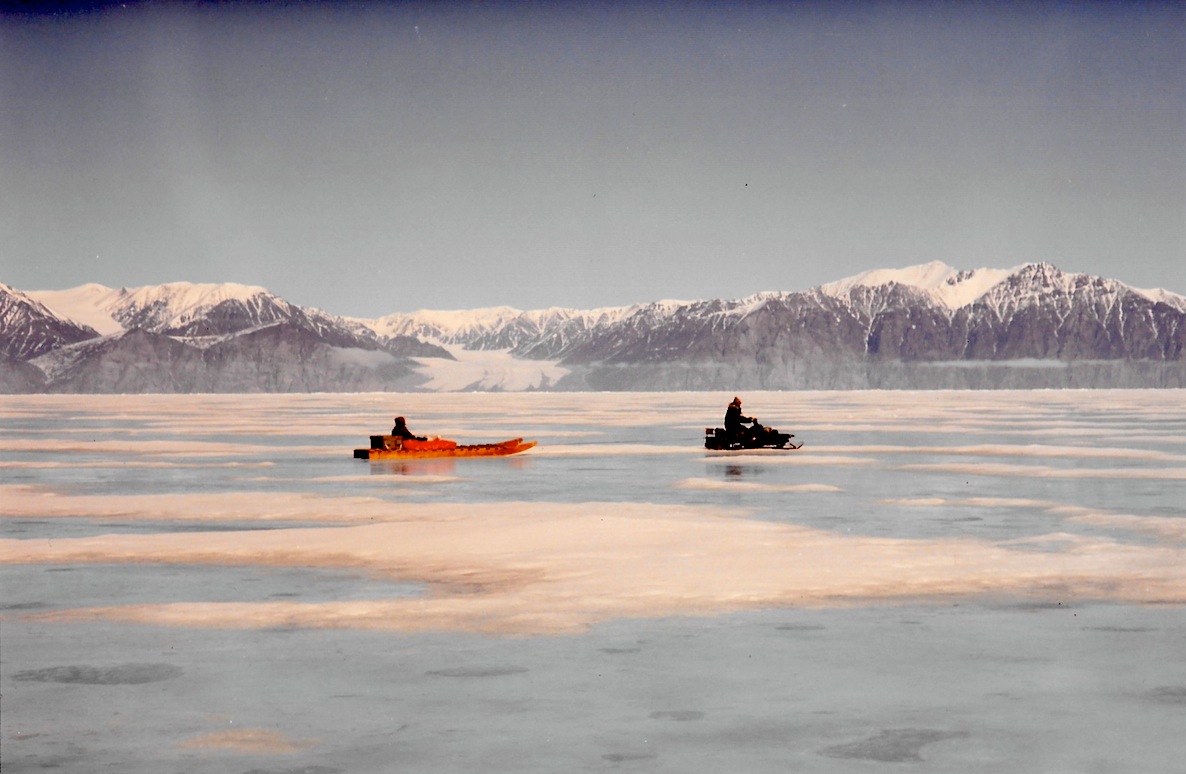
A snowmobile and qamutik leave Pond Inlet, 1994. (PHOTO BY JANE GEORGE)

A snowmobile and qamutik leave Pond Inlet, 1994. (PHOTO BY JANE GEORGE)

 You can read earlier instalments here:

Like an iceberg: on being a journalist in the Arctic

Like an iceberg, 1991…cont.

Like an iceberg, 1991…more

Like an iceberg, 1992, “Shots in the dark” 

Like an iceberg, 1992, “Sad stories”

Like an iceberg, 1993, “Learning the language of the snows”

Like an iceberg, 1993 cont., “Spring”

Like an iceberg, 1993 cont., “Chesterfield Inlet”

Like an iceberg, 1993 cont., more “Chesterfield Inlet”

Like an iceberg, 1994: “Seals and more”

Like an iceberg, 1994, cont., “No news is good news”

Like an iceberg, 1994 cont., more “No news is good news”

Like an iceberg, 1994 cont., “A place with four names”

Like an iceberg, 1995, “More sad stories”

Like an iceberg, 1995 cont., “No place like Nome”

Like an iceberg, 1995 cont., “Greenland”

Like an iceberg, 1995, cont. “Secrets”

Like an iceberg, 1996, “Hard Lessons”

Like an iceberg, 1996 cont., “Working together”

Like an iceberg, 1996 cont., “At the edge of the world”

Like an iceberg, 1994: “Seals and more”

Like an iceberg, 1994: “Seals and more”

I decided to return to Pangnirtung in the middle of February 1994. The sun had just begun to come back into this Baffin Island community. For months, the sun had lingered below the horizon. Now it was rising higher every day.

Pangnirtung fiord in February 1994. (PHOTO BY JANE GEORGE)

Pangnirtung fiord in February 1994. (PHOTO BY JANE GEORGE)

In mid-afternoon, a bit of sun peeked over the ridge of the mountains, casting long shadows in town. Most of the day, the snow-covered mountains still hovered in a perennial dawn. They were pinkish, with constantly changing flashes of yellow. I never tired of this vista. One day, we took a walk out on the frozen fiord, among the blocks of ice that created a cold, white forest.

Margaret Karpik, the director of the Visitors Centre, took me to visit her mother, Ida Karpik, a well-known artist: I was doing a report for CBC radio on the revival of sealskin trade.

Ida and a few other local women were gathered in the qammaq, a traditional tent-like structure, to work sealskins and sew. On its ceiling and walls, old newspapers and catalogues had been glued, helter-skelter, for wallpaper. In the corner, in the stone qulliq lamp a low fire burns. Moss was used as the wick, seal oil as the fuel.

Margaret Karpik (left), with her mother Ida Karpik (right), in the women's qammaq in February 1994. Karpik, a renowned artist, died in 2002 at 63. (PHOTO BY JANE GEORGE)

Margaret Karpik (left), with her mother Ida Karpik (right), in the women’s qammaq in February 1994. Karpik, a renowned artist, died in 2002 at 63. (PHOTO BY JANE GEORGE)

With Margaret helping to translate, Ida explained why sealskin was ideal for clothes, especially for jackets or boots that are warm in the cold and waterproof in the damp weather.

The hard work it takes to make sealskin into clothes is worth it, she said. I also spent a peaceful afternoon scraping a skin, watching her and the other women work and listening to their conversation.

In Pangnirtung, two local men were also trying to revive trade in sealskins. Only 15 years earlier, the market for sealskins had been strong, but that was before environmental lobby groups protested against the annual seal hunt and the United States slapped a ban on the import of sealskins. From Baffin Island alone, Inuit used to sell 15,000 sealskins. By the mid-1990s, not even a tenth of that amount were sold.

But Jaypeetee Akpalialuk and Michael Murphy told me they were planning to send skins over to Hokkaido, in Japan, where the Ainu, the indigenous people of northern Japan, would use them in their clothing and handicrafts. Akpalialuk  was then the mayor of Pangnirtung. Without seal meat, he told me, Inuit would never have been able to live in the North. It would be too cold without sealskin clothes to wear, and seal to eat, he said.

“When you’re out on the land and the temperature is -40, you don’t have time to eat, but your body needs energy. It needs energy and you have to be warm. So, when we eat raw seal meat when it’s very cold, your body starts to get warm. Seal meat is very rich, and seal meat is the best thing in the North,” he said. “And sealskin is one of the best clothing you can have. You can wear it in summer, in winter. You can wear it just about anywhere. It’s waterproof, it lasts a long time, it’s one of the best materials you can have for clothing.”

Akpalialuk said critics of the seal hunt have it all wrong: Their seal harvest doesn’t even make a dent in the population.

“As Inuit, too, we’ve never been over-killing any species up here. Outsiders have been harvesting our species. Europeans came over to Baffin Island in the 1800’s and over-killed the bowhead. We never overkill. We always managed the resources according to our knowledge,” he said.

And Inuit aren’t inhumane, either, he said. They don’t kill seals like Newfoundlanders: They nearly always just shoot them quickly with a gun.

Although the elder Etooangat had told me Inuit also used to hunt seals with hooks, one thing was certain: The seal ban had been a disaster for his community.

“Most Inuit were depending on hunting sealskins for a living, it was the major income for Inuit. Once the market was killed, people suffered. There’s not too many jobs up here, they couldn’t buy food, purchase equipment, so some of them had to depend on welfare. The way I see it, the government of Canada didn’t do too much about it. I guess they didn’t care,” Akpalialuk said.

Akpalialuk and Murphy took me to the sealift container where they were storing sealskins. Murphy, then a singer and local cable television company owner, said he thought that Canadians are ready for sealskin.

“This whole veil of anger at the sealing trade is beginning to lift,” Murphy said. “And I believe that Canadians are distinguishing between the major company and the small guy who is taking the meat for his family, and now, you can have his skins. Isn’t it fair and just that a man should be able to use that product without throwing it in the dump? It’s a sustainable, renewable resource when harvested properly.”

But their project to renew the sealskin trade never took off. Two years later, Akpalialuk was dead. He drowned in a drainage ditch in Kuujjuaq, while intoxicated — his death one of a string of alcohol-related deaths that year which led this Nunavik community to clamp down on liquor sales. Murphy ended up in Ottawa, where, at one time, he faced charges of arson connection with the burning of a small privately-owned fish plant in Pangnirtung.

The timeless triangle of the mountains at the end of Pangnirtung’s fiord remains the same, and Inuit continue to face obstacles to marketing sealskins abroad.

And everyone still takes seal hunting seriously.

“The seals are on the ice” was one of the first phrases I ever learned in Inuktitut.

“But never say that unless you mean it,” a friend warned me. “Because everyone in the room will jump up and run out!”

The next instalment of “Like an iceberg” goes live April 15.

You can read the first blog entry of “Like an iceberg” from April 2 here.

You can read previous instalments here:

Like an iceberg: on being a journalist in the Arctic

Like an iceberg, 1991…cont.

Like an iceberg, 1991…more

Like an iceberg, 1992, “Shots in the dark” 

Like an iceberg, 1992, “Sad stories”

Like an iceberg, 1993, “Learning the language of the snows”

Like an iceberg, 1993 cont., “Spring”

Like an iceberg, 1993 cont., “Chesterfield Inlet”

Like an iceberg, 1993 cont., more “Chesterfield Inlet”