A makeover for CamBay’s ocean observatory

Hauling a large, 250-pound device connecting hundreds of feet of fluorescent ethernet wire out of icy water is no simple task.

Two University of Victoria divers prepare to raise the ocean observatory. (PHOTO BY JANE GEORGE)

Two University of Victoria divers prepare to raise the ocean observatory. (PHOTO BY JANE GEORGE)

But that’s exactly what a team of divers and young researchers with the University of Victoria and the Ocean Networks Canada project did Sept. 16.

The waters near the Cambridge Bay dock stood at 1.9 C — and would, in fact, start freezing up the next day — but protected by drysuits, two divers managed to bring the marine observatory up to the surface and then hoist it on to the dock for its annual overhaul, a new platform and other new instruments.

By then, the sun was setting in over the Cam-Main North Warning System site to the west — and there would be no time for them to carry on with the plan to take apart the observatory for storage overnight.

Researchers and community volunteers help pull the ocean observatory out of the water. (PHOTO COURTESY OF OCEANS NETWORKS CANADA)

Researchers and community volunteers help pull the ocean observatory out of the water. (PHOTO COURTESY OF OCEANS NETWORKS CANADA)

But they didn’t have a place to store the four-foot-wide triangular device or even a way to move it.

The ocean observatory perches on top of an Adlair Aviation pick-up truck. (PHOTO BY JANE GEORGE)

The ocean observatory perches on top of an Adlair Aviation pick-up truck. (PHOTO BY JANE GEORGE)

Thanks to help from an Adlair Aviation pilot, they managed to lift the platform into the air charter’s pickup truck and bring it up to the airport hangar for safe storage.

When underwater, the device measures such things such as underwater temperature, sounds, salinity and ice thickness. It’s also equipped with a camera — which needs replacement — to keep an eye on the seabed.

Similar observatories have been installed off the coasts of British Columbia, part of Ocean Networks Canada, a University of Victoria project, which “operates world-leading cabled ocean observatories for the advancement of science and the benefit of Canada,” according to its website.
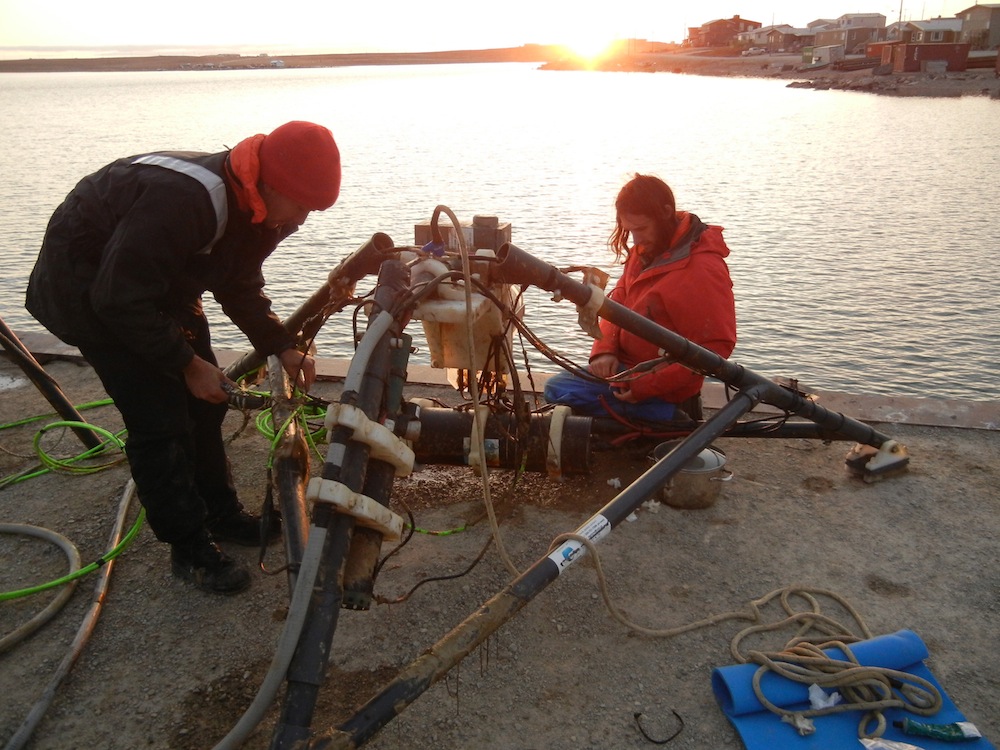
Researchers from the University of Victoria dismantle the ocean observatory for transport Sept. 16. (PHOTO BY JANE GEORGE)

Researchers from the University of Victoria dismantle the ocean observatory for transport Sept. 16. (PHOTO BY JANE GEORGE)

Cambridge Bay’s observatory could be the first in a series to monitor changes in the Arctic.

Launched in September 2012 — and observed by Premier Stephen Harper last month when he visited Cambridge Bay, the observatory will help establish a baseline of environmental conditions, such as rates of ice growth and the timing of algae blooms.

This year, the team plans to service and reinstall:

  • an underwater high definition video camera;
  • an acoustic ice profiler; and,
  • a fish tag receiver from the Ocean Tracking Network.

They also plan to install new instrumentation, including a photosynthetically active radiation sensor that will measure underwater light levels and help scientists study changes during key periods, such as spring, when the polar sunrise triggers algae blooms under the ice.

A sea snail retrieved from  the seabed near the ocean observatory. (PHOTO BU JANE GEORGE)

A sea snail retrieved from the seabed near the ocean observatory. (PHOTO BY JANE GEORGE)

Above water, a video camera will continue to monitor surface ice formation and the weather station will provide real-time atmospheric conditions.

An antenna positioned on top of a nearby building will continue capturing signals from nearby ships, a project website says.

Divers plan to sample fauna on the sea floor, and look for a new observatory location in 2015.

This will position the underwater sensors at a greater distance from vessels and winter road traffic near the busy Cambridge Bay dock.

Among the interesting tidbits learned to date by the observatory about air and sea water temperatures during the winter in Cambridge Bay:  while winter air temperatures frequently dip below -30 C, water beneath the ice remains near 0 C.

Then, during the summer, prolonged sunshine raises air temperatures and melts the ice, raising seawater temperatures to about 10 C.

And, in November 2013, the observatory caught the sound of ice cracking as a snowmobile travelled over the ice near the Cambridge Bay hydrophone. The snowmobile broke through the ice a short time later.

The University of Victoria team plan to wrap up their work some time next week after they meet with local students and people in the community to talk about their project.

Look for more posts from Cambridge Bay, Nunavut.

Recent posts on A date with Siku girl include:

Canada ignores Arctic infrastructure: veteran ice pilot

New roof, new life for CamBay’s old stone church

Two Arctic ships, two explorers: Franklin and Amundsen

Today, Arctic explorers take cruise ships


Like an iceberg, 1999 cont., “Fossil hunting”

Like an iceberg, 1999 cont.: “Fossil hunting”

My destination in July, 1999: a huge windswept island, Axel Heiberg, located 700 kilometres south of the North Pole, just off Ellesmere Island.

You can see fossil litter on the top of a hill overlooking the valley on Axel Heiberg where we camp in July, 1999. (PHOTO BY JANE GEORGE)

You can see fossil litter on the top of a hill overlooking the valley on Axel Heiberg where we camp in July, 1999. (PHOTO BY JANE GEORGE)

On this remote High Arctic island, fossils were everywhere, and, by the edge of a fast-running river in July, 1999, I saw millions of years of nature tumbling down into the water. With little vegetation to hold the soil together, earth and rocks constantly broke off along the river’s edge, creating clouds of dust as they fall.

Each time this happened, the fossils of trees and plants that grew here more than 40 million years ago were lost, carried away to the ocean or slowly dissolved in the swift current. The fragments of fossil wood were batted around in the water or cast up on the shore. Boulders embossed with the imprints of leaves were piled along the bank.

The fossil material is grey and dry after millions of years in the cold storage of Axel Heiberg. (PHOTO BY JANE GEORGE)

The fossil material is grey and dry after millions of years in the cold storage of Axel Heiberg. (PHOTO BY JANE GEORGE)

“It’s like a fossil superstore,” said Yusheng Liu, a fossil plant biologist, originally from China, who was then studying on a fellowship with paleo-botanist Jim Basinger in Saskatoon, who had invited me to see his High Arctic research team at work in 1998.

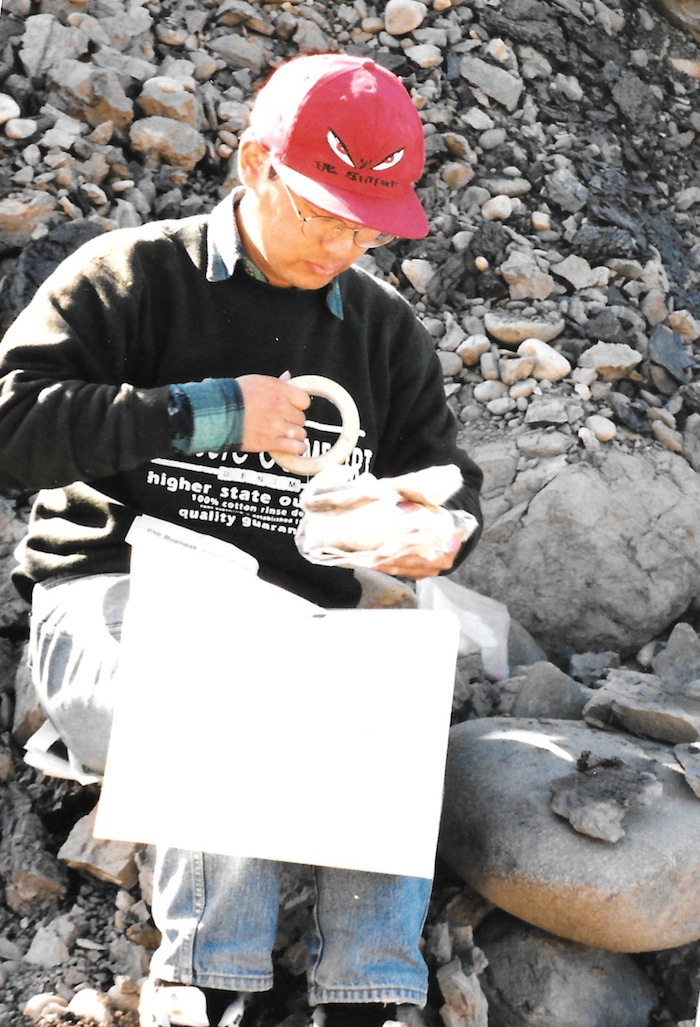
Liu expertly hammered a thick gray rock into sheets and quickly uncovered several remnants of leaves, some in almost mint condition, that were hidden in the clay.

“Canada has so many fossils, but so few paleontologists,” said Liu. “We have so much to learn.”

While the quantity of fossils on Axel Heiberg was unusual, so was their quality because they weren’t petrified, or turned to stone, but rather mummified or simply pressed into clay.

While fossil gathering, we mainly concentrated on the rocks by the water and on exposed leaf litter that sticks out of the eroding outcrop above. We tried not to disturb any materials that aren’t already at risk from erosion. The only tools used were a small pickaxe, a knife and a magnifying glass. Some clay boulders contained a treasure trove of fossils. We examined each chunk for fossils, and foundseveral intact leaves.

 Yusheng Liu carefully wraps up every interesting fossil when we are on Axel Heiberg in July, 1999. (PHOTO BY JANE GEORGE)

Yusheng Liu carefully wraps up every interesting fossil when we are on Axel Heiberg in July, 1999. (PHOTO BY JANE GEORGE)

Liu was especially pleased when he finds a well-preserved seed, cone or leaf. Most of the fossil leaves came from the huge Dawn Redwood, which flourished here during the warmer Eocene Era, some 45 million years ago.

This tall tree shed its leaves every year, casting thousands of its distinctive fronds on the ground, many of which survived the passage of time. Liu also found leaves from beech trees, kiwi-like seeds and cones from evergreens.

He said studying such fossils under an electron microscope could reveal what levels of oxygen and carbon dioxide existed in the atmosphere of that much warmer period and show how these plants differed from their modern counterparts.

“If we study these fossils, we can get an image of the paleo-vegetation and we can use it to reconstruct the climate because it’s a good indicator of the climate,” he said.

Every fossil selected for further study was sprayed with latex to keep the plant tissues fresh. Then,  the fossils were wrapped up in newspaper and taped, so that they would travel without breaking. Months later, the scientists would carefully unwrap the fossils.

After an afternoon by the river, we headed back to camp, weighed down by our load of heavy, clay rocks. We held hands as we forded across the water, which in the heat of the day, had risen with melt water from the nearby glaciers.

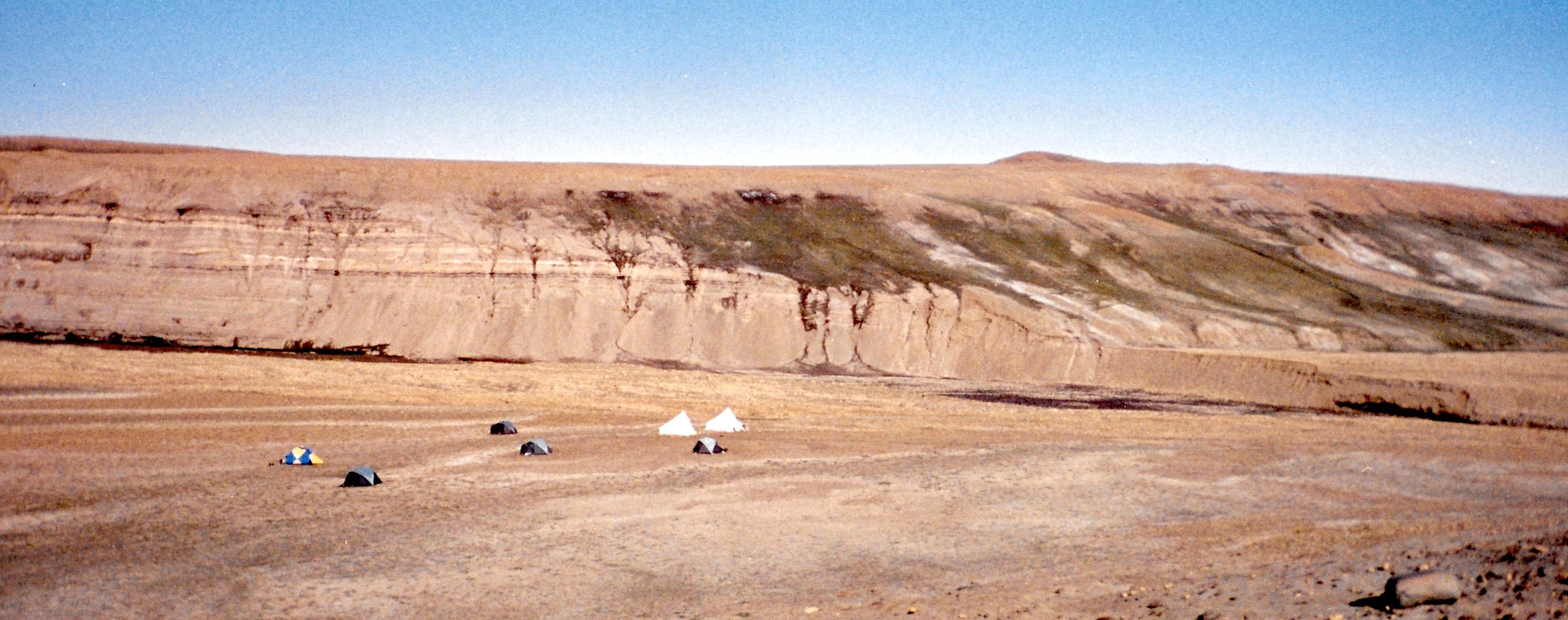
We camp out in a valley where the sun shines all day and night. (PHOTO BY JANE GEORGE)

We camp out in a valley where the sun shines all day and night. My tent is the blue and yellow one at the far left. (PHOTO BY JANE GEORGE)

Our field camp was a small group of tents pitched on a rocky slope. I had my own tent and — finally — I had invested in a warm sleeping bag. In the evening, along with the three other members of the team, we made a simple supper— Liu whipped up a Chinese-style soup based on the dry ingredients that could easily be stored in the camp refrigerator — a hole dug in the frozen ground — such as cabbage, carrots, onions and bacon.

After a couple of days by the river, we moved on to another site, by the Fossil Forest, where the stumps of 50-million-year-old trees were exposed.

That’s where the weather changed, from a 20 C to a windy, cold and snow-filled, and at the fossil forest, I also find a group of American scientists who were digging it up.

Like an iceberg continues May 30.

You can read earlier instalments here:

Like an iceberg: on being a journalist in the Arctic

Like an iceberg, 1991…cont.

Like an iceberg, 1991…more

Like an iceberg, 1992, “Shots in the dark” 

Like an iceberg, 1992, “Sad stories”

Like an iceberg, 1993, “Learning the language of the snows”

Like an iceberg, 1993 cont., “Spring”

Like an iceberg, 1993 cont., “Chesterfield Inlet”

Like an iceberg, 1993 cont., more “Chesterfield Inlet”

Like an iceberg, 1994: “Seals and more”

Like an iceberg, 1994, cont., “No news is good news”

Like an iceberg, 1994 cont., more “No news is good news”

Like an iceberg, 1994 cont., “A place with four names”

Like an iceberg, 1995, “More sad stories”

Like an iceberg, 1995 cont., “No place like Nome”

Like an iceberg, 1995 cont., “Greenland”

Like an iceberg, 1995, cont. “Secrets”

Like an iceberg, 1996, “Hard Lessons”

Like an iceberg, 1996 cont., “Working together”

Like an iceberg, 1996 cont., “At the edge of the world”

Like an iceberg, 1996, more “At the edge of the world”

Like an iceberg, 1996, cont. “Choices” 

Like an iceberg, 1997, “Qaggiq”

Like an iceberg, 1997, more “Qaggiq”

Like an iceberg, 1997, “Qaggiq” cont.

Like an iceberg, 1997 cont., “Qaggiq and hockey”

Like an iceberg, 1997 cont., “Brain surgery in POV”

Like an iceberg, 1997 cont.: “Masks on an island”

Like an iceberg, 1997 cont., “Abusers on the pulpit”

Like an iceberg, 1998, “Bearing gifts”

Like an iceberg, 1998 cont., “At the top of the world”

Like an iceberg, 1998 cont., “A bad week” 

Like an iceberg, 1998 cont.: more from “A bad week”

Like an iceberg, 1998 cont., “Memories”

Like an iceberg, 1999, “The avalanche”

Like an iceberg, 1999 cont., “An exorcism, followed by a penis cutting”

Like an iceberg, 1999 cont., more on “the Avalanche”

Like an iceberg, 1999 cont., “Robins in the Arctic”