Like an iceberg, 1996 cont., “At the edge of the world”

Like an iceberg, 1996 cont.: “At the edge of the world”

In June 1996 I headed out to the ice edge near Pond Inlet, something I’ve wanted to do since 1994 when I first visited the North Baffin community…

“Is this your first time traveling to Pond Inlet?” Rebecca had asked me in 1994, as we bumped along in the open back of a truck.Clyde River

It was 1 a.m. that June day and we were returning to the airport in Clyde River in northern Baffin Island where our airplane had broken down earlier.I told her I’d been traveling since 4 a.m. that morning, for 22 hours already.

“Now, you know how long it takes to get to Pond,” she joked.

In 1994, it was already possible to leave Montreal in the morning and arrive via Iqaluit to Pond Inlet by 8 p.m., but, on my first trip to Pond Inlet the plane ran into mechanical problems at a stopover in Clyde River.

The mountains beyond Clyde River were somewhat gold, completely clear and still in the cool late night air. I walked around the tarmac, contemplating icebergs out in the bay beyond — a set of blocks and triangles in ice.

Finally, we were ready to leave. It was nearly 3 a.m. by the time we landed in Pond Inlet. A few snowflakes were falling. Bylot Island, across from Pond Inlet, was shrouded in heavy fog. But it was still as light as midday here: I was 644 kilometres north of the Arctic Circle where the sun shines constantly from May to July.

The next morning the clouds completely vanished, and I ventured out into Pond Inlet. An Arctic combination of sun, ice and sand gave a cold-beach lift to each breath.

In my mind, I carried a picture of this community as it was in the 1950’s when Peter Murdoch managed the Hudson Bay trading post here.
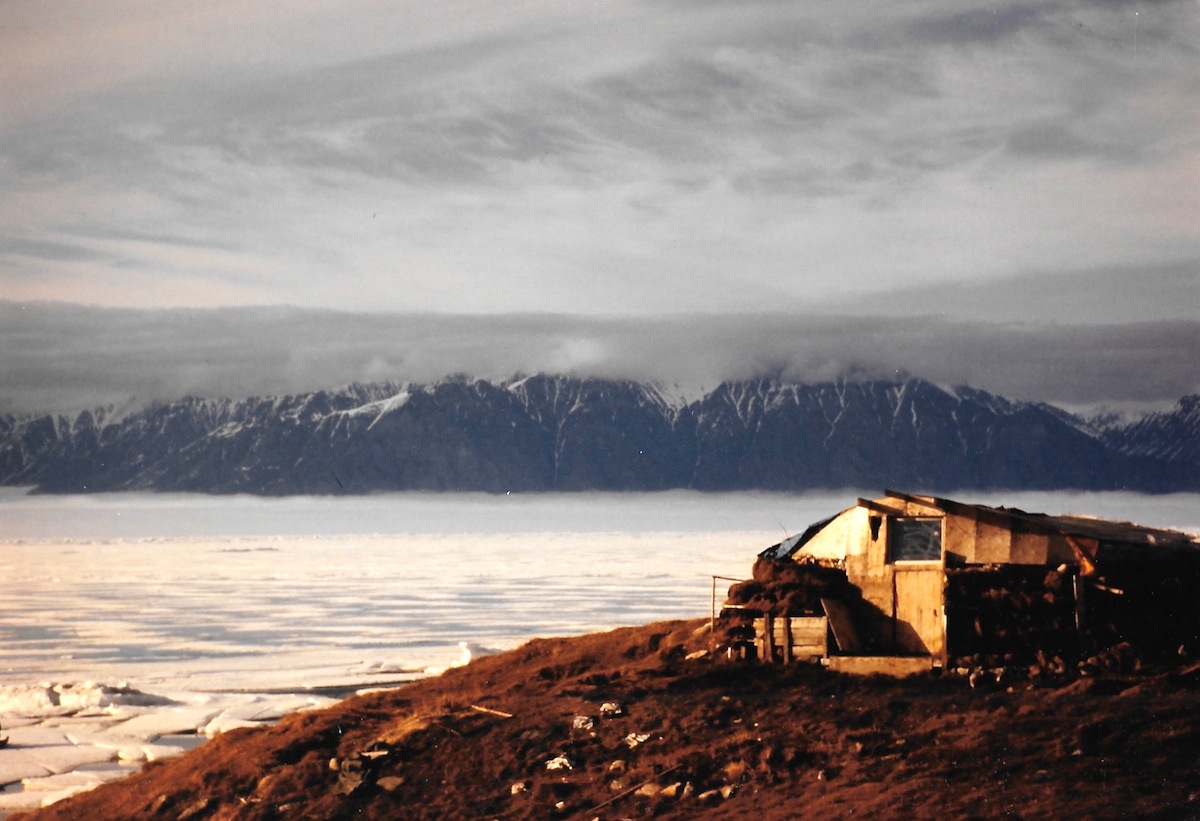
A qammaq in 1994 in Pond Inlet is a reminder of how the community looked like in the 1950s when Peter Murdoch lived there. (PHOTO BY JANE GEORGE)

A qammaq in 1994 in Pond Inlet is a reminder of how the community looked like in the 1950s when Peter Murdoch lived there. (PHOTO BY JANE GEORGE)

I remembered his stories of dog-teaming across the ice, of hikes on the tundra. In those days, only the white clapboard trading post and a few other buildings hugged the edge of the water. Inuit still lived off the land, in tents in the summer and snow houses in the winter. On the hill overlooking the sparsely populated shore, a huge sign spelled out “Pond Inlet” in white stones.

In 1994, this sprawling community of  about 1,100 filled the shoreline. There were two schools a library, government offices, a shopping mall, stores and homes built along the beach, up the hill and beyond.

A view down the street in Pond Inlet to the mountains beyond, 1994. (PHOTO BY JANE GEORGE)

A view down the street in Pond Inlet to the mountains beyond, 1994. (PHOTO BY JANE GEORGE)

And only a shadow of the sign that read “Pond Inlet” remained. The stones had tumbled out of place, down the hill to the shore.

Bylot Island, whose mountains face the community, though never changed. The steep cliffs appeared to completely fill the view on some clear days. Glacial rivers of ice flowed down through the peaks to the frozen waters of Eclipse Sound — like they always have done.

Many snowmobiles were parked on the ice along the beach, and the few teams of sled dogs were hitched a bit further out.

They ran no risk of sinking through the ice. At this time of the year, the surface of the ice melted under the 24-hour sunlight, yet it was still several feet thick and strong enough to hold considerable weight.

Even so, deep crevasses were opening up, filling with streams of water. I had to leap from edge to edge on one late-night walk.

My goal: a huge iceberg. (PHOTO BY JANE GEORGE)

My goal: a huge iceberg. (PHOTO BY JANE GEORGE)

My destination was an enormous iceberg with an elegant, curved top, but I never made it. Instead, I wandered around in maze of islands made by the water on the ice, before suddenly noticing the hour — almost midnight.

The next day, I decided to visit my travel companion, Rebecca, at her home. An elder, Isipi Qanguk, joined us. I wanted to interview him on what it’s like to live in a place where people spend months in the dark, and months in the light —  for a CBC radio documentary.

But our talk turned to life and death, and his memories of this time of year when he was a young boy.

Then, Qanguk told me, his parents left to go hunting in the spring. They left him in the care of his grandparents, planning to return for him.

“But they didn’t come back,” Qanguk said.

His parents were much later found dead in a snow house.

“I always expected that they would [come back]. For years and years, I still waited,” he said.

The return of light, he said, reminds him of a pathway to heaven.

Two days after we talk, Qanguk suffered a heart attack and died, and I worried about the story he told me that morning: Did he know he was going to die somehow?

Years later, I still can’t bear to read the transcript of that interview.

Among the others I met in Pond Inlet — a woman whom Murdoch asked me to look out for and send his greetings to. I can no longer recall her name. But I took a photo of her with her grandchildren in 1994 and made sure Murdoch got a copy later.

I run into this woman, a friend of Peter Murdoch, who lived there in the 1950s, who posed for a photo with her two grandchildren. (PHOTO BY JANE GEORGE)

I run into this woman, a friend of Peter Murdoch, who lived in Pond Inlet in the 1950s. She poses here for a photo with her two grandchildren. (PHOTO BY JANE GEORGE)

During that visit, an Inuk woman who works for the federal government, came to find me. Her business? She had heard I was talking to people around town. Do I have a permit to talk to them, she wanted to know.

I told her, no.

I am a journalist, I explained, working on stories that will be shared with the community and that, in Canada, Canadians are allowed speak to each other and to members of the media without needing permits to speak to each other — even in the North.

Like an iceberg’s “At the edge of the world” continues April 30.
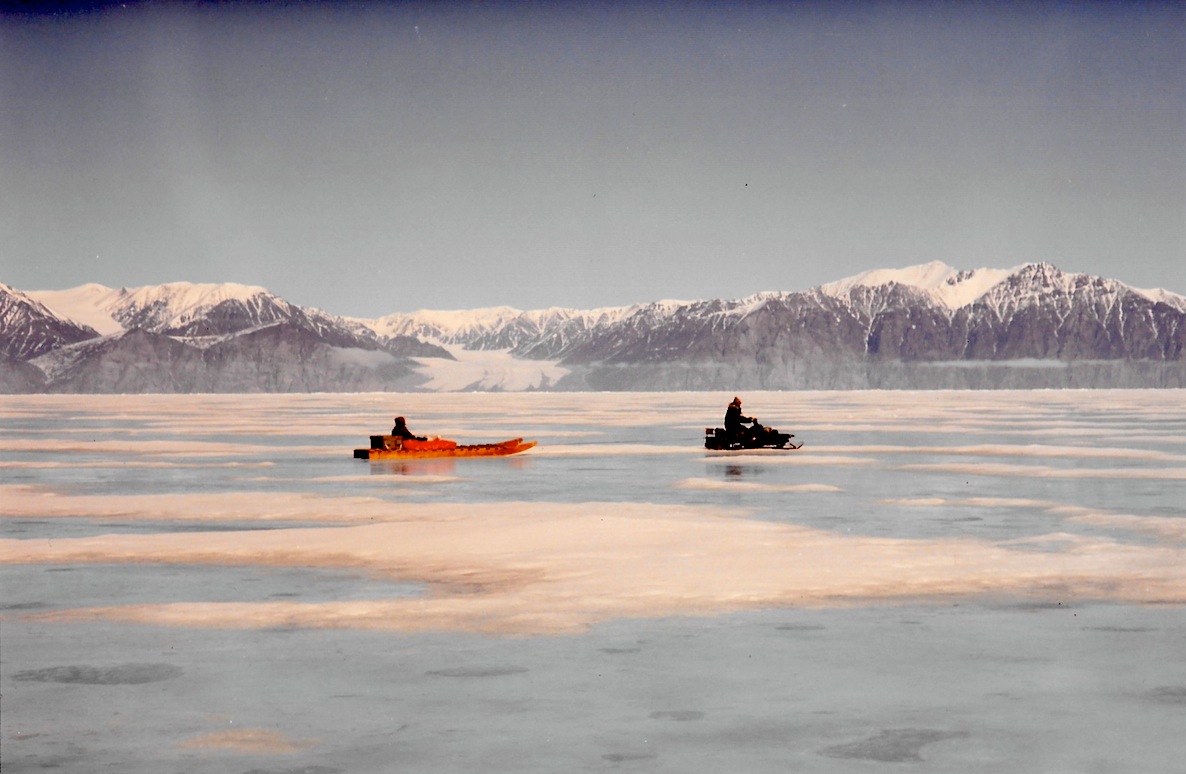
A snowmobile and qamutik leave Pond Inlet, 1994. (PHOTO BY JANE GEORGE)

A snowmobile and qamutik leave Pond Inlet, 1994. (PHOTO BY JANE GEORGE)

 You can read earlier instalments here:

Like an iceberg: on being a journalist in the Arctic

Like an iceberg, 1991…cont.

Like an iceberg, 1991…more

Like an iceberg, 1992, “Shots in the dark” 

Like an iceberg, 1992, “Sad stories”

Like an iceberg, 1993, “Learning the language of the snows”

Like an iceberg, 1993 cont., “Spring”

Like an iceberg, 1993 cont., “Chesterfield Inlet”

Like an iceberg, 1993 cont., more “Chesterfield Inlet”

Like an iceberg, 1994: “Seals and more”

Like an iceberg, 1994, cont., “No news is good news”

Like an iceberg, 1994 cont., more “No news is good news”

Like an iceberg, 1994 cont., “A place with four names”

Like an iceberg, 1995, “More sad stories”

Like an iceberg, 1995 cont., “No place like Nome”

Like an iceberg, 1995 cont., “Greenland”

Like an iceberg, 1995, cont. “Secrets”

Like an iceberg, 1996, “Hard Lessons”

Like an iceberg, 1996 cont., “Working together”

Like an iceberg, 1996 cont., “At the edge of the world”
Like an iceberg, 1996 cont., “Working together”

Like an iceberg, 1996 cont.: “Working together”

In May 1996 I was once more in Salluit, a community on Nunavik’s Hudson Strait, this time working with Inuit broadcasters at the Taqramiut Nipingat Inc. network. This radio and television network brings news to Inuit in Nunavik, in Inuktitut, and I was helping them develop a series of television specials to celebrate their 20th anniversary.

By this time of the year, the days were getting warmer as the sun shone from early in the morning until late at night. Even on cloudy days, the sun sent out swaths of sunlight that lit up the mountains at the far side of the fiord facing the community.

Children screamed happily as they slid down the slippery hills around Salluit and there was a soft milling sound in the background as snowmobiles headed off on the land. Each breath was full of that heady springtime combination of exhaust and melting snow.

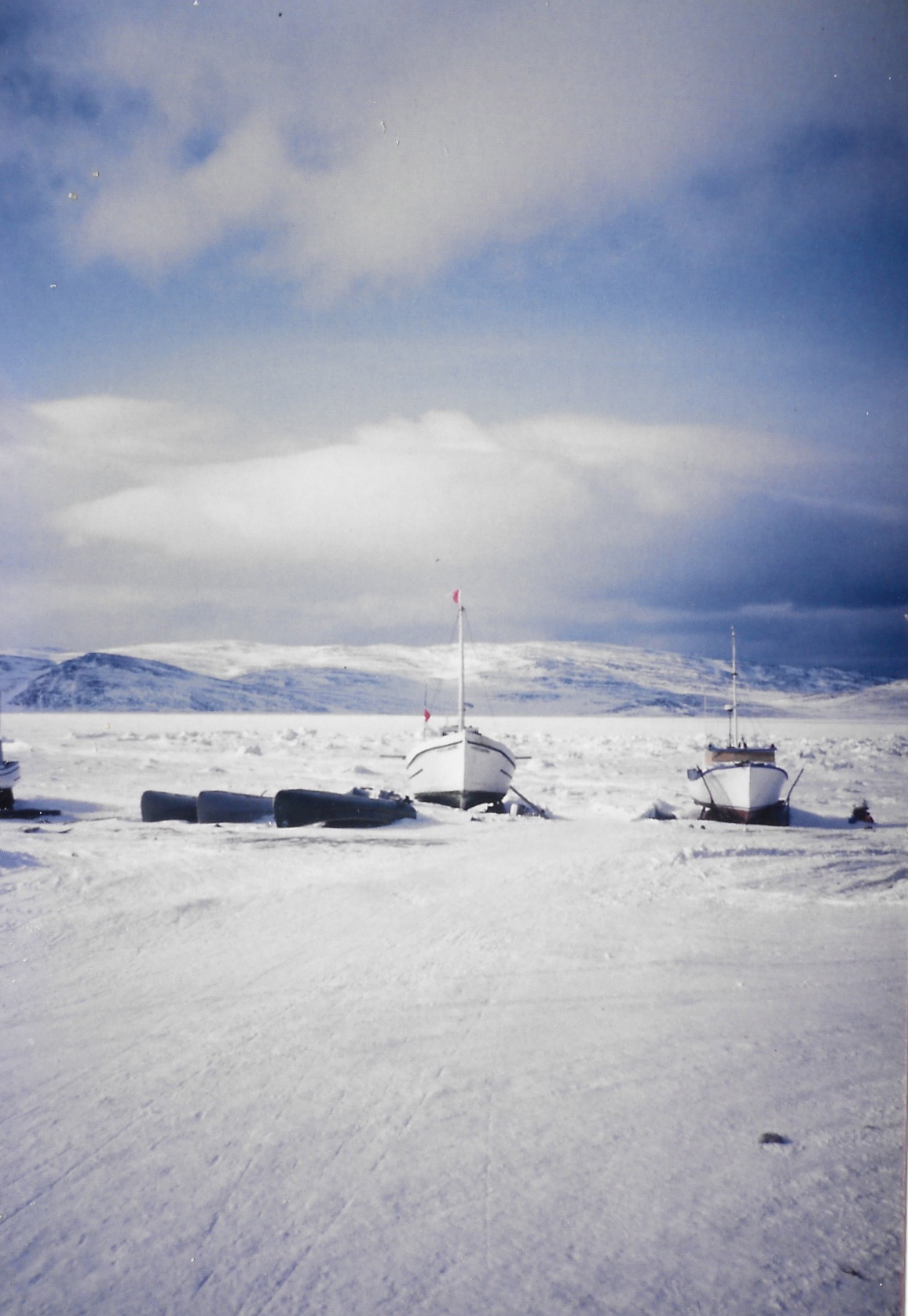
Boats are frozen in the ice, awaiting warmer days, in the spring of 1996. (PHOTO BY JANE GEORGE)

Boats are frozen in the ice, awaiting warmer days, in the spring of 1996. (PHOTO BY JANE GEORGE)

I stood in front of the TNI studio with Joanasie Koperqualuk, taking in this spring scene, when he suddenly asked me, “What do you suppose today’s date is in Roman numerals?”

I told him I have no idea, but this question made me laugh.

Koperqualuk was always surprising me. He was the secretary at TNI, but we discussed the story lines and planned interviews together for TNI and for reports I was also working on for CBC radio at the same time.

He became much more than an interpreter when we talked to people together: Koperqualuk was able to translate simultaneously for me, but at the same time he was also planning the next question that I should ask before I could even think about it.

The small TNI studio was almost entirely run by Inuit — the only other non-Inuk around maintained the equipment. Daily radio broadcasts and weekly television programs were all prepared by Inuit: there were no non-Inuit here behind the scenes thinking they make things work.

One of the employees never showed up the whole time I was there, but Koperqualuk and the other employees looked down on him. Koperqualuk arrived at the office every morning at 8:30 a.m., and often stayed until late in the evening, to finish an important document or plan for the next day.

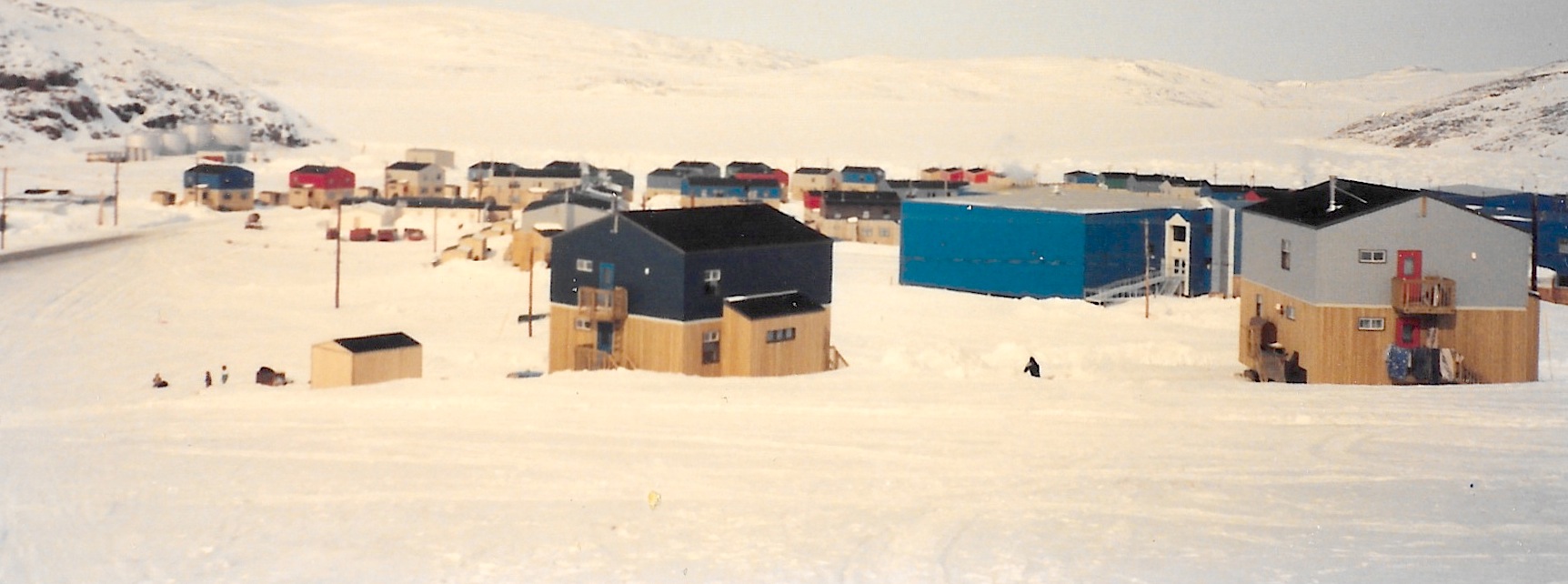
A view into the Nunavik community of Salluit in 1995. (PHOTO BY JANE GEORGE)

A view into the Nunavik community of Salluit in 1995. (PHOTO BY JANE GEORGE)

Elder broadcaster, the late Elashuk Pauyungie, then 55, was in charge of radio programming, and she took her work seriously, too. I learned that Pauyungie, who spoke only Inuktitut, had lived in an igloo until she was 17.

She never went to school. When she was young, communication was limited to letters between camps, often delivered by dog-team. The community of Salluit didn’t exist.

And, when I’m there, Salluit was on the brink of more big changes. The giant nickel mining company Falconbridge Ltd. was starting to build the Raglan nickel mine, located not far from the community. People in Salluit were hoping for jobs at the mine: With unemployment officially at 30 per cent, any new job possibilities were welcome.

Down at the former restaurant, a group of students had started a two-year professional cooking course. When I visit, two of them were cutting up onions and potatoes for a salad, while another mashed eggs for sandwich filling. Another added whipped cream to a pie for dessert.

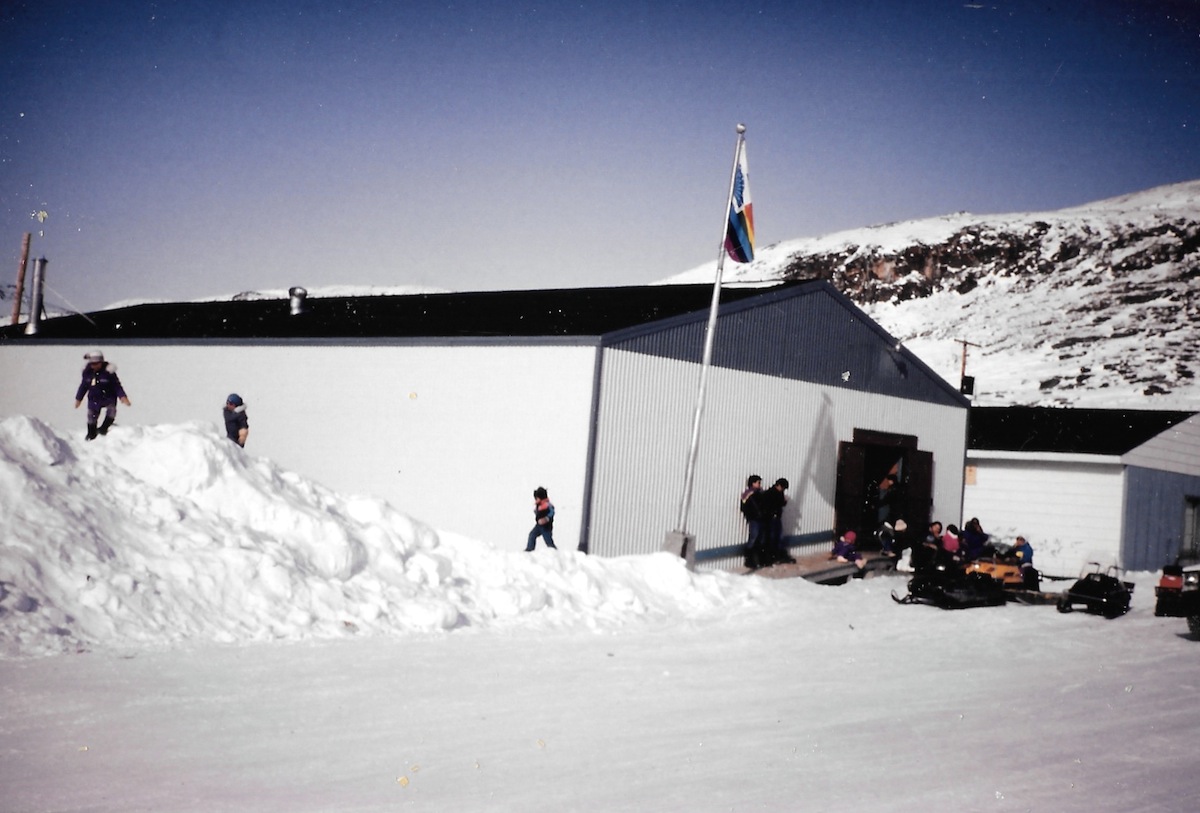
A big pile of snow beside the co-op store in Salluit is a draw to kids in the spring of 1996. (PHOTO BY JANE GEORGE)

A big pile of snow beside the co-op store in Salluit is a big draw for kids in the spring of 1996. (PHOTO BY JANE GEORGE)

As part of this course, the class had also been learning about making balanced meal menus and reading recipes. When participants mastered all aspects of cooking, they hoped jobs would be waiting for them at Raglan mine site.

The Quebec government gave Falconbridge the go-ahead to develop the Raglan nickel mine site in May 1995. Only a year later, serious construction work was beginning at Raglan, and jobs for qualified Inuit employees had already opened up.

Salluit and Kangiqsujuaq, the other community near the mine site, were also looking to link up with southern-based companies to make money.

About $75 million in compensation (and that turned out to be a low estimate) was already guaranteed over 20 years as part of the Raglan Agreement that Inuit signed with Falconbridge in 1995 —  money that could be used by the communities to invest in joint ventures.

But critics said this economic progress would come with a cost, environmental and social. Contaminants and pollutants might be stirred up by the mine’s construction as well as by the production and transport of nickel.

And nearby Deception Bay, a favourite hunting spot, where huge tankers would someday fetch nickel concentrate and deliver fuel, could be at risk from spills, airborne particles and run-off from the nickel extraction process that can produce substances like arsenic, chromium, cobalt and lead. Wildlife that provide country foods to Inuit in the region could also be affected by these contaminants.

Concern for the fragile environment around a future provincial park not far from the mine was also surfacing. The park would surround a huge naturally-formed crater called Pingualuit. Formed by the explosive impact of a meteorite 1.4 million years ago, this crater lake’s water is exceptionally pure, so clear and soft that researchers used it to study the atmospheric fall-out of trace elements.

Of course, the official word was then always that everyone supported the Raglan mine, but I didn’t have to look very hard to find dissenters.

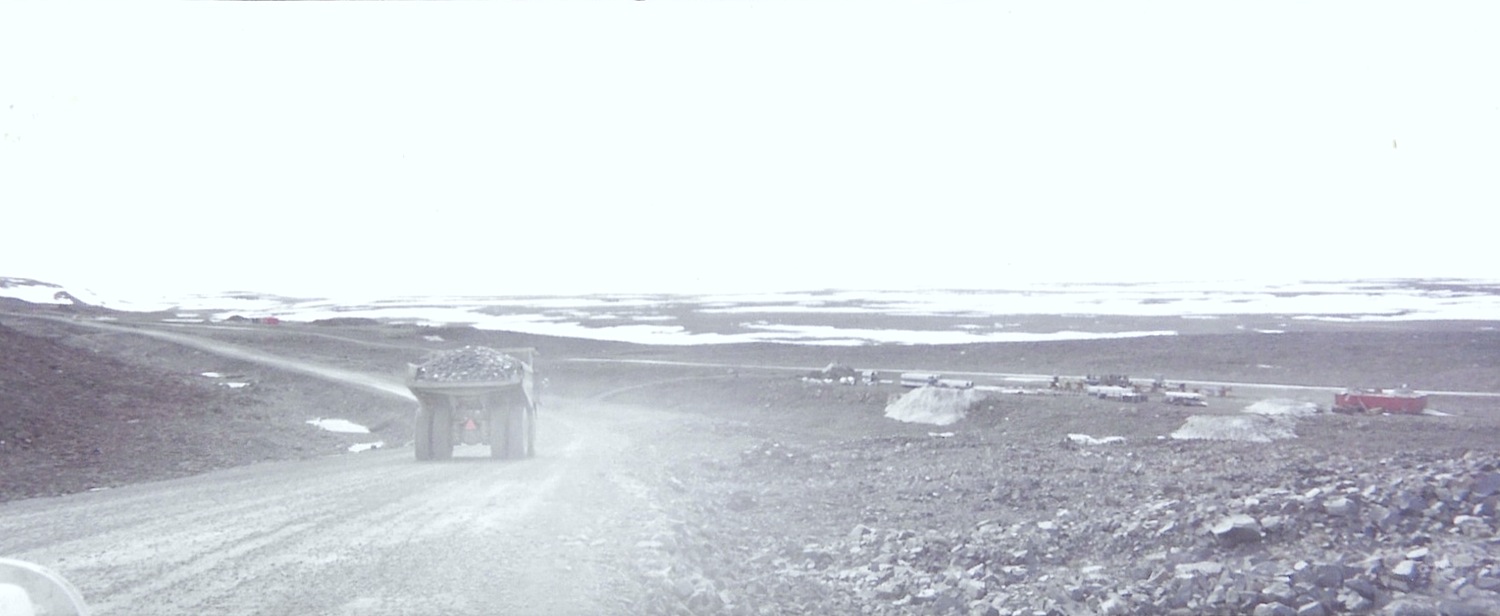
A truck rolls along a road outside the Raglan mine in Nunavik in the mid-1990s. (PHOTO BY JANE GEORGE)

A truck rolls along a road outside the Raglan mine in the mid-1990s. (PHOTO BY JANE GEORGE)

Putulik M. Okituk had nothing to fear from being outspoken. Twenty years earlier he had fallen off the top of the large gas reservoirs in Salluit while sniffing gas. He broke his back and had been in a wheelchair ever since. That fall changed his life, he told me.

In 1996, Okituk spent his time reading, listening to radio, playing crossword puzzles and thinking.

When I went over to his house, we chatted over tea. On this visit to Salluit, I learned that since I last saw him, Okituk had become also a municipal councillor.

Putilik Okituk is not afraid to say what he thinks about the Raglan mine. (PHOTO BY JANE GEORGE)

Putilik Okituk is not afraid to say what he thinks about the Raglan mine. (PHOTO BY JANE GEORGE)

But he still believed that the compensation payment Inuit would receive for the Raglan mine development could not make up for “the impending carnage of their land.”

He was upset that more local people didn’t show up here at a meeting held in early 1995 to discuss the project with representatives of Falconbridge. Okituk said those who did were handicapped by their poor grasp of English.

“The people who could understand the proceedings were not fluent enough to voice their concerns or to oppose the meagre offerings put before them,” he said.

“In the long run, people who did not attend the meeting will regret not having gone to the meeting of their lifetime. There will be a greater regret once they see the mistake they made when they start to see what is happening to the land which they so lovingly refer to as ‘our land.’”

I also went with Koperqualuk to visit Jimmy Kakayuk, one of Salluit’s elders, to talk to him about the mine development. Kakayuk said he wasn’t impressed by a $350 cheque he had received as part of the compensation money from the Raglan Agreement. To Kakayuk, the cheque seemed a bit like a pay-off.

“What did I do to deserve this?” asked Kakayuk, a hunter and carver who not is used to getting something for doing nothing.

Despite promises of money and proper environmental management, in 1996, there was huge uncertainty over just what changes the communities would face during the estimated 20-year lifespan of the mine — which is still in operating in 2015.

Although mine workers from the South were not supposed to visit the neighbouring communities, contact would be inevitable leading perhaps to more drugs, more teenage pregnancies and perhaps even violence, I heard (Some of those fears were realized later when huge resource-sharing cheques saw people in town walking off from the job and spending the extra money on drugs and alcohol.)

In 1996 people said they are also worried about environmental damage and how this would be monitored.

“The only time Inuit go out extensively on the land is in winter and we’re in snowmobiles. What covers debris and garbage better than snow?” a critic of the mine said.

One afternoon I went out snowmobiling with L., a broadcaster at TNI. We headed out from Salluit down the bay. On both sides we were flanked by cliffs. Everything was white.

She dodged giant hummocks of ice. Finally, we stopped by an open spot of water where locals came to harvest mussels. L. smoked a cigarette, while I looked around. It was May 4, and I was standing in an icy landscape, while I knew that in the South the first spring flowers were already in bloom.

From the top of the hill near Salluit, the community below, 1996. (PHOTO BY JANE GEORGE)

Salluit, from the top of a nearby hill, 1996. (PHOTO BY JANE GEORGE)

On the way back, we decided to head up one of the steep hills around Salluit. On top, the wind was blowing so hard it almost knocked us over, but you could see for kilometres, right over to Hudson Strait. The community spread out below us.

In the 1960s,  only a few dwellings hugged the shoreline of the bay. In 1996, new houses entirely filled the space between this hill and the next. A suburb had even sprung up since my last visit, a cluster of houses about 15 minutes from the centre of town, on the way up to the airport.

We raced down the hill back into town. While we were out on the land, I felt free: the streets of the community seemed to clash with the ice and snow we just navigated through.

I relished being in Salluit. I went to the Anglican church on Sunday, where I was invited home by fellow worshippers for Arctic char. I shopped at the co-op store and ran into people I knew.

I went visiting at night. I spent my evenings drinking tea and eating pilot biscuits. I visited with Elisapie Isaac, then a high school student and young broadcaster at TNI, who later would become a singer known throughout the North, in Quebec, and beyond.

When I leave Salluit, I was brought to the airport by Salluit resident Bill Smith. He always wore a tasseled crocheted hat, a nassak, with the word “Salluit” woven in the design.

As he dropped me off at the airport terminal, I suddenly remembered this hat from that first trip I took to Puvirnituq in 1991, but five years later, I, like everyone else that day, five years earlier, knew who the man wearing this hat is. This time he also knew me.

Like an iceberg continues April 29.

You can read previous instalments here:

Like an iceberg: on being a journalist in the Arctic

Like an iceberg, 1991…cont.

Like an iceberg, 1991…more

Like an iceberg, 1992, “Shots in the dark” 

Like an iceberg, 1992, “Sad stories”

Like an iceberg, 1993, “Learning the language of the snows”

Like an iceberg, 1993 cont., “Spring”

Like an iceberg, 1993 cont., “Chesterfield Inlet”

Like an iceberg, 1993 cont., more “Chesterfield Inlet”

Like an iceberg, 1994: “Seals and more”

Like an iceberg, 1994, cont., “No news is good news”

Like an iceberg, 1994 cont., more “No news is good news”

Like an iceberg, 1994 cont., “A place with four names”

Like an iceberg, 1995, “More sad stories”

Like an iceberg, 1995 cont., “No place like Nome”

Like an iceberg, 1995 cont., “Greenland”

Like an iceberg, 1995, cont. “Secrets”

Like an iceberg, 1996, “Hard Lessons”