How many glasses of Canadian wine and how many rich meals can a journalist from Iqaluit consume?
The surprising — perhaps — answer to that, which I found during ex-Governor General Adrienne Clarkson’s 2003 state visit to Finland and Iceland, is not that many.
A few days into the 10-day junket I couldn’t face one more official toast, banquet or multi-course airplane meal.

John Ralston Saul quaffs wine at a Helsinki wine tasting of Canadian wines during the 2003 state visit to Russia, Finland and Iceland. (PHOTO BY JANE GEORGE)
While the food and booze came my way non-stop , I didn’t forget the state visit was funded by taxpayers.
And I remembered that, thanks only to the Department of Foreign and International Affairs, which covered my costs, I was the only journalist along for the ride (allowed to come because I worked for northern news organization and, while on the state visit, wanted to explore the interest for the Siku circumpolar news service, which Greenlandic broadcaster Inga Hansen and I tried to develop.)
So, unlike some other “delegates” on the state visit, who could party late and hard, I tried to keep my mind clear for reporting for the newspaper I work for, Nunatsiaq News, and Maclean’s (to which I had pitched a column about the trip, eventually called Polar Gambit): being a journalist along for the ride was not always easy or even fun.
Now, more than 10 years later, I can look back at the stories I wrote on this state visit and be grateful for my sleepless nights: if I hadn’t written these stories, and somehow sent them via tediously slow internet connections, I wouldn’t remember a lot of what happened.
Why did I keep all the pieces of paper we received on the journey, every schedule, speech, briefing paper and menu? Their existence surprised me when I was going through my files, which are now at the Arctic Institute of North America in Calgary, Alberta, where you can also find the rest of my photos, notes and other northern paraphernalia from 20 years of working as a journalist and broadcaster in the Arctic.
But if I hadn’t kept those menus — those food offerings seemed stupendously over-the-top at the time — how would I recall that meal in Inari, Finland: salted white fish and trout “à la Inari,” fried reindeer sirloin, “lappish potatoes” and cloudberry cream jelly — with a selections of wine, of course.

Menus from two meals during the 2003 tour.
Most of the 30-plus members of the official delegation, who spent five days in Finland and then another five days in Iceland in October, 2003, weren’t even from what most Canadian northerners would consider the North.
They were from Ontario, Quebec or British Columbia. The delegation included winemakers, authors, architects, musicians and a smattering of artists, officials and academics.
But Clarkson and her husband, John Ralston Saul, said all Canadians are northerners.
“Where do you draw a line? It’s not just two pieces. There’s Ellesmere Island and it’s definitely not in Iqaluit. Iqaluit isn’t Whitehorse or Yellowknife. There are many Norths in Canada,” Saul said at the time.
Canada, Saul and Clarkson said, is much like Finland and most other circumpolar nations, with a “North-North” and a “South-North.”
Helsinki, the capital of Finland, is, for example, 1,200 kilometres south of Utsjoki, a Saami community at the northern border of Finland.
Clarkson and Saul suggested to me that Canadians should start identifying themselves as northerners to share with each other and support each other.
“The whole of our country is a northern country,” Clarkson said. “You don’t want to segment out different parts of it.”
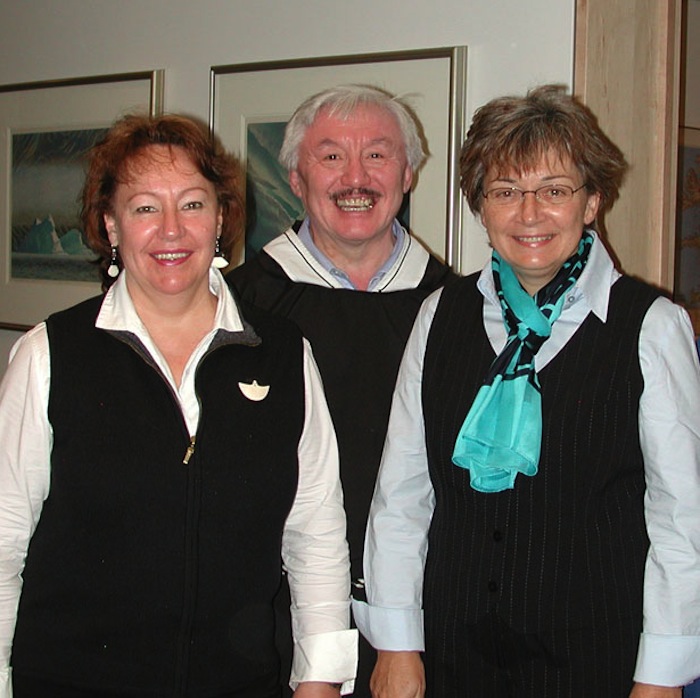
My tour companions: Shelia Watt-Cloutier, then president of the Inuit Circumpolar Conference (now Council), Nunavut’s first commissioner Peter Irniq, Mary May Simon, who was at that time Canada’s Arctic Ambassador. (PHOTO BY JANE GEORGE)
But if hadn’t been for the presence of Inuit — Sheila Watt-Cloutier, then president of the Inuit Circumpolar Conference (now Council), who later would be nominated for a Nobel Peace Prize for her work on climate change, Nunavut’s first commissioner Peter Irniq. and Mary May Simon, who was at that time Canada’s Arctic Ambassador, one might have thought folks from Vancouver and Toronto or the careful, Anglo-Canadian accents of the GG couple or wine-tastings defined Canada’s North.
Alarmed by word that this state visit, which started in Russia and would end more than three weeks later in Iceland, would cost more than $1 million, the House of Commons standing committee on operations and estimates started to examine its spending. The price tag of the visit would eventually come in at more than $5 million.
That’s a cost estimate I had no trouble believing as we wined and dined our way through Finland and Iceland.
Read more later on A date with Siku girl about the 2003 journey from Ottawa to Helsinki, Oulu, Rovaniemi, Inari, Reykjavik, Akureyri and back to Ottawa.