Language learning: not hard at all

Most babies can learn to speak a language or languages without even trying  — and so can older children, too, as I saw when I started to absorb, then speak, Finnish.

But my success in learning Inuktitut later, as an adult, was less successful.
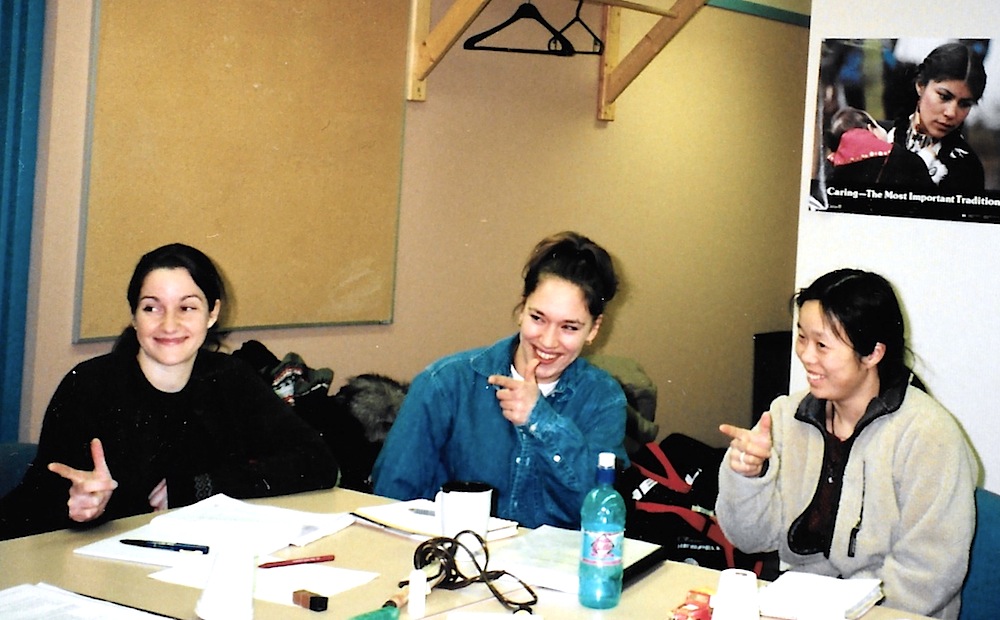
Jocelyn Barrett, Sylvia Cloutier and Siu-Ling Han participate in an exercise during the 1999 Intermediate Inuktitut class at Nunavut Arctic College in Iqaluit, which involves "shooting" the right person, according to the command in Inuktitut. (PHOTO BY JANE GEORGE)

Jocelyn Barrett, Sylvia Cloutier and Siu-Ling Han participate in an exercise during the 1999 Intermediate Inuktitut class at Nunavut Arctic College in Iqaluit, which involves “shooting” the right person, according to the command in Inuktitut. (PHOTO BY JANE GEORGE)

Why? For one thing, I was never immersed totally in the language outside my Nunavut Arctic College courses. In Iqaluit there are many English- and French-speakers, and even when in more unilingual communities, there was always the presence of another language somewhere in the background — on television or the internet.

Had I been able to visit an outpost camp and hear no English for a few months, I believe my mastery of Inuktitut could have quickly improved — but that was hard to do with job and family.

On the other hand, although my mainly school-learned French was imperfect,  I quickly became fluent when I worked in a unilingual French-language office as a young adult in Quebec. Perhaps if Nunavut or Nunavik had Inuktitut-only work environments, people would get better at speaking Inuktitut more quickly.

And if all Inuktitut dialects in Canada used Roman orthography for writing,  it might be easier to learn and use the language without mastering an entirely new alphabet. Even now, I can read and understand more of something written in Greenlandic or Inuinnaqtun than in syllabics, which require an additional level of effort to understand.

Based on my experiences, here’s what I think the list of ingredients for language-learning — which could be applied to Inuktitut teaching (or as it’s now called by the Government of Nunavut ,”Inuktut”) — include, namely to:

• start language-learning early when the brain is more open to learning language(s) in schools and child care centres (as is the rule in Nunavik child care centres) and at home;

• provide immersion in the language, at home and in the community, if possible;

• make the language worth learning — that’s because if there’s a need to speak, then you’ll want to learn it;

• draw on the language skills of unilingual elders;

• put the language into situations like social activities, sewing or hunting or whatever —because  it’s much easier to remember that way;

• adopt Roman orthography ASAP;

• put less emphasis on dialects and work on basic communication skills; and,

• foster more publishing of books, magazines and other reading materials.

None of these ideas are new. In fact, the above list reads like the to-do lists of many language specialists in Nunavut and Nunavik.

But although these are commonsense, already-accepted ideas, many have gone nowhere in Canada’s North or moved too slowly to have an impact.

Money isn’t the only issue, either: it’s will — if you just talk to your children in a language, they will learn.

Look for future A date with Siku girl posts on Arctic talk, travel, thoughts and news.


Saami, Finnish, Inuktitut: ancient cousins, once removed

Wouldn’t it be great if everyone in the circumpolar region could understand each other without translators or interpreters? At least one linguist thinks that may have been the case about 20,000 years ago.

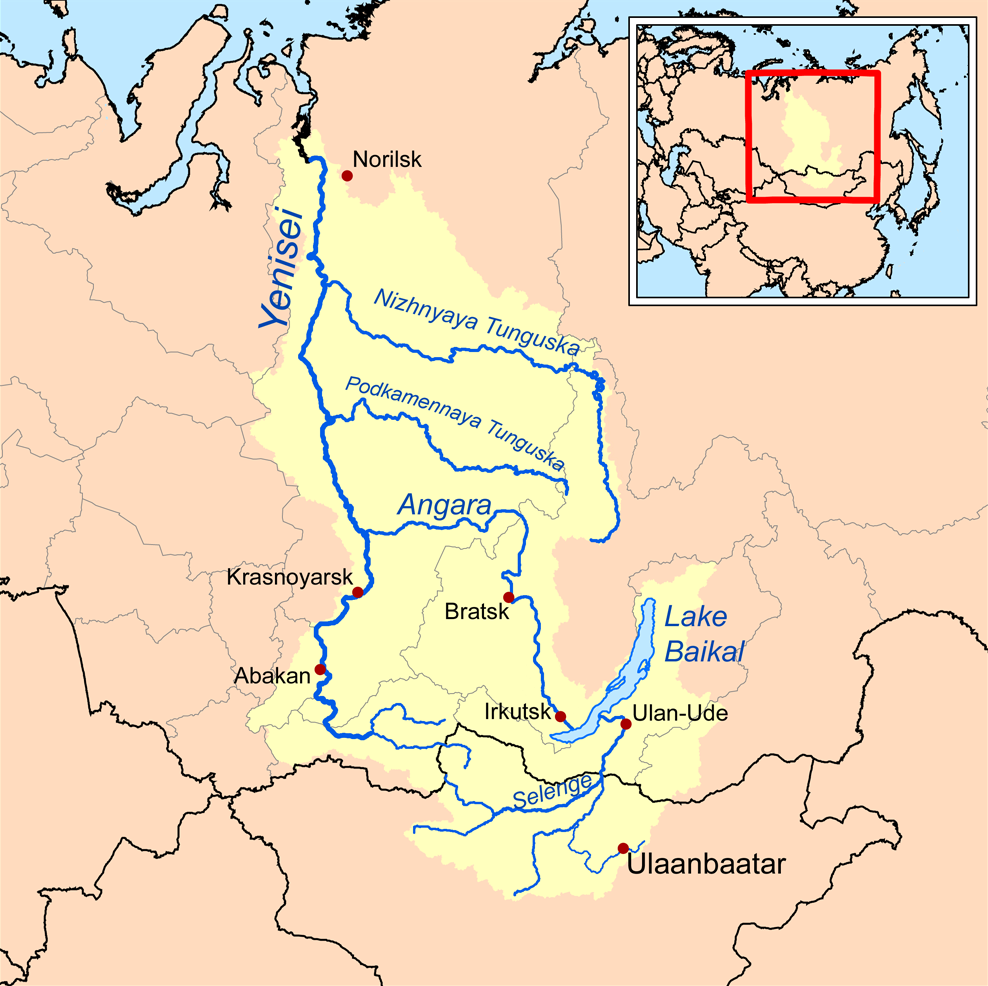
Michael Fortescue, a linguist and expert in Eskimo–Aleut and Chukotko-Kamchatkan, believes that a group of people, all speaking a common language that he’s dubbed “Uralo-Siberian,” then lived by hunting, fishing and gathering in south-central Siberia (an area located roughly between the upper Yenisei river and Lake Baikal in today’s Russia, as shown in the map).

The area between the Yenisei River and Lake Baikal in central Siberia where early residents are thought to have spoken a common language that gave rise to Saami, Finnish and Inuit languages.

The area between the Yenisei River and Lake Baikal in central Siberia where early residents are thought to have spoken a common language called Uralo-Siberian that gave rise to Saami, Finnish and Inuit languages.

There, families whose migrations were ruled by the coming and going of glaciers during the Ice Age moved northward out of this area in successive waves until about 4,000 BC.

Some headed west along the northern coasts and others went east, eventually crossing the Bering Strait to North America.

They would end up living across the circumpolar region, with Inuit living from Alaska through to Canada and Greenland, Saami in Sápmi (northern Norway, Sweden, Finland and northern Russia) and Finns in Finland (or Suomi in Finnish.)

During those long-ago migrations, travelers took their common language, Uralo-Siberian, Fortescue suggests.

You can still hear today’s version of that language in Nunavut — where Uralo-Siberian developed into Inuktitut — and in Finland — where that language survived as Saami and as Finnish.

To me, someone who has lived in both regions and speaks Finnish (fairly fluently) and Inuktitut (not nearly as well) and can understand when people speak Saami (usually), the idea that there was once a united Uralo-Siberian family of languages makes sense.

That’s because the grammars of the three languages feel so similar (not to mention many shared cultural elements).

Map of the Uralo-Siberian languages.

A family tree of the Uralo-Siberian and related languages which shows the various Inuit languages as well as Saami and Finnish and how they are related.

Indeed, on this family tree of Uralo-Siberian languages, Inuktitut and Finnish look like fairly close cousins.

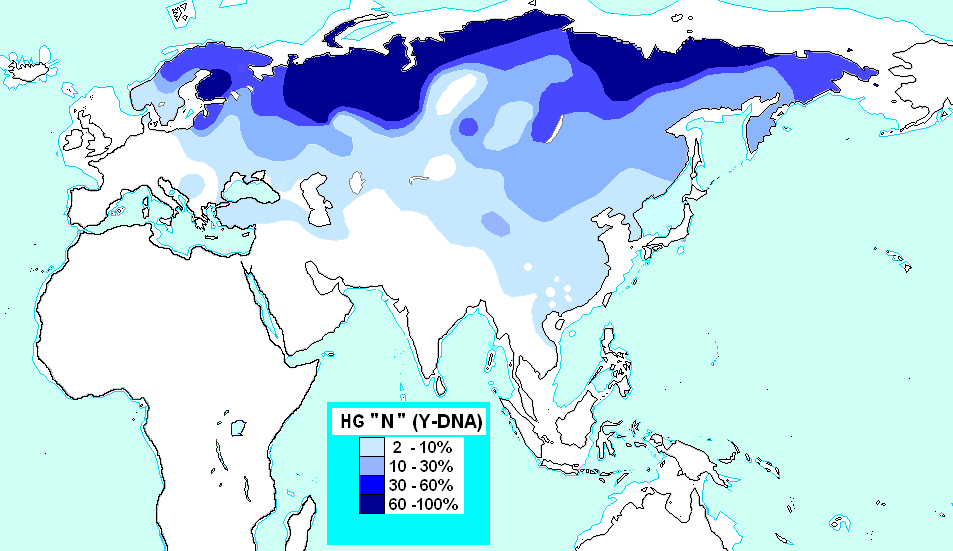
This map shows the spread of the genetic marker Haplo group N "Y", which goes from the northern coast of Scandinavia through Siberia towards North America.

This map shows the spread of the genetic marker Haplogroup N “Y”, which goes from the northern coast of Scandinavia through Siberia towards North America.

This language family was first proposed in 1998 by Fortescue in his book Language Relations across Bering Strait . But some linguists still don’t embrace his proposal, because it looks at the spread of languages and people in a new way.

More recent genetic tests do show Saami and Finns share more genetic markers linked with Asian populations in the Bering Strait and beyond than do any other European populations.

As for this early language, Uralo-Siberian, Fortescue argues that some common grammatical marker features are recognizable in the Inuit languages, Saami and Finnish, namely:

*-t   — plural

*-k  — dual

*m — 1st person

*t  —  2nd person

*ka  —interrogative pronoun

*-n —  genitive case

And you can still find verb roots in the Inuit languages of Canada and in Saami or Finnish as well as words in all three that appear to stem from that ancient common language:

Proto-Uralo-Siberianaj (aɣ) — ‘push forward’

Proto-Eskimo–Aleut ajaɣ —‘push, thrust at with pole’

In today’s Finnish —  ajaa, ‘drive’

Or you can hear similarities in other words used today, such as:

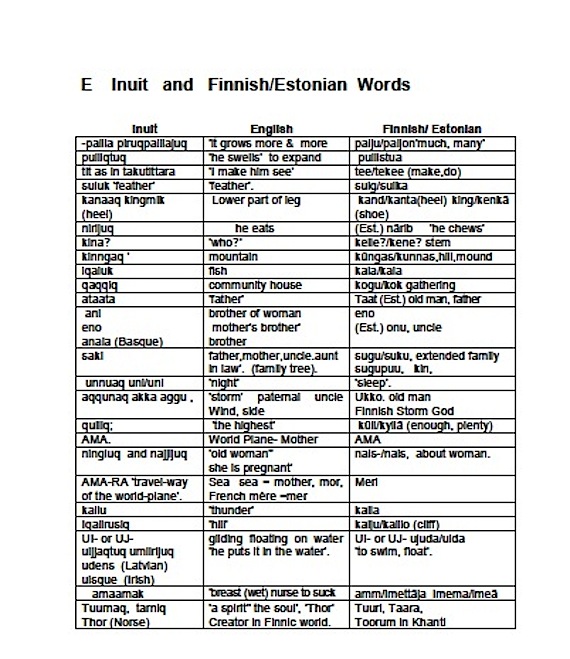
• kina (who) in Inuktitut, ken in Finnish;

• mannik (egg) in Inukitut, monne in Saami, muna in Finnish; and,

• kamek (boot) in Inuktitut, gama in Saami, kenka in Finnish.

The spoken languages also sound similar because they’re spoken with a word-initial stress (that is with the first syllable being emphasized — i.e. Nu-navut, Su-omi.)

As well, words (both nouns and verbs) get their meaning from many added-on chunks that tell you, among other things, who did what and when and to whom. This allows for a precision that  you don’t find in English.

For example, in Inuktitut and Finnish, even the notion of saying “there” must be precise — you need to say exactly where something is, whether it’s at a certain point nearby, here or there or further away.

For some experts, the enduring similarities in these languages, spoken by a majority of people who live within the jurisdictions of Nunavut, Greenland and Finland, reflect the amazing survival of that early  Uralo-Siberian grammar and lexicon of words.

But its isolation in the North in may also have had something to do with the Uralo-Siberian language’s endurance.

The Origin and Genetic Background of the Sámi suggests that Saami and, to a lesser extent, Finns were able to maintain their separate language identities over the centuries due to their geographic isolation in the Arctic while other peoples were losing their languages to Indo-European speakers from the South.

We now see different situations between the Inuit languages, Saami and Finnish — the largest of the three languages, which is spoken by more than five million people in Finland.

In Like an iceberg. I talk about learning Inuktitut.

In a future post in A Date with Siku girl, I will talk about what it was like for me to learn Finnish as a young girl and what this experience reveals — at least to me — about language learning and preservation.

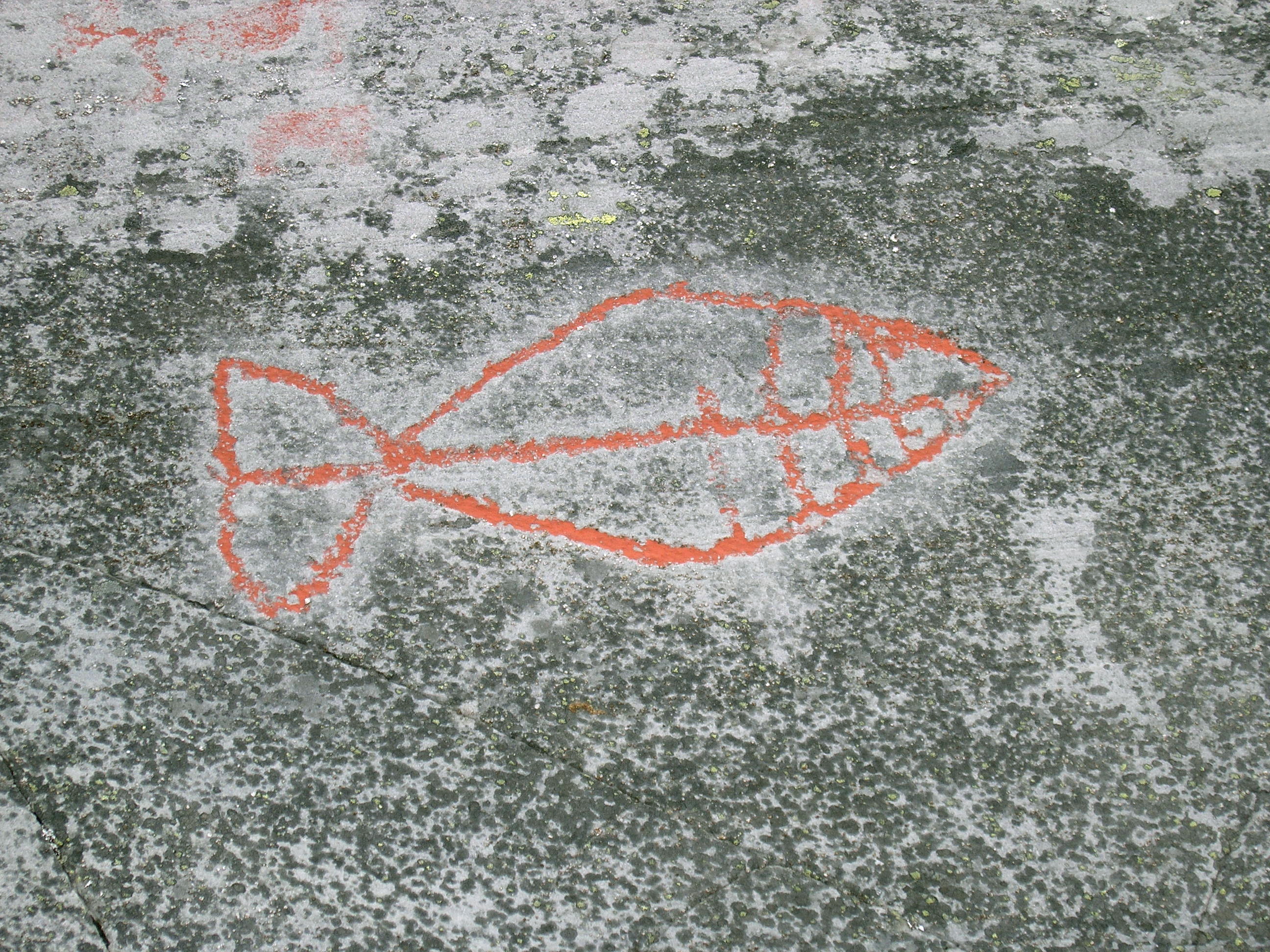
Rock art in northern Norway from the earliest inhabitants of the region. (PHOTO BY JANE GEORGE)

Rock art in northern Norway from the earliest inhabitants of the region. (PHOTO BY JANE GEORGE)

(For this post, I consulted so many sources online that I have not provided links to them all, but if you’re curious about the relationships between the ancient Uralo-Siberian languages, I urge you to do your own online searches and see what turns up. There appears to be many disputes over all the genetics and linguistics about which I could write a book, not simply a blog post. As for me, I’d be interested in receiving feedback from those more knowledgeable than I am in this area. Since publishing this blog in 2014, I received this very interesting list of words in Inuktitut, Finnish and Estonian: