Like an iceberg, 1991…cont.

The back view from the apartment where I stayed in Puvirnituq in November 1991. (PHOTO BY JANE GEORGE)

The back view out of the apartment where I stayed in Puvirnituq in November 1991. (PHOTO BY JANE GEORGE)

1991, continued from April 2:

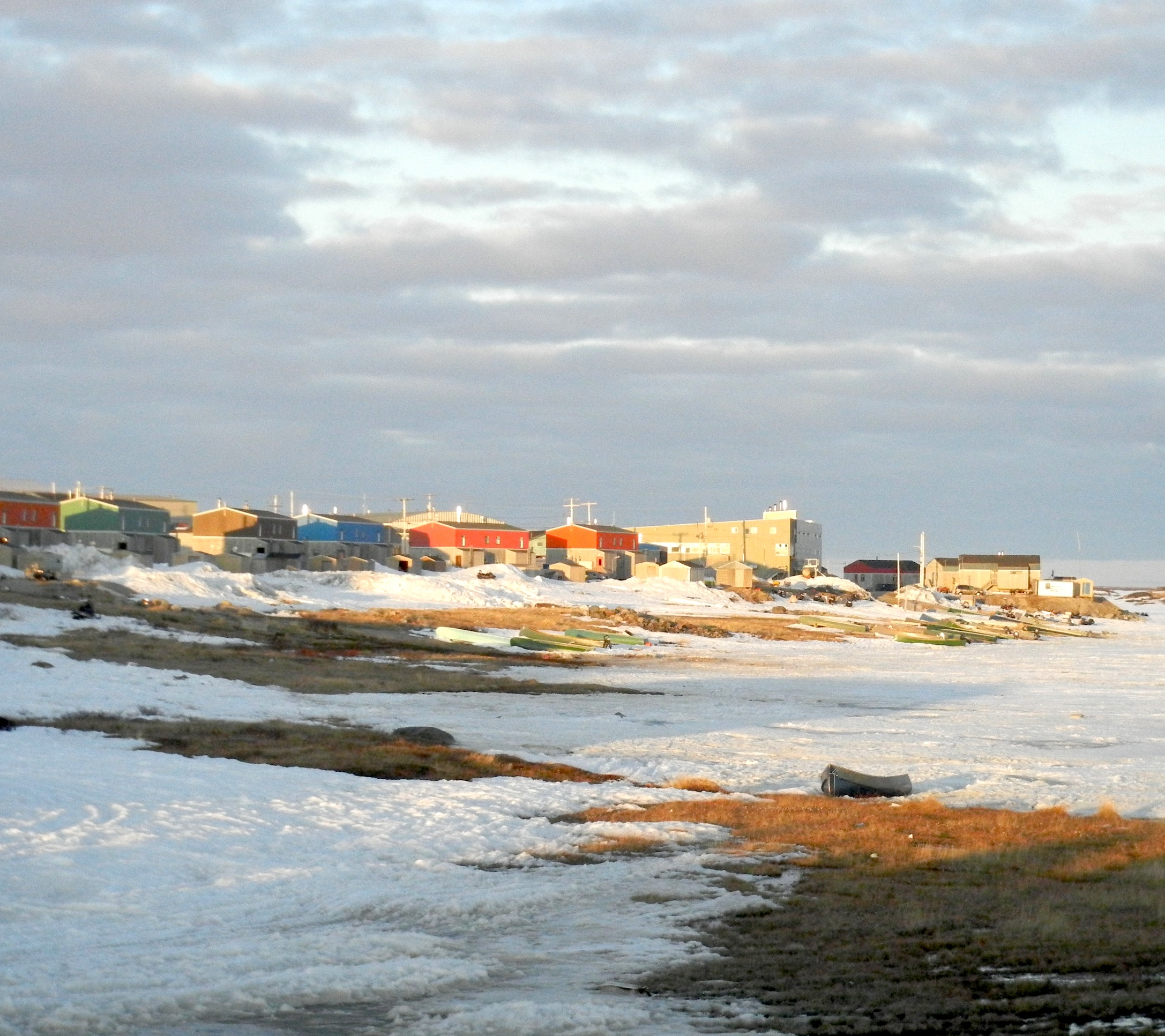
I can still see the view from J.’s apartment in Puvirnituq. I’d press my nose against the glass and look out, past older matchbox houses, to more recently-built units with red, blue or green siding and a few three-storey apartment buildings, all separated by huge banks of snow.

Beyond the last house: an endless view of rocks and snow. As I looked out the window, I would run my tongue over my teeth. I could taste the film of seal fat.

“No matter what you do,” J. had counselled me. “Don’t eat too much of the seal fat. I burped it up for a week.”

On my second day in Purvirnituq, wind and snow were still blowing in from the land.

In this cold place, everyone then lived in heated homes, there were snowplows to clear the roads and trucks to pick up sewage and bring in fresh water. In 1991, snowmobiles took people around the community or out on the land — but chained-up sled dogs still howled behind every home and woke me up during the night.

I’d been invited for lunch at the home of L.’s mother-in-law. There, in the vestibule of her house, my too-bright, felt-lined boots joined the huge pile of  boots stacked up against fox pelts and parkas.

L.’s relatives met at her mother-in-law’s kitchen every day for lunch. I walked in and greeted them. They were already sitting around the floor around a large piece of cardboard. In the middle of the sheet lay several large chunks of raw caribou — one looked like a leg, the other a roast. That is, it would have, had it been cooked. Everyone was busy slicing slivers of the half-frozen meat. The women used a rounded ulu knife to deftly cut the caribou right into their mouths. The men handled straight-edged knives. These were the only utensils around.

“Sit down, sit down,” L.’s sister-in-law called over.

I joined the group, sitting cross-legged on the linoleum.

“Try this,” said L., handing me a slice of the raw caribou. It’s surprisingly tender.

She pointed out a container of oil in the middle of the cardboard.

“We dip the tuktu in this seal oil, misaraq — it’s like our ketchup! But, watch out, it tastes hot.”

This Puvirnituq elder, who hosted my first country foods meal in November 1991, deftly slices caribou with an ulu. (PHOTO BY JANE GEORGE)

This Puvirnituq elder, who hosted of first country foods meal in November 1991, deftly slices caribou with an ulu. (PHOTO BY JANE GEORGE)

Lots of laughs. I immersed a small piece of my meat into the pungent, cheesy oil. L. then carved me a large piece of the raw Arctic char. I wasn’t able to figure out what raw caribou tasted like, but the first bite of char reminded me of more familiar textures of sushi or gravlax salmon. It was good. Between the bits of conversation, there was only the sound of razor-sharp ulus flipping over the meat. As I nibbled on the char, I was searching for ways to digest the scene in front of me. No, it wasn’t a picnic, not a barbecue. We were inside, in the middle of a November mini-blizzard.

I joined in. I was given a hunk of whale blubber, mataaq,  neatly carved into a waffle pattern for easier eating. It looked like bacon, I couldn’t help thinking, but tasted a bit like coconut-flavoured bubble gum and the rind was thicker. We sipped coolish tea as we ate.

“Too bad you’re not here when we’re having snowy owl,” L. said. “It’s my favourite.”

Country foods, as I learned Inuit call these raw local dishes,  reflected the reality of the fuel-less tundra around us, a harvest of the wild where agriculture is impossible.

After everyone had eaten enough, it was time to clean up. The leftover pieces of meat and fish were wrapped up and put back in the freezer or tossed out on to the porch. The few scraps that remained were pushed to the centre. These were to be fed to the dogs. Then, the cardboard that was been our table was folded up for storage until the next meal. Finally, L. whisked the kitchen floor with a large feathered goose wing. The kitchen was clean again and there was no sign that we had our feast at all.

I saw how country foods still nourished this community in 1991.

When a fishing boat returned after a five-day trip up the coast, its arrival was announced on the community radio station. Everyone ran down to the dock with plastic bags. The walrus caught by the men was spread out in front of the boat. Then, there was a kind of banquet when everyone in the community sampled the walrus, and afterwards, each family took a big piece home.

From what I could see at the local co-operative store in Puvirnituq, foods from the South looked like an expensive choice: $3.15 for a lettuce, a melon for $6.60 or how about cookies at over $7.00 a box? I saw bottled water on sale for the first time in my life — something I never thought of buying in the South. And why would people need to buy water here? Because, I learned, the water delivered to homes could sometimes make people sick. Co-op members received a discount when they buy at the store, I learn, and they could always charge their purchases when money was tight.

Over the co-op’s office counter, I spoke with the manager, Aisara Tukalak. How do people survive here, I asked him. Sometimes they didn’t, was his answer. He told me — for the first time  — a story that I would hear countless times, of how during a famine, many years ago, the Hudson Bay Co. trading post refused to offer Inuit credit. With no furs to barter, many starved to death, he told me. I asked Tukalak many questions, but he spoke almost no English and I didn’t yet speak any Inuktitut at all.

“Talk to Peter Murdoch,” Tukalak said, pronouncing the word like “Peetah.” “At the hotel… later.”

To be continued April 4

You can read the first part here.

iceberg in davis strait

Join me in “Like an iceberg” as I remember my travels in the Canadian Arctic during the 1990s, a period when few journalists travelled as widely in the region.

I started working on this tale back in 1996, thanks to a Canada Council Literary Development grant, and then put everything aside for more than 15 years as I worked for the Nunatsiaq News. 

I am taking the liberty of changing some names and details to protect the many people who spoke to me freely and to safeguard myself against any possible defamation lawsuits.

Comments are welcome!

Like an iceberg: on being a journalist in the Arctic

“The iceberg needs to be broken. Even if it’s big, it will break. The only way it can get fixed is if you talk. We have to break the iceberg into pieces. Then things will come out. After the iceberg has crumbled, there’s a cleansing of the body. Everything will come out in anger and rage.” — Meeka Arnakaq of Pangnirtung, 1995

An iceberg melts in August off the shore of Baffin Island. (PHOTO BY JANE GEORGE)

An iceberg melts in August off the shore of Baffin Island. (PHOTO BY JANE GEORGE)

Join me as I remember my travels in the Canadian Arctic during the 1990s, a period when few journalists travelled as widely in the region.

I started working on this tale back in 1996, thanks to a Canada Council Literary Development grant, and then put everything aside for more than 15 years.

I have taken the liberty of changing some names and details to protect the many people who spoke to me freely and to safeguard myself against any possible defamation lawsuits.

November 1991: I watched as the dark red apple rolled under the plane. All around me snow whipped by horizontally, lit up in swaths by the headlights from idling snowmobiles. The small plane was surrounded by half-lit, snow-covered figures.

A woman with a baby on her back carefully maneuvered down the airplane’s ladder. She was carrying her newborn baby in the roomy hood of her fur-edged parka. In her arms: a plastic-wrapped package, also lovingly tended to. It was a houseplant, protected against the elements.

I retrieved my apple, and discovered it was frozen. But as I bent over, another one slipped out from the bag and rolled away. Looking around, I realized suddenly, that I knew nobody, that no one had come to meet me. A strange feeling came over me, of almost panic.

The plane landed at Puvirnituq, a community on the Arctic coastline of Hudson Bay, but clearly, there was no airport terminal. I didn’t really have a clue about where I was…everything was so dark and so white. I’d experienced the deep kaamos twilight of winter in northern Finland, but it had been years since I’d felt the uneasiness of a traveler in an unfamiliar land.

With a sudden energy, I grabbed my overflowing backpack and went towards the sole vehicle on wheels that I could see, a white truck with a large red cross. “I’m here to visit a friend of mine who works at the hospital,” I explained in a loud voice, my words almost blown away by the snow. “Can you take me into town?”

“Sure, get in the back,” the driver said.

I sat there, under the protection of my bag, watching the muted figures outside in the blizzard. I had packed that bag with care, stuffing it with soft toilet paper, coloured sweet peppers, a couple of beers, sourdough bread, fresh lettuce, all according to the requests of my friend J., but the apples had come loose and as I sat there in the dark that night I could feel the round hard lumps against my chest. The day I lost that apple began in Montreal.

A blue sky, with temperatures on that Nov. 15 well above freezing. At the airport I stood out, overdressed for the weather in my northern gear, knee-high, felt-lined fluorescent boots and a parka. But, two hours later, when the plane landed at La Grande, snow, mixed with ice pellets, was already falling, and I was dressed for the day.

In the year since I had last been in La Grande, midway up Quebec’s northern territory, a new terminal had been built, replacing the worn, wooden building. But the crowds inside were the same, a cross-section of Quebec, French-speaking workers from the nearby hydroelectric power project camps, clasping small bags, ready for a return south after weeks of 12-hour days, while their bosses gathered together in trench coats. In the opposite corner, Cree men stood around in leather jackets with emblems on the back, with braids and large-brimmed hats, and on the other side, there were Inuit traveling north, a few women in parkas, sitting on the floor.

No one seemed to notice me as I dragged my backpack to the Air Inuit counter to check in. “Oh yes, I can see your name. Weren’t you supposed to fly two weeks ago?”

I had suddenly changed plans. Does she remember every traveler, I wondered.

“I’ve got to weigh your bags. Hmm. 76 kilos. You’re only allowed 44, so at $4.00 a kilo extra, that’ll be $128.00.” Yikes! In my backpack was the food order J. placed with me. I pulled my briefcase off the scale. “That’s your carry-on? Well, ok, that makes it only 11 kilos over. $44.00, ok? The plane leaves at noon.”

Nunavik (IMAGE/ KATIVIK SCHOOL BOARD)

Nunavik (IMAGE/ KATIVIK SCHOOL BOARD)

The first stop for the small airplane, a Hawker-Siddley 748, loaded with passengers and cargo: Great Whale, also known as Kuujjuaraapik in Inuktitut. Located at the point where the Great Whale River empties into Hudson Bay, the community spread out below me, flanked by endless, snowy beaches.

The bay had not frozen over yet and cold waves breaking formed a blue and white edge along the sand that stretched up the coast. We had to get off the plane, crowding into the one-room terminal.

A few benches lined the walls. The brown linoleum on the floor was dull and lifted in several places, revealing soiled plywood underneath.

A woman approached the check-in counter with an array of bundles, wrapped up in plastic, which she dragged on a child’s sled.

We reboarded the plane. The next stop on our journey north  — Sanikiluaq, the sole community on the Belcher Islands. We flew over the open water, over to a group of island-sized flat rocks. Even snow seemed to have a hard time clinging to the smooth surfaces. Suddenly, we were landing at an airport and its tiny terminal welcomed us to the Northwest Territories, the first time I’d ever thought about visiting that territory.

Our next stop brought us out of Hudson Bay to Inukjuak on its coastline, at the end of the crescent-shaped northern peninsula of Quebec. We were now more than 1,000 kilometres north of Montreal, and it was late afternoon. It was getting dark out.

The snow, suddenly plentiful, piled in drifts between the plane and terminal. Faces pressed against the glass, looking at our small group of passengers as we navigated towards the door. This terminal was new, a miniature version of a southern airport.

There was just one room, featuring a rolling baggage rack, yellow plastic chairs and a drinking fountain. Milling around, women in amautiit parkas, traditional garments, which are generally white, cut high on the front and sides, low in the back, with a rick-rack edging, and featuring huge hoods, trimmed with garlands of fur.

Almost all the women smoked cigarettes, while the heads of a couple of infants peeked up from the hoods of the parkas. There was a whole gang of Inuit boys, too. They were dressed in rocker-style jackets, high-cropped sneakers, dark glasses, no hats. Their only concession to the cold: black leather gloves.

The 748 travelled north. Only soft drinks and peanuts were handed out by the attendant who doubled as a cargo hand at stops.

“People always ask for rum and Coke,” she said. “Or  say ‘I’ll have mine medium-rare.’”

We were already behind schedule because the crew only had 20 minutes at each stop to unload cargo and it always tool longer. But at our last stop, Akulivik, where I was to change planes for Puvirnituq, it became clear we were going nowhere. The storm had now become a blizzard.

I waited, maybe three hours, in the terminal. I watched a heavy-set, tall, white man with a tasseled hat that had the name of a community, “Salluit,” crocheted into the design. He seemed to know everyone else while I knew nobody. I was jealous. The time passed. I ate the end of a sandwich that a friend packed for me hours ago, in the South. I read a copy of an English and Inuktitut-language paper that was lying around, the Nunatsiaq News from Iqaluit — although I wasn’t even sure where that was: When I was in school, that community was called Frobisher Bay.

Finally the Twin Otter that would take us to Puvirnituq, then known as Povungnituk or POV, arrived. I was nearly blown away on the walk to the aircraft. Its inside resembled a trailer’s dinette, with fake wood paneling and seats that folded down. The pilot leaned through the opening which half separated the cockpit from the passengers.

“It’ll take twenty-five minutes to get to POV,” he said. “Remember there are two exits. Survival gear is in the front. Have a good flight.”

The plane lurched down the snowy runway. No one said anything on the dimly-lit aircraft. The noise  from the propellers was too loud and it was too cold to think. I sat huddled in a corner. “How can it fly?” I wondered.

You can continue reading the series “Like an iceberg” here where you will find all the links to other posts.

Late evening sunlight illuminates the Nunavik community of Puvirnituq on northern Quebec's Hudson Bay coast. (PHOTO BY JANE GEORGE)

Late evening sunlight illuminates the Nunavik community of Puvirnituq on northern Quebec’s Hudson Bay coast. (PHOTO BY JANE GEORGE)