Like an iceberg, 1994, cont., “No news is good news”

Like an iceberg, 1994, cont: “No news is good news”

After I’d spent three years poking around the North, people in Nunavik started to get feedback from the stories I’d written and from my radio documentaries that aired across Canada, mainly in the South, in English or French.

“At the municipal council, we have been receiving a number of calls from people outside the community, checking to see if it was still safe to come to Puvirnituq after all the news broadcasts earlier this year … I now believe that news, especially bad news, should never be transmitted without the consent of the municipal council.”

The mayor of Puvirnituq (then still known as Povungnituk) said this edict was needed because of articles I wrote about his community in 1993 and 1994.
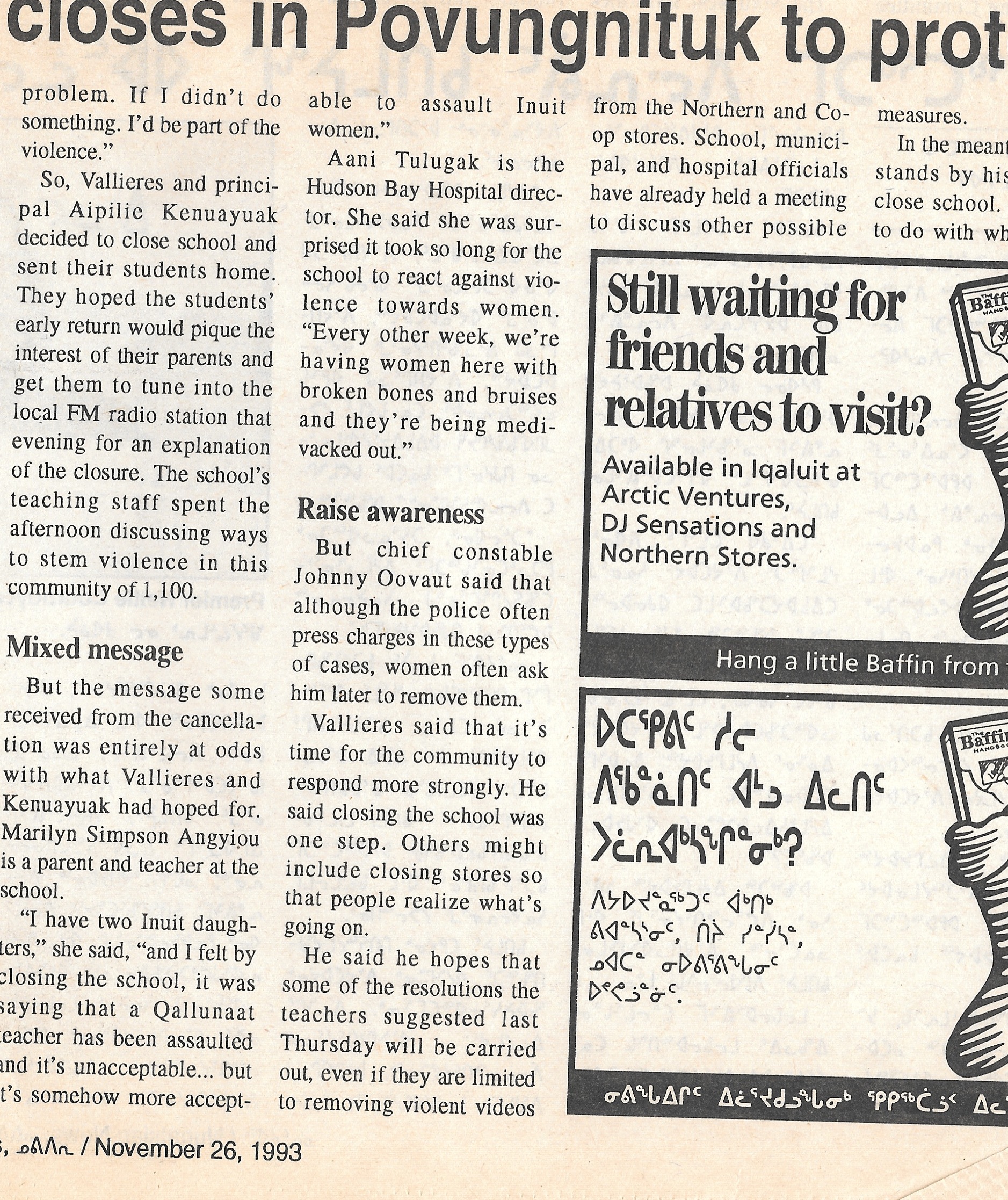
An excerpt from a news story in the Nunatsiaq News from November 2003, one of several which angered municipal officials.

An excerpt from a news story in the Nunatsiaq News from November 1993, one of several that angered municipal officials.

This is how things went: A female teacher from the South was brutally assaulted by a local man and left the community.

Although the new $7-million school had opened 29 days late, the school principal and the school facility director decided to close the school for yet another day.

“It’s nothing to do with white or Inuit,” Claude Vallières, the facility director, said in a story I wrote for the Nunatsiaq News.

“It’s about violence and I can’t let it go on for the sake of the children.”

This incident was soon followed by violence that affected all southern teachers who returned to Puvirnituq from Christmas holidays in early 1994. They found their homes had been trashed: ketchup spread on the walls, doors torn off, televisions smashed. The teachers refused to return to work unless the damage was repaired, appealing through the media — me — to call attention to their plight.

The outraged mayor then told the teachers in an official letter to stop all communication with members of the media.

Of course, it’s exactly this kind of violence and reaction which are considered as “news” by southern-style media and are always reported on. But the role of a free press and this new way of circulating news was still foreign in the 1990s — before the 1970s, any journalistic coverage  of anything was completely unknown in the eastern Arctic.

“Is the media in the North making it worse by exploiting the lives of abusers?” wrote a woman to the Nunatsiaq News. “When you give a name right on the front page or on the radio and what the person did, you are also affecting the child, wife, husband, grandparent and relatives.”

I subscribed to this Iqaluit-based weekly newspaper after picking it up a few times on trips in northern Quebec. In fact, I made my first telephone call to Iqaluit, to the newspaper’s office, to do this.

Before I called, I had to look on a map to see where Iqaluit is. For months afterwards, I read the newspaper every week when it arrived, trying to figure out where all the communities mentioned were located and to understand the issues.

In 1992, I submitted my first story to the Nunatsiaq News — on a topic that wouldn’t interest any media in the South, about a business dispute brewing in northern Quebec over fuel distribution rights.

I didn’t actually meet anyone on the staff of the newspaper until several months later, when I finally did make it to Iqaluit. Although I’d been reading the newspaper, the news didn’t prepare me for the first breath of minus 45 C air that hit me as I stepped off the plane in Iqaluit in March, 1993.

Even worse, the morning of my arrival, in Montreal, I had racked my glasses in half, and spent the first couple of days in Iqaluit almost blind, trying to find my way around in sub-zero temperatures until someone at the Nunavut Arctic College fine arts studio joined the two pieces together with a screw.

I found the office of the Nunatsiaq News in a renovated building called T-1, originally used by the United States Air Force, at an intersection in Iqaluit now known as the Four Corners.

Too small for the staff, the trailer’s walls looked as if they were held up by mounds of leftover newspapers. The air in the office was smoke-filled and stale. Old brown paper bags from take-out orders were stuck in between the stacks of newspapers.

Every table and desk held a computer or some other piece of equipment, but the paper was fed  to Ottawa for translation, layout and printing. The newspaper arrived  every Friday afternoon on the daily jet from Ottawa and was sent to communities all over the eastern Arctic. Printed in Inuktitut and English, it was then often the only current information available.

Whenever I returned to Iqaluit, even when I was working for CBC or other media, I stopped by the Nunatsiaq News office. I occasionally interviewed the staff for various reports I was doing. For a long time, I contributed only sporadically to the newspaper.
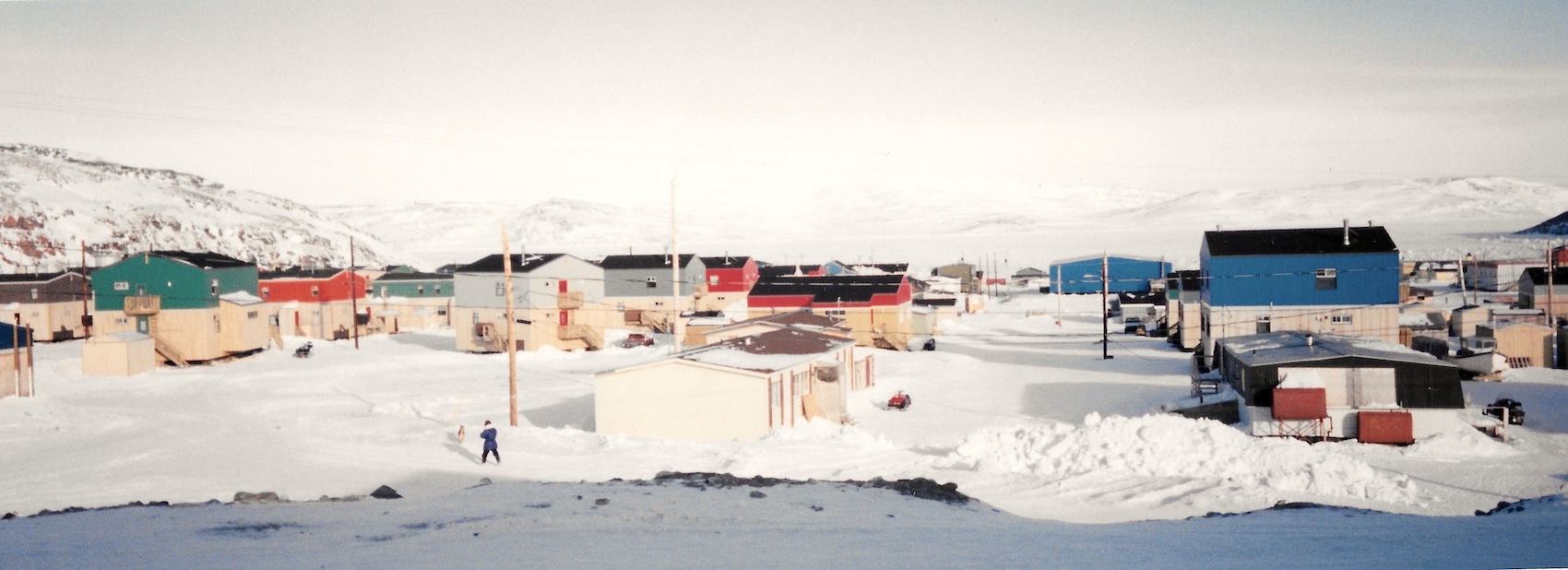
The Nunavik community of Salluit on Hudson Strait, April 1994. (PHOTO BY JANE GEORGE)

The Nunavik community of Salluit on Hudson Strait, April 1994. (PHOTO BY JANE GEORGE)

But there I was in 1994, sitting in the broom closet at Ikusik School in Salluit, mulling over what I’d write for the newspaper. I’d retreated to this bleak space after being kicked out of the meeting I was covering in this Hudson Strait community. I was armed with a set of earphones for interpretation. So, I sat with the mops and bails, listening in to “closed-door” discussions.

Although I’d been to Salluit before, its airport still seemed like the terminal at the end of the universe to me: huge, eroded mountains of rock, partially snow-covered and icy. You saw nothing of the community below.

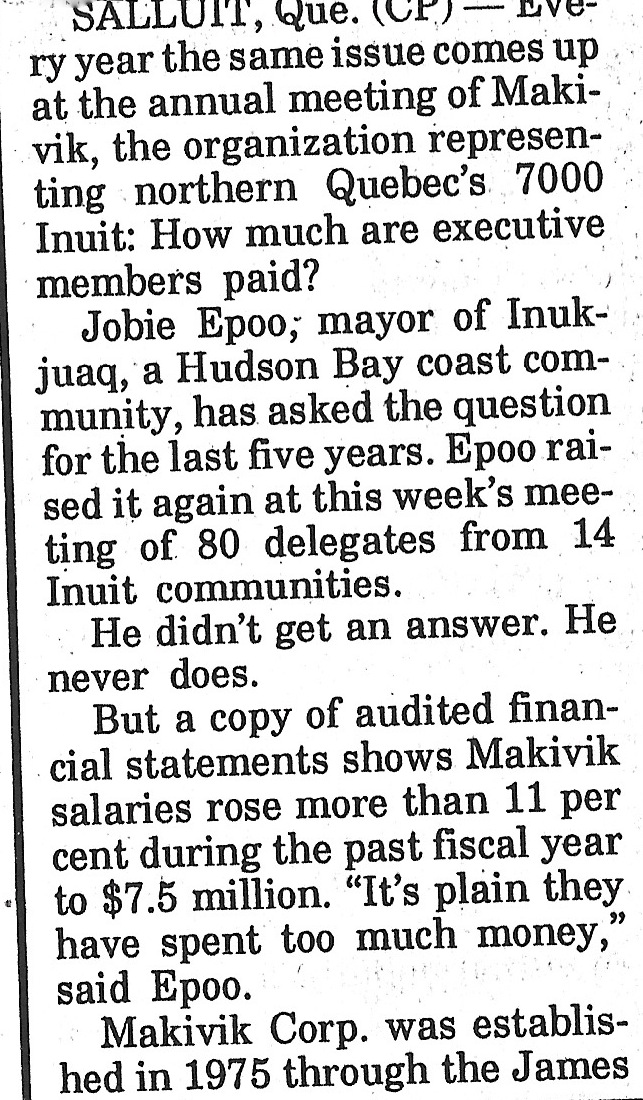
But the who’s-who of 8,000 Inuit from communities in northern Quebec had come there to attend Makivik Corp.’s annual get-together — its annual general meeting.

Makivik administers land claims settlement funds for Inuit in northern Quebec. But in 1994 only a little over $120 million of the nearly $130 million  the organization had received after 1975 in compensation remained, a fact leaders had a hard time explaining — and they certainly didn’t want to talk at all about the state of their finances with any members of the media present.makivik_story_one
So journalists were told straight off that they were not welcome to sit in the meeting room, and would not receive a copy of audited financial statements, as in previous years’ annual general meetings.

But a careless delegate left a copy of the financial statements in the bathroom, where I picked it up.

I decide to duck into a broom closet next door to the bathroom. There, surrounded by mops and pails, in a small space I could visualize more than 20 years later, I continued to listen to the closed discussions on my headset.

It was clear that some people were upset that their capital had dropped $6 million in two years. They complained that too much of their money was spent in the South.

“If we spend a lot in the South, it’s the people there who are getting rich,” said one speaker. “And the situation here isn’t getting any better.”

“They’re getting rich, while people here are living like dogs,” another speaker said.

The stickler? Makivik had purchased a home for its incumbent president, Senator Charlie Watt, on the West Island area of Montreal. In the wake of a story about Watt, his property and business affairs by investigative  journalist Stevie Cameron for Macleans, which appeared just before the meeting and was distributed via fax throughout Nunavik, Watt lost his re-election vote. Scan 46

My own coverage before the meeting and about what took place there helped to spur more debate in Nunavik.

But not long after that meeting in Salluit, I began to experience harassment. These took the form of a hostile call to me at my office from a Makivik staffer, as well as letters and calls to my various employers.

Some publicly-elected officials in Nunavik also started to hang up on me, and I was told that all employees of a major organization in northern Quebec had been advised not to speak to me.

As well, a major story I was working on for a newspaper in the South was dropped: I couldn’t get both official sides of the story, I was told, because the some spokespeople from Makivik wouldn’t speak to me anymore.

The editor at this southern newspaper decided to listen more to my critics than to me — after all, I was just a freelancer.

The Nunatsiaq News stood by me, although I was only a very minor contributor. The staff members there had many similar stories of their own about harassment. I realized that I had a lot in common with everyone at the newspaper.

The next instalment of “Like an Iceberg” goes live April 15.

You can read the first blog entry of “Like an iceberg” from April 2 here.

You can previous instalments here:

Like an iceberg: on being a journalist in the Arctic

Like an iceberg, 1991…cont.

Like an iceberg, 1991…more

Like an iceberg, 1992, “Shots in the dark” 

Like an iceberg, 1992, “Sad stories”

Like an iceberg, 1993, “Learning the language of the snows”

Like an iceberg, 1993 cont., “Spring”

Like an iceberg, 1993 cont., “Chesterfield Inlet”

Like an iceberg, 1993 cont., more “Chesterfield Inlet”

Like an iceberg, 1994: “Seals and more”


Like an iceberg: on being a journalist in the Arctic

“The iceberg needs to be broken. Even if it’s big, it will break. The only way it can get fixed is if you talk. We have to break the iceberg into pieces. Then things will come out. After the iceberg has crumbled, there’s a cleansing of the body. Everything will come out in anger and rage.” — Meeka Arnakaq of Pangnirtung, 1995

An iceberg melts in August off the shore of Baffin Island. (PHOTO BY JANE GEORGE)

An iceberg melts in August off the shore of Baffin Island. (PHOTO BY JANE GEORGE)

Join me as I remember my travels in the Canadian Arctic during the 1990s, a period when few journalists travelled as widely in the region.

I started working on this tale back in 1996, thanks to a Canada Council Literary Development grant, and then put everything aside for more than 15 years.

I have taken the liberty of changing some names and details to protect the many people who spoke to me freely and to safeguard myself against any possible defamation lawsuits.

November 1991: I watched as the dark red apple rolled under the plane. All around me snow whipped by horizontally, lit up in swaths by the headlights from idling snowmobiles. The small plane was surrounded by half-lit, snow-covered figures.

A woman with a baby on her back carefully maneuvered down the airplane’s ladder. She was carrying her newborn baby in the roomy hood of her fur-edged parka. In her arms: a plastic-wrapped package, also lovingly tended to. It was a houseplant, protected against the elements.

I retrieved my apple, and discovered it was frozen. But as I bent over, another one slipped out from the bag and rolled away. Looking around, I realized suddenly, that I knew nobody, that no one had come to meet me. A strange feeling came over me, of almost panic.

The plane landed at Puvirnituq, a community on the Arctic coastline of Hudson Bay, but clearly, there was no airport terminal. I didn’t really have a clue about where I was…everything was so dark and so white. I’d experienced the deep kaamos twilight of winter in northern Finland, but it had been years since I’d felt the uneasiness of a traveler in an unfamiliar land.

With a sudden energy, I grabbed my overflowing backpack and went towards the sole vehicle on wheels that I could see, a white truck with a large red cross. “I’m here to visit a friend of mine who works at the hospital,” I explained in a loud voice, my words almost blown away by the snow. “Can you take me into town?”

“Sure, get in the back,” the driver said.

I sat there, under the protection of my bag, watching the muted figures outside in the blizzard. I had packed that bag with care, stuffing it with soft toilet paper, coloured sweet peppers, a couple of beers, sourdough bread, fresh lettuce, all according to the requests of my friend J., but the apples had come loose and as I sat there in the dark that night I could feel the round hard lumps against my chest. The day I lost that apple began in Montreal.

A blue sky, with temperatures on that Nov. 15 well above freezing. At the airport I stood out, overdressed for the weather in my northern gear, knee-high, felt-lined fluorescent boots and a parka. But, two hours later, when the plane landed at La Grande, snow, mixed with ice pellets, was already falling, and I was dressed for the day.

In the year since I had last been in La Grande, midway up Quebec’s northern territory, a new terminal had been built, replacing the worn, wooden building. But the crowds inside were the same, a cross-section of Quebec, French-speaking workers from the nearby hydroelectric power project camps, clasping small bags, ready for a return south after weeks of 12-hour days, while their bosses gathered together in trench coats. In the opposite corner, Cree men stood around in leather jackets with emblems on the back, with braids and large-brimmed hats, and on the other side, there were Inuit traveling north, a few women in parkas, sitting on the floor.

No one seemed to notice me as I dragged my backpack to the Air Inuit counter to check in. “Oh yes, I can see your name. Weren’t you supposed to fly two weeks ago?”

I had suddenly changed plans. Does she remember every traveler, I wondered.

“I’ve got to weigh your bags. Hmm. 76 kilos. You’re only allowed 44, so at $4.00 a kilo extra, that’ll be $128.00.” Yikes! In my backpack was the food order J. placed with me. I pulled my briefcase off the scale. “That’s your carry-on? Well, ok, that makes it only 11 kilos over. $44.00, ok? The plane leaves at noon.”

Nunavik (IMAGE/ KATIVIK SCHOOL BOARD)

Nunavik (IMAGE/ KATIVIK SCHOOL BOARD)

The first stop for the small airplane, a Hawker-Siddley 748, loaded with passengers and cargo: Great Whale, also known as Kuujjuaraapik in Inuktitut. Located at the point where the Great Whale River empties into Hudson Bay, the community spread out below me, flanked by endless, snowy beaches.

The bay had not frozen over yet and cold waves breaking formed a blue and white edge along the sand that stretched up the coast. We had to get off the plane, crowding into the one-room terminal.

A few benches lined the walls. The brown linoleum on the floor was dull and lifted in several places, revealing soiled plywood underneath.

A woman approached the check-in counter with an array of bundles, wrapped up in plastic, which she dragged on a child’s sled.

We reboarded the plane. The next stop on our journey north  — Sanikiluaq, the sole community on the Belcher Islands. We flew over the open water, over to a group of island-sized flat rocks. Even snow seemed to have a hard time clinging to the smooth surfaces. Suddenly, we were landing at an airport and its tiny terminal welcomed us to the Northwest Territories, the first time I’d ever thought about visiting that territory.

Our next stop brought us out of Hudson Bay to Inukjuak on its coastline, at the end of the crescent-shaped northern peninsula of Quebec. We were now more than 1,000 kilometres north of Montreal, and it was late afternoon. It was getting dark out.

The snow, suddenly plentiful, piled in drifts between the plane and terminal. Faces pressed against the glass, looking at our small group of passengers as we navigated towards the door. This terminal was new, a miniature version of a southern airport.

There was just one room, featuring a rolling baggage rack, yellow plastic chairs and a drinking fountain. Milling around, women in amautiit parkas, traditional garments, which are generally white, cut high on the front and sides, low in the back, with a rick-rack edging, and featuring huge hoods, trimmed with garlands of fur.

Almost all the women smoked cigarettes, while the heads of a couple of infants peeked up from the hoods of the parkas. There was a whole gang of Inuit boys, too. They were dressed in rocker-style jackets, high-cropped sneakers, dark glasses, no hats. Their only concession to the cold: black leather gloves.

The 748 travelled north. Only soft drinks and peanuts were handed out by the attendant who doubled as a cargo hand at stops.

“People always ask for rum and Coke,” she said. “Or  say ‘I’ll have mine medium-rare.’”

We were already behind schedule because the crew only had 20 minutes at each stop to unload cargo and it always tool longer. But at our last stop, Akulivik, where I was to change planes for Puvirnituq, it became clear we were going nowhere. The storm had now become a blizzard.

I waited, maybe three hours, in the terminal. I watched a heavy-set, tall, white man with a tasseled hat that had the name of a community, “Salluit,” crocheted into the design. He seemed to know everyone else while I knew nobody. I was jealous. The time passed. I ate the end of a sandwich that a friend packed for me hours ago, in the South. I read a copy of an English and Inuktitut-language paper that was lying around, the Nunatsiaq News from Iqaluit — although I wasn’t even sure where that was: When I was in school, that community was called Frobisher Bay.

Finally the Twin Otter that would take us to Puvirnituq, then known as Povungnituk or POV, arrived. I was nearly blown away on the walk to the aircraft. Its inside resembled a trailer’s dinette, with fake wood paneling and seats that folded down. The pilot leaned through the opening which half separated the cockpit from the passengers.

“It’ll take twenty-five minutes to get to POV,” he said. “Remember there are two exits. Survival gear is in the front. Have a good flight.”

The plane lurched down the snowy runway. No one said anything on the dimly-lit aircraft. The noise  from the propellers was too loud and it was too cold to think. I sat huddled in a corner. “How can it fly?” I wondered.

You can continue reading the series “Like an iceberg” here where you will find all the links to other posts.

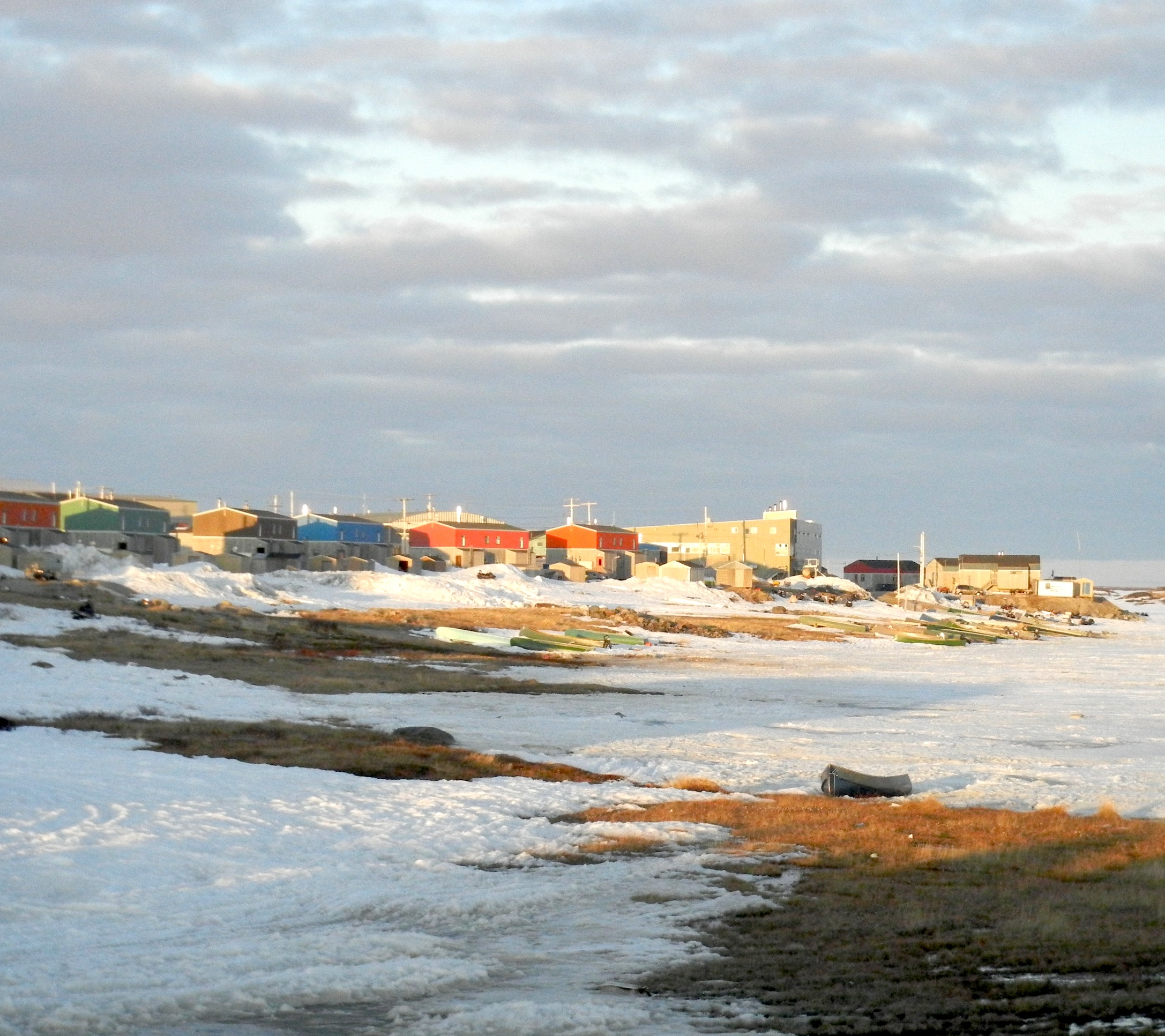
Late evening sunlight illuminates the Nunavik community of Puvirnituq on northern Quebec's Hudson Bay coast. (PHOTO BY JANE GEORGE)

Late evening sunlight illuminates the Nunavik community of Puvirnituq on northern Quebec’s Hudson Bay coast. (PHOTO BY JANE GEORGE)