Part 3: You know you’ve never been to Iqaluit/Frobisher Bay when…

Let’s go on a little tour of downtown Iqaluit, spurred on by what I read in a recent article more about the 1950-era dome-dream for Frobisher Bay, now known as Iqaluit.

This shows some of what was designed for the then-community of  Frobisher Bay.

This shows some of what was designed for the then-community of Frobisher Bay.

This would have been the biggest Arctic dome ever — “conceived in a manner similar to the gothic vaulting, but constructed in thin shell concrete with ribs radiating from a central pier, as a large fan vault,” reads the design information for “Frobisher Bay: The Design of Accommodation for a Community of 4,500 People.”

Does this seem incredible?

Well,  I am ready to take you to some equally fantastic buildings. But these you can see today in Iqaluit, Nunavut’s capital city whose population is now likely nearing 8,000.

The place to start our tour lies right in the heart of Iqaluit, at the Four Corners crossroads of Queen Elizabeth Way and the Federal Rd. with Mivvik St. and Niaqunngusiaq Rd. It’s a location which, over the past few years, has morphed into a strikingly unattractive place where southern architects’ fancies, or blunders, are still played out.

I can’t help thinking that when the Arctic Council’s top ministers for its eight circumpolar nation members and their entourages pour into Iqaluit at the end of April, they will be whisked from the airport through this — but maybe they can keep their eyes closed and think about climate change.

Heads above all those new structures is the Qamutiq building, which an Inuk friend of mine calls “Noah’s Ark” due to its shape.

The Noah's Ark of Iqaluit. (PHOTO BY JANE GEORGE)

The Noah’s Ark of Iqaluit. (PHOTO BY JANE GEORGE)

But you may note there are many things to reflect on here with this building:

• its shape — why the ultra-high roof? and why red?

• the name — the huge syllabics are correct, but the Roman orthography is wrong and should be “qamutik.”

You can't miss the misspelling even at night. (PHOTO BY JANE GEORGE)

You can’t miss the misspelling even at night. (PHOTO BY JANE GEORGE)

• the location — why not hide this building somewhere instead of putting it in the centre of town where the late domed restaurant, the Kamotiq (also a misspelling), once stood? What’s more, you can see the “Qamutiq” from all over town because of its relatively enormous height.

Iqaluit's Kamotiq Inn, now demolished. (PHOTO/NUNATSIAQ NEWS)

Iqaluit’s Kamotiq Inn, now demolished. (PHOTO/NUNATSIAQ NEWS)

Next door to the Qamutiq stands another brand-new and equally unappealing building called the Qilaut, or drum in Inuktitut, which also features some decorations as well weird multi-coloured wings. Why? That’s all I’d like to know.
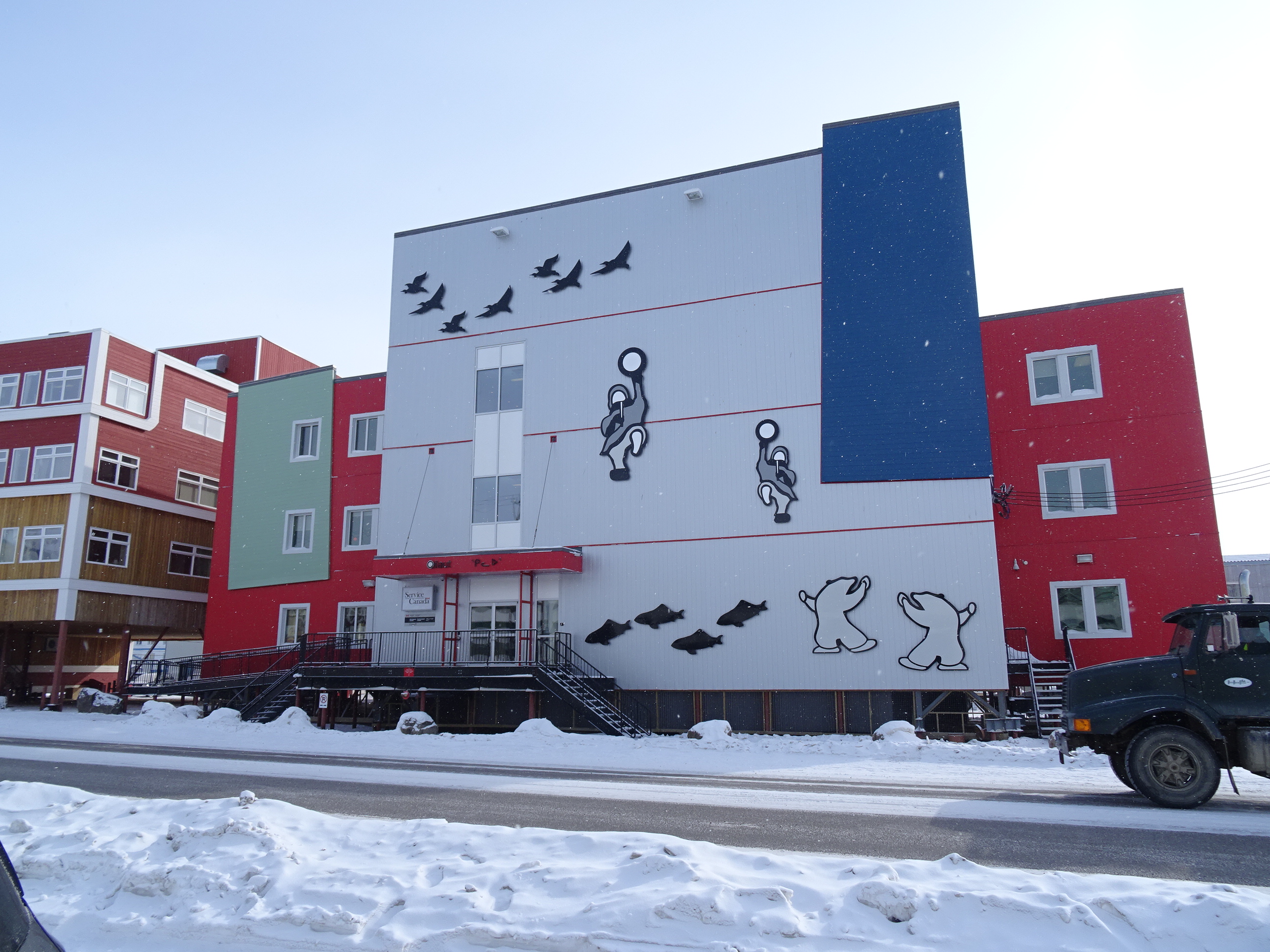
Iqaluit's Qilaut building and its topsy-turvy annex, March 2015. (PHOTO BY JANE GEORGE)

Iqaluit’s Qilaut building and its topsy-turvy wings, March 2015. (PHOTO BY JANE GEORGE)

Kitty-corner to these two buildings lies the nondescript Igluvut building where the T-1 building, which used to house the Nunatsiaq News office, once stood.

Here you can’t miss the giant-sized carving, unveiled in 2013 in honour of the 20th anniversary of the proclamation of the Nunavut Land Claims Agreement on July 9, 1993. The commissioning this monument, a collaboration of carvers from Nunavut’s three regions — may have seemed like a good idea at the time. But the end result done by three talented carvers, looks like an Arctic nightmare  — a mish-mash of every polar animal and symbol of Inuit culture.
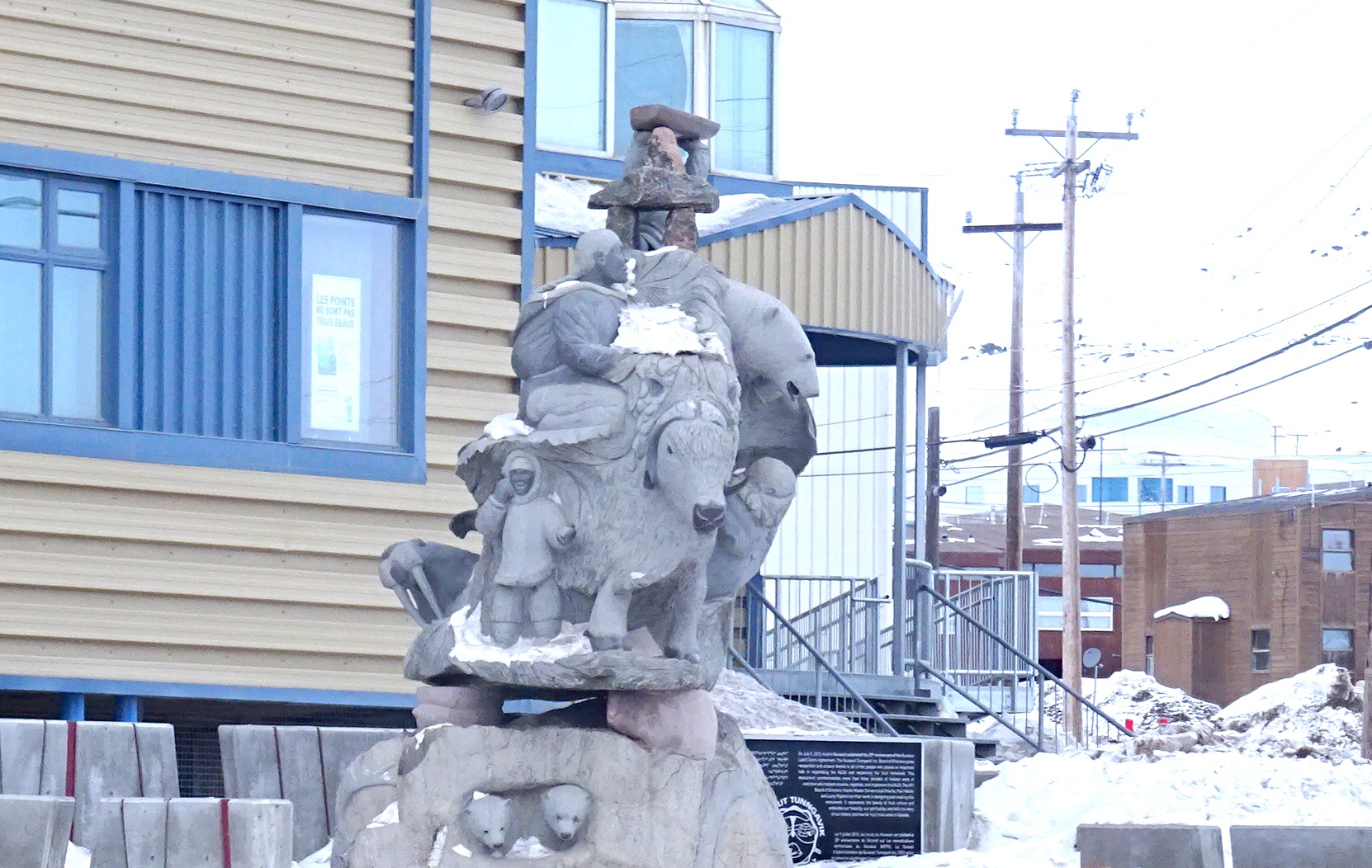
From every angle there's something new on this huge carving about the Igluvut building in Iqaluit. (PHOTO BY JANE GEORGE)

From every angle there’s something new on this huge carving in front of the Igluvut building in Iqaluit. (PHOTO BY JANE GEORGE)

Nearby stands the Hotel Arctic, featuring colours best described as mustard and ketchup, and a strange igloo-dome appendage on top. Can you tell me what this is? Enough said.

Here at the Four Corners intersection lies the red and mustard-coloured Hotel Arctic with its dome-ish decorated roof. (PHOTO BY JANE GEORGE)

Here at the Four Corners intersection lies the red and mustard-coloured Hotel Arctic with its dome-ish decorated roof. (PHOTO BY JANE GEORGE)

Across the street, the low-key, boxy Parnaivik building, whose parking lot lies on the site of Iqaluit’s long-gone mini-golf course.

If you head down the street, looking for other sights, you’ll wonder at the boarded-up, but still operating hotel, bar and restaurant, the Navigator Inn.
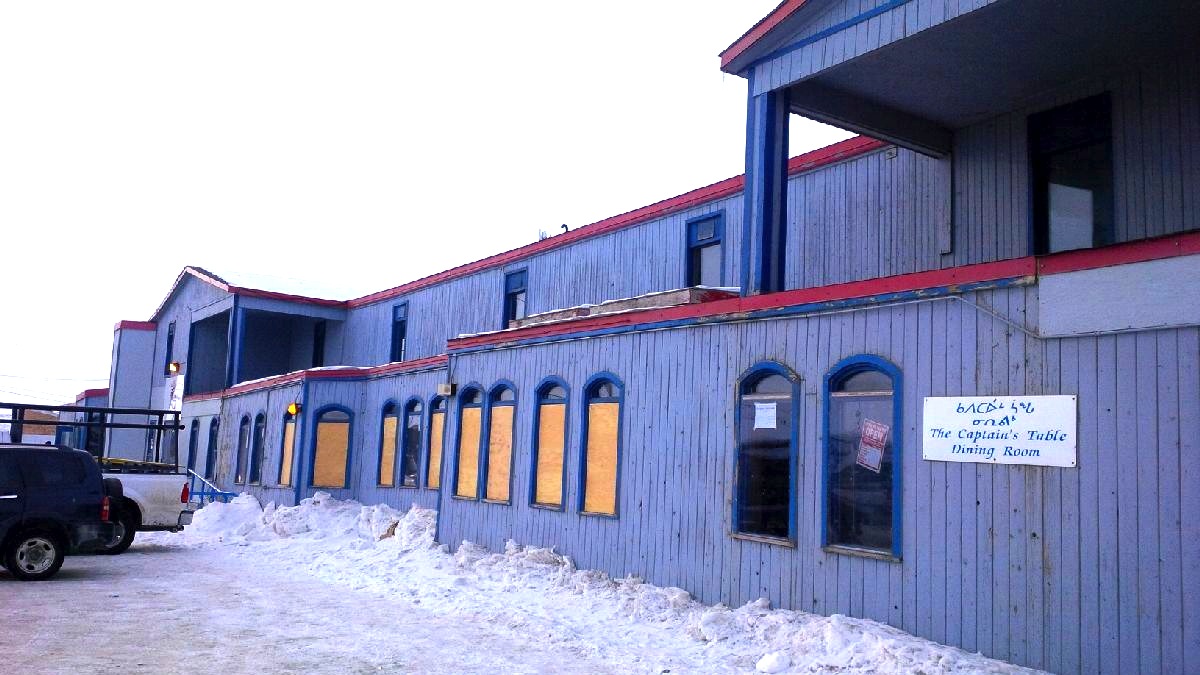
Not a lot of natural light these days at the Navigator in Iqaluit. (PHOTO BY JANE GEORGE)

Not a lot of natural light these days at the Navigator in Iqaluit. (PHOTO BY JANE GEORGE)

I’ll let you decide if you dare to venture inside. A comment on Trip Advisor from a few years ago might make you think twice about this: “Can’t believe that they call this a hotel. The front door locks at 11 and there is nobody running this zoo until the next morning… I’ve been here for 4 nights now and the chambermaid hasn’t been to my room once. Its probably for the better as I have heard of several things walking out of peoples rooms.”

Nearby you can see the Iqaluit of yesterday and today: in the foreground to the right the sole remaining Butler building, former military accomodation from Frobisher Bay’s Cold War beginnings that last served as government staff housing, in the foreground, and, at the end of the street, the Qamutiq.
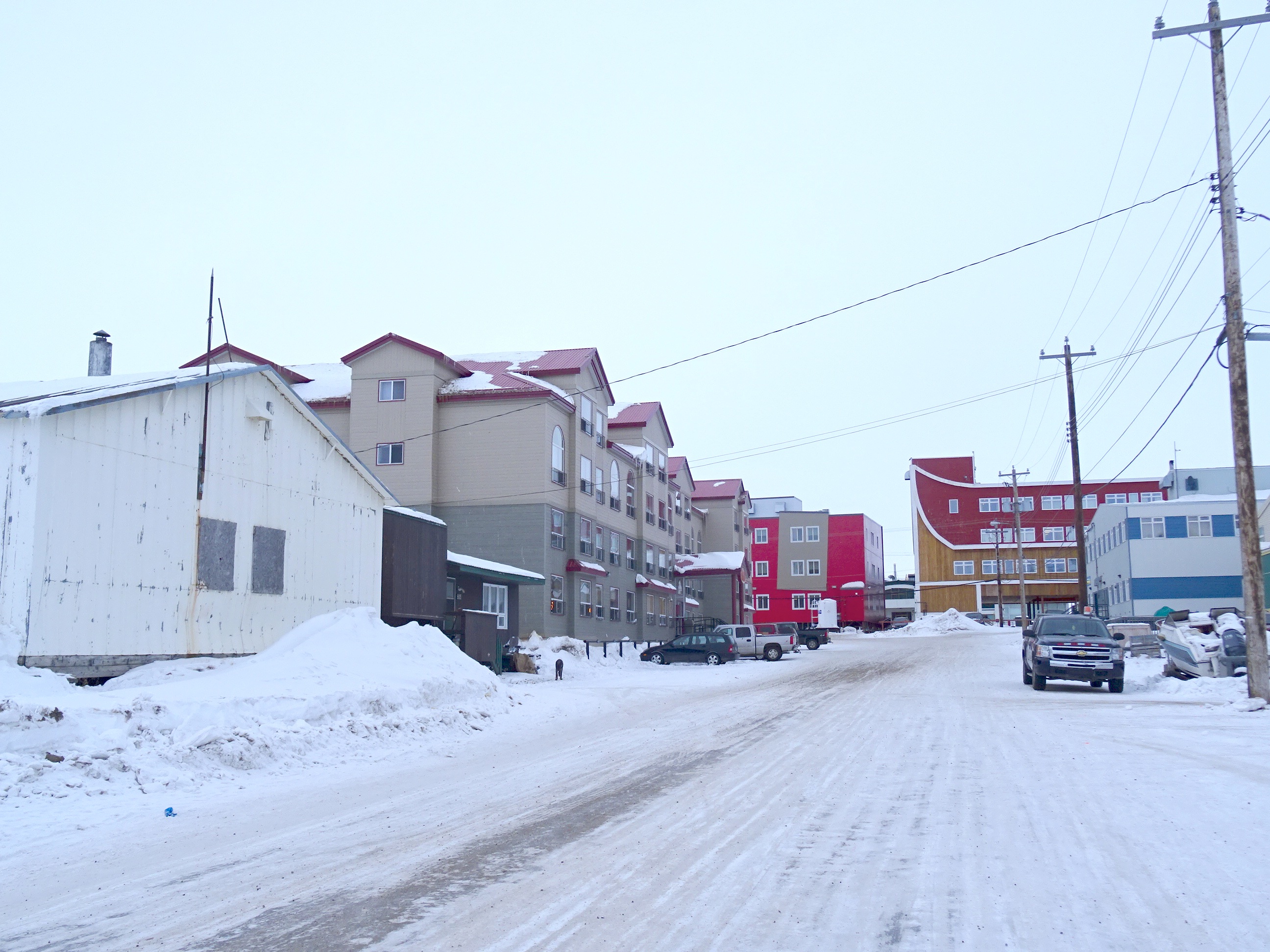
Looking down this street you travel through time, from the Butler building of the early 1960s to the Qamutiq of today,

Looking down this street you travel through time, from the Butler building of the early 1960s to the Qamutiq of today. (PHOTO BY JANE GEORGE)

And that’s enough for today’s tour of Iqaluit.

Did you read my first posts about Iqaluit?

Part 2: You know you’ve never been to Iqaluit/Frobisher Bay when

You know you’ve never been to Iqaluit/Frobisher Bay when…

And are you curious about the Canadian Arctic of the 1990s?

You will want to read my “Like an iceberg” series of blog posts. You can find all the links here.

Part 2: You know you’ve never been to Iqaluit/Frobisher Bay when…

Will I be happy in Happy Valley? Is everyone happy here?

Happy Valley, Iqaluit, March, 2015. (PHOTO BY JANE GEORGE)

Happy Valley, Iqaluit, March, 2015. (PHOTO BY JANE GEORGE)

That’s the name of the neighbourhood in Iqaluit where I’m staying. Despite its name, it seems no more happy than any other area in this city, which has known more than its share of change and loss.

And the “happy” valley has now been filled by houses.

As I walk to town, the view on the clear sunny days, which are now the norm for this month of April, includes the  Creekside Village housing complex.

Creekside Village, Iqaluit, March 2015. (PHOTO BY JANE GEORGE)

Creekside Village, Iqaluit, March 2015. (PHOTO BY JANE GEORGE)

The Creekside blocks, known informally as “White Row housing,” built  back in the 1970s, hug the space between the hill and the road circling the centre of Iqaluit. An entire building burned down in February 2012 and I stood there in minus 50 C temperature until 3 a.m. watching the fire, which took two lives and left 300 temporarily homeless.

Fire ravages the block of Creekside Village housing in Iqaluit, Feb. 27,  2012. (PHOTO BY JANE GEORGE)

Fire ravages the block of Creekside Village housing in Iqaluit, Feb. 27, 2012. (PHOTO BY JANE GEORGE)

Ash, probably toxic, rained down on me but I didn’t notice.

Three weeks after that deadly fire, grieving friends and family said goodbye to the two siblings who died in the blaze, Andrew Papatsie, 27, and Connie Papatsie, 25, at a joint funeral in the Cadet Hall.

Wreaths of artificial and — rare in cold Iqaluit — real arrangements of flowers overflowed atop a nearby table.

During the bilingual service, retired Anglican minister Mike Gardener tried to comfort the assembled, saying their presence would be a “great help” to the Papatsie family. Hymns sung during the service, “There is a happy land,” “Blessed assurance, “Abide with me,” and “God leads us along,” also carried messages of comfort.

But, during and after the final hymn, at the repeated line of “God leads his dear children along,” many broke down in tears…

It was not easy to cover this event. And the context of the changed city scenery sticks with me as I walk around today.

This is how the still smoking site of the Feb. 27 fire looked in early March of that year. (PHOTO BY JANE GEORGE)

This is how the still smoking site of the Feb. 27 fire looked in early March of that year. (PHOTO BY JANE GEORGE)

Down the hill towards the beach lies the Nunatsiaq News newspaper office: formerly a pharmacy, and a far cry from the cigarette-smoke filled building where the staff worked when I met first them in the early 1990s.

This blue building houses the office of the Nunatsiaq News. (PHOTO BY JANE GEORGE)

This blue building houses the office of the Nunatsiaq News. (PHOTO BY JANE GEORGE)

But, on this 2015 tour, let’s just backtrack a bit — to a noteworthy Arctic dome, which I forgot about in a previous blog post. Although it’s not geodesic, this dome is probably the most beautiful building in the city today. You will be able to judge for yourself that later when I show some of the other photos of what passes for architecture in future blog posts.

It’s the St. Jude’s Anglican Cathedral, which famously burned by arson in 2005 and was then rebuilt for about $8 million. The new, metal clad dome is much larger — and likely far more fire-resistant — than the iconic, white-domed, wooden building from the 1970s.

St. Jude's Anglican Cathedral in Iqaluit. (PHOTO BY JANE GEORGE)

St. Jude’s Anglican Cathedral in Iqaluit. (PHOTO BY JANE GEORGE)

And if you’re looking for some welcome spiritual renewal or just something to do on Sunday in Iqaluit, it’s also the place to admire the building’s structure. Inside the nave, where the congregation sits, you can look straight up more than 40 feet high into the skylight.

This is how St, Jude's looked before it burned down in 2005. (HANDOUT PHOTO)

This is how St. Jude’s looked before it burned down in 2005. (HANDOUT PHOTO)

On Palm Sunday that’s where I end up, listening to songs by the red-amauti-clad Inuksuk high school choir. I’m also in for a welcome surprise: Rev. Gardener, whose voice always manages to be both melodic, comforting and authoritative in English and Inukitut, is serving as minister.

Rev. Mike Gardener, March 28, in  today's St. Jude's Anglican Cathedral. (PHOTO BY JANE GEORGE)

Rev. Mike Gardener, March 28, in today’s St. Jude’s Anglican Cathedral. (PHOTO BY JANE GEORGE)

During the service, he encourages children to wave their palm fronds and asks them what animal Jesus rode: not a camel or a whale, but a donkey.

Soon the service is over. It’s back out into the bright light of a cold Sunday and more walks around the city.

Did you read my first post about Iqaluit?

You know you’ve never been to Iqaluit/Frobisher Bay when…

Curious about the Canadian Arctic of the 1990s? You will want to read my Like an iceberg series of blog posts. You can find all the links here.

VIEW OF ST. JUDES