Like an iceberg, 1994: “Seals and more”

Like an iceberg, 1994: “Seals and more”

I decided to return to Pangnirtung in the middle of February 1994. The sun had just begun to come back into this Baffin Island community. For months, the sun had lingered below the horizon. Now it was rising higher every day.

Pangnirtung fiord in February 1994. (PHOTO BY JANE GEORGE)

Pangnirtung fiord in February 1994. (PHOTO BY JANE GEORGE)

In mid-afternoon, a bit of sun peeked over the ridge of the mountains, casting long shadows in town. Most of the day, the snow-covered mountains still hovered in a perennial dawn. They were pinkish, with constantly changing flashes of yellow. I never tired of this vista. One day, we took a walk out on the frozen fiord, among the blocks of ice that created a cold, white forest.

Margaret Karpik, the director of the Visitors Centre, took me to visit her mother, Ida Karpik, a well-known artist: I was doing a report for CBC radio on the revival of sealskin trade.

Ida and a few other local women were gathered in the qammaq, a traditional tent-like structure, to work sealskins and sew. On its ceiling and walls, old newspapers and catalogues had been glued, helter-skelter, for wallpaper. In the corner, in the stone qulliq lamp a low fire burns. Moss was used as the wick, seal oil as the fuel.
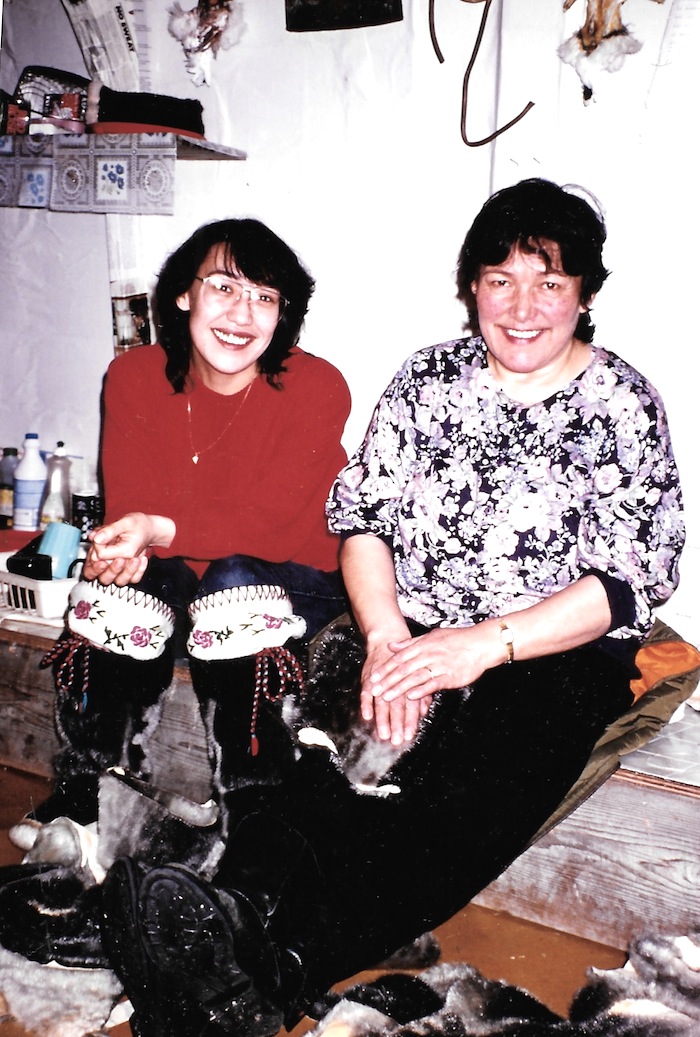
Margaret Karpik (left), with her mother Ida Karpik (right), in the women's qammaq in February 1994. Karpik, a renowned artist, died in 2002 at 63. (PHOTO BY JANE GEORGE)

Margaret Karpik (left), with her mother Ida Karpik (right), in the women’s qammaq in February 1994. Karpik, a renowned artist, died in 2002 at 63. (PHOTO BY JANE GEORGE)

With Margaret helping to translate, Ida explained why sealskin was ideal for clothes, especially for jackets or boots that are warm in the cold and waterproof in the damp weather.

The hard work it takes to make sealskin into clothes is worth it, she said. I also spent a peaceful afternoon scraping a skin, watching her and the other women work and listening to their conversation.

In Pangnirtung, two local men were also trying to revive trade in sealskins. Only 15 years earlier, the market for sealskins had been strong, but that was before environmental lobby groups protested against the annual seal hunt and the United States slapped a ban on the import of sealskins. From Baffin Island alone, Inuit used to sell 15,000 sealskins. By the mid-1990s, not even a tenth of that amount were sold.

But Jaypeetee Akpalialuk and Michael Murphy told me they were planning to send skins over to Hokkaido, in Japan, where the Ainu, the indigenous people of northern Japan, would use them in their clothing and handicrafts. Akpalialuk  was then the mayor of Pangnirtung. Without seal meat, he told me, Inuit would never have been able to live in the North. It would be too cold without sealskin clothes to wear, and seal to eat, he said.

“When you’re out on the land and the temperature is -40, you don’t have time to eat, but your body needs energy. It needs energy and you have to be warm. So, when we eat raw seal meat when it’s very cold, your body starts to get warm. Seal meat is very rich, and seal meat is the best thing in the North,” he said. “And sealskin is one of the best clothing you can have. You can wear it in summer, in winter. You can wear it just about anywhere. It’s waterproof, it lasts a long time, it’s one of the best materials you can have for clothing.”

Akpalialuk said critics of the seal hunt have it all wrong: Their seal harvest doesn’t even make a dent in the population.

“As Inuit, too, we’ve never been over-killing any species up here. Outsiders have been harvesting our species. Europeans came over to Baffin Island in the 1800’s and over-killed the bowhead. We never overkill. We always managed the resources according to our knowledge,” he said.

And Inuit aren’t inhumane, either, he said. They don’t kill seals like Newfoundlanders: They nearly always just shoot them quickly with a gun.

Although the elder Etooangat had told me Inuit also used to hunt seals with hooks, one thing was certain: The seal ban had been a disaster for his community.

“Most Inuit were depending on hunting sealskins for a living, it was the major income for Inuit. Once the market was killed, people suffered. There’s not too many jobs up here, they couldn’t buy food, purchase equipment, so some of them had to depend on welfare. The way I see it, the government of Canada didn’t do too much about it. I guess they didn’t care,” Akpalialuk said.

Akpalialuk and Murphy took me to the sealift container where they were storing sealskins. Murphy, then a singer and local cable television company owner, said he thought that Canadians are ready for sealskin.

“This whole veil of anger at the sealing trade is beginning to lift,” Murphy said. “And I believe that Canadians are distinguishing between the major company and the small guy who is taking the meat for his family, and now, you can have his skins. Isn’t it fair and just that a man should be able to use that product without throwing it in the dump? It’s a sustainable, renewable resource when harvested properly.”

But their project to renew the sealskin trade never took off. Two years later, Akpalialuk was dead. He drowned in a drainage ditch in Kuujjuaq, while intoxicated — his death one of a string of alcohol-related deaths that year which led this Nunavik community to clamp down on liquor sales. Murphy ended up in Ottawa, where, at one time, he faced charges of arson connection with the burning of a small privately-owned fish plant in Pangnirtung.

The timeless triangle of the mountains at the end of Pangnirtung’s fiord remains the same, and Inuit continue to face obstacles to marketing sealskins abroad.

And everyone still takes seal hunting seriously.

“The seals are on the ice” was one of the first phrases I ever learned in Inuktitut.

“But never say that unless you mean it,” a friend warned me. “Because everyone in the room will jump up and run out!”

The next instalment of “Like an iceberg” goes live April 15.

You can read the first blog entry of “Like an iceberg” from April 2 here.

You can read previous instalments here:

Like an iceberg: on being a journalist in the Arctic

Like an iceberg, 1991…cont.

Like an iceberg, 1991…more

Like an iceberg, 1992, “Shots in the dark” 

Like an iceberg, 1992, “Sad stories”

Like an iceberg, 1993, “Learning the language of the snows”

Like an iceberg, 1993 cont., “Spring”

Like an iceberg, 1993 cont., “Chesterfield Inlet”

Like an iceberg, 1993 cont., more “Chesterfield Inlet”


Like an iceberg, 1993 cont., “Chesterfield Inlet”

Like an iceberg, 1993, cont.: “Chesterfield Inlet”

The heavy DC-3 flew in low, almost touching the tundra. In the distance, as far as the eye could see, a flat expanse of greenish-yellow spread out, broken only by long flat stretches of water, as if the nearby Hudson Bay was extending a long, watery hand over the barrens.

Everyone clapped as the plane landed on the small gravel airstrip that separated Chesterfield Inlet from the water and the land. As the passengers filed off the plane, cheering broke out. They ran into clusters of waiting friends. In the back of a pick-up truck, I was driven to my campsite, a sandy playground behind the school.

I was among a handful of journalists here to cover the first reunion of the Inuit students who were scooped off the tundra in the 1950s and 1960s to study at Sir Joseph Bernier Federal School, where Oblate priests and Grey Nuns taught them, and — their former students said — often abused them.

In the evening, rocks that framed the shore were pink and gray, punctuated by small purple flowers and miniature daisies. The tide was out, exposing a dark, shiny inlet of sand and seaweed. The air was full of smells, of rank kelp, wet rocks and a slight smell from the flowers. A brisk breeze blew mosquitoes far from the campsite.

“I used to know every rock here,” said C., looking around. “Over there was our skating rink in winter. I remembered it as being so big, but it’s just a pond.”

She was returning after 25 years to Chesterfield Inlet, a community on the western coast of Hudson Bay, population 300, to get in touch with those memories, those of a small child taken from the makeshift camp where she lived with her family on the Distance Early Warning line to attend the federal school here. The school was now closed, and the Turquetil Hall residence she lived in was gone, but she and her former classmates came back.

This sign commemorates Turquetil Hall in Chesterfield Inlet. (PHOTO BY JANE GEORGE)

This sign commemorates Turquetil Hall in Chesterfield Inlet. (PHOTO BY JANE GEORGE)

In July 1993, they were back for their first school reunion. But the reunion was a pretext. Like her childhood friends, C. was there to also make peace with memories of abuse that with the years, which had grown bigger in her mind.

There were the “things-you-shouldn’t-forget” and can’t: the teachers who threw yardsticks and erasers in class when you didn’t know the answer, being forced to drink stale milk or to take meals alone, or not being able to speak to a brother and knowing something even darker was happening to him, but not telling anyone, just remembering and suffering.

“Perhaps they thought we’d never grow up,” said a friend of C.’s from the past. “No one knew the pain behind Turquetil Hall,” said another. “I wish they could see our pain.”

Girls in Turquetil Hall residence in Chesterfield Inlet before bedtime. (PHOTO FROM COLLECTIONS CANADA)

Girls at the  Turquetil Hall residence in Chesterfield Inlet before bedtime. (PHOTO FROM COLLECTIONS CANADA)

Students came from all over the eastern Arctic, the brightest young Inuit children, hand-picked by missionaries for education.

“I witnessed a lot of physical abuse. One of my classmates was asked a question and couldn’t answer it. A teacher shouted at her and she went stiff, didn’t say a word. The more he yelled, the more paralysed she was,” a former student told me.

“Finally, he had chalk in one hand and an eraser in the other. He threw it at her. She didn’t move. But I could see the blood trickling down her finger. It made me feel so awful. I felt so helpless. But I couldn’t go to her because I’d get it too.”

She said an even harder realization came later, when she had a formal southern education. She’d lost her culture and didn’t feel comfortable with herself or her former home.

“I went through the school system and I can’t erase it. This is me. I’ve stopped struggling with it, ” she said.

J. said he felt he was kidnapped in 1958, from a camp along the DEW line, to attend the federal school where he became isolated from his family, his culture and his language.

“We were so scared all the time that we learned to speak English very quickly. There was a lot of commitment on my part to learn this language. I was told to forget our culture and language because I would never use them again,” he said.

He didn’t talk that first year with his parents until Christmas.

“The mission had a high-frequency radio, so I spoke to my parents. It was the first time I’d ever spoken to my parents on a high-frequency radio, and I didn’t even know what to say. I heard my parents say, ‘Be good. Listen to your teachers and supervisors and don’t do bad things.’ I remember receiving maybe three letters because there were very few planes that went through Repulse Bay in those years. I was extremely lonely.”

At the school, J. played new games, like baseball, which took his mind off his loneliness. He learned how to use a bathtub and toilet, wear shoes, eat unfamiliar, cooked food, and wake up at precise hours.

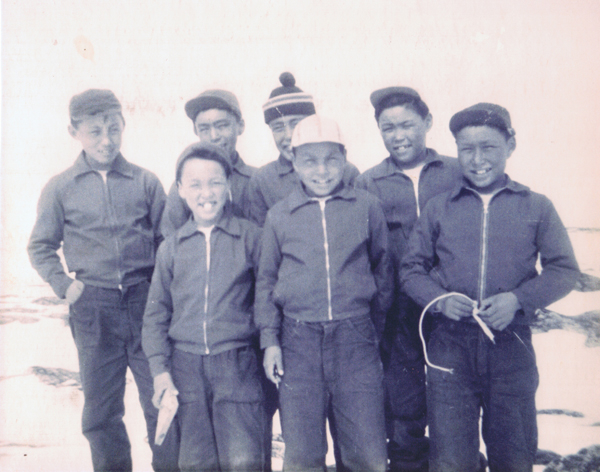
Classmates at the Sir Joseph Bernier Federal Day School in Chesterfield Inlet, 1960.  (PHOTOGRAPH COURTESY OF P. IRNIQ FOR THE "WE WERE SO FAR AWAY" EXHIBIT)

Classmates at the Sir Joseph Bernier Federal Day School in Chesterfield Inlet, 1960. (PHOTOGRAPH COURTESY OF PETER IRNIQ FOR THE “WE WERE SO FAR AWAY” EXHIBIT)

“Education here was top-notch,” J. said. “It produced many people into the leadership of the Inuit. This is a success story for all of us. But the price was pretty high. I lost a lot of my culture. I lost a lot of my language. I lost a lot of my spiritual beliefs. At home, part of the happiness was to tell me stories at night, legends that were passed on from generations. I’m not able to pass these on to my children. We lost a hell of a lot for what we got in terms of education in Chesterfield Inlet.”

J. said he doesn’t have the good quality  that he admired in his parents: their ability to fully enjoy life. He hears the voices of his teachers when he gets angry. For years, he drank too much, held in too much pain.

“At home, I learned about love, your family, your neighbours, but here I learned about the Bible. There’s no emotion. It’s just written on paper.”

Sexual abuse was also part of the exchange, something J. didn’t want to talk about for 30 years. He said he narrowly escaped being a victim of Brother Parent, the one they called Iggaialuk, the big cook. J. said he wanted to be a priest, and Brother Parent wanted to encourage him. So, Parent made him cakes. He’d invite him to his private quarters to look at pamphlets on the church.

“Sexual abuse does not belong only to the men of the Roman Catholic Church. It’s still happening in our communities in the 1990s. We have to be prepared to do something about it so it doesn’t happen again 100 years from now,” he said.

“We were children,” said a fellow former student. “We didn’t even know the meaning of sexual abuse, but the impact of it was so great that we didn’t have the words to disclose it.

“There’s no reason to gloss it over because it’s just another in a long line of sexual abuses across the country and the world in terms of residential schools.

“There is never any excuse for abuse. We survived to succeed in spite of sexual abuse. We were sexually abused and that was 30 years ago. The only thing to do is heal.”

“Chesterfield Inlet” will be continued April 11.

You can read the first blog entry of “Like an iceberg” from April 2 here.

Earlier instalments are here:

Like an iceberg: on being a journalist in the Arctic

Like an iceberg, 1991…cont.

Like an iceberg, 1991…more

Like an iceberg, 1992, “Shots in the dark” 

Like an iceberg, 1992, “Sad stories”

Like an iceberg, 1993, “Learning the language of the snows”

Like an iceberg, 1993 cont., “Spring”

This map from Aboriginal Affairs and Northern Development Canada shows the Inuit regions of northern Canada.

This map from Aboriginal Affairs and Northern Development Canada shows the Inuit regions of northern Canada.