Like an iceberg, 1994 cont., more “No news is good news”

Like an iceberg, 1994, cont.: “No news is good news”

I decided in 1994 to do a documentary on Nunatsiaq News for CBC radio’s national media program, “Now the details,” about the difficulties of journalism in the North. For this program, which required my spending hours with the newspaper’s staff during its production, I forged an even closer professional relationship with the newspaper. That’s because the Nunatsiaq News was often a target for high-level threats, too.

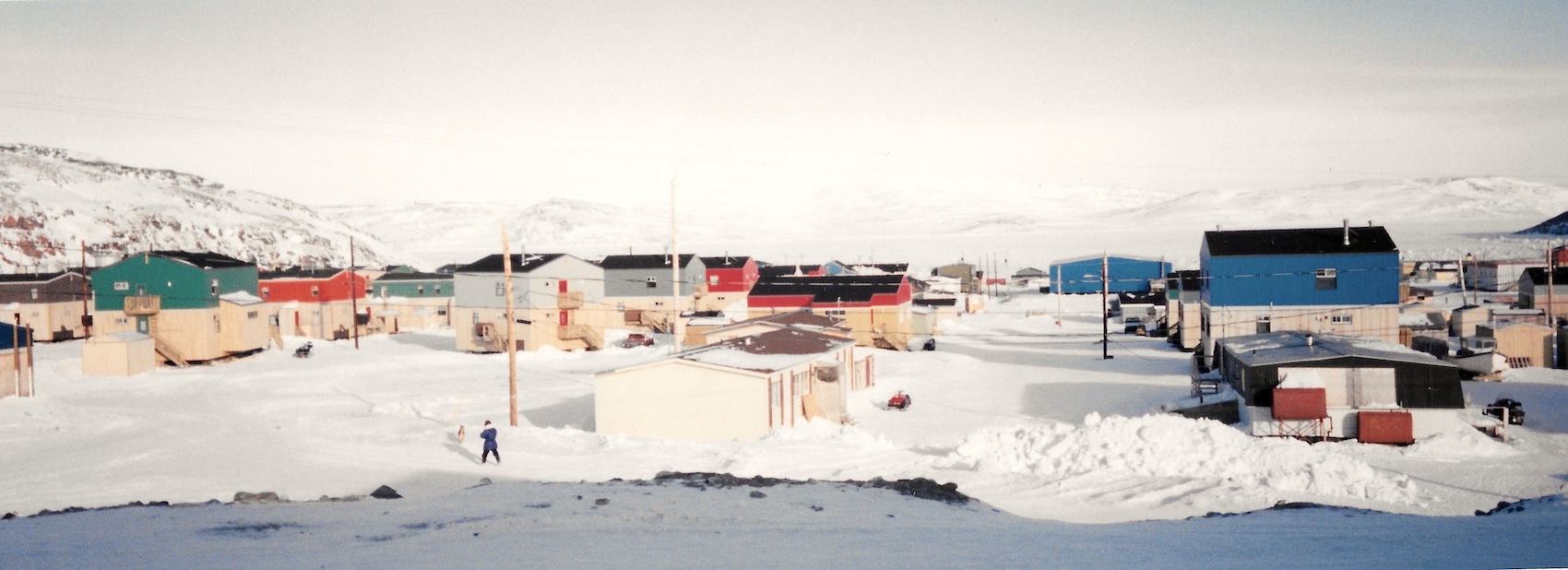
The way Iqaluit looked when I first arrived there. (PHOTO/ FACEBOOK)

The way Iqaluit looked when I first arrived there. (PHOTO/ FACEBOOK)

“Often comments are made in front of other media that are referring to us. That’s a messenger service. It’s a kind of back-door intimidation which frankly doesn’t work,” the  newspaper’s publisher, Steven Roberts, said in an interview.

In one instance, the Nunatsiaq News was pulled off airline flights to the eastern Arctic when there was a story about a plane crash involving one of the airline’s aircraft.

And members of political organizations often called in to complain either about specific journalists or their stories’ content.

“This is how the game is played. In the North, the way to influence the media is to intimidate them: it’s not to work with them, it’s not to make the media’s job easier so they can report. The tack taken is to make it harder for the media to do their job and hopefully they’ll forget about the story,” Roberts said.

So, I learned that I was not the only one who had a tough time getting information: Journalists who continued to report “negatively” or completely on issues that leaders or communities would prefer not to make public could be ostracized.

As a result, many northern journalists and news organizations simply chose to avoid certain subjects.

In some respects, this was not surprising: in the not-so-distant past, news was simply transmitted by word of mouth. This sort of first-person reporting was the way a hunter might talk about a recent adventure.

When news was told in this “first-hand” fashion, it was grounded in personal experience. People always could believe it, and, as French polar explorer Jean Malaurie noted in his classic tale of Greenland, The Last Kings of Thule, “each item of news, each scrap of information a hunter imparted, had both practical and moral value.”

So, modern-day reports on abuse or other forms of violence, delivered by media, as a third party, were perceived negatively and even as not being truthful or “factual.” These reports were — ands still often are — also viewed as hurtful.

During my interviews the staff at the newspaper told me what I’d already experienced first-hand — that when efforts to control media by threats, coercion or self-censorship fail, journalists will often simply be thrown out of meetings. The impact of news stories could create a debate with disastrous consequences for leaders, so it was in their interest to be the first to say that “news” was not part of traditional Inuit culture.

Political dealings between Inuit and southern-based Canadian governments hadn’t helped create a tradition of open communication, either, and land claim agreements were negotiated behind closed doors, not in a public fashion.

The political reality — where the land claim organizations administer huge sums of money —  led to a situation where powerful political figures also control much of the economy — so, why not control of the media as well?
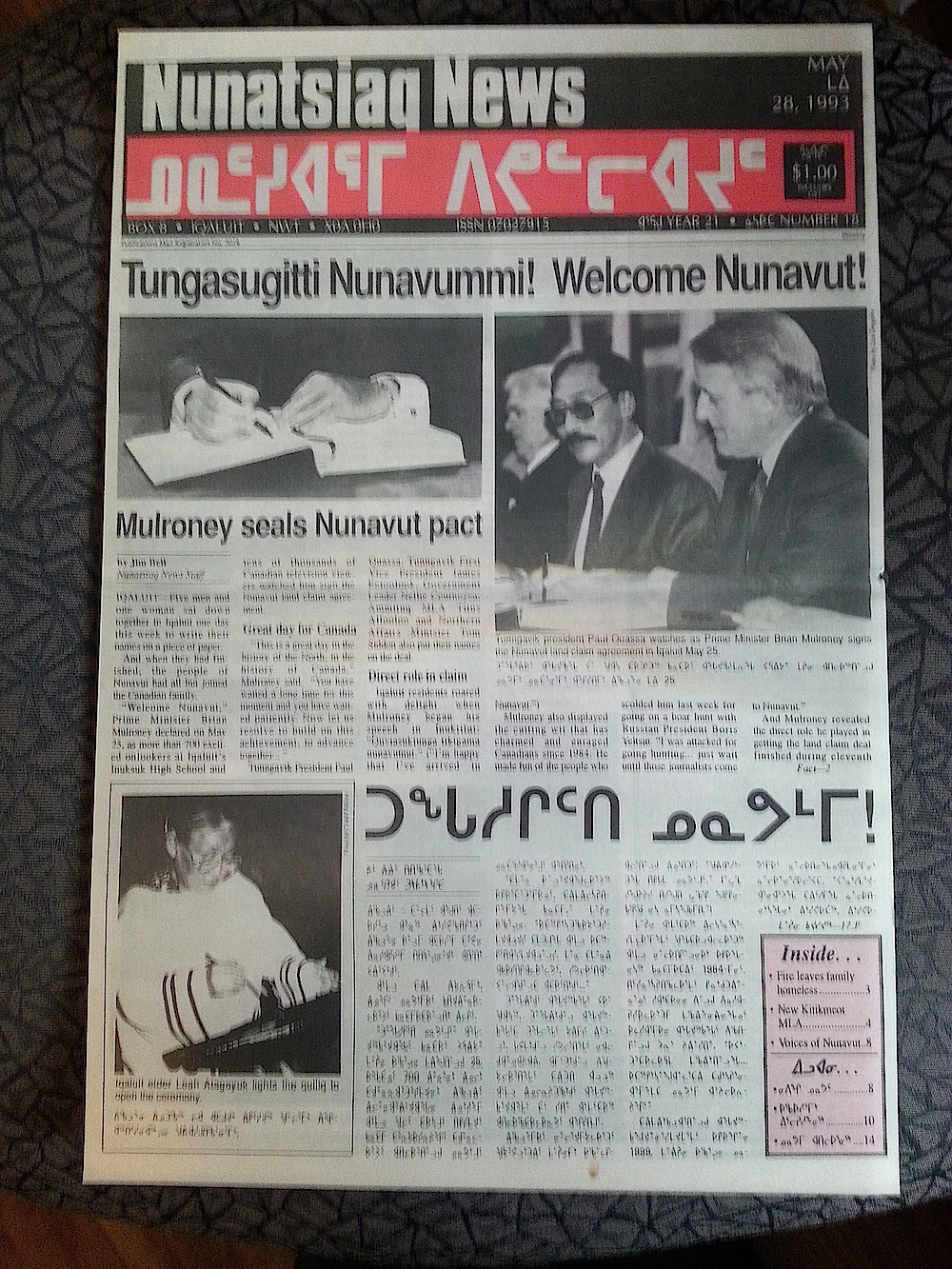
Nunatsiaq News from 1993.

A Nunatsiaq News cover from 1993.

“If we are going to be threatened, we’re going to tell our readers that’s what’s happening. ‘If you notice we’re not covering these events anymore it’s because this has happened, we have been warned off, we have been threatened that if we do this, our business may be hurt.’

“Up until now, we’re managed to take on all these challenges head-on. I’m not going to say that there are winners and loser in this, but the day that we face a situation that we’re unable to handle, it’s the readers that have the right to know first,” Roberts said.

But not all Inuit were opposed to the revelations of southern-style journalism.

“I always think about you,” an Inuk broadcaster told me in the 1990s. “When I’m in a tough place, running up against powerful people, then I remember that it’s important to talk even so.”

“There were things we couldn’t talk about then to see our society grow. Today, it’s different and we have to talk about certain issues people are uncomfortable with, but we have to talk about it for future generations to be create a good society, like the society we had 100 years ago,” said another woman I know.

Sometimes, I would even get calls at home, from Inuit I met, telling me not to give up, so I didn’t.

You can read the first part of “No news is good news” here.

The next instalment of Like an iceberg will go live April 17.

You can read previous instalments here:

Like an iceberg: on being a journalist in the Arctic

Like an iceberg, 1991…cont.

Like an iceberg, 1991…more

Like an iceberg, 1992, “Shots in the dark” 

Like an iceberg, 1992, “Sad stories”

Like an iceberg, 1993, “Learning the language of the snows”

Like an iceberg, 1993 cont., “Spring”

Like an iceberg, 1993 cont., “Chesterfield Inlet”

Like an iceberg, 1993 cont., more “Chesterfield Inlet”

Like an iceberg, 1994: “Seals and more”

Like an iceberg, 1994, cont., “No news is good news”

Like an iceberg, 1994 cont., more “No news is good news”
 

Like an iceberg, 1994, cont., “No news is good news”

Like an iceberg, 1994, cont: “No news is good news”

After I’d spent three years poking around the North, people in Nunavik started to get feedback from the stories I’d written and from my radio documentaries that aired across Canada, mainly in the South, in English or French.

“At the municipal council, we have been receiving a number of calls from people outside the community, checking to see if it was still safe to come to Puvirnituq after all the news broadcasts earlier this year … I now believe that news, especially bad news, should never be transmitted without the consent of the municipal council.”

The mayor of Puvirnituq (then still known as Povungnituk) said this edict was needed because of articles I wrote about his community in 1993 and 1994.

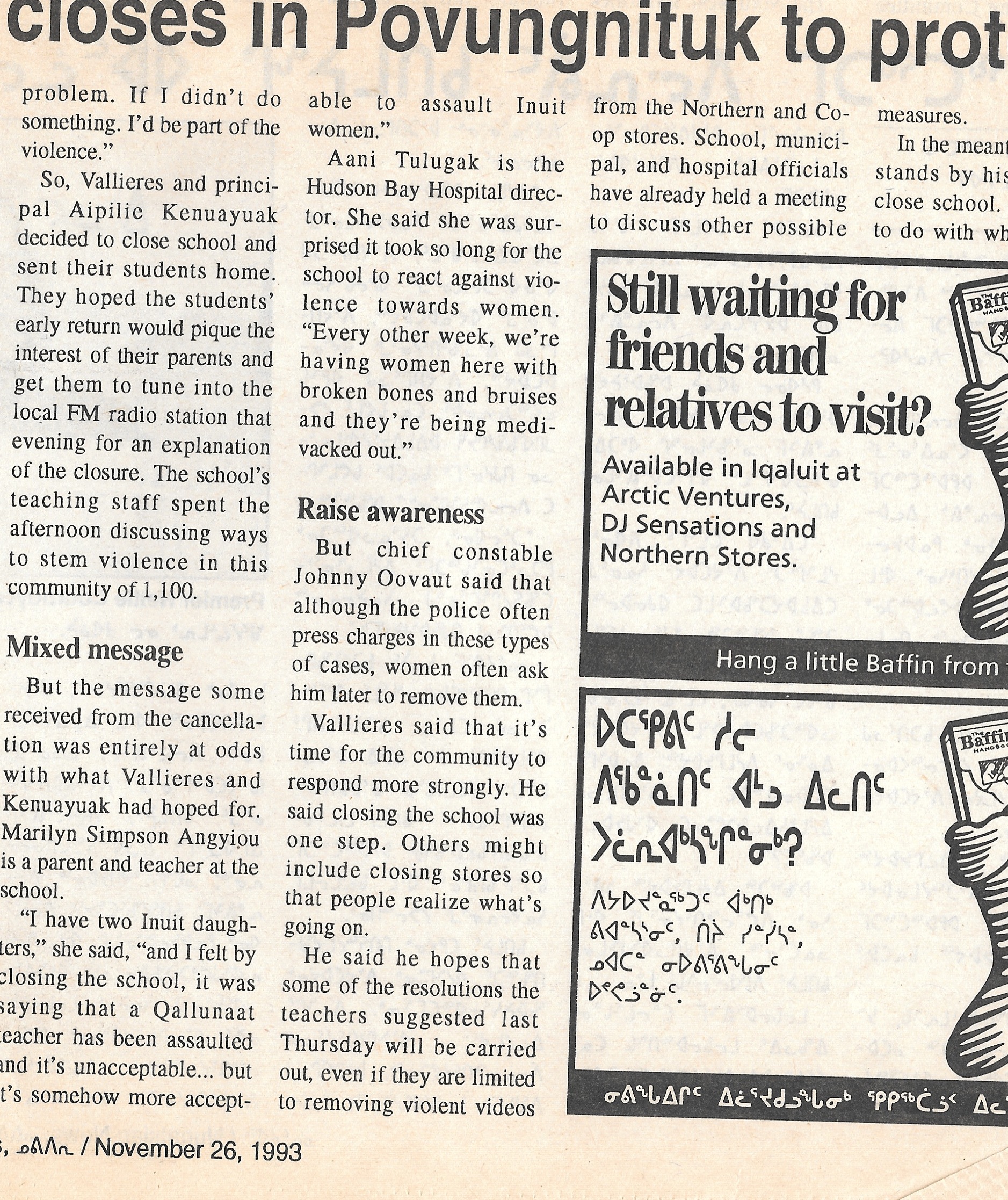
An excerpt from a news story in the Nunatsiaq News from November 2003, one of several which angered municipal officials.

An excerpt from a news story in the Nunatsiaq News from November 1993, one of several that angered municipal officials.

This is how things went: A female teacher from the South was brutally assaulted by a local man and left the community.

Although the new $7-million school had opened 29 days late, the school principal and the school facility director decided to close the school for yet another day.

“It’s nothing to do with white or Inuit,” Claude Vallières, the facility director, said in a story I wrote for the Nunatsiaq News.

“It’s about violence and I can’t let it go on for the sake of the children.”

This incident was soon followed by violence that affected all southern teachers who returned to Puvirnituq from Christmas holidays in early 1994. They found their homes had been trashed: ketchup spread on the walls, doors torn off, televisions smashed. The teachers refused to return to work unless the damage was repaired, appealing through the media — me — to call attention to their plight.

The outraged mayor then told the teachers in an official letter to stop all communication with members of the media.

Of course, it’s exactly this kind of violence and reaction which are considered as “news” by southern-style media and are always reported on. But the role of a free press and this new way of circulating news was still foreign in the 1990s — before the 1970s, any journalistic coverage  of anything was completely unknown in the eastern Arctic.

“Is the media in the North making it worse by exploiting the lives of abusers?” wrote a woman to the Nunatsiaq News. “When you give a name right on the front page or on the radio and what the person did, you are also affecting the child, wife, husband, grandparent and relatives.”

I subscribed to this Iqaluit-based weekly newspaper after picking it up a few times on trips in northern Quebec. In fact, I made my first telephone call to Iqaluit, to the newspaper’s office, to do this.

Before I called, I had to look on a map to see where Iqaluit is. For months afterwards, I read the newspaper every week when it arrived, trying to figure out where all the communities mentioned were located and to understand the issues.

In 1992, I submitted my first story to the Nunatsiaq News — on a topic that wouldn’t interest any media in the South, about a business dispute brewing in northern Quebec over fuel distribution rights.

I didn’t actually meet anyone on the staff of the newspaper until several months later, when I finally did make it to Iqaluit. Although I’d been reading the newspaper, the news didn’t prepare me for the first breath of minus 45 C air that hit me as I stepped off the plane in Iqaluit in March, 1993.

Even worse, the morning of my arrival, in Montreal, I had racked my glasses in half, and spent the first couple of days in Iqaluit almost blind, trying to find my way around in sub-zero temperatures until someone at the Nunavut Arctic College fine arts studio joined the two pieces together with a screw.

I found the office of the Nunatsiaq News in a renovated building called T-1, originally used by the United States Air Force, at an intersection in Iqaluit now known as the Four Corners.

Too small for the staff, the trailer’s walls looked as if they were held up by mounds of leftover newspapers. The air in the office was smoke-filled and stale. Old brown paper bags from take-out orders were stuck in between the stacks of newspapers.

Every table and desk held a computer or some other piece of equipment, but the paper was fed  to Ottawa for translation, layout and printing. The newspaper arrived  every Friday afternoon on the daily jet from Ottawa and was sent to communities all over the eastern Arctic. Printed in Inuktitut and English, it was then often the only current information available.

Whenever I returned to Iqaluit, even when I was working for CBC or other media, I stopped by the Nunatsiaq News office. I occasionally interviewed the staff for various reports I was doing. For a long time, I contributed only sporadically to the newspaper.

The Nunavik community of Salluit on Hudson Strait, April 1994. (PHOTO BY JANE GEORGE)

The Nunavik community of Salluit on Hudson Strait, April 1994. (PHOTO BY JANE GEORGE)

But there I was in 1994, sitting in the broom closet at Ikusik School in Salluit, mulling over what I’d write for the newspaper. I’d retreated to this bleak space after being kicked out of the meeting I was covering in this Hudson Strait community. I was armed with a set of earphones for interpretation. So, I sat with the mops and bails, listening in to “closed-door” discussions.

Although I’d been to Salluit before, its airport still seemed like the terminal at the end of the universe to me: huge, eroded mountains of rock, partially snow-covered and icy. You saw nothing of the community below.

But the who’s-who of 8,000 Inuit from communities in northern Quebec had come there to attend Makivik Corp.’s annual get-together — its annual general meeting.

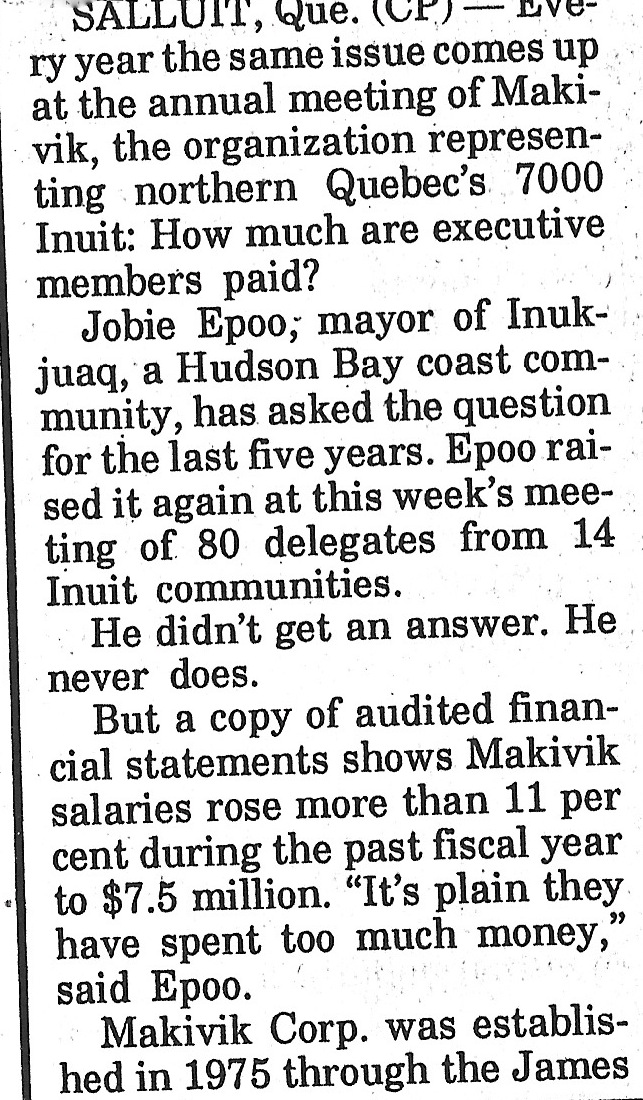
Makivik administers land claims settlement funds for Inuit in northern Quebec. But in 1994 only a little over $120 million of the nearly $130 million  the organization had received after 1975 in compensation remained, a fact leaders had a hard time explaining — and they certainly didn’t want to talk at all about the state of their finances with any members of the media present.makivik_story_one

So journalists were told straight off that they were not welcome to sit in the meeting room, and would not receive a copy of audited financial statements, as in previous years’ annual general meetings.

But a careless delegate left a copy of the financial statements in the bathroom, where I picked it up.

I decide to duck into a broom closet next door to the bathroom. There, surrounded by mops and pails, in a small space I could visualize more than 20 years later, I continued to listen to the closed discussions on my headset.

It was clear that some people were upset that their capital had dropped $6 million in two years. They complained that too much of their money was spent in the South.

“If we spend a lot in the South, it’s the people there who are getting rich,” said one speaker. “And the situation here isn’t getting any better.”

“They’re getting rich, while people here are living like dogs,” another speaker said.

The stickler? Makivik had purchased a home for its incumbent president, Senator Charlie Watt, on the West Island area of Montreal. In the wake of a story about Watt, his property and business affairs by investigative  journalist Stevie Cameron for Macleans, which appeared just before the meeting and was distributed via fax throughout Nunavik, Watt lost his re-election vote. Scan 46

My own coverage before the meeting and about what took place there helped to spur more debate in Nunavik.

But not long after that meeting in Salluit, I began to experience harassment. These took the form of a hostile call to me at my office from a Makivik staffer, as well as letters and calls to my various employers.

Some publicly-elected officials in Nunavik also started to hang up on me, and I was told that all employees of a major organization in northern Quebec had been advised not to speak to me.

As well, a major story I was working on for a newspaper in the South was dropped: I couldn’t get both official sides of the story, I was told, because the some spokespeople from Makivik wouldn’t speak to me anymore.

The editor at this southern newspaper decided to listen more to my critics than to me — after all, I was just a freelancer.

The Nunatsiaq News stood by me, although I was only a very minor contributor. The staff members there had many similar stories of their own about harassment. I realized that I had a lot in common with everyone at the newspaper.

The next instalment of “Like an Iceberg” goes live April 15.

You can read the first blog entry of “Like an iceberg” from April 2 here.

You can previous instalments here:

Like an iceberg: on being a journalist in the Arctic

Like an iceberg, 1991…cont.

Like an iceberg, 1991…more

Like an iceberg, 1992, “Shots in the dark” 

Like an iceberg, 1992, “Sad stories”

Like an iceberg, 1993, “Learning the language of the snows”

Like an iceberg, 1993 cont., “Spring”

Like an iceberg, 1993 cont., “Chesterfield Inlet”

Like an iceberg, 1993 cont., more “Chesterfield Inlet”

Like an iceberg, 1994: “Seals and more”