Like an iceberg, 1997, cont., “Talking”

Like an iceberg, 1997, cont., “Talking”

Quebec Premier Lucien Bouchard’s visit to Kangiqsualujjuaq in September,1997 — a couple of months after I started to work full-time for the Nunatsiaq News — signalled the beginning of warmer relations between Quebec and Nunavik.

Maggie Emudluk, then mayor of Kangiqsualujjuaq, and Quebec Premier Lucien Bouchard shortly after his arrival in Kangiqsualujjuaq in September, 1997. (PHOTO BY JANE GEORGE)

Maggie Emudluk, then mayor of Kangiqsualujjuaq, and Quebec Premier Lucien Bouchard shortly after his arrival in Kangiqsualujjuaq in September, 1997. (PHOTO BY JANE GEORGE)

But for me, Bouchard’s visit mainly provided a chance to follow up on several tips I had received: a prominent Nunavik leader was being investigated by police in Montreal for an allegation of sexual assault — and the alleged complainant, whose name I also received from an informant, lived in Kangiqsualujjuaq.

During his visit, Bouchard — on his first official visit to Nunavik, and the first by any Quebec government leader since 1984 — urged people in Nunavik not to try and solve all the world’s problems, and to put aside all “negative” ideas, such as the partition of Quebec.
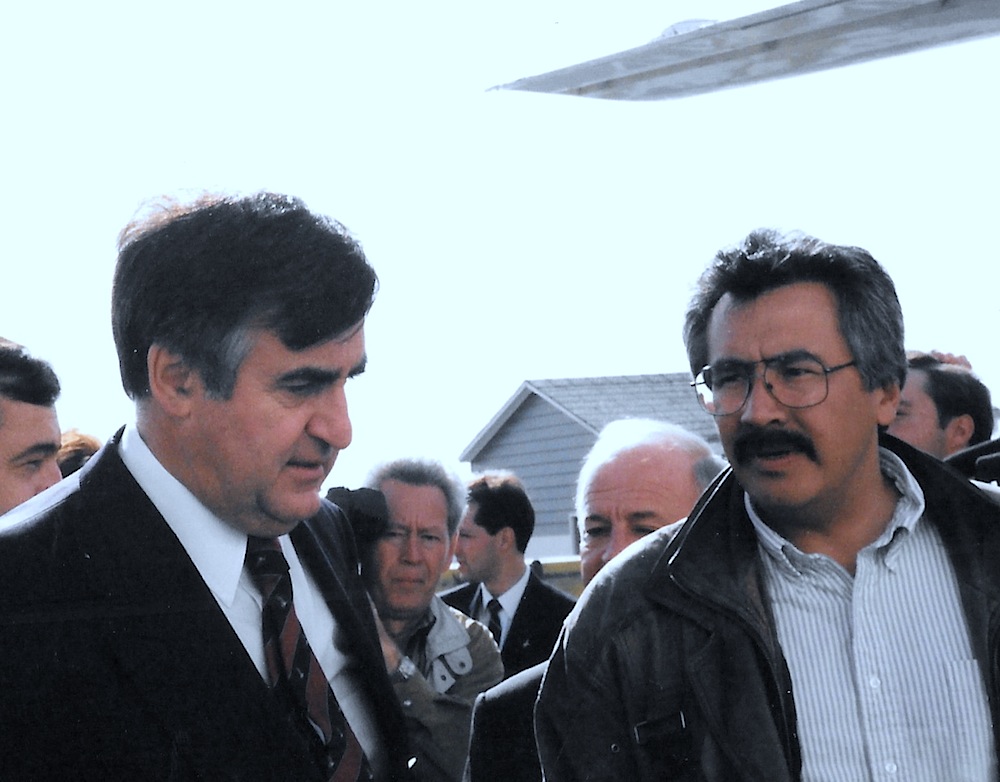
Quebec Premier Lucien Bouchard and Johnny Adams, then chairperson of the Kativik Regional Government, chat in Kangiqsualujjuaq in September 1997. (PHOTO BY JANE GEORGE)

Quebec Premier Lucien Bouchard and Johnny Adams, then chairperson of the Kativik Regional Government, chat in Kangiqsualujjuaq in September 1997. (PHOTO BY JANE GEORGE)

Nunavik leaders told Bouchard they wanted to move ahead once more with self-government negotiations, which would hit an impasse 10 years later in 2011 when Nunavik voters would say no to the creation of a Nunavik Regional Government.

“We have a common future,” Bouchard told the gathering in 1997. “We have so much to work on.”

Those from Quebec and Nunavik who participated in a two-hour official meeting behind closed doors called the discussions “positive,” “optimistic,” “fruitful,” “civil” and a “solid step forward.”

But, for once, while they were talking behind closed doors, I was not upset to be left out. With an Inuktitut-speaking friend I headed out to talk to the woman about what she alleged to have happened to her in Montreal.

She turned out to be an elderly person who she sat on a mattress on the floor when she spoke to us. I recorded the conversation.

The woman, then a patient at a Nunavik boarding home, related how during the summer she had gone to an apartment with a man after they had met in Dorval, a longstanding gathering place for Inuit in Montreal.

Kangiqsualujjuaq residents welcome Quebec Premier Lucien Bouchard, September, 1997. (PHOTO BY JANE GEORGE)

Kangiqsualujjuaq residents welcome Quebec Premier Lucien Bouchard, September, 1997. (PHOTO BY JANE GEORGE)

She alleged that, in his apartment, he touched her leg and attempted to sexually assault her.

“Me, an old woman,” she said.

If he had apologized or offered her money as compensation later — in the North, two commonly accepted ways make amends — she would have forgiven him, she said.

We made it back to the school in time for the speeches and gifts, before the Quebec officials left Kangiqsualujjuaq to continue on to the James Bay region to visit the hydro-electric facilities there.

But before heading south, the Quebec government airplane dipped close above the water to give Bouchard a look at some huge icebergs — but that wasn’t the only treat on that aircraft, where I was the only Anglophone and very likely the only federalist on board: for dessert we had chocolates covered with gold paper embossed with Quebec’s fleur de lys symbol.
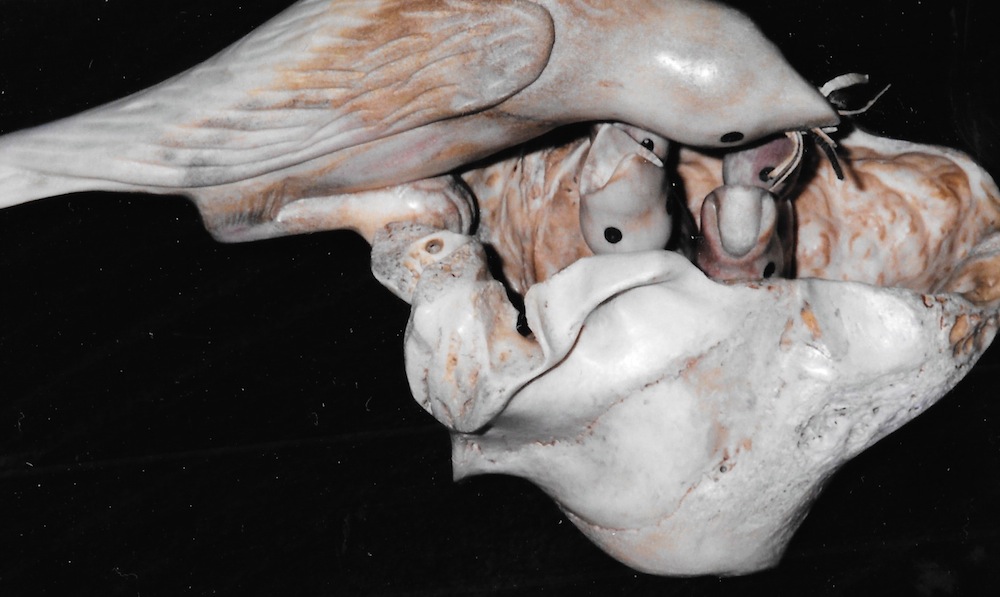
Carving given to Quebec Premier Lucien Bouchard in September 1997 in Kanigqsuallujuaq. (PHOTO BY JANE GEORGE)

Carving given to Quebec Premier Lucien Bouchard in September 1997 in Kanigqsualujjuaq. (PHOTO BY JANE GEORGE)

I did not report on my conversation with the elder in Kangiqsualujjuaq as the charges against the man were dropped.

However, in September 1998, the prominent leader resigned over allegations of erratic behaviour caused by alcohol abuse.

The next instalment of Like an iceberg goes live May 14.

You can read earlier instalments here:


Like an iceberg: on being a journalist in the Arctic

Like an iceberg, 1991…cont.

Like an iceberg, 1991…more

Like an iceberg, 1992, “Shots in the dark” 

Like an iceberg, 1992, “Sad stories”

Like an iceberg, 1993, “Learning the language of the snows”

Like an iceberg, 1993 cont., “Spring”

Like an iceberg, 1993 cont., “Chesterfield Inlet”

Like an iceberg, 1993 cont., more “Chesterfield Inlet”

Like an iceberg, 1994: “Seals and more”

Like an iceberg, 1994, cont., “No news is good news”

Like an iceberg, 1994 cont., more “No news is good news”

Like an iceberg, 1994 cont., “A place with four names”

Like an iceberg, 1995, “More sad stories”

Like an iceberg, 1995 cont., “No place like Nome”

Like an iceberg, 1995 cont., “Greenland”

Like an iceberg, 1995, cont. “Secrets”

Like an iceberg, 1996, “Hard Lessons”

Like an iceberg, 1996 cont., “Working together”

Like an iceberg, 1996 cont., “At the edge of the world”

Like an iceberg, 1996, more “At the edge of the world”

Like an iceberg, 1996, cont. “Choices” 

Like an iceberg, 1997, “Qaggiq”

Like an iceberg, 1997, more “Qaggiq”

Like an iceberg, 1997, “Qaggiq” cont.

Like an iceberg, 1997 cont., “Qaggiq and hockey”

Like an iceberg, 1997 cont., “Brain surgery in POV”

Like an iceberg, 1997 cont.: “Masks on an island”


Like an iceberg, 1997 cont., “Qaggiq and hockey”

Like an iceberg, 1997 cont.: “Qaggiq and hockey”

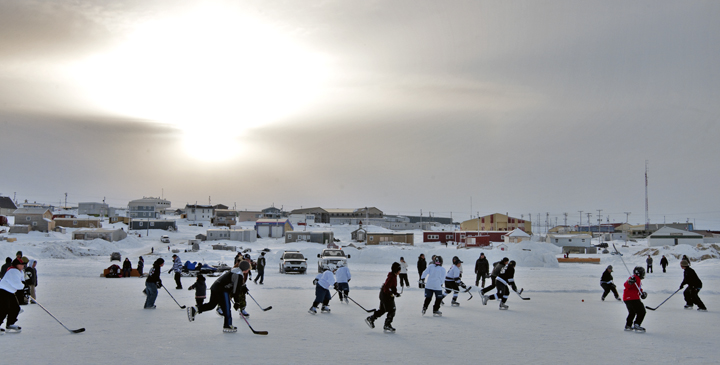
An outside hockey game in Igloolik, (PHOTO/ PROJECT NORTH)

An outdoor hockey game in Igloolik. (PHOTO/ PROJECT NORTH)

It was a typical Saturday afternoon in Igloolik, January 1997: The temperature was minus 30 C with blowing snow, so more like minus 60 C. It was still pitch black outside, despite the increasing minutes of sunlight around noon every day. Inside the Kipsigak arena, a brisk game of hockey was underway.

There I found James Ungalaq and Celestino Uyarak discussing the weekend hockey tournament between the Igloolik Suns, the Assassins, Aqviqs and Eskimos. With no paid staff, their volunteer-run hockey association kept the arena open and found coaches and referees for the many players in the community.

It was taking volunteers an hour and a half to sweep the arena, then another hour to flood the ice. On weekends, there was more even work and 14-hour-long days at the arena. If the rink had been able to have a zamboni to groom the ice, the ice might have been ready much earlier for the kids, who looked forward to skating every day after school.

That’s why Ungalaq and Uyarak set their sights on a zamboni — the hamlet was willing to give them $50,000 if, by March 31, they could fundraise the additional $20,000 needed to buy the ice-grooming machine. In January, they were still $9,000 away from meeting that goal.

Maple Leafs fan Uyarak, who was unemployed in 1997, spent nearly all his time at the rink.

“I’m not a hunter, either. This is one thing I was never good at. If I have a choice to go hunting or play hockey, I’d play hockey,” he said.

Hockey had helped him over the previous two years, he said.

Igloolik as the sun returns. (PHOTO/ WIKIPEDIA)

Igloolik as the sun returns in mid-winter. (PHOTO/ WIKIPEDIA)

“When I’m at home, I’m a little upset, or a little confused, it helps relax [me]. It probably helped others too… you can’t go up to punch and whack someone. You can’t do that. You just play, and the best you can do it. Then the game’s over. That anger is gone. It helped me. Something else to think about. Something positive.”

Ungalaq, then a student at Nunavut Arctic College, said he didn’t think there was a problem with Inuit turning from traditional activities to hockey.

“It’s always been a matter of survival for us. If it makes them happier… they should be hockey players,” he said.

“I wish kids could turn more to sports rather than go and do something bad. Igloolik has a sniffing problem and we have a drug problem… If we can take these children into places like this, it doesn’t hurt.”

Ungalaq said he couldn’t wait until there would be an Inuk player in the National Hockey League — which didn’t happen until  2003, when Jordin Tootoo of Rankin Inlet joined the Nashville Predators.

NHL player Jordin Tootoo stands in front of an iceberg in Qikiqtarjuaq in 2013 (PHOTO BY DAVID MURPHY/NUNATSIAQ NEWS)

NHL player Jordin Tootoo stands in front of an iceberg in Qikiqtarjuaq in 2013 (PHOTO BY DAVID MURPHY/NUNATSIAQ NEWS)

“There’s about 24,000 Inuit up North and if the NHL gets one Inuk player, all those 24,000 Inuit will root for the team, that’s for sure,” Ungalaq said.

But I learned that the game of hockey, as it was played in Igloolik, wasn’t quite the same as in the South.

“The first night I played in the arena, there was a stick duel going on. It was a pick-up game before the teams were formed for the season,” said the high school principal, Doug MacLean, when we crossed paths in the arena.

“I was a little bit shocked, mentioned my discomfort to a fellow player. He turned to me and said ‘it’s ok, they’re brothers.'”

Still MacLean said he saw respect for age played out at the rink, with younger kids obeying the older ones.

“It’s not a traditional kind of respect because it’s in a non-traditional setting, but it does underscore a traditional set of values which does exist in the communities, and a place where you’ll see it” — unlike at school, he added.

When I left Igloolik after more than two weeks in the community, on a flight scheduled between two storms, I arrived back in Iqaluit where it feels light and balmy, although it was still way below zero.

Iqaluit's Kamotiq Inn (PHOTO/NUNATSIAQ NEWS)

Iqaluit’s Kamotiq Inn (PHOTO/NUNATSIAQ NEWS)

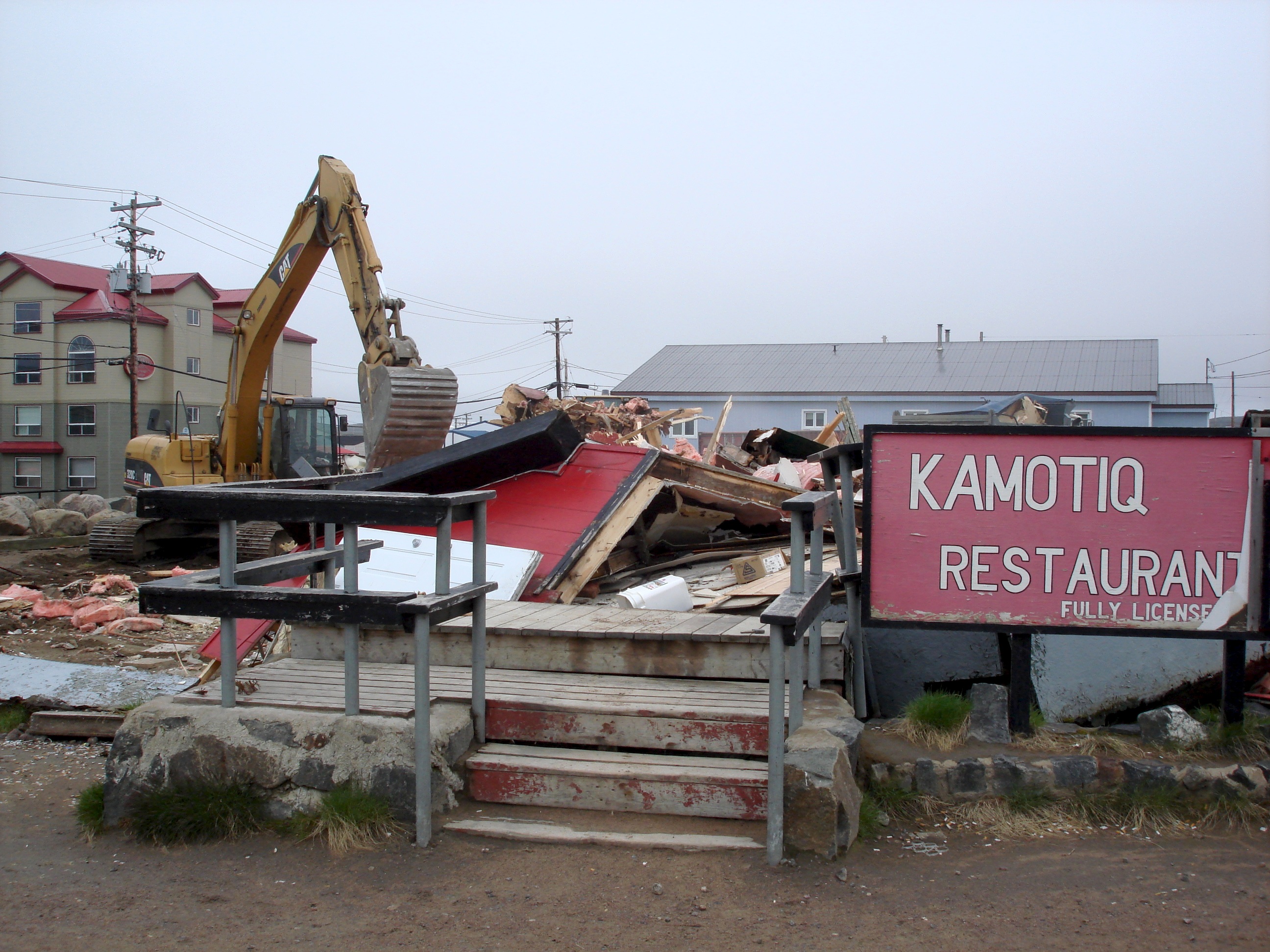
I meet a journalist at the Nunatsiaq News (where I would start to work full-time only later in 1997) for pizza and beer at the Kamotiq Inn, an igloo-shaped landmark at Iqaluit’s main intersection, the Four Corners — which was torn down in 2008.

The Kamotiq Inn at Iqaluit's Four Corners intersection is torn down in 2008. (PHOTO BY JANE GEORGE)

The Kamotiq Inn at Iqaluit’s Four Corners intersection is torn down in 2008. (PHOTO BY JANE GEORGE)

Afterwards, I went to a friend’s apartment where I cuddled up under a warm quilt. The stomach pains which plagued me in Igloolik were gone and I felt sunny again.

Not long after my visit to Igloolik, I learned that a zamboni was on order for the Kipsigak rink.

The next instalment of Like an iceberg goes live May 9.

You can read earlier instalments here:

Like an iceberg: on being a journalist in the Arctic

Like an iceberg, 1991…cont.

Like an iceberg, 1991…more

Like an iceberg, 1992, “Shots in the dark” 

Like an iceberg, 1992, “Sad stories”

Like an iceberg, 1993, “Learning the language of the snows”

Like an iceberg, 1993 cont., “Spring”

Like an iceberg, 1993 cont., “Chesterfield Inlet”

Like an iceberg, 1993 cont., more “Chesterfield Inlet”

Like an iceberg, 1994: “Seals and more”

Like an iceberg, 1994, cont., “No news is good news”

Like an iceberg, 1994 cont., more “No news is good news”

Like an iceberg, 1994 cont., “A place with four names”

Like an iceberg, 1995, “More sad stories”

Like an iceberg, 1995 cont., “No place like Nome”

Like an iceberg, 1995 cont., “Greenland”

Like an iceberg, 1995, cont. “Secrets”

Like an iceberg, 1996, “Hard Lessons”

Like an iceberg, 1996 cont., “Working together”

Like an iceberg, 1996 cont., “At the edge of the world”

Like an iceberg, 1996, more “At the edge of the world”

Like an iceberg, 1996, cont. “Choices” 

Like an iceberg, 1997, “Qaggiq”

Like an iceberg, 1997, more “Qaggiq”

Like an iceberg, 1997, “Qaggiq” cont.