Like an iceberg, 1994 cont., more “No news is good news”

Like an iceberg, 1994, cont.: “No news is good news”

I decided in 1994 to do a documentary on Nunatsiaq News for CBC radio’s national media program, “Now the details,” about the difficulties of journalism in the North. For this program, which required my spending hours with the newspaper’s staff during its production, I forged an even closer professional relationship with the newspaper. That’s because the Nunatsiaq News was often a target for high-level threats, too.

The way Iqaluit looked when I first arrived there. (PHOTO/ FACEBOOK)

The way Iqaluit looked when I first arrived there. (PHOTO/ FACEBOOK)

“Often comments are made in front of other media that are referring to us. That’s a messenger service. It’s a kind of back-door intimidation which frankly doesn’t work,” the  newspaper’s publisher, Steven Roberts, said in an interview.

In one instance, the Nunatsiaq News was pulled off airline flights to the eastern Arctic when there was a story about a plane crash involving one of the airline’s aircraft.

And members of political organizations often called in to complain either about specific journalists or their stories’ content.

“This is how the game is played. In the North, the way to influence the media is to intimidate them: it’s not to work with them, it’s not to make the media’s job easier so they can report. The tack taken is to make it harder for the media to do their job and hopefully they’ll forget about the story,” Roberts said.

So, I learned that I was not the only one who had a tough time getting information: Journalists who continued to report “negatively” or completely on issues that leaders or communities would prefer not to make public could be ostracized.

As a result, many northern journalists and news organizations simply chose to avoid certain subjects.

In some respects, this was not surprising: in the not-so-distant past, news was simply transmitted by word of mouth. This sort of first-person reporting was the way a hunter might talk about a recent adventure.

When news was told in this “first-hand” fashion, it was grounded in personal experience. People always could believe it, and, as French polar explorer Jean Malaurie noted in his classic tale of Greenland, The Last Kings of Thule, “each item of news, each scrap of information a hunter imparted, had both practical and moral value.”

So, modern-day reports on abuse or other forms of violence, delivered by media, as a third party, were perceived negatively and even as not being truthful or “factual.” These reports were — ands still often are — also viewed as hurtful.

During my interviews the staff at the newspaper told me what I’d already experienced first-hand — that when efforts to control media by threats, coercion or self-censorship fail, journalists will often simply be thrown out of meetings. The impact of news stories could create a debate with disastrous consequences for leaders, so it was in their interest to be the first to say that “news” was not part of traditional Inuit culture.

Political dealings between Inuit and southern-based Canadian governments hadn’t helped create a tradition of open communication, either, and land claim agreements were negotiated behind closed doors, not in a public fashion.

The political reality — where the land claim organizations administer huge sums of money —  led to a situation where powerful political figures also control much of the economy — so, why not control of the media as well?
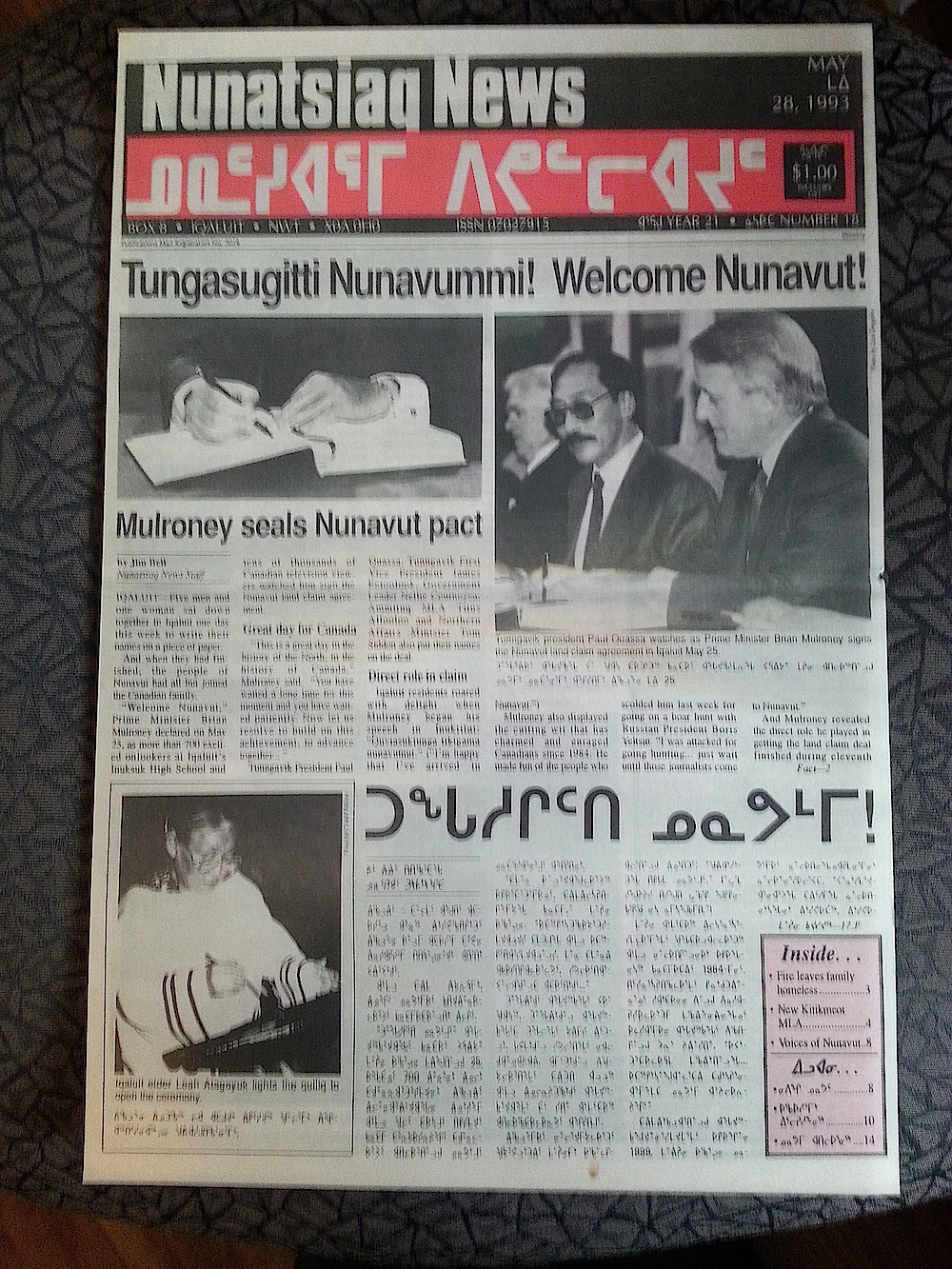
Nunatsiaq News from 1993.

A Nunatsiaq News cover from 1993.

“If we are going to be threatened, we’re going to tell our readers that’s what’s happening. ‘If you notice we’re not covering these events anymore it’s because this has happened, we have been warned off, we have been threatened that if we do this, our business may be hurt.’

“Up until now, we’re managed to take on all these challenges head-on. I’m not going to say that there are winners and loser in this, but the day that we face a situation that we’re unable to handle, it’s the readers that have the right to know first,” Roberts said.

But not all Inuit were opposed to the revelations of southern-style journalism.

“I always think about you,” an Inuk broadcaster told me in the 1990s. “When I’m in a tough place, running up against powerful people, then I remember that it’s important to talk even so.”

“There were things we couldn’t talk about then to see our society grow. Today, it’s different and we have to talk about certain issues people are uncomfortable with, but we have to talk about it for future generations to be create a good society, like the society we had 100 years ago,” said another woman I know.

Sometimes, I would even get calls at home, from Inuit I met, telling me not to give up, so I didn’t.

You can read the first part of “No news is good news” here.

The next instalment of Like an iceberg will go live April 17.

You can read previous instalments here:

Like an iceberg: on being a journalist in the Arctic

Like an iceberg, 1991…cont.

Like an iceberg, 1991…more

Like an iceberg, 1992, “Shots in the dark” 

Like an iceberg, 1992, “Sad stories”

Like an iceberg, 1993, “Learning the language of the snows”

Like an iceberg, 1993 cont., “Spring”

Like an iceberg, 1993 cont., “Chesterfield Inlet”

Like an iceberg, 1993 cont., more “Chesterfield Inlet”

Like an iceberg, 1994: “Seals and more”

Like an iceberg, 1994, cont., “No news is good news”

Like an iceberg, 1994 cont., more “No news is good news”


Like an iceberg, 1994: “Seals and more”

Like an iceberg, 1994: “Seals and more”

I decided to return to Pangnirtung in the middle of February 1994. The sun had just begun to come back into this Baffin Island community. For months, the sun had lingered below the horizon. Now it was rising higher every day.

Pangnirtung fiord in February 1994. (PHOTO BY JANE GEORGE)

Pangnirtung fiord in February 1994. (PHOTO BY JANE GEORGE)

In mid-afternoon, a bit of sun peeked over the ridge of the mountains, casting long shadows in town. Most of the day, the snow-covered mountains still hovered in a perennial dawn. They were pinkish, with constantly changing flashes of yellow. I never tired of this vista. One day, we took a walk out on the frozen fiord, among the blocks of ice that created a cold, white forest.

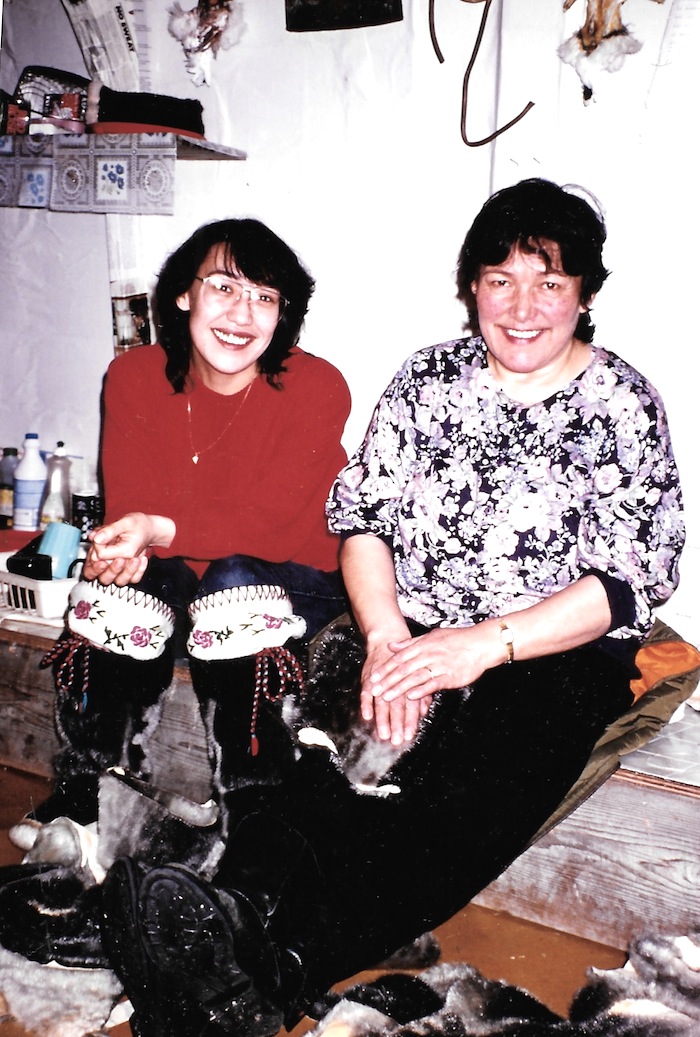
Margaret Karpik, the director of the Visitors Centre, took me to visit her mother, Ida Karpik, a well-known artist: I was doing a report for CBC radio on the revival of sealskin trade.

Ida and a few other local women were gathered in the qammaq, a traditional tent-like structure, to work sealskins and sew. On its ceiling and walls, old newspapers and catalogues had been glued, helter-skelter, for wallpaper. In the corner, in the stone qulliq lamp a low fire burns. Moss was used as the wick, seal oil as the fuel.

Margaret Karpik (left), with her mother Ida Karpik (right), in the women's qammaq in February 1994. Karpik, a renowned artist, died in 2002 at 63. (PHOTO BY JANE GEORGE)

Margaret Karpik (left), with her mother Ida Karpik (right), in the women’s qammaq in February 1994. Karpik, a renowned artist, died in 2002 at 63. (PHOTO BY JANE GEORGE)

With Margaret helping to translate, Ida explained why sealskin was ideal for clothes, especially for jackets or boots that are warm in the cold and waterproof in the damp weather.

The hard work it takes to make sealskin into clothes is worth it, she said. I also spent a peaceful afternoon scraping a skin, watching her and the other women work and listening to their conversation.

In Pangnirtung, two local men were also trying to revive trade in sealskins. Only 15 years earlier, the market for sealskins had been strong, but that was before environmental lobby groups protested against the annual seal hunt and the United States slapped a ban on the import of sealskins. From Baffin Island alone, Inuit used to sell 15,000 sealskins. By the mid-1990s, not even a tenth of that amount were sold.

But Jaypeetee Akpalialuk and Michael Murphy told me they were planning to send skins over to Hokkaido, in Japan, where the Ainu, the indigenous people of northern Japan, would use them in their clothing and handicrafts. Akpalialuk  was then the mayor of Pangnirtung. Without seal meat, he told me, Inuit would never have been able to live in the North. It would be too cold without sealskin clothes to wear, and seal to eat, he said.

“When you’re out on the land and the temperature is -40, you don’t have time to eat, but your body needs energy. It needs energy and you have to be warm. So, when we eat raw seal meat when it’s very cold, your body starts to get warm. Seal meat is very rich, and seal meat is the best thing in the North,” he said. “And sealskin is one of the best clothing you can have. You can wear it in summer, in winter. You can wear it just about anywhere. It’s waterproof, it lasts a long time, it’s one of the best materials you can have for clothing.”

Akpalialuk said critics of the seal hunt have it all wrong: Their seal harvest doesn’t even make a dent in the population.

“As Inuit, too, we’ve never been over-killing any species up here. Outsiders have been harvesting our species. Europeans came over to Baffin Island in the 1800’s and over-killed the bowhead. We never overkill. We always managed the resources according to our knowledge,” he said.

And Inuit aren’t inhumane, either, he said. They don’t kill seals like Newfoundlanders: They nearly always just shoot them quickly with a gun.

Although the elder Etooangat had told me Inuit also used to hunt seals with hooks, one thing was certain: The seal ban had been a disaster for his community.

“Most Inuit were depending on hunting sealskins for a living, it was the major income for Inuit. Once the market was killed, people suffered. There’s not too many jobs up here, they couldn’t buy food, purchase equipment, so some of them had to depend on welfare. The way I see it, the government of Canada didn’t do too much about it. I guess they didn’t care,” Akpalialuk said.

Akpalialuk and Murphy took me to the sealift container where they were storing sealskins. Murphy, then a singer and local cable television company owner, said he thought that Canadians are ready for sealskin.

“This whole veil of anger at the sealing trade is beginning to lift,” Murphy said. “And I believe that Canadians are distinguishing between the major company and the small guy who is taking the meat for his family, and now, you can have his skins. Isn’t it fair and just that a man should be able to use that product without throwing it in the dump? It’s a sustainable, renewable resource when harvested properly.”

But their project to renew the sealskin trade never took off. Two years later, Akpalialuk was dead. He drowned in a drainage ditch in Kuujjuaq, while intoxicated — his death one of a string of alcohol-related deaths that year which led this Nunavik community to clamp down on liquor sales. Murphy ended up in Ottawa, where, at one time, he faced charges of arson connection with the burning of a small privately-owned fish plant in Pangnirtung.

The timeless triangle of the mountains at the end of Pangnirtung’s fiord remains the same, and Inuit continue to face obstacles to marketing sealskins abroad.

And everyone still takes seal hunting seriously.

“The seals are on the ice” was one of the first phrases I ever learned in Inuktitut.

“But never say that unless you mean it,” a friend warned me. “Because everyone in the room will jump up and run out!”

The next instalment of “Like an iceberg” goes live April 15.

You can read the first blog entry of “Like an iceberg” from April 2 here.

You can read previous instalments here:

Like an iceberg: on being a journalist in the Arctic

Like an iceberg, 1991…cont.

Like an iceberg, 1991…more

Like an iceberg, 1992, “Shots in the dark” 

Like an iceberg, 1992, “Sad stories”

Like an iceberg, 1993, “Learning the language of the snows”

Like an iceberg, 1993 cont., “Spring”

Like an iceberg, 1993 cont., “Chesterfield Inlet”

Like an iceberg, 1993 cont., more “Chesterfield Inlet”