Like an iceberg, 1997, “Qaggiq”

Like an iceberg, 1997: “Qaggiq”
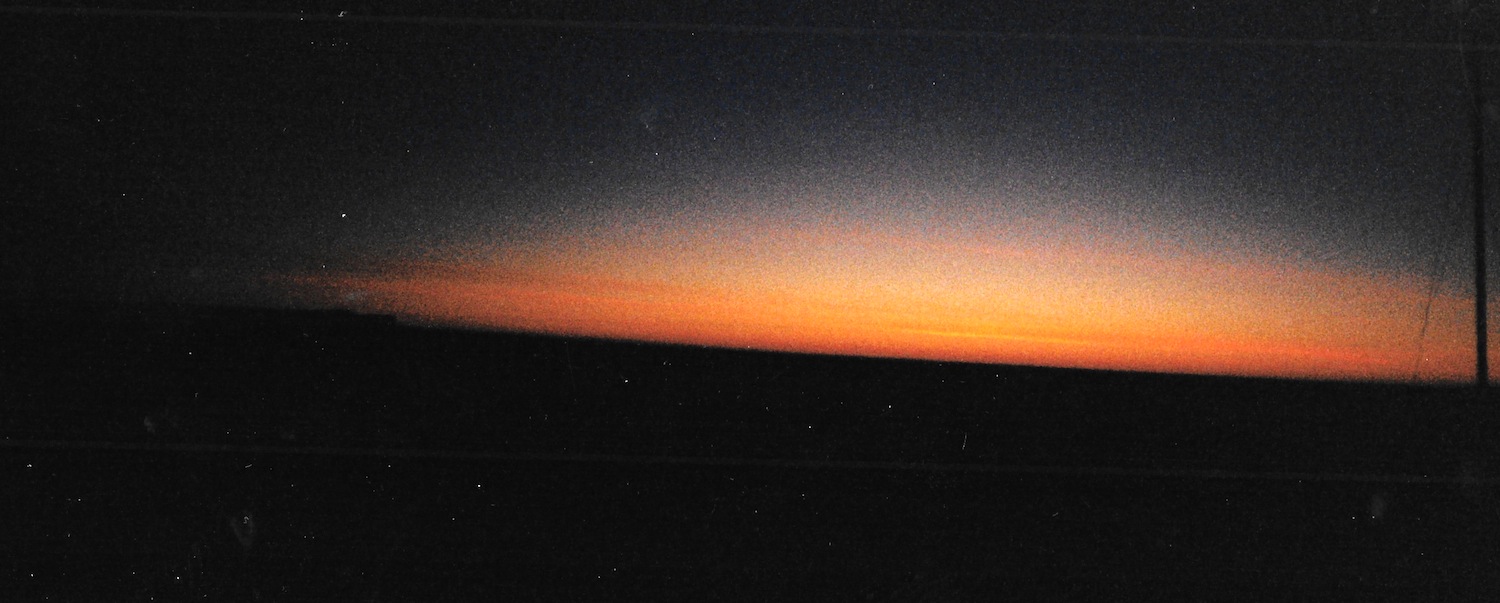
The sun still doesn't rise above the horizon in mid-January, 1997, when I visit. (PHOTO BY JANE GEORGE)

The sun still remained below the horizon in January, 1997, when I first arrived in Igloolik. (PHOTO BY JANE GEORGE)

The long polar night was not yet over in Igloolik when I decided to visit this eastern Arctic community, 870 kilometres northwest of Iqaluit, in early January 1997. I’d heard about its ceremony to welcome back the sun, and for years I’d wanted to visit Igloolik, because it was supposedly the most “traditional” place in the region.

In Igloolik, residents spoke the purest dialect of Inuktitut, so my Inuktitut teachers told me. It was a community that still kept Inuit traditional culture alive, I heard.

And I’d been watching a television series called Nunavut: Our Land, by Igloolik filmmaker Zacharias Kunuk, which made me want to see that landscape and its people for myself.

When I was in Igloolik, I stayed with the local Anglican minister’s family at their informal bed-and-breakfast — the only place I could afford. I’d come on a shoestring budget, patching together contracts from CBC radio and Canadian Press, and cashed in some frequent flyer points to get there.

Rev. Dana Dean baked bread daily. His puffy warm loaves were something to look forward to. But my basement room depressed me. If I was lucky enough to be there in the middle of the day, I could see a bit of reddish twilight through its two windows for a few minutes.

The rest of the time my view on the world was dark, with a veil of ice and snow. In fact, it seemed that I could always feel the minus 40 C cold through the walls: It chilled me even as I lay on the bed rolled up in my down sleeping bag.

I arrived on a Friday, spending the weekend mainly trying to get my bearings in this dark and cold place.
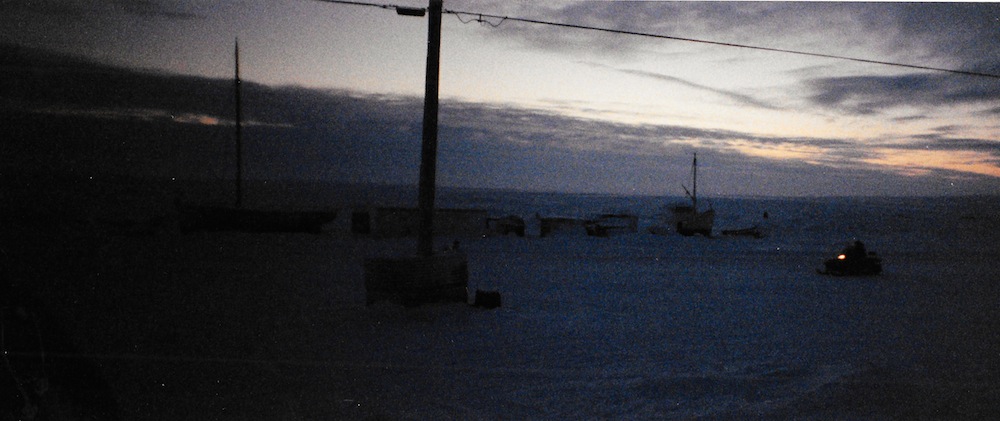
It's hard to get my bearings in Igloolik which never gets lighter than this in the middle of the day. (PHOTO BY JANE GEORGE)

It was hard to know where I was going in Igloolik, which never gets lighter than this in the middle of the day in early January. (PHOTO BY JANE GEORGE)

I’d read about Igloolik’s unusual stone church, but when I found it, clearly no one was using the church any more for worship: The low, curved stone walls were covered in a layer of ice and huge drifts were banked up against the sides. Inuit built the church at the behest of one of the Catholic missionaries. Later, they wanted to tear it down: It was too hard to heat and kids climbed up the drifts to jump on the roof. Someone could get hurt, I heard.

Few people were out on the slippery, ice-packed streets of Igloolik when I ventured around town. Wind was blowing off the sea ice and it swept freezing crystals of snow along in its path. Over in the east, a bloodshot light stained the blowing snow pink.
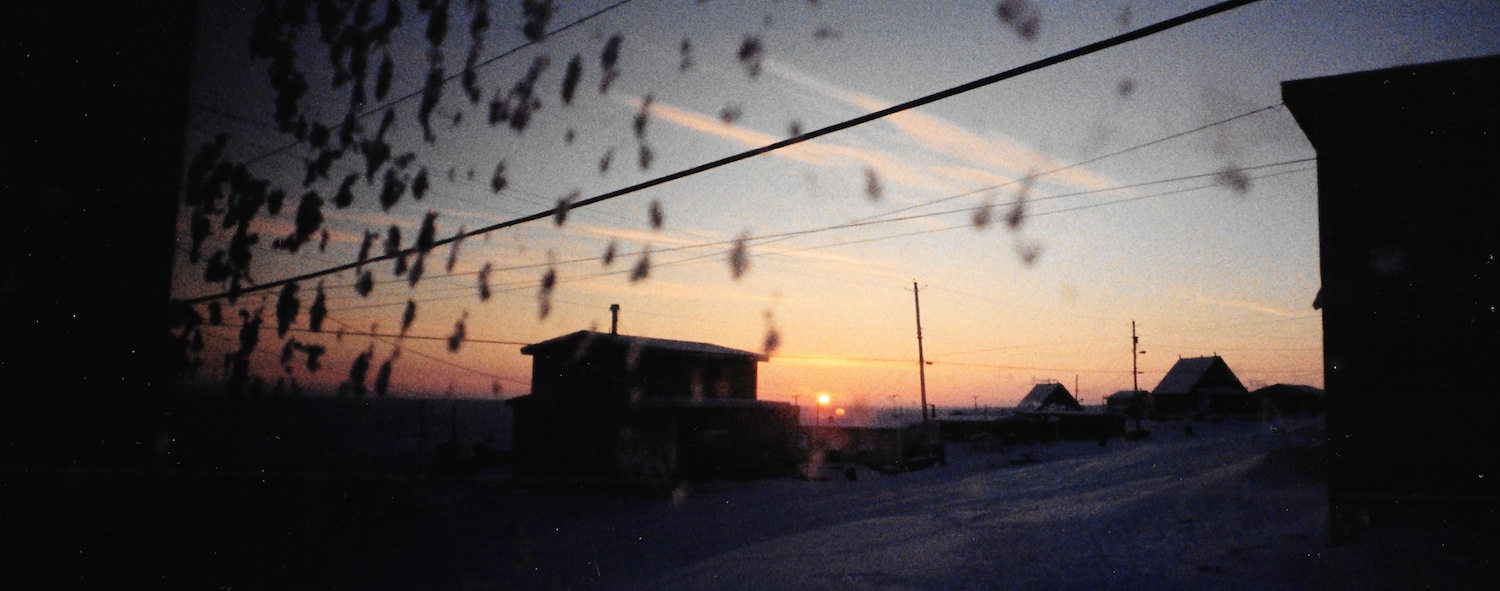
When the sun first rose above the horizon, I could see it from my room in Igloolik. (PHOTO BY JANE GEORGE)

When the sun first rose above the horizon, I could see it from my room in Igloolik. (PHOTO BY JANE GEORGE)

On the Monday following my arrival, when the sun finally peeked over the horizon, its return was supposed to be a reason for celebration. A qaggiq, inspired by the gatherings Inuit used to hold out on the sea ice in a huge snow house, had been scheduled for that evening. It would be held in the school gym, though, not in an igloo.

But plans for that evening’s Qaggiq were quickly shelved when the community ended up mourning the sudden death of a young man who died from a drug overdose.

Qaggiq organizer Louis Tapardjuk told me that going on with the celebration later in the week would be important for everyone in the community.

“The Qaggiq does give them some alternatives. It gives new ways of looking at things,” he said. “It’s preventative —and is also going to help the parents in their bereavement, as a distraction for longing for their loved one.”

Qaggiq celebrations, he said, were based on information from the oral histories of Igloolik’s elders. Iglulingmiut had stopped qaggiqs because of their shamanistic elements: drum-dancing, songs and story-telling. When local researchers began to interview elders in the late 1980s, these forgotten traditions were rediscovered.

“From the interviews we’ve conducted, we’ve seen how important the role of the sun was,” Tapardjuk said. “I decided that we might as well do something about it because it’s a heritage, it’s a culture that was more or less wiped out with the introduction of Christianity and missionaries coming in.”

Before hearing the elders’ stories, he had no knowledge of January’s qaggiq ceremonies.

“When I was growing up, I went to residential school in Chesterfield Inlet, and the government’s policy of the day was assimilation,” Tapardjuk said. “You look like an Inuk, but you begin to realize how little you know.”

Elders told him how, on the day of the sun’s reappearance, children would run to each igloo and blow out the wicks on the stone lamps, known as qulliit in Inuktitut. Then, new wicks would be set into place and relit from a single ceremonial flame.
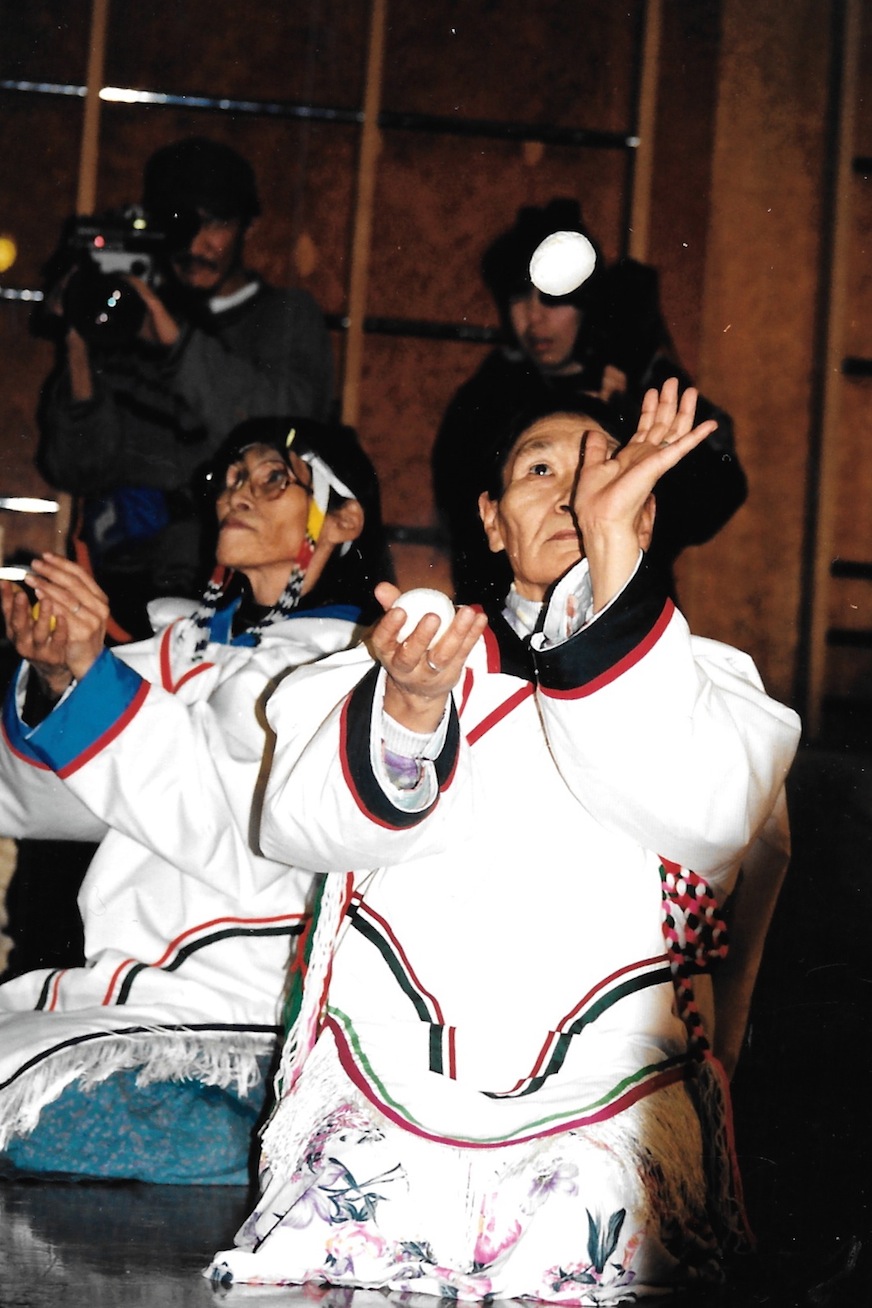
A demonstration of ajagaq, a cup and ball game, is included in the Return of the Sun ceremony in Igloolik in January, 1997. (PHOTO BY JANE GEORGE)

A demonstration of ajagaq, a cup and ball game, is included in the Return of the Sun ceremony in Igloolik in January, 1997. (PHOTO BY JANE GEORGE)

The long, dark time of the year was an anxious time, said elders. They remembered playing cat’s-cradle string games to catch the sun and prevent its disappearance. Then, near the end of the polar night, they would cut up their ajaraaq strings and begin, instead, to play an version of the ajagaq, a cup and ball game, in which a bone used to be thrown up in the air and speared with a stick, to encourage the sun to rise.

Elders also remembered that people scanned the skies intently, looking for signs that the sun would return. When the morning stars, called akuttujuuk, stayed out even during the brief twilight, they knew that sun would soon return.

“Akuttujuuk appear. Yonder the daylight, A-ya-ya. It is a joyous feeling that I will go on living,” goes a traditional song.

With the promise of easier times ahead, elders said that children would smile, but with only a half-smile. One side would be happy because the sun was back, the other side straight because it would still be a long time before warmer weather would return.

But I didn’t see a lot smiles of any sort when I was in Igloolik in 1997, except at the hockey arena or during bingo games. Over the past year, more than a dozen people had died, and many said it was difficult to pick up and go on.
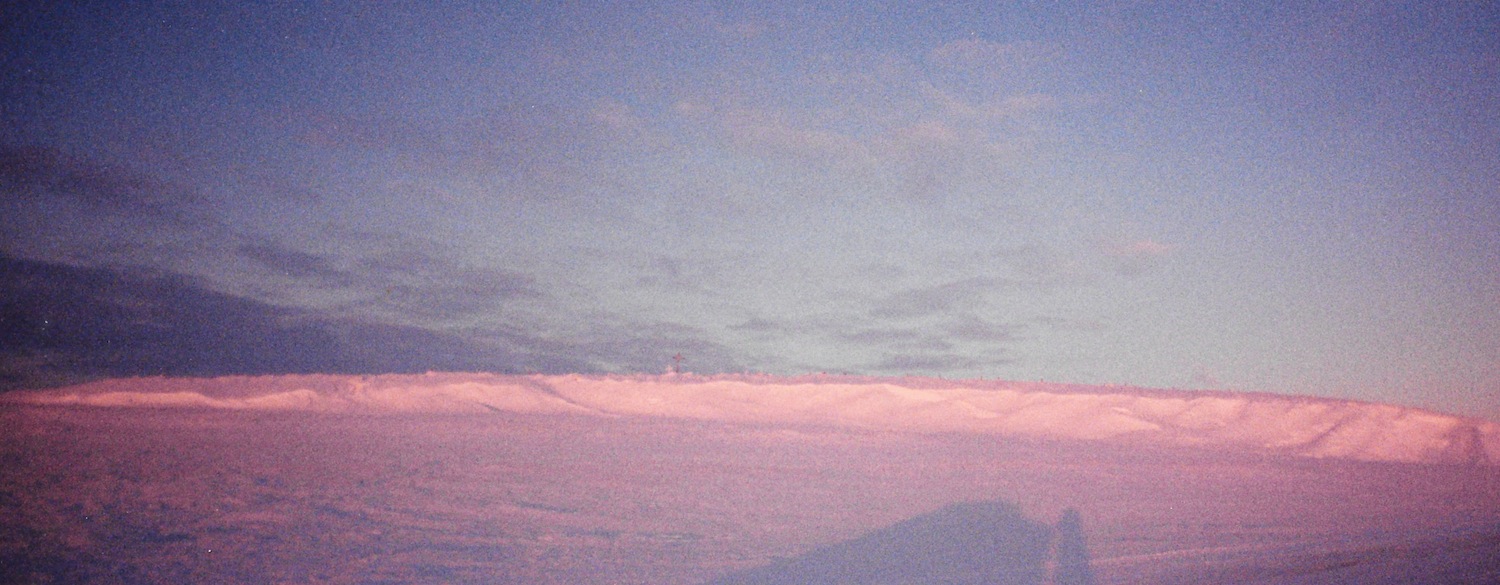
Pink light illuminates the cemetery in Igloolik in January, 1997. (PHOTO BY JANE GEORGE)

Pink light illuminates the cemetery in Igloolik in January, 1997. (PHOTO BY JANE GEORGE)

Several of the deceased were elders.

Before the Return of the sun qaggiq, the 22 remaining elders of Igloolik were fêted at a traditional meal, followed by drum-dancing. They ate an entire seal, sliced open for the occasion. There were also shanks of frozen caribou, fermented walrus called igunaq, maktaaq and char, and lots of bannock spread out on plastic bags in the middle of the large, circular floor.

The elders’ get-together was held at the Igloolik Research Centre, a building shaped midway between a mushroom and water-tower. The circular space on the elevated floor of the building suited the occasion.

Elders sat around the edges of this room, much as they would have in an igloo. Their deeply creased faces hinted at a difficult life; their hands showed signs of hard labour. Their intricately embroidered boots and felt liners witnessed to their artistry. They all joined in to sing traditional a-ya-ya songs as drum dancers beat out a rhythm on round drums.

“If it weren’t for their dedication and hardship, we wouldn’t be here today,” Tapardjuk said. “From them we learn how to cope with life.”

Like an iceberg, 1997, “Qaggiq,” a four-part series, continues May 6.
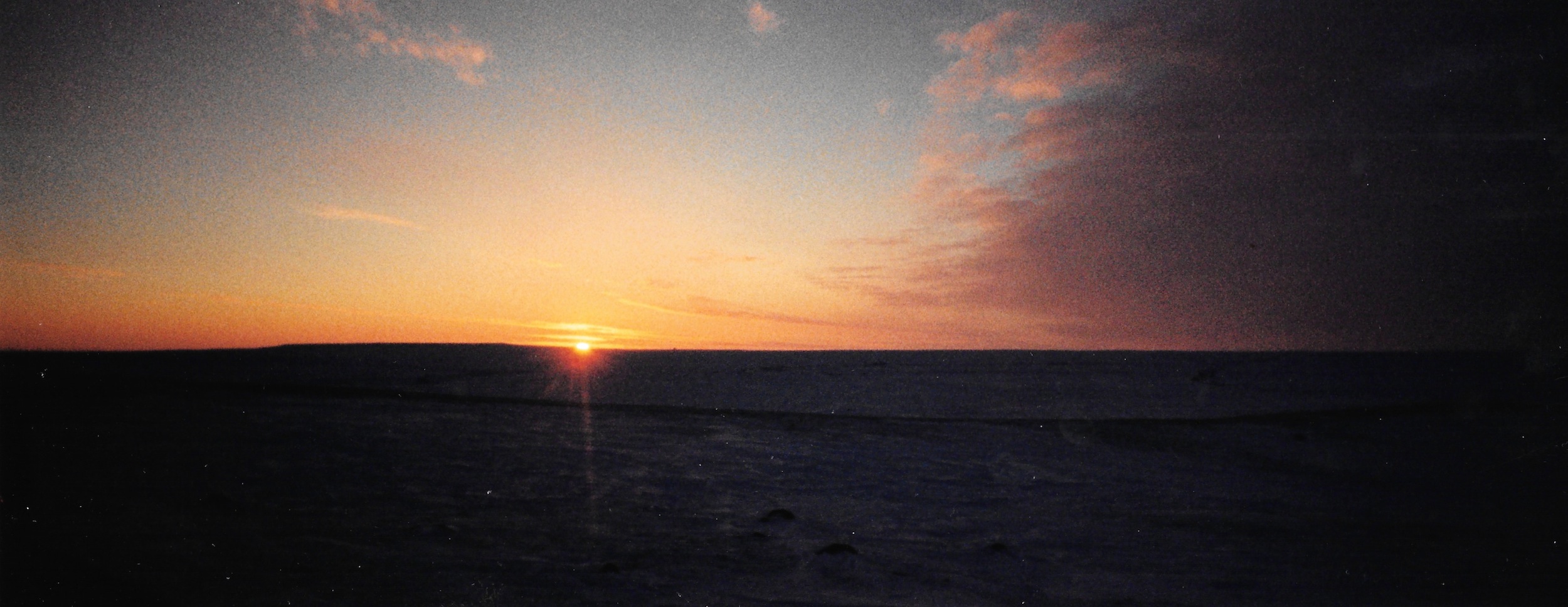
The sun rises over the horizon in mid-January, 1997. (PHOTO BY JANE GEORGE)

The sun rises over the horizon in mid-January, 1997. (PHOTO BY JANE GEORGE)

You can find previous instalments here:

Like an iceberg: on being a journalist in the Arctic

Like an iceberg, 1991…cont.

Like an iceberg, 1991…more

Like an iceberg, 1992, “Shots in the dark” 

Like an iceberg, 1992, “Sad stories”

Like an iceberg, 1993, “Learning the language of the snows”

Like an iceberg, 1993 cont., “Spring”

Like an iceberg, 1993 cont., “Chesterfield Inlet”

Like an iceberg, 1993 cont., more “Chesterfield Inlet”

Like an iceberg, 1994: “Seals and more”

Like an iceberg, 1994, cont., “No news is good news”

Like an iceberg, 1994 cont., more “No news is good news”

Like an iceberg, 1994 cont., “A place with four names”

Like an iceberg, 1995, “More sad stories”

Like an iceberg, 1995 cont., “No place like Nome”

Like an iceberg, 1995 cont., “Greenland”

Like an iceberg, 1995, cont. “Secrets”

Like an iceberg, 1996, “Hard Lessons”

Like an iceberg, 1996 cont., “Working together”

Like an iceberg, 1996 cont., “At the edge of the world”

Like an iceberg, 1996, more “At the edge of the world”

Like an iceberg, 1996, cont, “Choices”
Like an iceberg, 1996, “Who speaks for Inuit”

Like an iceberg, 1996, “Who speaks for Inuit”

In August, 1996, I ran into Piita Irniq at the Dorval airport in Montreal.

“Piita,” I said, “It’s me — Jane. I don’t think we’ve seen each other since Chesterfield Inlet.”

That’s was in 1993, when Irniq was an organizer of the first reunion of former residential school students from the Sir Joseph Bernier School in Chesterfield Inlet.

As we waited for our flight over tea, Irniq told me as we waited for our plane that he had stopped smoking and drinking. And  that he was busy — with the Nunavut Implementation Commission, the group that was designing the new government for Nunavut, to be created in 1999.

Piita Irniq, shown here in a handout photo after he become the first Commissioner of Nunavut.

Piita Irniq, shown here in a handout photo after he become the first Commissioner of Nunavut.

Irniq, like me, was on his way to Memorial University in St. John’s, Nfld. for the Inuit Studies Conference.

But he said he was not happy when non-Inuit academics talk about Inuit, which is exactly what happened at these gatherings.

Two years ago, at the previous Inuit Studies conference in Iqaluit, Bernard Saladin d’Anglure, a professor from Quebec City’s Laval university and president of the Inuit Studies Association (Inuksiutitt Katimajiit Association), had issued a “call for help from the spirits of the numerous Inuit shamans of the past” to solve the social, cultural and economic crises in Inuit communities.

Saladin d’Anglure said then that a return to traditional religion might restore the value system and ideology that Inuit had lost. He said that shamanism is the “original religion of humanity,” with a powerful message for today.

“Why such a social crisis,” asked Saladin d’Anglure, “when at the same time Inuit succeeded so marvelously in their political negotiations?”

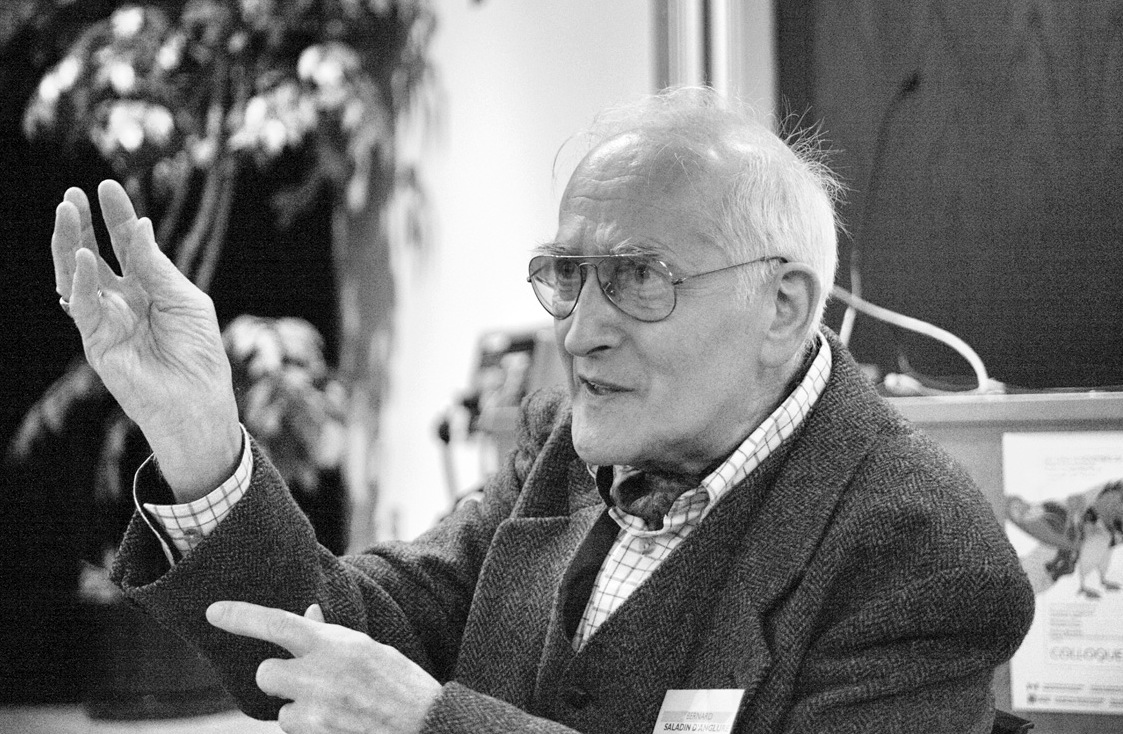
Bernard Saladin D'Anglure in a photo from Université Laval.

Bernard Saladin D’Anglure in a photo from Université Laval.

Saladin d’Anglure continued to study shamanism, in Igloolik, in Siberia and in South America, and, in  St. John’s, he hadn’t changed his point of view.

“The Inuit political development is a big success, but in terms of philosophy, ideology and religion, it’s a big disaster,” he said.

“Now, the Arctic is full of preachers coming in from the United States and Canada. It’s like a new attack from the South.”

At the conference in St. John’s, Saladin d’Anglure chaired a special session on “Shamanism and Possession.” He shared stories collected during 40 years of research, about shamans’ special abilities to communicate with unseen spirits and to mediate between unknown forces and people, from the past and the future.

“We only understand the point of the iceberg,” Saladin d’Anglure said. “The old traditional way of thinking of the Inuit was shared in other parts of the world where dream, mythology and religion, all that is connected.”

But Irniq said he thought Saladin d’Anglure, a non-Inuk, shouldn’t be talking about shamanism.

“It’s Inuit who should be invited to talk about shamanism at an Inuit Studies Conference. It’s a spiritual belief,” Irniq said.

He said he believed Inuit should decide if they want to revive shamanism, not researchers.

“Their purpose is to study Inuit ways,” Irniq said. “Not to promote a new kind of colonialism. It’s none of Inuit Studies’ business to promote shamanism and things like that.”

Nelson Takkiruq Canadian, 1930–1999 Double Shaman Drum Dancer, 1989. (PHOTO/ WINNIPEG ART GALLERY

Carving by Nelson Takkiruq called
Double Shaman Drum Dancer. (PHOTO/ WINNIPEG ART GALLERY

Resentment against researchers was common in the North during the 1990s.

And the joke that an Inuit family consists of a man, a woman, two children, dogs and an anthropologist wasn’t seen as funny anymore.

Martha Flaherty, then the president of the Pauktuutit Inuit Women’s Association, also used the Inuit Studies Conference in St. John’s as a forum to get this message across. She said too often southerners come north, do field research for a few months and then influence government funding and policy with their results.

Flaherty said Inuit needed to assume tighter controls over research and its impact.

“This is a very difficult standard to uphold, especially with all the talk of freedom of expression in universities,” she said. “However, we take this strict line because we know the power and consequences of such research when not restricted.”

Some 40 or more years in the past researchers could freely study Inuit, traveling wherever they pleased and talking to anyone who would speak to them — just like I had been doing as a journalist.

When Saladin d’Anglure was a young man, he went to northern Quebec, and stayed for months, learning the language and recording stories.

His Inuktitut nickname was apiqsuk — the one who asks questions. As long as he lived with the Inuit who were living around Kangiqsujuaq, then known as Wakeham Bay, in tents and igloos, he was accepted as a member of their community and learned to speak Inuktitut.

“They tested my capacity as a hunter,and when I succeeded at the test, they all wanted to go out hunting with me!” he said in a 1996 interview.

Saladin d’Anglure used to give notebooks to elders, so that they could write all their stories down in syllabics. A young woman called Mitiarjuk became one of his main sources. Mitiarjuk first began writing for Father Robert Lechat, who wanted to improve his Inuktitut.

But she soon tired of writing simple sentences. So, with Saladin d’Anglure’s encouragement, she began to weave — out of her own imagination — an entire saga.

An undated photo of Mitiardjuk Nappaaluk.

An undated photo of Mitiarjuk Nappaaluk.

That long story, called Sanaaq, tells the story of a fictional Inuit family living on the land when white men were just beginning to come into northern Quebec during the 1920s and 1930s. The heroine and narrator of the tale is a woman — called Sanaaq.

No one had ever told her that fiction existed: the only book Mitiarjuk had ever seen was the Bible, “so she actually reinvented the novel,” Saladin d’Anglure said.

When in 1997, I finally visited Kangiqsujuaq, where Mitiarjuk lived until her death at 78 in 2007. I arranged to meet her at the local school, where she was a language and culture instructor. When I met her, she was an elder, a small, thin woman with lank, grey hair.

These seal bones are similar to the ones which Mitiarjuk used to teach about Inuit culture and language. (PHOTO/ UNIVERSITY OF WATERLOO)

These seal bones are similar to the ones which Mitiarjuk used to teach about Inuit culture and language. (PHOTO/ UNIVERSITY OF WATERLOO)

We talked over the kitchen table. She took a few small bones out of a bag and put them on the kitchen table. Out of these she deftly constructed a traditional camp scene.

“There’s the qamutik,” she explained, pointing to one arrangement of bones. “Over there, the dogs, the mother, father and children…”

Under her hands, these bones appeared as if they were really taking off over the land. She reflected on the scene she created out of bones. She sang a short song to the dogs, using words that she saif most young Inuit today would scarcely recognize.

Sanaaq is now available in English, through Nunavik's Avataq Cultural Institute.

Sanaaq is now available in English, through Nunavik’s Avataq Cultural Institute.

“If I hadn’t written, no one would know the old words anymore,” said Mitiarjuk who had also compiled an Inuit Encyclopedia based on Inuit traditional knowledge.

But Saladin d’Anglure said Sanaaq might never have been written, preserved and eventually published, if he hadn’t worked with her and translated her first writings.

However, in 1996, there was very little of this kind of close collaboration between anthropologists and Inuit.

“They ask us to have a form with the signature of the informant, so many things that when we try to do that with old informants and friends they respond, ‘So I have to sign on this form? Until now, we were working so well together. If you are not confident in me, I stop to work with you.’ So that’s the other side of the medal,” said Saladin d’Anglure.

Louis-Jacques Dorais, an anthropologist from Laval university, said that, when the Inuit Studies Conference first convened in 1978, Inuit were only indirectly involved in research and not always informed of the results, which were shared in southern professional journals or at conferences in the South.

“The knowledge you gain comes from our ideas, beliefs and traditions,” Flaherty told researchers in St. John’s. “Our right to ownership of the direction and findings of research cannot be contested or denied.”

Many said they don’t agree with this attitude, and some contested the idea that knowledge of any kind is owned.

The result would be that, for many years, particularly during the 1990s, much research wouldn’t be done. That’s because researchers were uneasy with the new way of doing things, which meant they could no longer come into a community and walk away with what they learned.

And research, particularly on controversial subjects such as violence against women, was often never made public because many studies, usually commissioned by organizations, remained their property.

As a journalist, I sometimes felt that I walked on thin ice: I talked to people freely, about the most touchy of subjects, but I shared what I learn: I published everything for people in the North— and, in the Nunatsiaq News, for which I was writing more and more in 1996 most stories were also translated into Inuktitut.

However, journalists who parachuted in to Inuit communities and published in the South would experience problems many years later — particularly in Nunavik where many of the reports and articles were usually published in French only.

Many years down the road, in 2012, the Nunatsiaq News even published translations of some stories so people could read these after outrage followed a series called “La tragédie Inuite” (The Inuit Tragedy) in La Presse.

The next instalment of Like an iceberg goes live May 2.

You can read previous posts here:

Like an iceberg: on being a journalist in the Arctic

Like an iceberg, 1991…cont.

Like an iceberg, 1991…more

Like an iceberg, 1992, “Shots in the dark” 

Like an iceberg, 1992, “Sad stories”

Like an iceberg, 1993, “Learning the language of the snows”

Like an iceberg, 1993 cont., “Spring”

Like an iceberg, 1993 cont., “Chesterfield Inlet”

Like an iceberg, 1993 cont., more “Chesterfield Inlet”

Like an iceberg, 1994: “Seals and more”

Like an iceberg, 1994, cont., “No news is good news”

Like an iceberg, 1994 cont., more “No news is good news”

Like an iceberg, 1994 cont., “A place with four names”

Like an iceberg, 1995, “More sad stories”

Like an iceberg, 1995 cont., “No place like Nome”

Like an iceberg, 1995 cont., “Greenland”

Like an iceberg, 1995, cont. “Secrets”

Like an iceberg, 1996, “Hard Lessons”

Like an iceberg, 1996 cont., “Working together”

Like an iceberg, 1996 cont., “At the edge of the world”

Like an iceberg, 1996, more “At the edge of the world”