Birding book puts spotlight on Cambridge Bay, Nunavut

When a new book on the birds of Cambridge Bay arrived last week in my mailbox I was thrilled: “Birds of Cambridge Bay, southeastern Victoria Island and adjacent small islands, Nunavut, Canada,” by Jim Richards and Richard Knapton provides as much information as any Arctic birder, wannabe or otherwise, could hope for.

That’s in addition to many spectacular photos of the birds you can see around this area of western Nunavut.

The book brought back memories many personal sightings of birds around Cambridge Bay, such has this hawk basking in warm September sun with Ovayok (Mt. Pelly) in the distance.

The new bird book, published by Polar Knowledge Canada, notes you could stand to see about 156 birds with 51 breeding in the region. Some 74 vagrants have also been recorded, with species diversity likely to increase under climate change, the book notes.

The birds you can now see regularly around the town of Cambridge Bay include buntings, red polls, trumpeter swans, loons, falcons, snowy owls, cranes and stunning king eiders, just to mention a few I have seen.

While there a still a lack of year-round birding observations, the book says, it meticulously reflects what Richards, who first visited Cambridge Bay in 1990, has recorded as well as information from the various birding trips of Knapton and notes from others on local birds (including me,) before and after.

Ornithologist Richards also authoured the magnificent two-volume “Birds of Nunavut,” which I reviewed for the Nunatsiaq News. My review copies of that landmark publication on Nunavut’s birds are now at the May Hakongak library in Cambridge Bay, along with other volumes from my other Arctic book collection.

The way it was: the winter of of 2020-21 delivered heat to many in Nunavut, Nunavik

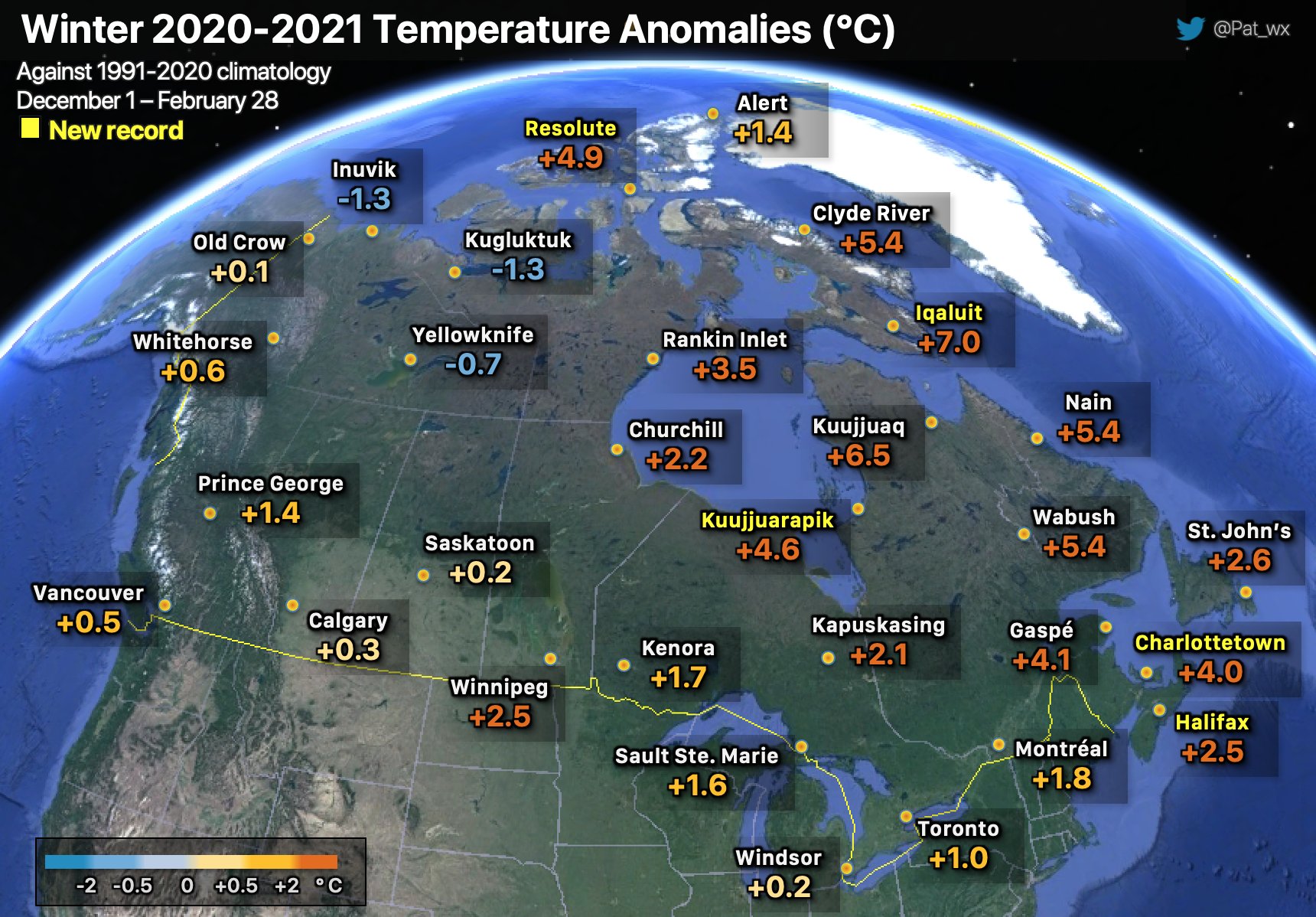
You could call it Arctic warming: temperatures in Iqaluit, Nunavut were overall  +7 C higher during December, January and February than they were during these same three months between 1991 and 2020, as this map by Patrick Duplessis of Dalhousie University shows.

Duplessis found weather records show that average temperatures over this past winter were up to seven degrees Celsius higher than the average temperature over those same months between 1991 and 2020.

The significant positive anomalies during the winter of 2020-21:

+7 C for Iqaluit

+6.5 C for Kuujjuaq

+5.4 C for Clyde River

+3.5 C for Rankin Inlet

+4.9 C for Resolute Bay

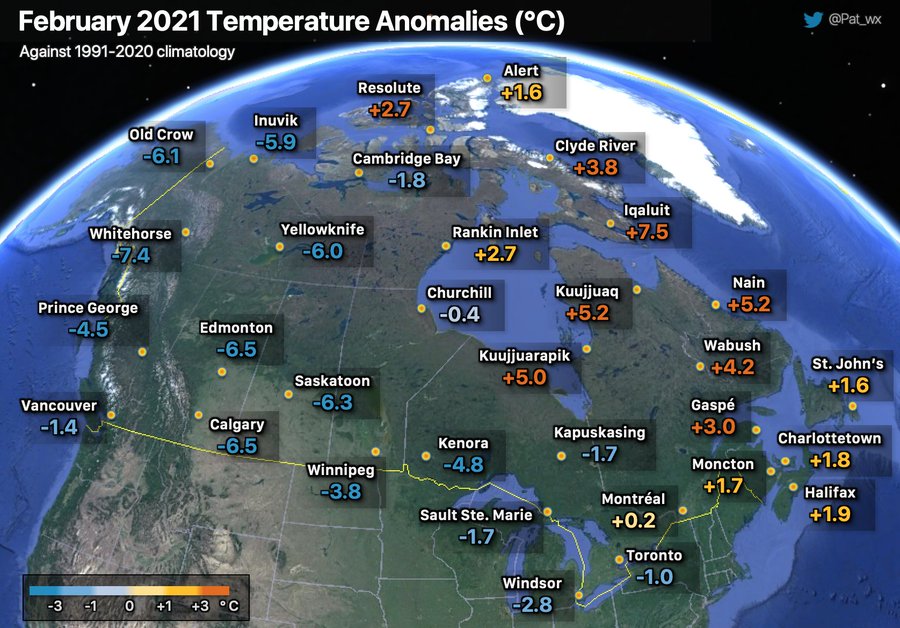
Here you can see the anomalies or temperature variations from the average during the month of February. (Image courtesy of Patrick Duplessis)

February weather helped feed the three-month anomalies in Canada’s Arctic.

In February alone, Kuujjuaraapik and Kuujjuaq showed an increase of more than five degrees C over the normal average temperatures for the month. Iqaluit had a 7.5 C degree increase and Resolute Bay was 2.7 C warmer.

Also during that month, new records for daily high temperatures were set in Baker Lake, Gjoa Haven, Resolute Bay, Grise Fiord, Pond inlet Rankin Inlet and Arviat.

Three-month anomalies fed by record-breaking daily Arctic weather in February

In Naujaat, the temperature topped off at -5 C on Feb. 8 beating the previous old record from 2010 was -14.5 C.

And on Feb. 9 a high of -11.7 C in Resolute Bay set a new record high that date, The previous record was -13.9 C in 1960.

Feb. 11 also saw records tumble in Nunavut’s most northerly community of Grise Fiord where the high temperature of -6 C beat the old record of -10 C set 35 years in 1986. And in Grise Fiord it grew even warmer on Feb. 12, with the high of 2.5 C beating the old record of -9.6 C from 2011.

As well, in Kuujjuaq, record highs and lows were dropped on Feb. 6: the maximum temperature reached -0.2 C (old record  -0.6 C set in 1958) and the minimum temperature was only  -3.7 C (old record of  -11.1 C set in 1958.)

Heat in the Arctic, cold to the south

Meanwhile, amidst these warmer than usual Arctic temperatures in mid-February, the southern continental United States saw frigid weather that produced big snowfalls over Texas, paralyzed much of the southern states and led to the death of nearly 80 people.

The cause: a meteorological event which meteorologists call a Sudden Stratospheric Warming Event. This one was located about 30 kilometres over the North Pole, said the World Meteorological Organization.

The warming event led to a weakening of the polar vortex, an area of low pressure and cold air surrounding the North, the WMO said.

And this weakness allowed the cold air to slip down into the mid-latitudes and warmer air to enter the Arctic…