Saami, Finnish, Inuktitut: ancient cousins, once removed

Wouldn’t it be great if everyone in the circumpolar region could understand each other without translators or interpreters? At least one linguist thinks that may have been the case about 20,000 years ago.

Michael Fortescue, a linguist and expert in Eskimo–Aleut and Chukotko-Kamchatkan, believes that a group of people, all speaking a common language that he’s dubbed “Uralo-Siberian,” then lived by hunting, fishing and gathering in south-central Siberia (an area located roughly between the upper Yenisei river and Lake Baikal in today’s Russia, as shown in the map).
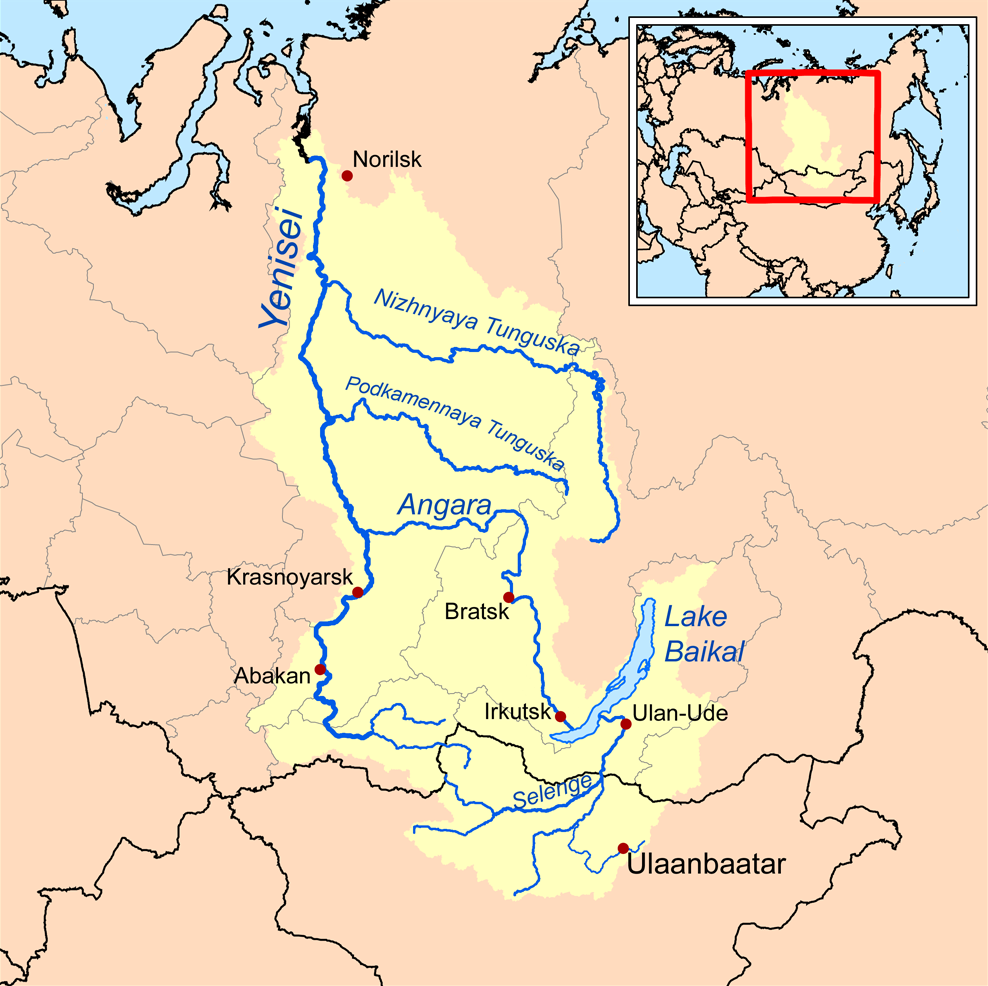
The area between the Yenisei River and Lake Baikal in central Siberia where early residents are thought to have spoken a common language that gave rise to Saami, Finnish and Inuit languages.

The area between the Yenisei River and Lake Baikal in central Siberia where early residents are thought to have spoken a common language called Uralo-Siberian that gave rise to Saami, Finnish and Inuit languages.

There, families whose migrations were ruled by the coming and going of glaciers during the Ice Age moved northward out of this area in successive waves until about 4,000 BC.

Some headed west along the northern coasts and others went east, eventually crossing the Bering Strait to North America.

They would end up living across the circumpolar region, with Inuit living from Alaska through to Canada and Greenland, Saami in Sápmi (northern Norway, Sweden, Finland and northern Russia) and Finns in Finland (or Suomi in Finnish.)

During those long-ago migrations, travelers took their common language, Uralo-Siberian, Fortescue suggests.

You can still hear today’s version of that language in Nunavut — where Uralo-Siberian developed into Inuktitut — and in Finland — where that language survived as Saami and as Finnish.

To me, someone who has lived in both regions and speaks Finnish (fairly fluently) and Inuktitut (not nearly as well) and can understand when people speak Saami (usually), the idea that there was once a united Uralo-Siberian family of languages makes sense.

That’s because the grammars of the three languages feel so similar (not to mention many shared cultural elements).

Map of the Uralo-Siberian languages.

A family tree of the Uralo-Siberian and related languages which shows the various Inuit languages as well as Saami and Finnish and how they are related.

Indeed, on this family tree of Uralo-Siberian languages, Inuktitut and Finnish look like fairly close cousins.
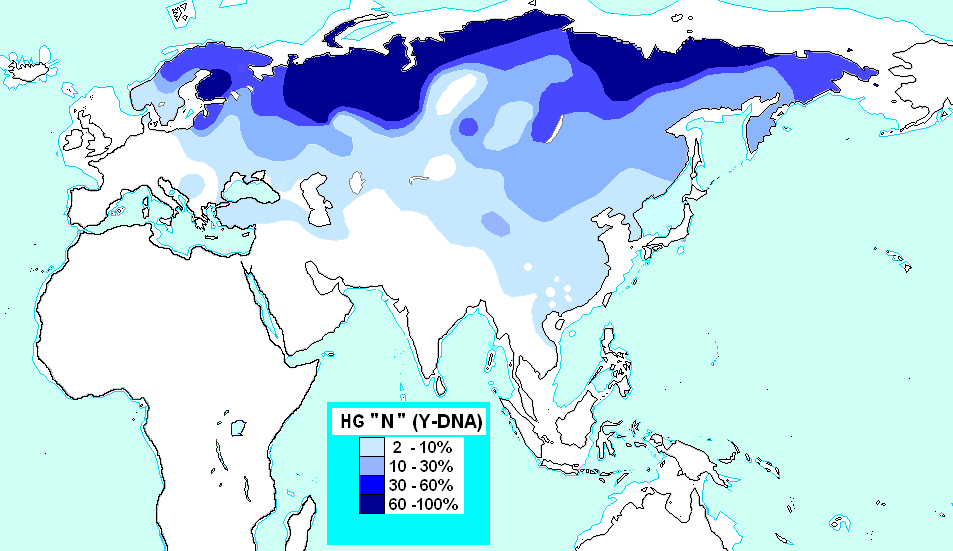
This map shows the spread of the genetic marker Haplo group N "Y", which goes from the northern coast of Scandinavia through Siberia towards North America.

This map shows the spread of the genetic marker Haplogroup N “Y”, which goes from the northern coast of Scandinavia through Siberia towards North America.

This language family was first proposed in 1998 by Fortescue in his book Language Relations across Bering Strait . But some linguists still don’t embrace his proposal, because it looks at the spread of languages and people in a new way.

More recent genetic tests do show Saami and Finns share more genetic markers linked with Asian populations in the Bering Strait and beyond than do any other European populations.

As for this early language, Uralo-Siberian, Fortescue argues that some common grammatical marker features are recognizable in the Inuit languages, Saami and Finnish, namely:

*-t   — plural

*-k  — dual

*m — 1st person

*t  —  2nd person

*ka  —interrogative pronoun

*-n —  genitive case

And you can still find verb roots in the Inuit languages of Canada and in Saami or Finnish as well as words in all three that appear to stem from that ancient common language:

Proto-Uralo-Siberianaj (aɣ) — ‘push forward’

Proto-Eskimo–Aleut ajaɣ —‘push, thrust at with pole’

In today’s Finnish —  ajaa, ‘drive’

Or you can hear similarities in other words used today, such as:

• kina (who) in Inuktitut, ken in Finnish;

• mannik (egg) in Inukitut, monne in Saami, muna in Finnish; and,

• kamek (boot) in Inuktitut, gama in Saami, kenka in Finnish.

The spoken languages also sound similar because they’re spoken with a word-initial stress (that is with the first syllable being emphasized — i.e. Nu-navut, Su-omi.)

As well, words (both nouns and verbs) get their meaning from many added-on chunks that tell you, among other things, who did what and when and to whom. This allows for a precision that  you don’t find in English.

For example, in Inuktitut and Finnish, even the notion of saying “there” must be precise — you need to say exactly where something is, whether it’s at a certain point nearby, here or there or further away.

For some experts, the enduring similarities in these languages, spoken by a majority of people who live within the jurisdictions of Nunavut, Greenland and Finland, reflect the amazing survival of that early  Uralo-Siberian grammar and lexicon of words.

But its isolation in the North in may also have had something to do with the Uralo-Siberian language’s endurance.

The Origin and Genetic Background of the Sámi suggests that Saami and, to a lesser extent, Finns were able to maintain their separate language identities over the centuries due to their geographic isolation in the Arctic while other peoples were losing their languages to Indo-European speakers from the South.

We now see different situations between the Inuit languages, Saami and Finnish — the largest of the three languages, which is spoken by more than five million people in Finland.

In Like an iceberg. I talk about learning Inuktitut.

In a future post in A Date with Siku girl, I will talk about what it was like for me to learn Finnish as a young girl and what this experience reveals — at least to me — about language learning and preservation.
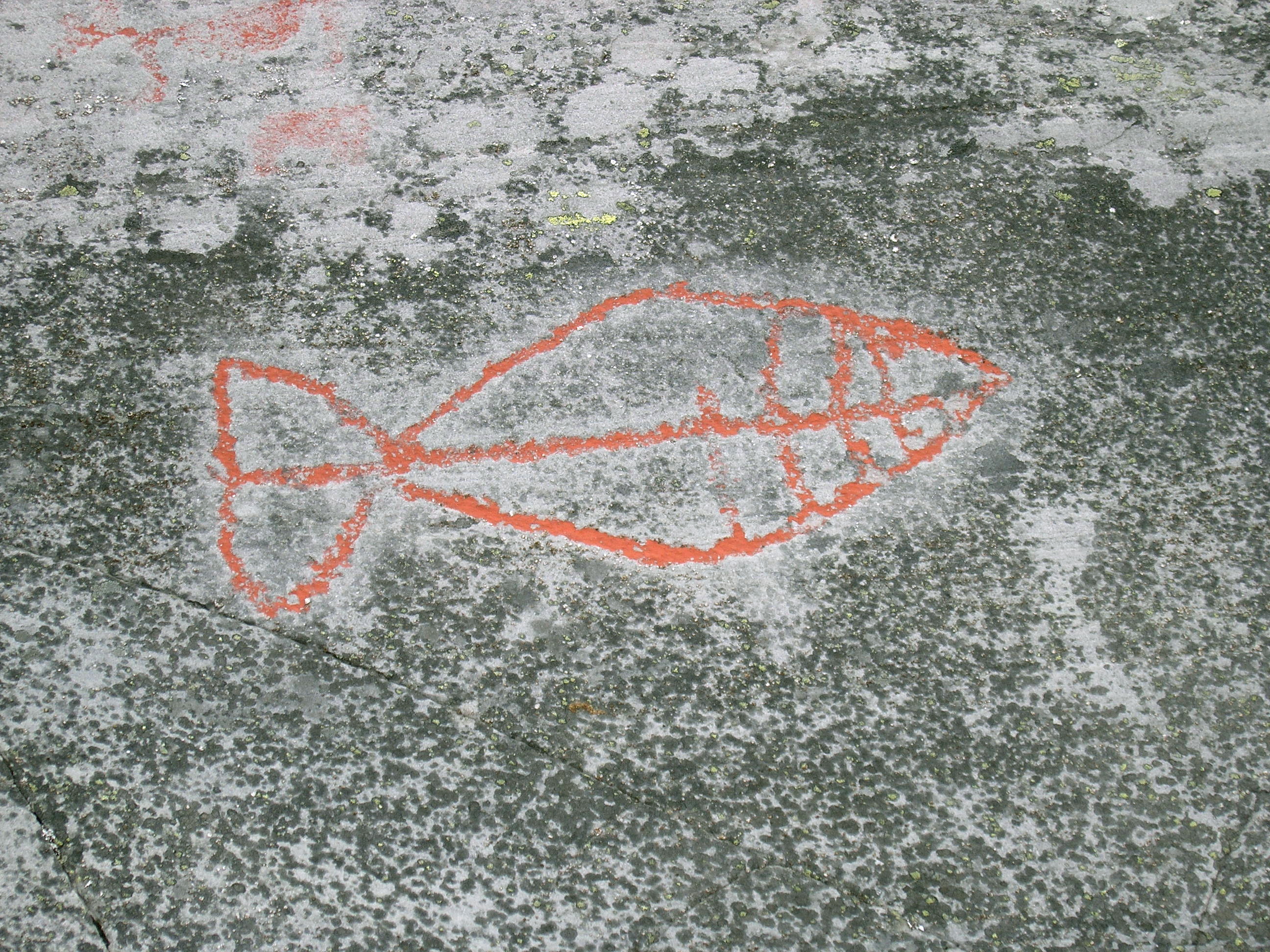
Rock art in northern Norway from the earliest inhabitants of the region. (PHOTO BY JANE GEORGE)

Rock art in northern Norway from the earliest inhabitants of the region. (PHOTO BY JANE GEORGE)

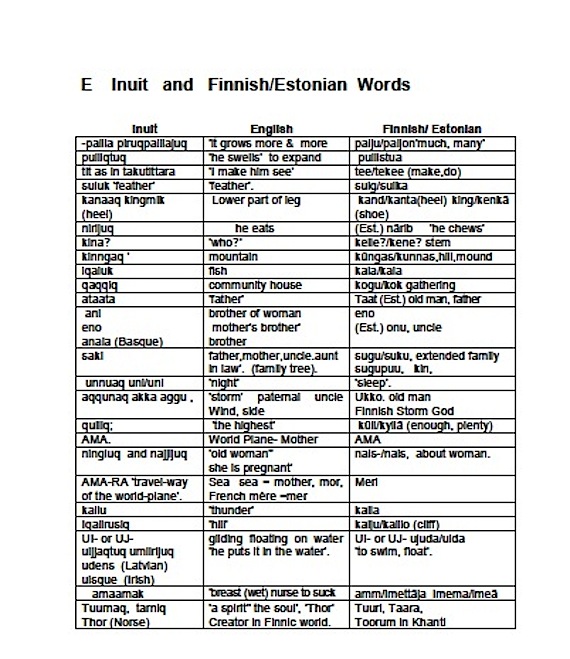
(For this post, I consulted so many sources online that I have not provided links to them all, but if you’re curious about the relationships between the ancient Uralo-Siberian languages, I urge you to do your own online searches and see what turns up. There appears to be many disputes over all the genetics and linguistics about which I could write a book, not simply a blog post. As for me, I’d be interested in receiving feedback from those more knowledgeable than I am in this area. Since publishing this blog in 2014, I received this very interesting list of words in Inuktitut, Finnish and Estonian:
 

Like an iceberg, 1999 cont., “Fossil hunting”

Like an iceberg, 1999 cont.: “Fossil hunting”

My destination in July, 1999: a huge windswept island, Axel Heiberg, located 700 kilometres south of the North Pole, just off Ellesmere Island.

You can see fossil litter on the top of a hill overlooking the valley on Axel Heiberg where we camp in July, 1999. (PHOTO BY JANE GEORGE)

You can see fossil litter on the top of a hill overlooking the valley on Axel Heiberg where we camp in July, 1999. (PHOTO BY JANE GEORGE)

On this remote High Arctic island, fossils were everywhere, and, by the edge of a fast-running river in July, 1999, I saw millions of years of nature tumbling down into the water. With little vegetation to hold the soil together, earth and rocks constantly broke off along the river’s edge, creating clouds of dust as they fall.

Each time this happened, the fossils of trees and plants that grew here more than 40 million years ago were lost, carried away to the ocean or slowly dissolved in the swift current. The fragments of fossil wood were batted around in the water or cast up on the shore. Boulders embossed with the imprints of leaves were piled along the bank.

The fossil material is grey and dry after millions of years in the cold storage of Axel Heiberg. (PHOTO BY JANE GEORGE)

The fossil material is grey and dry after millions of years in the cold storage of Axel Heiberg. (PHOTO BY JANE GEORGE)

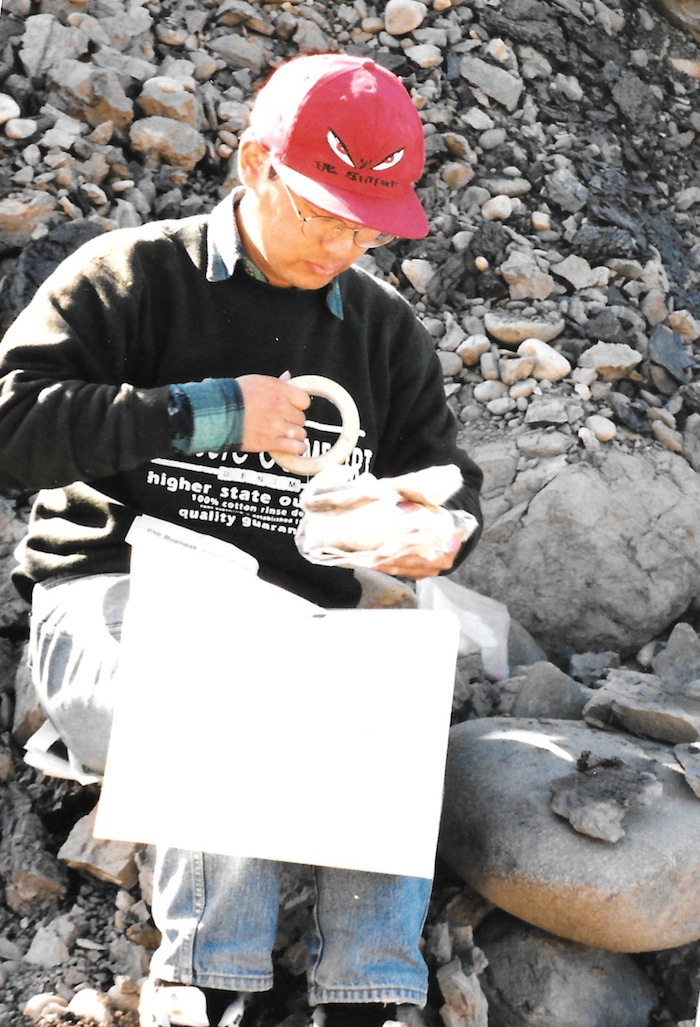
“It’s like a fossil superstore,” said Yusheng Liu, a fossil plant biologist, originally from China, who was then studying on a fellowship with paleo-botanist Jim Basinger in Saskatoon, who had invited me to see his High Arctic research team at work in 1998.

Liu expertly hammered a thick gray rock into sheets and quickly uncovered several remnants of leaves, some in almost mint condition, that were hidden in the clay.

“Canada has so many fossils, but so few paleontologists,” said Liu. “We have so much to learn.”

While the quantity of fossils on Axel Heiberg was unusual, so was their quality because they weren’t petrified, or turned to stone, but rather mummified or simply pressed into clay.

While fossil gathering, we mainly concentrated on the rocks by the water and on exposed leaf litter that sticks out of the eroding outcrop above. We tried not to disturb any materials that aren’t already at risk from erosion. The only tools used were a small pickaxe, a knife and a magnifying glass. Some clay boulders contained a treasure trove of fossils. We examined each chunk for fossils, and foundseveral intact leaves.

 Yusheng Liu carefully wraps up every interesting fossil when we are on Axel Heiberg in July, 1999. (PHOTO BY JANE GEORGE)

Yusheng Liu carefully wraps up every interesting fossil when we are on Axel Heiberg in July, 1999. (PHOTO BY JANE GEORGE)

Liu was especially pleased when he finds a well-preserved seed, cone or leaf. Most of the fossil leaves came from the huge Dawn Redwood, which flourished here during the warmer Eocene Era, some 45 million years ago.

This tall tree shed its leaves every year, casting thousands of its distinctive fronds on the ground, many of which survived the passage of time. Liu also found leaves from beech trees, kiwi-like seeds and cones from evergreens.

He said studying such fossils under an electron microscope could reveal what levels of oxygen and carbon dioxide existed in the atmosphere of that much warmer period and show how these plants differed from their modern counterparts.

“If we study these fossils, we can get an image of the paleo-vegetation and we can use it to reconstruct the climate because it’s a good indicator of the climate,” he said.

Every fossil selected for further study was sprayed with latex to keep the plant tissues fresh. Then,  the fossils were wrapped up in newspaper and taped, so that they would travel without breaking. Months later, the scientists would carefully unwrap the fossils.

After an afternoon by the river, we headed back to camp, weighed down by our load of heavy, clay rocks. We held hands as we forded across the water, which in the heat of the day, had risen with melt water from the nearby glaciers.

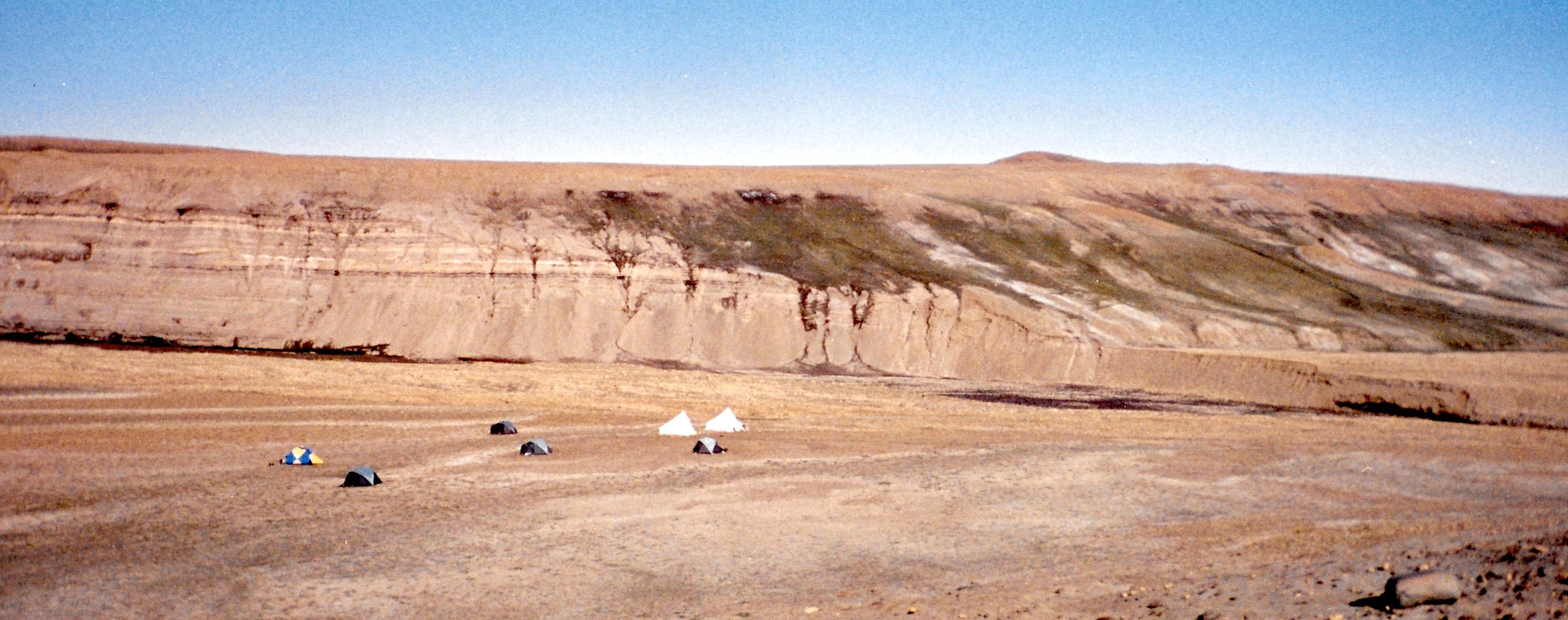
We camp out in a valley where the sun shines all day and night. (PHOTO BY JANE GEORGE)

We camp out in a valley where the sun shines all day and night. My tent is the blue and yellow one at the far left. (PHOTO BY JANE GEORGE)

Our field camp was a small group of tents pitched on a rocky slope. I had my own tent and — finally — I had invested in a warm sleeping bag. In the evening, along with the three other members of the team, we made a simple supper— Liu whipped up a Chinese-style soup based on the dry ingredients that could easily be stored in the camp refrigerator — a hole dug in the frozen ground — such as cabbage, carrots, onions and bacon.

After a couple of days by the river, we moved on to another site, by the Fossil Forest, where the stumps of 50-million-year-old trees were exposed.

That’s where the weather changed, from a 20 C to a windy, cold and snow-filled, and at the fossil forest, I also find a group of American scientists who were digging it up.

Like an iceberg continues May 30.

You can read earlier instalments here:

Like an iceberg: on being a journalist in the Arctic

Like an iceberg, 1991…cont.

Like an iceberg, 1991…more

Like an iceberg, 1992, “Shots in the dark” 

Like an iceberg, 1992, “Sad stories”

Like an iceberg, 1993, “Learning the language of the snows”

Like an iceberg, 1993 cont., “Spring”

Like an iceberg, 1993 cont., “Chesterfield Inlet”

Like an iceberg, 1993 cont., more “Chesterfield Inlet”

Like an iceberg, 1994: “Seals and more”

Like an iceberg, 1994, cont., “No news is good news”

Like an iceberg, 1994 cont., more “No news is good news”

Like an iceberg, 1994 cont., “A place with four names”

Like an iceberg, 1995, “More sad stories”

Like an iceberg, 1995 cont., “No place like Nome”

Like an iceberg, 1995 cont., “Greenland”

Like an iceberg, 1995, cont. “Secrets”

Like an iceberg, 1996, “Hard Lessons”

Like an iceberg, 1996 cont., “Working together”

Like an iceberg, 1996 cont., “At the edge of the world”

Like an iceberg, 1996, more “At the edge of the world”

Like an iceberg, 1996, cont. “Choices” 

Like an iceberg, 1997, “Qaggiq”

Like an iceberg, 1997, more “Qaggiq”

Like an iceberg, 1997, “Qaggiq” cont.

Like an iceberg, 1997 cont., “Qaggiq and hockey”

Like an iceberg, 1997 cont., “Brain surgery in POV”

Like an iceberg, 1997 cont.: “Masks on an island”

Like an iceberg, 1997 cont., “Abusers on the pulpit”

Like an iceberg, 1998, “Bearing gifts”

Like an iceberg, 1998 cont., “At the top of the world”

Like an iceberg, 1998 cont., “A bad week” 

Like an iceberg, 1998 cont.: more from “A bad week”

Like an iceberg, 1998 cont., “Memories”

Like an iceberg, 1999, “The avalanche”

Like an iceberg, 1999 cont., “An exorcism, followed by a penis cutting”

Like an iceberg, 1999 cont., more on “the Avalanche”

Like an iceberg, 1999 cont., “Robins in the Arctic”