Nunavut, still Canada’s youngest, fastest growing jurisdiction: StatsCan

Canada’s rate of population growth is expected to slow over the next 25 years.

But that won’t be the case in Nunavut, a Sept. 17 Statistics Canada report finds.

Nunavut in red (WIKIPEDIA COMMONS)

Nunavut in red (WIKIPEDIA COMMONS)

Over the next 25 years Nunavut will continue to be the youngest and most quickly growing jurisdiction in Canada, the report on population projections finds.

“Fertility is the key driver of population growth in Nunavut, as its population would continue to increase despite losses in migration exchanges with the rest of Canada and almost no gains from international migration,” the report says.

Due to much higher fertility — that is the average number of children born to each woman — than elsewhere in Canada, the population of Nunavut is projected to increase over the next 25 years to reach between 43,800 and 53,300 by 2038, depending on the scenario, Stats Can says.

“All scenarios indicate strongly positive natural increase for the territory, a result of the fact that Nunavut would continue to hold the highest fertility rates in the country while also having a young age structure,” the report says.

That’s unlike population growth in Yukon and in the Northwest Territories over the next 25 years, which would be largely influenced by interprovincial migration flows, the report says.

Nunavut’s population stood at 35,600 in 2013.

In 2038, the territory’s population is also projected to remain the youngest in Canada in all scenarios.

And, the population may even become younger than today.

“The median age of the population of Nunavut could in fact decrease over the next 25 years a phenomenon that would not be seen anywhere else in the country,” the report states.

However, the proportion of seniors aged 65 years and over will more than double, to as high as nine per cent, compared with only 3.5 per cent in 2013.

Nunavut would nevertheless remain the youngest population in the country, StatsCan says.

The population of Nunavut is projected to remain the youngest in Canada in all scenarios. The projected median age ranges between 24.6 years and 28.3 years in 2038, in comparison to 25.4 years in 2013.
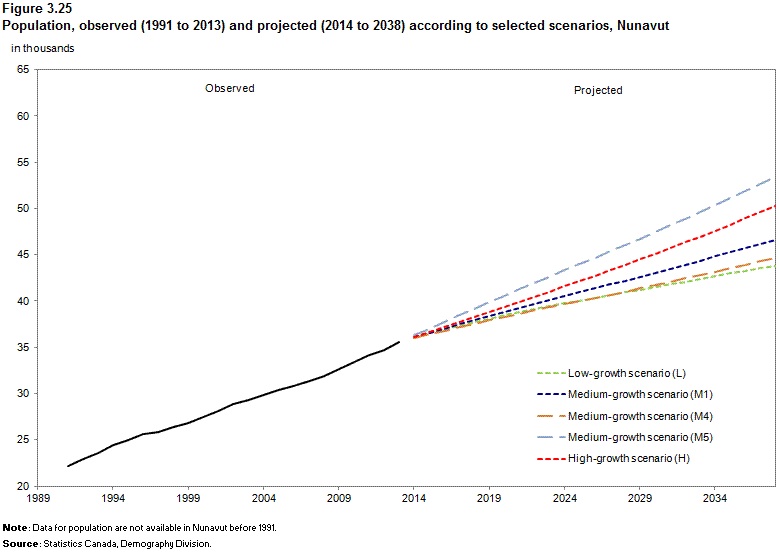
This figure from Statistics Canada shows Nunavut's observed and project population.

This figure from Statistics Canada shows Nunavut’s observed and project population.

Recent posts on A date with Siku girl include:

Canada ignores Arctic infrastructure: veteran ice pilot

New roof, new life for CamBay’s old stone church

Two Arctic ships, two explorers: Franklin and Amundsen

Today, Arctic explorers take cruise ships

A makeover for CamBay’s ocean observatory

Hauling a large, 250-pound device connecting hundreds of feet of fluorescent ethernet wire out of icy water is no simple task.

Two University of Victoria divers prepare to raise the ocean observatory. (PHOTO BY JANE GEORGE)

Two University of Victoria divers prepare to raise the ocean observatory. (PHOTO BY JANE GEORGE)

But that’s exactly what a team of divers and young researchers with the University of Victoria and the Ocean Networks Canada project did Sept. 16.

The waters near the Cambridge Bay dock stood at 1.9 C — and would, in fact, start freezing up the next day — but protected by drysuits, two divers managed to bring the marine observatory up to the surface and then hoist it on to the dock for its annual overhaul, a new platform and other new instruments.

By then, the sun was setting in over the Cam-Main North Warning System site to the west — and there would be no time for them to carry on with the plan to take apart the observatory for storage overnight.

Researchers and community volunteers help pull the ocean observatory out of the water. (PHOTO COURTESY OF OCEANS NETWORKS CANADA)

Researchers and community volunteers help pull the ocean observatory out of the water. (PHOTO COURTESY OF OCEANS NETWORKS CANADA)

But they didn’t have a place to store the four-foot-wide triangular device or even a way to move it.

The ocean observatory perches on top of an Adlair Aviation pick-up truck. (PHOTO BY JANE GEORGE)

The ocean observatory perches on top of an Adlair Aviation pick-up truck. (PHOTO BY JANE GEORGE)

Thanks to help from an Adlair Aviation pilot, they managed to lift the platform into the air charter’s pickup truck and bring it up to the airport hangar for safe storage.

When underwater, the device measures such things such as underwater temperature, sounds, salinity and ice thickness. It’s also equipped with a camera — which needs replacement — to keep an eye on the seabed.

Similar observatories have been installed off the coasts of British Columbia, part of Ocean Networks Canada, a University of Victoria project, which “operates world-leading cabled ocean observatories for the advancement of science and the benefit of Canada,” according to its website.

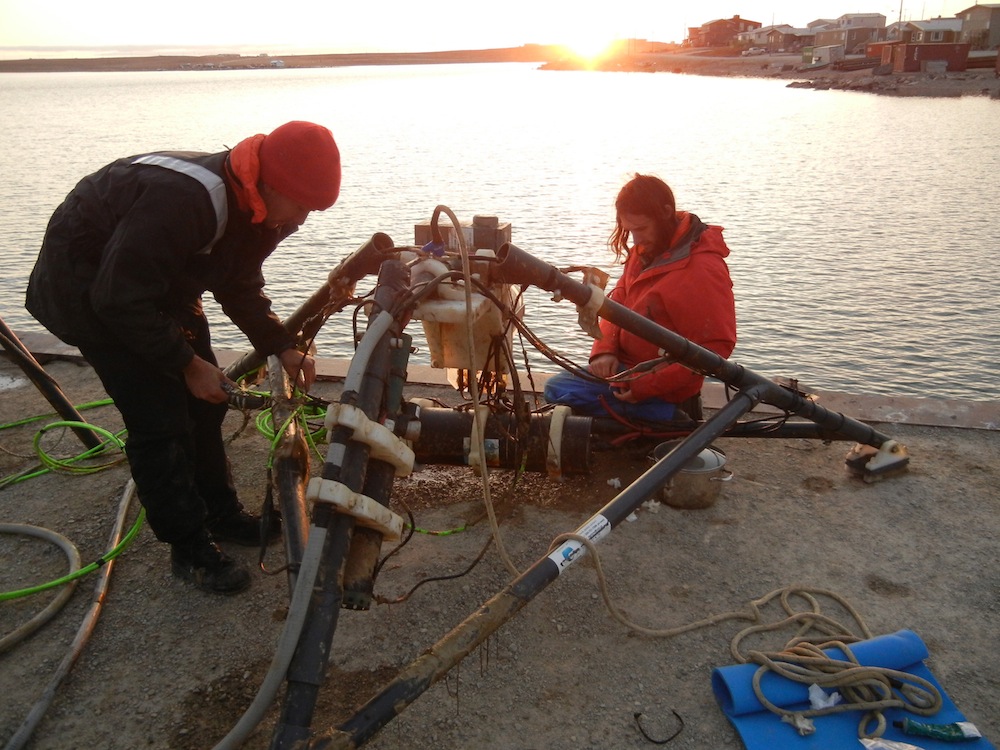
Researchers from the University of Victoria dismantle the ocean observatory for transport Sept. 16. (PHOTO BY JANE GEORGE)

Researchers from the University of Victoria dismantle the ocean observatory for transport Sept. 16. (PHOTO BY JANE GEORGE)

Cambridge Bay’s observatory could be the first in a series to monitor changes in the Arctic.

Launched in September 2012 — and observed by Premier Stephen Harper last month when he visited Cambridge Bay, the observatory will help establish a baseline of environmental conditions, such as rates of ice growth and the timing of algae blooms.

This year, the team plans to service and reinstall:

  • an underwater high definition video camera;
  • an acoustic ice profiler; and,
  • a fish tag receiver from the Ocean Tracking Network.

They also plan to install new instrumentation, including a photosynthetically active radiation sensor that will measure underwater light levels and help scientists study changes during key periods, such as spring, when the polar sunrise triggers algae blooms under the ice.

A sea snail retrieved from  the seabed near the ocean observatory. (PHOTO BU JANE GEORGE)

A sea snail retrieved from the seabed near the ocean observatory. (PHOTO BY JANE GEORGE)

Above water, a video camera will continue to monitor surface ice formation and the weather station will provide real-time atmospheric conditions.

An antenna positioned on top of a nearby building will continue capturing signals from nearby ships, a project website says.

Divers plan to sample fauna on the sea floor, and look for a new observatory location in 2015.

This will position the underwater sensors at a greater distance from vessels and winter road traffic near the busy Cambridge Bay dock.

Among the interesting tidbits learned to date by the observatory about air and sea water temperatures during the winter in Cambridge Bay:  while winter air temperatures frequently dip below -30 C, water beneath the ice remains near 0 C.

Then, during the summer, prolonged sunshine raises air temperatures and melts the ice, raising seawater temperatures to about 10 C.

And, in November 2013, the observatory caught the sound of ice cracking as a snowmobile travelled over the ice near the Cambridge Bay hydrophone. The snowmobile broke through the ice a short time later.

The University of Victoria team plan to wrap up their work some time next week after they meet with local students and people in the community to talk about their project.

Look for more posts from Cambridge Bay, Nunavut.

Recent posts on A date with Siku girl include:

Canada ignores Arctic infrastructure: veteran ice pilot

New roof, new life for CamBay’s old stone church

Two Arctic ships, two explorers: Franklin and Amundsen

Today, Arctic explorers take cruise ships