Here’s something that bugs me. People in southern Canada often ask me, “isn’t it boring in the North?” They have no idea how interesting a weekend in Cambridge Bay, Nunavut can be.
My weekend starts on Friday, Sept. 19, at 5 p.m.
That’s when I head off to where you go in this western Nunavut community for some good conversation and maybe a drink or two — the Elks’ social club.

You use a token like this one at the Elks’ bar in exchange for a drink. (PHOTO BY JANE GEORGE)
There, around a dozen round tables, I meet people of all ages, from youth to elders, Inuit and non-Inuit, who talk, drink, watch television or play darts.
At 5:30 p.m., the room is nearly empty, but, by 8 p.m. it’s full and noisy, so I leave.
But I stop off on the way home to make a date to speak with the crew of the Martin Bergmann research vessel — named after the director of the Polar Continental Shelf Program who died in the Aug. 20, 2010 crash of First Air flight 6560 in Resolute Bay, which I covered.
The Bergmann crew members, I learned at the Elks, had just disembarked from their boat after helping to locate one of Sir John Franklin’s wrecked ships, an event announced earlier this month by Prime Minister Stephen Harper.
I knock on the crew’s door. After I introduce myself, we agree to speak the next morning. But one of them tells to me not to expect much information: “it’s secret, secret. It’s all secret. There are things only the PM can reveal.”
So I wonder what will come of our arrangement to speak. We agree to meet at 10 a.m. the next day.

After sunrise, with Mt. Pelly in the distance. (PHOTO BY JANE GEORGE)
On the morning of Saturday, Sept. 20, the sunrise is enveloped in sherbet — or that’s what it looks like to me. Shades of orange, yellow and green cloak Mt. Pelly in the distance. The view from where I am staying is diffused by fog for a while.
At 10 a.m., when I venture out for my interview, I am not surprised to learn that the Bergmann folks have got cold feet: they say need to speak to their “comms” person before they can speak to me. I’m polite, but I know they have no intention of getting back to me, and they don’t (I read later in the Toronto Star, a southern news outlet which no one here besides me probably reads, that the plan is “to reveal some details soon.”)
I walk down to the shore and the dock where their boat and a tug, the Tandberg Polar, here to fetch Roald Amundsen’s Maud, are floating back to back, vying for space: each vessel needs secure moorings before the ice, which first showed itself on the bay a few days ago, moves in for good.
I watch a lone kayaker paddling across the still waters while I continue to walk to towards the airport, about 3.5 km out of town. There, I think, I’ll have a latte at the the Arctic Closet airport concession, which my friend, Vicki Aitaok, operates there.

I work the cash while Vicki makes hot dogs at her Arctic Closet Airport concession. (PHOTO BY JANE GEORGE)
I do have a latte — but I also end up spending the next four hours helping Vicki make coffees from a huge expresso machine and selling snacks. Polar-bear shaped fridge magnets in the shape of the former Nunavut license plate, saying “Cambridge Bay,” are big sellers.
The small airport terminal is packed because of crew changes on two Coast Guard icebreakers, the Louis St. Laurent and the Terry Fox. They’ve just returned from the North Pole on the 20th anniversary of the first icebreaker visit to the Pole.
“We had a day off [at the North Pole]. We went out on the ice,” said a man, dressed in a hoodie with a giant logo showing the Louis St. Laurent surrounded by the ice.
At the North Pole, he said they played games and took photos. It was so warm on the ice that they needed only hoodies and light jackets. “One guy was wearing a Hawaiian shirt,” he said.
They took a day off from their seismic seabed scanning to collect information needed for Canada’s submission to the United Nations Convention on the Law of the Sea on seabed rights to its continental shelf extension.
But that would have been an expensive day of fun at the pole, I think. That’s because it costs up to $80,000 a day just to operate an icebreaker, I learned while travelling through the Northwest Passage on the CCGS Amundsen in 2010.
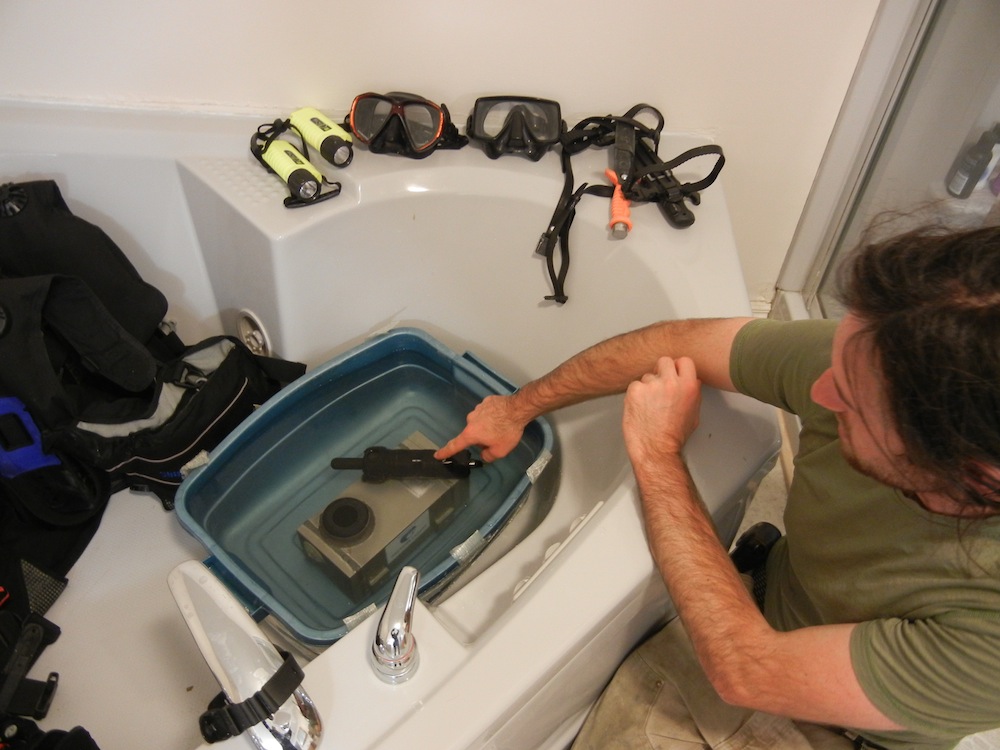
I walk back from the airport and see the Polar Tandberg and Bergmann still jostling for space at the dock as a team from Ocean Networks Canada prepares for another dive.

Cambridge Bay’s sunset on Sept. 21. (PHOTO BY JANE GEORGE)
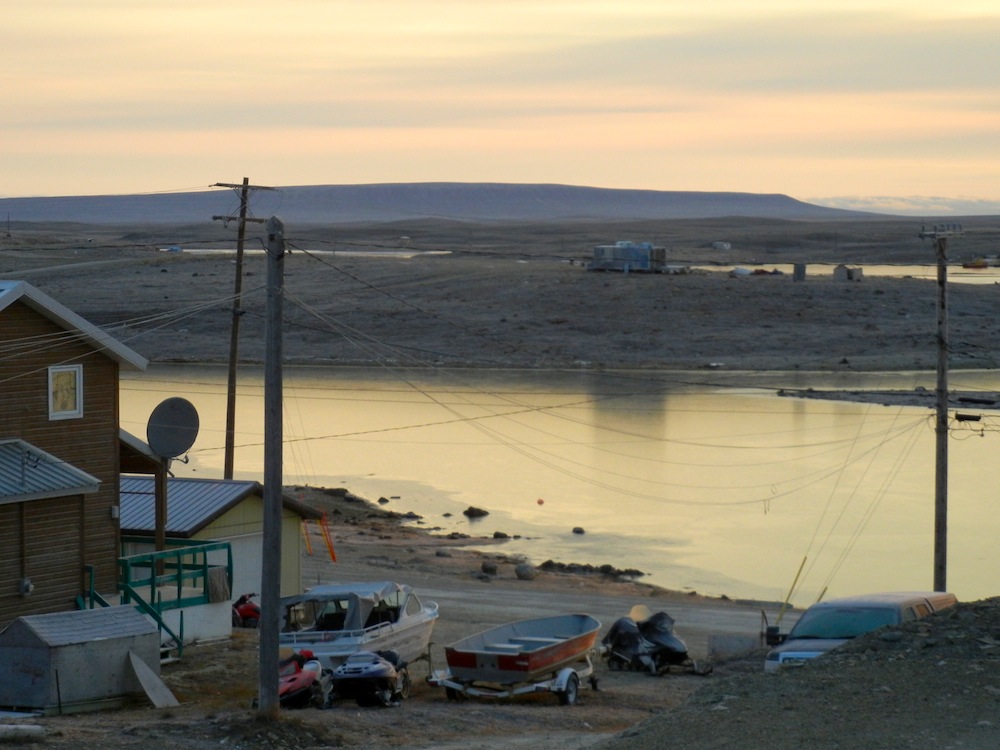
Later, I head out past Cam-Main, a North Warning System site, to see the sunset. The clouds explode again in ice-cream colours and then move into cherry-red.
The next day, Sunday, Sept. 21, includes a bilingual church service, at the tiny, white St. George’s Anglican Church.
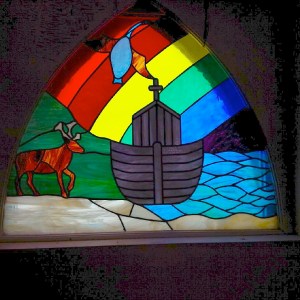
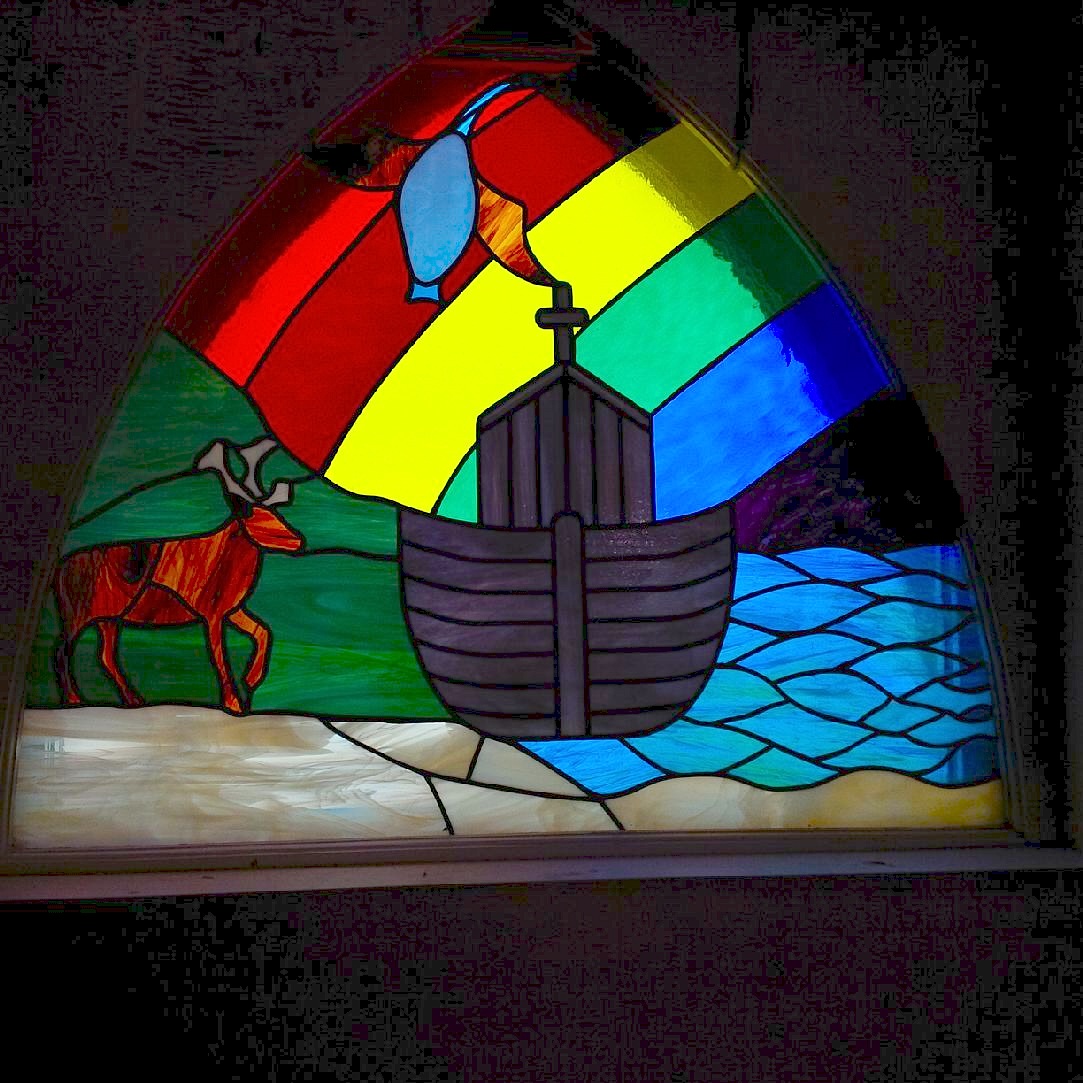
A stained glass window at St. George’s Anglican Church. (PHOTO BY JANE GEORGE)
A respected elder, Paul Omilgoituk, died Sept. 20. During the service, he’s remembered as a leader in the church who became a community leader because of his position in the church.
As I listen to prayers in Inuinnaqtun, I remember the late Bishop of the Arctic, John Sperry, who translated all the hymns and prayers into Inuinnaqtun.

A stained glass window at St. George’s Anglican Church. (PHOTO BY JANE GEORGE)
The “Bish,” as we called him, 84 and with poor eyesight when I met him in 2008 at the Bathurst Lodge, never stopped enjoying life. He would hike around with his cane, and once, when we visited an island, he pointed out a complex of huge rocks once used for early Inuit dwellings.
After church, light snow starts to fall.
And so Sunday continues.
Just another weekend in the Bay.
Recent “A date with Siku girl” posts from Cambridge Bay include:
Nunavut, still Canada’s youngest, fastest growing jurisdiction: StatsCan
A makeover for CamBay’s ocean observatory
Canada ignores Arctic infrastructure: veteran ice pilot
New roof, new life for CamBay’s old stone church
Two Arctic ships, two explorers: Franklin and Amundsen
Today, Arctic explorers take cruise ships

Bright light from the setting sun illuminates part of the town Sept. 21. (PHOTO BY JANE GEORGE)







 A date with Siku girl