New roof, new life for CamBay’s old stone church

An old stone church, a landmark in the western Nunavut community of Cambridge Bay, celebrated its 60th anniversary — and new roof — with a barbecue Sept. 12, just two days shy of the anniversary date of its first mass: Sept. 14, 1954.

Here you can see the new roof of the old stone church and the plywood now covering the windows. (PHOTO BY JANE GEORGE)

Here you can see the new roof of the old stone church and the plywood now covering its windows. (PHOTO BY JANE GEORGE)

Father André Pierre Marie Steinmann, an Oblate missionary much better known for his years in northern Quebec, built the church, which had fallen into disrepair.

But this past summer Cambridge Bay Coast Guard auxiliary was able to carry out $100,000-worth of renovation work, which is still not complete.

And they undertook the project with no government assistance — raising the needed money only through fundraising.

“Rocks and mortar — we knew we could do it on our own,” said Wilf Wilcox, a local businessman and member of the local Roman Catholic congregation. “We had the blessing of the community and the church.

And we didn’t want any red-tape.”

Wilcox’s mother, Bella, who attended the Sept. 12 BBQ, is among those who still remember when the church was used.

Nine parishioners attended its first mass on Sept. 14, 1954.
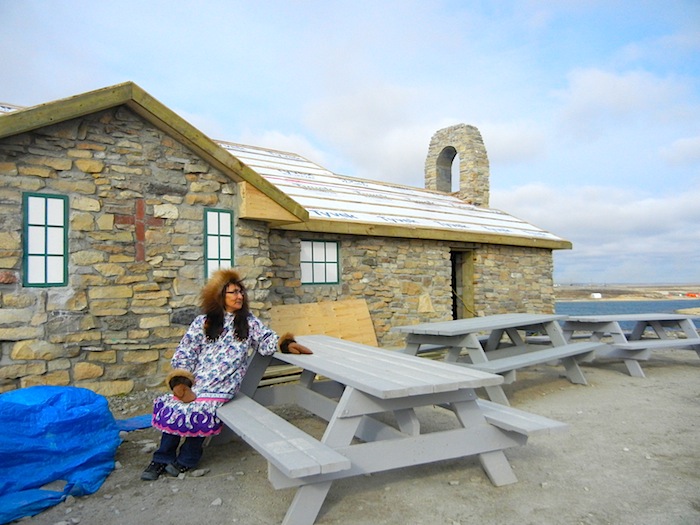
Ida Neglak sits in front of the newly-renovated old stone church.  (PHOTO BY JANE GEORGE)

Ida Neglak sits in front of the newly-renovated old stone church. (PHOTO BY JANE GEORGE)

After Father Steinmann’s arrival in Cambridge Bay from northern Quebec in 1953, he worked with local parishioners and two fellow missionaries, Fathers Lemer and Menez, to build the church.

Their materials: seal oil and clay as mortar and broken rocks for the walls — plentiful around Cambridge Bay.

Built for warmth, the church retained heat with an insulating layer of caribou fur between two layers of stone walls.

But soon after its completion, Father Steinmann left the western Arctic.

After several attempts to reconstruct the crumbling structure — not easy because of the original mortar used, vandals set fire to the church in 2006.
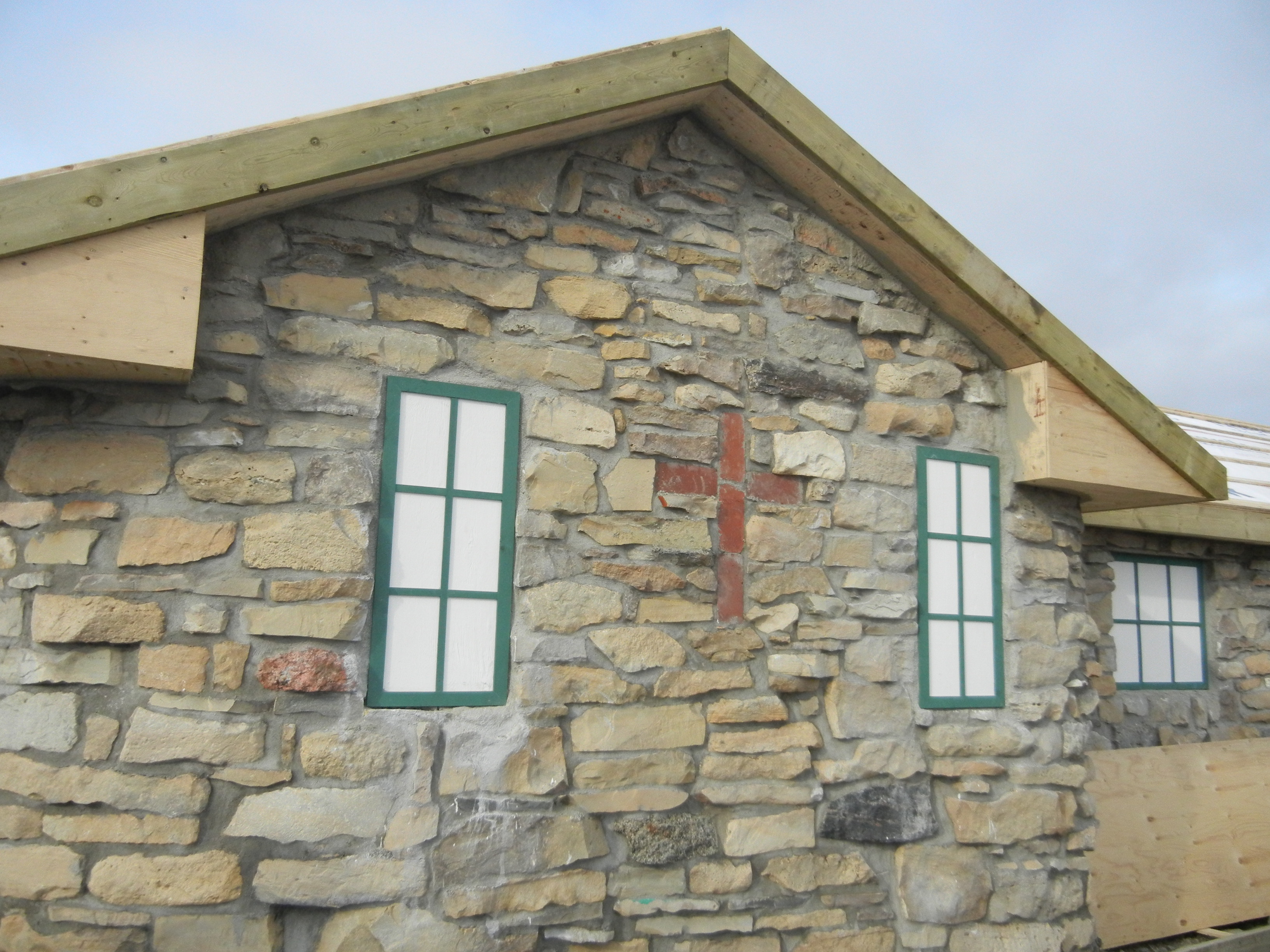
A cross on a wall in front of the old stone church. (PHOTO BY JANE GEORGE)

A cross on a wall in front of the old stone church. (PHOTO BY JANE GEORGE)

While the roof and interior burned completely that day, snow still clung to the outside as the fire blazed and didn’t melt, due to the insulation from the double walls and fur lining.

The stone church isn’t the only legacy of Father Steinmann to be found today in Cambridge Bay.

In 1954, Father Steinmann purchased the Eagle, a small longline fishing boat, said to have been towed from Tuktoyaktok to Cambridge Bay, leaking all the way.

Father Steinmann's boat, the Eagle, as it sits today in Cambridge Bay. (PHOTO BY JANE GEORGE)

Father Steinmann’s boat, the Eagle, as it sits today in Cambridge Bay. (PHOTO BY JANE GEORGE)

When the Eagle arrived, Steinmann had left for northern Quebec, where he had already spent the years between 1938 and the early 1950s, in Wakeham Bay (now Kangiqsujuaq), Sugluk (now Salluit) and Koartak (now Quaqtaq).

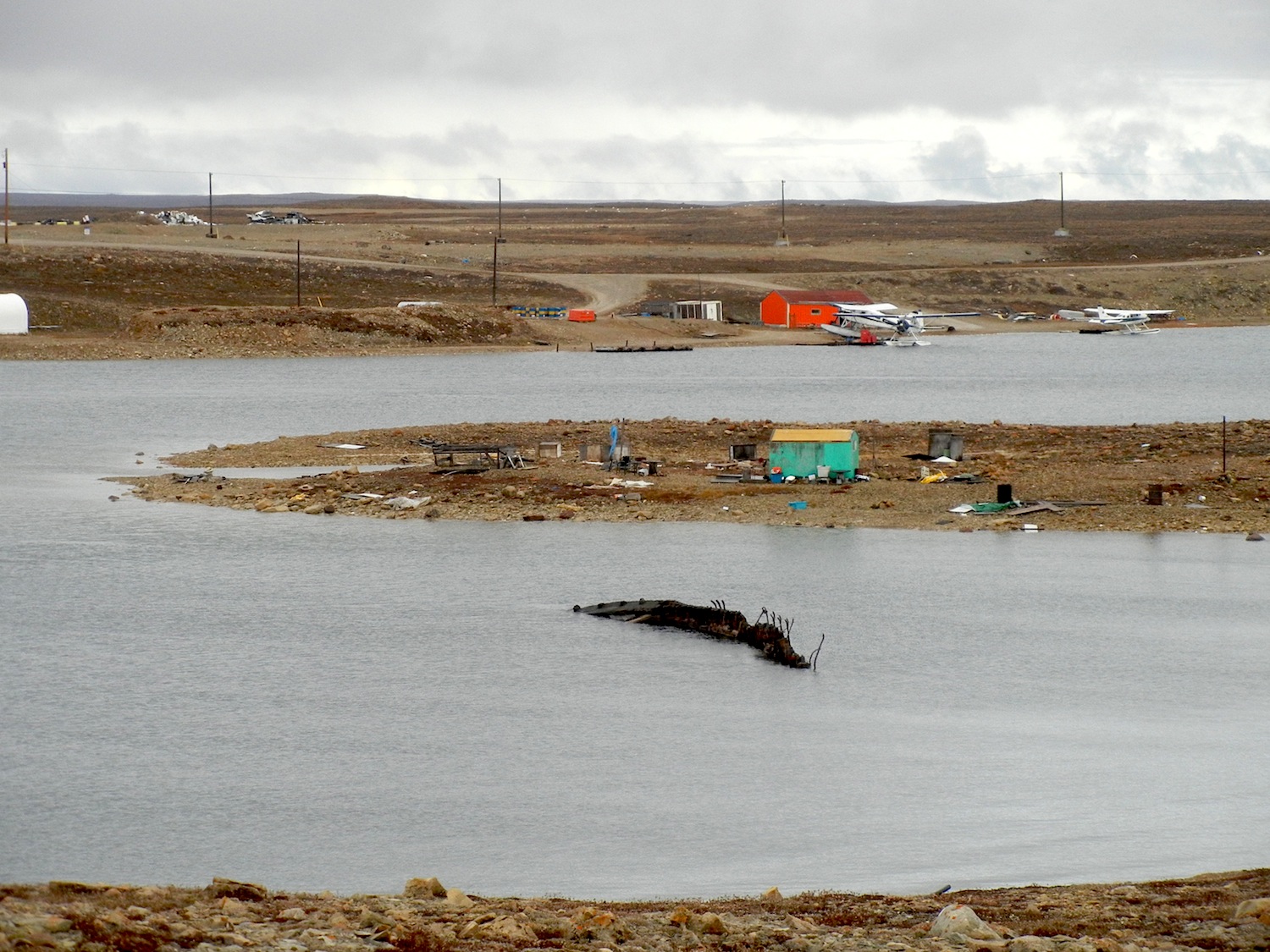
There’s no record of what he intended to use the Eagle for, so the boat stayed on the beach, not far from the semi-submerged hulk of the Maud, once sailed by Norwegian Roald Amundsen, the first European adventurer to successfully voyage through the Northwest Passage.

In the Nunavik community of Puvirnituq, then called Povungnituk or POV, Father Steinmann and Pitaaluk, the tall, Inuktitut-speaking Hudson’s Bay Co. manager Peter Murdoch, worked with Inuit living in camps around today’s community to set up a new way of trading and buying goods — which would eventually grow into today’s co-operatives in Nunavik and serve as an inspiration to those in Nunavut.

During the 1950s and 1960s, Father Steinmann encouraged artists, such as the great artist Davidialuk Alasuak, to portray Inuit legends and humour in his carvings and prints.

Father Steinmann himself was said to have owned “the best examples of erotic Eskimo carvings to be found in the world,” according to an article on Inuit art and co-operatives by anthropologist Nelson Graburn, which was published in the journal Museum Anthropology in 2000.

Father Steinmann’s cramped quarters were said to be crammed with “mythological carvings and humorous nudes.”

Some say Father Steinmann’s earthiness was intended to draw Inuit away from the strait-laced Anglicans towards Roman Catholicism.

But others in Puvirnituq have told me that Steinmann, like some other Oblate missionaries and Roman Catholic priests, including Eric Dejaeger, sentenced this Sept. 12,  was banished from northern Quebec after he had abused youth there.

This practice he picked up again on his return to the region, according to many in that Hudson Bay community, and one which produced a legacy of child sex abuse.

Cambridge Bay Catholics now worship at our Lady of the Arctic, built in the 1970s.  They hope the old stone church will be used for special events, such weddings or baptisms.

Look for further posts from A date with Siku girl from Cambridge Bay.

Recent posts include:

Two Arctic ships, two explorers, Franklin and Amundsen

Today, Arctic explorers take cruise ships

Parts of this post were previously published in a Nunatsiaq News feature from 2011.

A view of the church with its new roof on. (PHOTO BY JANE GEORGE)

A view of the church with its new roof. (PHOTO BY JANE GEORGE)

Two Arctic ships, two explorers: Franklin and Amundsen

As Prime Minister Stephen Harper touted the Sept. 9 discovery of  one of Sir John Franklin’s ships, located after more than 160 years, Jan Wanggaard of the Maud Returns Home project couldn’t help thinking about the parallels between Franklin’s newly-relocated ship and the vessel that he and a group of Norwegian investors plan to bring back to Norway.

That’s the Maud, sailed by Norway’s polar exploration hero, Roald Amundsen, who in 1906 was the first European explorer to sail through the Northwest Passage.

Amundsen left Norway in 1918 with the Maud, planning to drift westwards with the ice across the Northeast Passage, now called the Northern Sea Route, and over the North Pole — but never completed that journey and the Maud eventually ended up outside Cambridge Bay, Nunavut, where it sunk.

In the forefront, a cairn built by Jan Wanggaard, the half-submerged Maud and the town of Cambridge Bay. (PHOTO BY JANE GEORGE)

In the forefront, a cairn built by Jan Wanggaard, the half-submerged Maud and the town of Cambridge Bay. (PHOTO BY JANE GEORGE)

The Maud, at 36.5 metres, was about the same size as the Franklin ship.

But there the parallels end, Jan Wanggaard told me in Cambridge Bay where I’m visiting this month.

First of all, there’s been no mystery surrounding the Maud. That’s because everyone in Cambridge Bay knows where the ship is located because part of the hull is still visible above the water.

Part of the Maud, shown here in September, 2014. sticks up through the water. (PHOTO BY JANE GEORGE)

Part of the Maud, shown here in September, 2014. sticks up through the water. (PHOTO BY JANE GEORGE)

And unlike Sir John Franklin’s two ships, the history and location of Amundsen’s ship is well known.

And there’s another big difference: the Maud was designed to avoid the kinds of mistakes made during the disastrous voyage of the Terror and Erebus. The round hull of Amundsen’s vessel was designed to avoid being crushed by ice and he travelled with a small crew, well versed in Arctic survival skills, which Amundson learned from Inuit, Wanggaard said.

“Amundsen learned from other people’s mistakes,” he said.

And then there’s the way that Norwegians have gone about retrieving the Maud.

A private investment company, Tandberg Eindom, is underwriting a modest project to bring the Maud back to Norway — a low-key effort, now four years old, that employs a handful of people, unlike the huge multi-year Franklin ship search launched by the Canadian government.

“If we had to work with a government, it [the effort to bring the Maud to Norway] would not happen,” Wangaard said. “When there’s too many people in the kitchen, it will be a mess.”

So, what will happen to the Franklin ship? Wanggaard thinks its fate will be discussed for years, because it’s also connected to political issues, although the technical work of studying the vessel could be done quickly, he said.

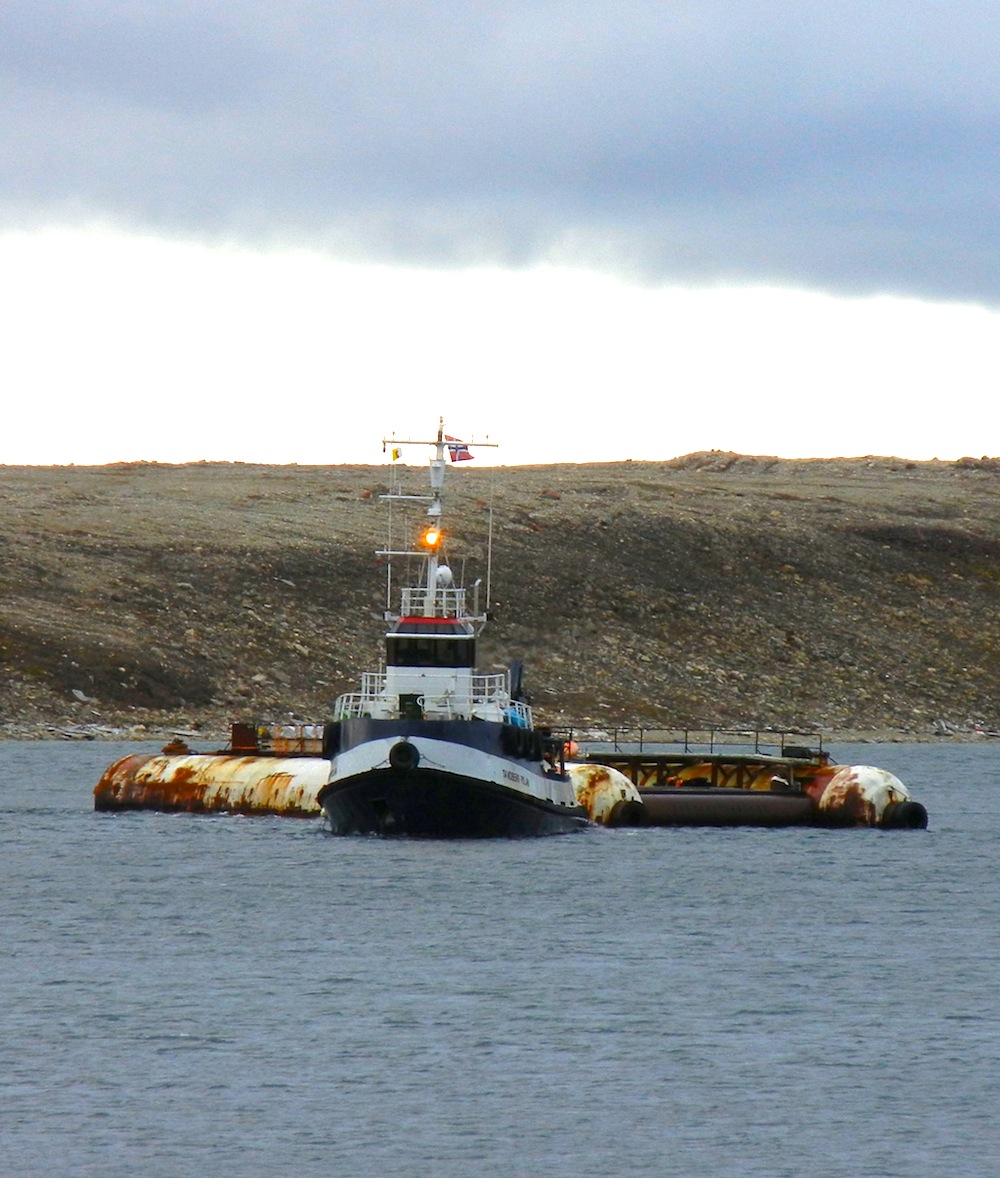
The Tandberg Polar tug arrives in Cambridge Bay with the pontoon barge which will help raise the Maud to the surface. (PHOTO BY JANE GEORGE)

The Tandberg Polar tug arrives in Cambridge Bay with the pontoon barge which will help raise the Maud to the surface. (PHOTO BY JANE GEORGE)

This summer, the Norwegians, who obtained an export permit to move the Maud in 2012, moved close to bringing the ship back with the arrival of the Tandberg Polar tug and barge in Cambridge Bay.

They plan to raise the Maud with balloons, drag the hulk over to a barge, lift it into a kind of “cradle” in the barge, raise it out of the water, slowly, to avoid any stress, and then tow it back to Norway — a 7,000-kilometre journey, Wanggaard said.

The Maud is to be exhibited at a museum in Asker, a suburb of Oslo, from which the Maud was launched on its first voyage.

But, with the short ice-free season of 2014 moving to a close, Wanggaard plans to let the Maud stay where it is until 2015.

“We can’t risk having a problem in the middle of the procedure of lifting,” he said.

And how long will it take to move the Maud onto the submerged barge?

That’s similar to the question of how much time it would take the team to travel from Norway to Nunavut, Wanggaard  said. In the end, due to bad ice conditions in the Northwest Passage, that journey took three months — more than anticipated.

But, if bringing the Maud back to Norway takes just a few years, that’s a much shorter period of time than any similar government effort would take, he said.

Look regularly at A date with Siku girl for most posts from Cambridge Bay, Nunavut.

Did you miss Today, Arctic explorers take cruise ships?