A makeover for CamBay’s ocean observatory

Hauling a large, 250-pound device connecting hundreds of feet of fluorescent ethernet wire out of icy water is no simple task.

Two University of Victoria divers prepare to raise the ocean observatory. (PHOTO BY JANE GEORGE)

Two University of Victoria divers prepare to raise the ocean observatory. (PHOTO BY JANE GEORGE)

But that’s exactly what a team of divers and young researchers with the University of Victoria and the Ocean Networks Canada project did Sept. 16.

The waters near the Cambridge Bay dock stood at 1.9 C — and would, in fact, start freezing up the next day — but protected by drysuits, two divers managed to bring the marine observatory up to the surface and then hoist it on to the dock for its annual overhaul, a new platform and other new instruments.

By then, the sun was setting in over the Cam-Main North Warning System site to the west — and there would be no time for them to carry on with the plan to take apart the observatory for storage overnight.

Researchers and community volunteers help pull the ocean observatory out of the water. (PHOTO COURTESY OF OCEANS NETWORKS CANADA)

Researchers and community volunteers help pull the ocean observatory out of the water. (PHOTO COURTESY OF OCEANS NETWORKS CANADA)

But they didn’t have a place to store the four-foot-wide triangular device or even a way to move it.

The ocean observatory perches on top of an Adlair Aviation pick-up truck. (PHOTO BY JANE GEORGE)

The ocean observatory perches on top of an Adlair Aviation pick-up truck. (PHOTO BY JANE GEORGE)

Thanks to help from an Adlair Aviation pilot, they managed to lift the platform into the air charter’s pickup truck and bring it up to the airport hangar for safe storage.

When underwater, the device measures such things such as underwater temperature, sounds, salinity and ice thickness. It’s also equipped with a camera — which needs replacement — to keep an eye on the seabed.

Similar observatories have been installed off the coasts of British Columbia, part of Ocean Networks Canada, a University of Victoria project, which “operates world-leading cabled ocean observatories for the advancement of science and the benefit of Canada,” according to its website.
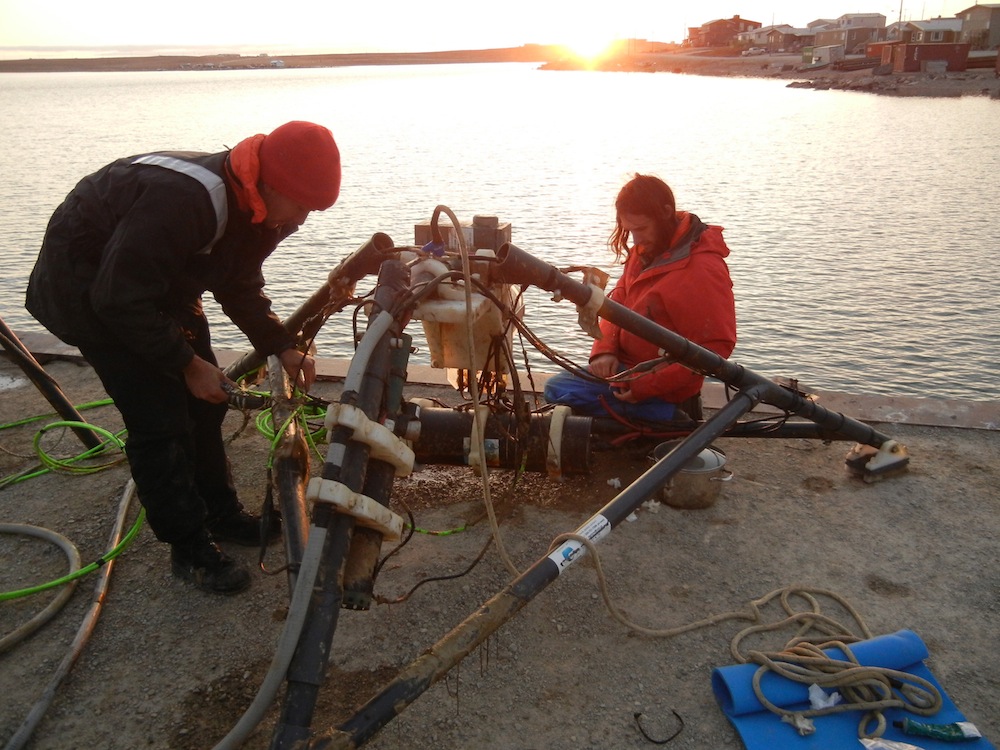
Researchers from the University of Victoria dismantle the ocean observatory for transport Sept. 16. (PHOTO BY JANE GEORGE)

Researchers from the University of Victoria dismantle the ocean observatory for transport Sept. 16. (PHOTO BY JANE GEORGE)

Cambridge Bay’s observatory could be the first in a series to monitor changes in the Arctic.

Launched in September 2012 — and observed by Premier Stephen Harper last month when he visited Cambridge Bay, the observatory will help establish a baseline of environmental conditions, such as rates of ice growth and the timing of algae blooms.

This year, the team plans to service and reinstall:

  • an underwater high definition video camera;
  • an acoustic ice profiler; and,
  • a fish tag receiver from the Ocean Tracking Network.

They also plan to install new instrumentation, including a photosynthetically active radiation sensor that will measure underwater light levels and help scientists study changes during key periods, such as spring, when the polar sunrise triggers algae blooms under the ice.

A sea snail retrieved from  the seabed near the ocean observatory. (PHOTO BU JANE GEORGE)

A sea snail retrieved from the seabed near the ocean observatory. (PHOTO BY JANE GEORGE)

Above water, a video camera will continue to monitor surface ice formation and the weather station will provide real-time atmospheric conditions.

An antenna positioned on top of a nearby building will continue capturing signals from nearby ships, a project website says.

Divers plan to sample fauna on the sea floor, and look for a new observatory location in 2015.

This will position the underwater sensors at a greater distance from vessels and winter road traffic near the busy Cambridge Bay dock.

Among the interesting tidbits learned to date by the observatory about air and sea water temperatures during the winter in Cambridge Bay:  while winter air temperatures frequently dip below -30 C, water beneath the ice remains near 0 C.

Then, during the summer, prolonged sunshine raises air temperatures and melts the ice, raising seawater temperatures to about 10 C.

And, in November 2013, the observatory caught the sound of ice cracking as a snowmobile travelled over the ice near the Cambridge Bay hydrophone. The snowmobile broke through the ice a short time later.

The University of Victoria team plan to wrap up their work some time next week after they meet with local students and people in the community to talk about their project.

Look for more posts from Cambridge Bay, Nunavut.

Recent posts on A date with Siku girl include:

Canada ignores Arctic infrastructure: veteran ice pilot

New roof, new life for CamBay’s old stone church

Two Arctic ships, two explorers: Franklin and Amundsen

Today, Arctic explorers take cruise ships
 

Canada ignores Arctic infrastructure: veteran ice pilot

The ice pilot for the 50-metre-long yacht, the Latitude, author of the ice pilot’s Bible, the 2010 Ice Navigation Manual, did manage to guide the vessel through this summer’s heavy ice-clogged waters to Cambridge Bay — for his 15th transit of the Northwest Passage.

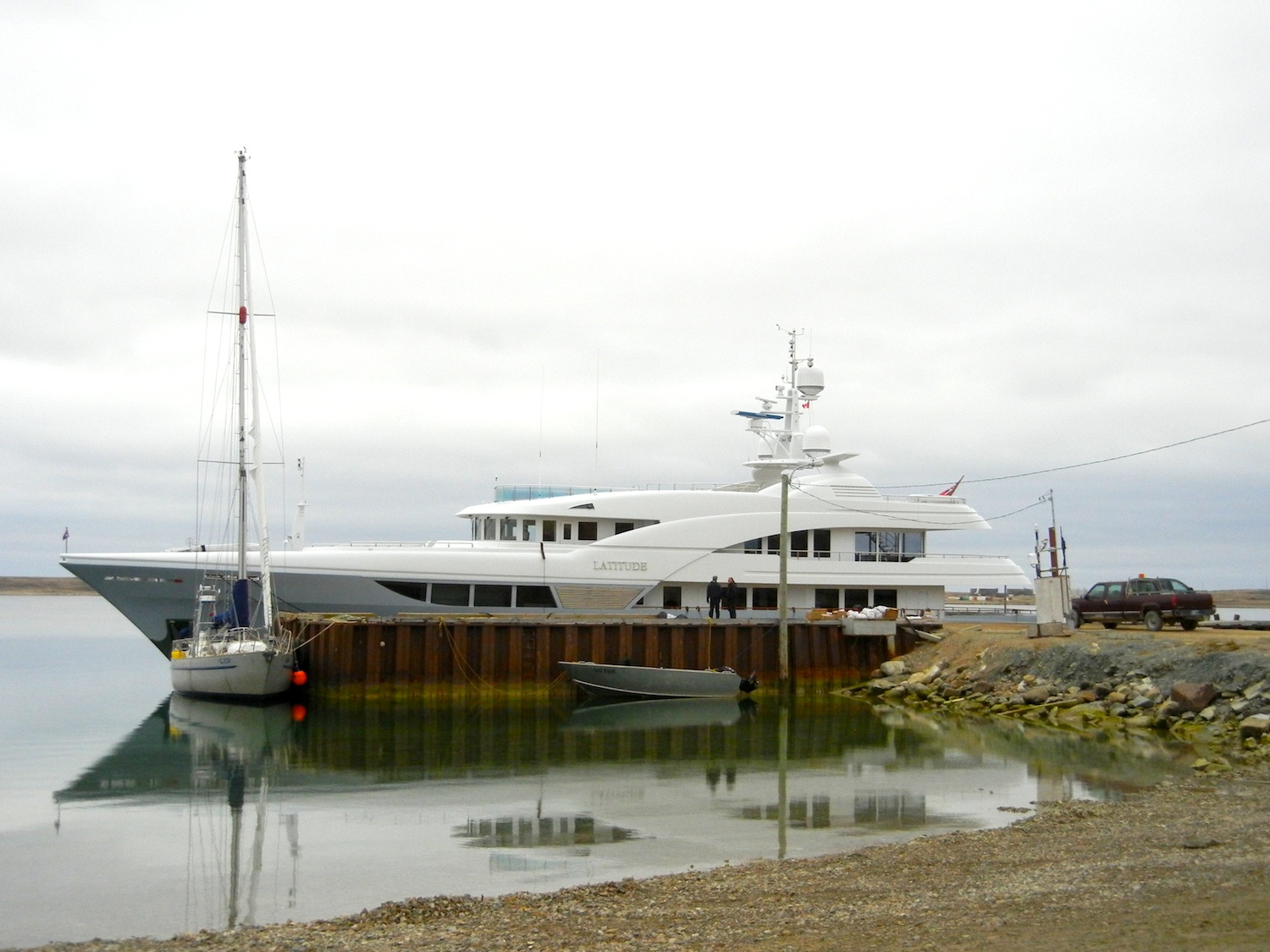
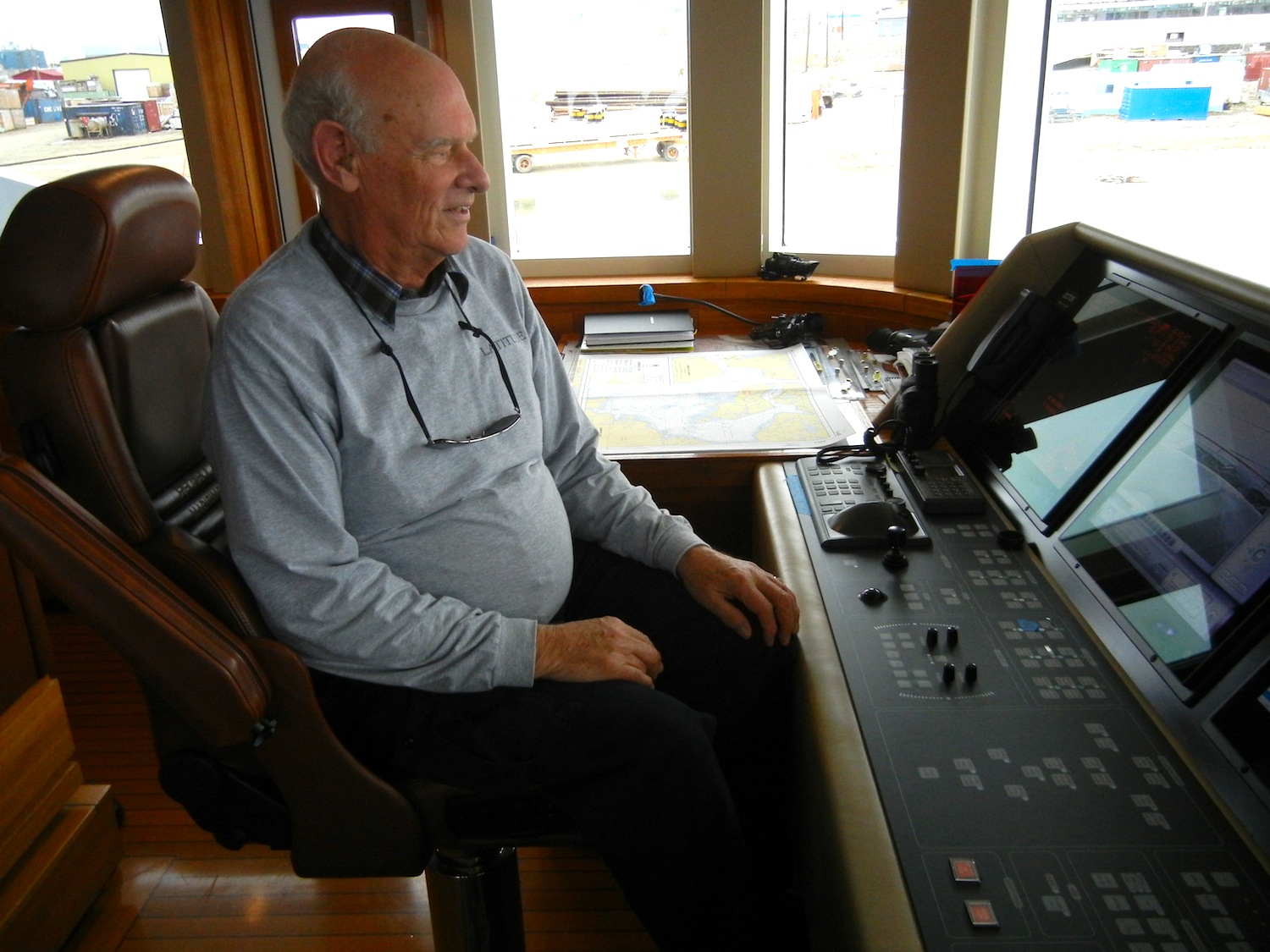
But veteran ice pilot Patrick Toomey didn’t have anything good to say about Canada’s Arctic maritime infrastructure efforts as he sat Sept. 13 on the bridge of the privately-owned yacht, docked near Cambridge Bay’s aging fuel tank farm and sealift marshalling area.

The federal government could do “a hell of a lot more” about improving infrastructure in the Canadian Arctic, Toomey said during our talk.

Toomey slammed what he called Arctic “grandstanding” by politicians such as Prime Minister Stephen Harper, who visited the north Baffin community of Pond Inlet with other federal officials this past August at the same time that the Latitude called there.

“Then they go home and forget about it,” Toomey said of the Tories’ annual event in the Arctic.

As of Sept. 13, the Latitude had been sitting in Cambridge Bay for four days waiting for the arrival of more fuel — which was finally transported to the tank farm via a pipe connected to a tanker sitting in the bay.

Patrick Toomey, ice navigator, at the bridge of the Latitude. (PHOTO BY JANE GEORGE)

Patrick Toomey, ice navigator, at the bridge of the Latitude. (PHOTO BY JANE GEORGE)

Most ships transiting the Northwest Passage either don’t need to fuel up in Cambridge Bay or they require less fuel than the Latitude, Toomey said.

The Latitude is the first vessel of its size to arrange for a 40,000 litres of fuel in the western Nunavut hub, he said.

Toomey was happy that his yacht would be refueled later that day. But he said it’s ridiculous that fuel and cargo is still delivered to Arctic communities the same way it was delivered in 1968.

A tug brings containers to shore in Cambridge Bay. (PHOTO BY JANE GEORGE)

A tug brings containers to shore in Cambridge Bay. (PHOTO BY JANE GEORGE)

That’s when Toomey, now 80, first began sailing around the Arctic.

During his long career, he served as captain on nine Canadian icebreakers and six Russian ones, and retired from the Canadian Coast Guard 23 years ago. He retired because he said he was frustrated with the federal government’s decision to cancel the Polar 8 icebreaker project in 1990.

And Canada still doesn’t invest in enough icebreakers, refueling points, charts, docks or ports of refuge in the Arctic, he said.

Toomey, who rattled off an impressive number of trips through the Northwest Passage and the Northern Sea Route, has also logged 33 trips to Antarctica, where a body of water was named “Toomey Strait” after him.

Over the past two years, he visited Cambridge Bay while serving as an ice pilot on the Michaela Rose and on the World, a mega-yacht.

In 2016, Toomey will make a return voyage through the Northwest Passage, with the 13-deck 69,000-tonne Crystal Serenity and its 1,070 passengers and 665-member crew.

Toomey is already working with Crystal Cruises to prepare for that voyage.

But any vessel in the Northwest Passage should be staffed by a skilled ice pilot, Toomey said.

The Latitude at dock in Cambridge Bay. (PHOTO BY JANE GEORGE)

The Latitude at the dock in Cambridge Bay. (PHOTO BY JANE GEORGE)said.

And he said there should be a way to keep the Northwest Passage free of poorly equipped vessels or reckless adventurers, like group of Americans who tried to travel through the passage on jet skis for a reality television show and then required a rescue.

Either that, or lay charges against such people when they require help from an icebreaker, Toomey said.

As well, he’d like to see the International Marine Organization’s Polar Code adopted.

This code for ships operating in polar waters would cover design, construction, equipment, training, search and rescue, and environmental protection matters “relevant to ships operating in the inhospitable waters surrounding the two poles,” the IMO says.

And the Polar Code would come into effect in 2016 — four years after the original target delivery date — to replace voluntary regulations in place since 2002.

The code would supplement existing mandatory regulations in place in the Arctic and Antarctic, and apply to a wide variety of ships, including sealift vessels and cruise ships.

Russia is far ahead of Canada already in training ice navigators and developing infrastructure, Toomey said.

As for the Northwest Passage, this waterway will be used more often, he said, because it’s simply the shortest way to get from Europe to North America.

Toomey said ice conditions still vary greatly from year to year. This past August, Toomey guided the Latitude, which does not have an ice-class hull, through “bad ice,”  and, at one point, the Coast Guard icebreaker, Pierre Radisson, piloted by one of his former students, helped guide the Latitude through dense fog.

As the yacht sailed slowly, at one to three knots, its eight passengers, which included Singaporean business magnate Anil Thadani, the owner of the Latitude, saw 18 polar bears, including many females with cubs.

Trisha Ogina, Jerry Puglik, Tetra Otokiak and Pam Gross of Cambridge Bay preform Sept. 12 aboard the luxury yacht, the Latitude, which was awaiting refueling in Cambridge Bay. (PHOTO COURTESY OF THE KITIKMEOT HERITAGE SOCIETY)

Trisha Ogina, Jerry Puglik, Tetra Otokiak and Pam Gross of Cambridge Bay preform Sept. 12 aboard the luxury yacht, the Latitude, which was awaiting refueling in Cambridge Bay. (PHOTO COURTESY OF THE KITIKMEOT HERITAGE SOCIETY)

Thadani and his guests were keen on photographing wildlife, but while in Cambridge Bay, they toured around the town also and hired local drummers and dancers to perform for them.

The Latitude departed Cambridge Bay for Nome, Alaska late Sept. 13 and plans to end its leisurely Arctic cruise sometime in October in Seattle, before heading to the South Pacific.

Look for more posts from Cambridge Bay, Nunavut.

Recent posts on A date with Siku girl include:

New roof, new life for CamBay’s old stone church

Two Arctic ships, two explorers: Franklin and Amundsen

Today, Arctic explorers take cruise ships